The fastest way to fail a clinical skills exam is not bad medicine. It is bad communication that makes you look unprofessional.
You can know every guideline and still walk out with a fail because your patient thought you were rushed, dismissive, or confusing. I have watched strong students do it to themselves. Repeatedly.
Step 2 CS (and its school OSCE equivalents) is not just “talk nicely and wash your hands.” The bar is higher. They are judging whether they would trust you alone with their family member at 2 a.m. If your communication looks sloppy, rehearsed, or insensitive, the answer is no.
Let me walk you through the most common communication errors that silently tank professional impression—and how to avoid them.
1. Starting the Encounter Like an Amateur
The first 60 seconds set the tone. Many students blow it here.
Typical errors:
- Walking in without knocking
- Forgetting to introduce yourself by name and role
- Skipping hand hygiene or doing it with your back to the patient
- Jumping into questions before acknowledging the patient’s discomfort
- Using the patient’s first name without permission or using “sweetie/honey”
This does not look minor on an exam. It screams: “I do not understand professional basics.”
What a bad start looks like
You walk in, eyes on your clipboard:
“Hi, what brings you in today?”
No name, no role, no rapport, no permission to sit, no confirmation of identity. The standardized patient will still talk to you, but your professionalism score just dropped.
Or worse:
“Hey, Jim, what seems to be the problem?”
Friendly? Maybe. Professional? Absolutely not, unless the patient has already given permission to use their first name and you have established rapport.
How to fix this—every single encounter
Memorize a tight, standard opening. Not robotic. Just consistent.
Example:
- Knock. Wait for a response. Enter.
- Direct eye contact, neutral expression.
- “Good morning, Mr. Smith. My name is Alex Lee. I am a third-year medical student working with the team here.”
- Shake hands if appropriate (and if the exam setup allows it), otherwise a small nod.
- “How would you like me to address you?”
- Sit down. At eye level.
- “What brought you in today?”
That entire sequence takes 10–15 seconds. Skip any part and you look less polished than you should.
Do not:
- Sit without asking or acknowledging the patient
- Ask “Why are you here?” (sounds accusatory)
- Start charting before introducing yourself
Professionalism is built on very small, very visible habits.
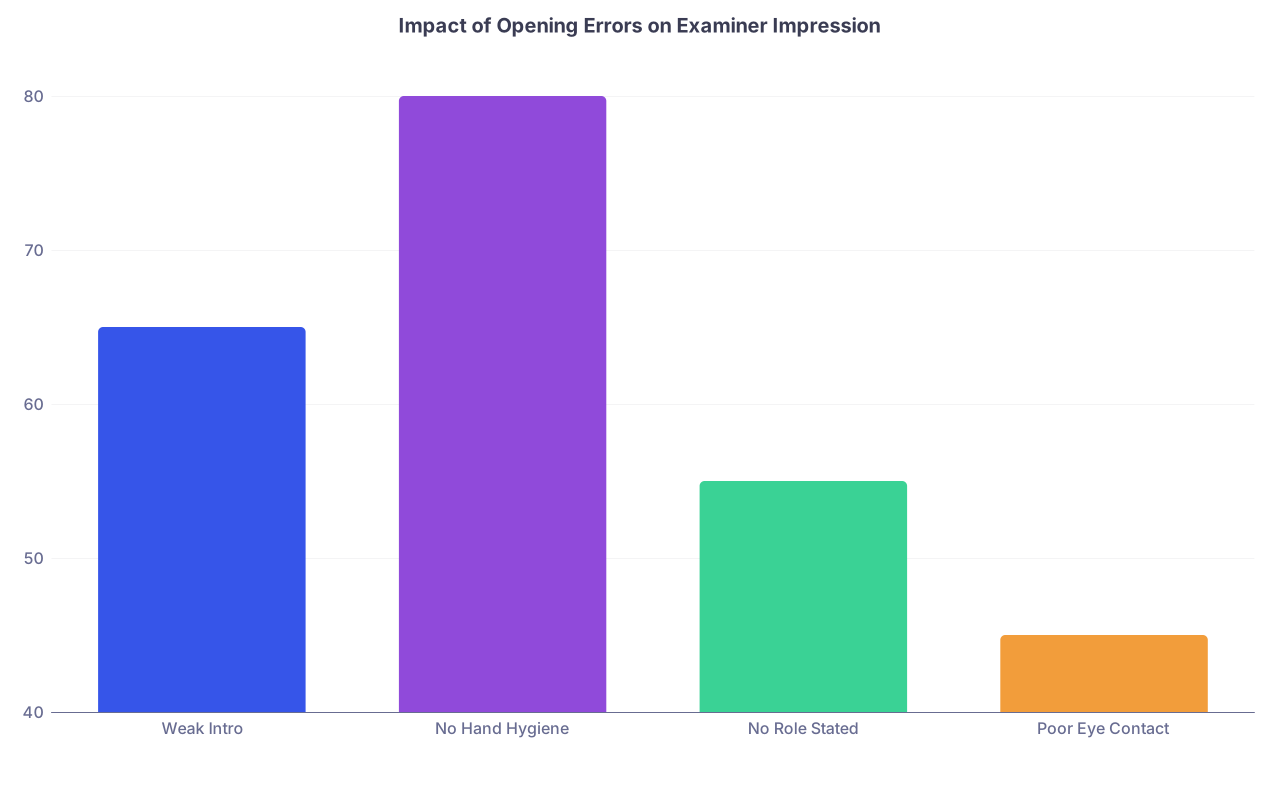
| Category | Value |
|---|---|
| Weak Intro | 65 |
| No Hand Hygiene | 80 |
| No Role Stated | 55 |
| Poor Eye Contact | 45 |
(Values approximate percentage of examiners who report these as ‘major professionalism concerns’ in faculty workshops.)
2. Sounding Like a Checklist Robot
Memorized checklists kill you in OSCE-style exams. Not because content is wrong, but because delivery is obviously fake.
Common robotic patterns:
- Same exact phrasing in every case (“Can you rate the pain from 0 to 10, where 0 is no pain and 10 is the worst pain you can imagine?” repeated 12 times verbatim)
- Asking rapid-fire review-of-systems questions with no transitions
- Ignoring emotional cues because you are busy checking boxes in your head
The moment the standardized patient thinks, “This person is reciting,” your professionalism score starts to look shaky. Real clinicians adapt their language. Students recite.
Red flags you sound robotic
Listen for yourself in practice:
- You never rephrase questions (always “shortness of breath” instead of sometimes “trouble breathing”)
- You never acknowledge patient answers with anything beyond “okay”
- You change topics abruptly (“Any chest pain? Any nausea? Any vomiting?”)
- Your tone stays flat even when the patient mentions something serious (“I thought I was dying.” “Any diarrhea?”)
How to avoid the “OSCE robot” trap
You still need structure. You just do not need to announce it like a standardized script.
Try this instead:
- Use natural transitions:
- “You mentioned the pain started yesterday. Let me ask a few questions to understand the pain better.”
- “I also want to check on other systems that could be related.”
- Reflect important statements briefly:
- “You were scared that it might be a heart attack. That sounds very frightening.”
- Vary your pain question:
- “On a scale from 0 to 10, with 10 being the worst pain you can imagine, where is it right now?”
- Next patient: “How bad is the pain on that 0–10 scale at this moment?”
Do not make the mistake of thinking “natural” means “unstructured.” The examiners can tell when you are wandering versus when you are following a plan in normal language.
3. Ignoring or Mishandling Emotion
If you treat emotion as background noise, you will look unprofessional. Full stop.
I have seen students do beautiful differentials and then say to a patient who just started crying:
“Okay… does anyone in your family have diabetes?”
That is an automatic professionalism red flag.
Common emotional mistakes
- Not acknowledging visible distress (crying, anger, fear)
- Over-apologizing in a way that sounds insincere or excessive
- Minimizing concerns (“It’s probably nothing serious, don’t worry about it”)
- Giving false reassurance (“I’m sure you’re going to be fine”) without data
- Switching back to checklist mode immediately after a major emotion disclosure
The minimum professional response
You do not have to be a therapist. You do have to be human.
Simple, high-quality responses you can default to:
- “Hearing that must be very difficult.”
- “I can see this is really worrying you.”
- “I am glad you told me that.”
- “Can you tell me more about what concerns you the most?”
Then pause. Let silence work. Do not fill it with more questions unless the patient is done.
The big mistake: false reassurance
This one will sink you fast:
- “I am sure it is not cancer.”
- “I do not think it is anything serious.”
- “You are too young for that.”
You do not have diagnostic certainty. The examiners know it. The patient knows it. You just look careless.
Better alternatives:
- “There are several possible causes, and many are minor, but some are more serious. We will need to do [tests/monitoring] to understand what is happening.”
- “I cannot promise you an answer today, but I can promise that we will take your symptoms seriously and work systematically to find the cause.”
That is honest. Professional. Safe.
4. Explaining Plan and Diagnosis Poorly
You can have the right plan and still look unprofessional if you explain it badly.
The worst offenders:
- Using unexplained jargon: “We are going to get a CT pulmonary angiogram to rule out PE.”
- Dumping information in one monologue with no checks for understanding
- Never asking about the patient’s goals or concerns about treatment
- Giving patient instructions that are vague or incomplete
Examiners watch this part very closely. This is where you either sound like a future intern or like someone who should not talk to real patients yet.
Turn your plan into a conversation, not a speech
Bad version:
“We will do EKG, CXR, CBC, BMP, and troponins to rule out ACS and PE and then monitor.”
Better version:
Summarize in plain language:
“Based on what you told me and what I found on the exam, I am concerned about your chest pain and want to make sure it is not coming from your heart or lungs.”Name a few key tests with explanation:
- “An EKG checks the electrical activity of your heart.”
- “A chest X-ray gives us a picture of your lungs and heart size.”
Invite questions:
- “How does that plan sound?”
- “What questions do you have about these tests?”
You are not being graded on naming every possible lab. You are being graded on whether a normal person could follow what you are doing.
| Jargon-Heavy Phrase | Professional Alternative |
|---|---|
| “We’ll get labs to rule out MI.” | “We’ll do blood tests to check if your heart muscle has been damaged.” |
| “You may have GERD.” | “You may have acid reflux, where stomach acid irritates your esophagus.” |
| “We’ll start you on an ACE inhibitor.” | “We’ll start a blood pressure medication that helps relax your blood vessels and protect your kidneys.” |
| “We need to do a CT to evaluate for PE.” | “We need a special kind of scan of your lungs to look for blood clots.” |
Use the right medical term if needed, then immediately translate it. Not the other way around.
5. Disrespecting Time, Space, and Privacy
Professionalism is not just “being nice.” It is how you respect the patient’s autonomy, comfort, and dignity.
Common privacy-related mistakes:
- Starting a sensitive topic (sexual history, substance use) with no lead-in or permission
- Failing to ask permission before physical exam maneuvers
- Not draping appropriately or exposing too much of the patient at once
- Speaking loudly near the “door” as if someone could overhear
- Writing or typing with your back fully to the patient for extended periods
Even in a fake exam room with no real curtains, act like privacy matters. Because on test day, it does.
How to frame sensitive questions like a professional
Bad:
“Do you use any drugs? Any STDs?”
Professional:
- “I ask all my patients a few questions about alcohol, tobacco, and other substances because they can affect health. Is that okay?”
- “Some of my questions are more personal, but I ask them of all my patients to make sure I am not missing anything important. Is it okay if I ask about your sexual health now?”
The difference is not “being polite.” It is showing you understand boundaries.

| Step | Description |
|---|---|
| Step 1 | Knock & Enter |
| Step 2 | Intro & Role |
| Step 3 | Confirm Name & Preferred Form of Address |
| Step 4 | Open-Ended Chief Concern |
| Step 5 | Focused History |
| Step 6 | Address Emotions |
| Step 7 | Explain Exam & Ask Permission |
| Step 8 | Perform Focused Exam |
| Step 9 | Summarize Findings |
| Step 10 | Explain Assessment & Plan |
| Step 11 | Check Understanding & Questions |
| Step 12 | Close & Safety-Net |
Memorize this general flow. Then fit each case into it.
6. Ending the Encounter Weakly (or Not at All)
You can ruin a strong case in the last 30 seconds.
Classic ending errors:
- Ending with: “Okay, that’s it.” and leaving
- Not asking if the patient has any questions
- Not checking understanding of key instructions
- Not giving any form of safety-net advice (“If X happens, seek help immediately”)
- Not saying goodbye or acknowledging the patient’s time
Examiners hate “door-handle endings.” So do patients.
Professional closing checklist (yes, here a checklist helps)
Before you leave, you should almost always:
- Summarize:
- “So, Mr. Lee, you came in today because of… [one–two sentences].”
- State your working impression in plain language:
- “Right now, the most likely cause seems to be…”
- Briefly restate the immediate plan
- Ask for questions:
- “What questions do you have for me?” (Do not say “Do you have any questions?”—it invites a no.)
- Safety-net:
- “If your chest pain gets worse, you feel short of breath, or you pass out, you should seek immediate care.”
- Close:
- “Thank you for speaking with me today. It was nice meeting you.”
The mistake is rushing out because the bell is about to ring. A 10-second professional close is better than 30 extra seconds of random ROS questions that will not change your score.
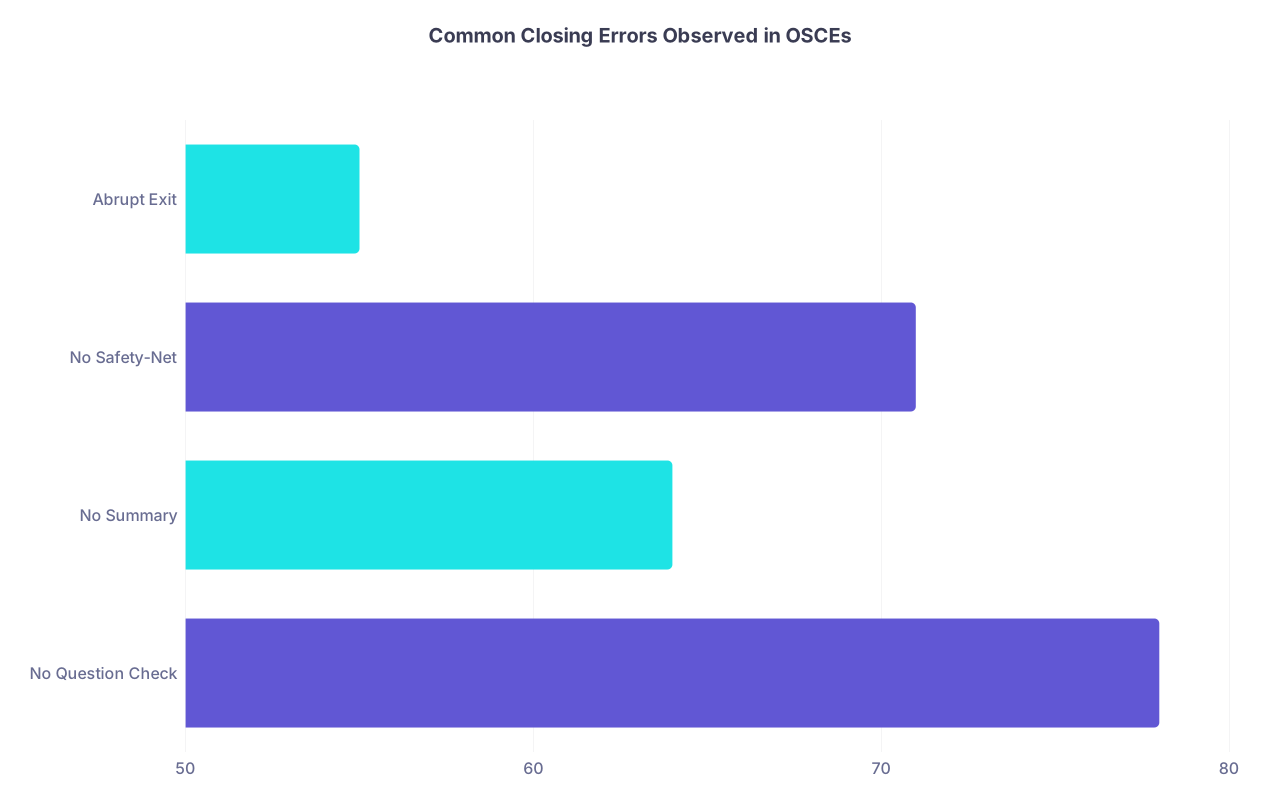
| Category | Value |
|---|---|
| No Question Check | 78 |
| No Summary | 64 |
| No Safety-Net | 71 |
| Abrupt Exit | 55 |
7. Trying to Impress Instead of Trying to Help
Examiners can spot this mindset in the first minute.
Patterns that scream “I care more about my grade than my patient”:
- Name-dropping obscure diagnoses repeatedly
- Over-ordering tests verbally to signal knowledge
- Correcting the patient’s word choice unnecessarily (“It’s not your ‘stomach,’ it’s your ‘abdomen’”)
- Lecturing instead of explaining
- Arguing with patient beliefs rather than understanding them
You are not there to show off. You are there to show you can be trusted.
The professionalism red flag: arguing
Examples:
- Patient: “I read online that antibiotics will fix this.”
Student: “That is not true. Antibiotics do not work for viruses.”
Yes, medically right. But communication wrong.
Better:
- “You are right that antibiotics can help some infections. In your case, this looks like a viral infection, where antibiotics would not help and could cause side effects. Let me explain the difference.”
You correct the belief while respecting the person who holds it. That is professional.
8. Not Practicing Communication Like a Skill
Here is the primary mistake almost everyone makes: they treat communication as something you either “have” or “do not,” instead of something you deliberately train.
Students will do 2,000 UWorld questions, but never record themselves doing a single full encounter and watch it.
You cannot fix what you never see.
A simple, ruthless practice method
Do this with a classmate or by yourself using case prompts:
- Record a full 15-minute encounter (phone or laptop).
- Watch with a blank sheet of paper.
- Every time you cringe at something you said or did, write it down.
- Group them:
- Openings
- Transitions
- Emotion handling
- Explanations
- Closings
- Pick one category to fix next encounter. Not all of them. One.
- Repeat with a new case.
Yes, this is uncomfortable. That is the point. The people who improve fastest are always the ones willing to watch themselves be bad.

9. Red-Flag Behaviors That Look Unprofessional Instantly
Let me just list a few behaviors that will get noticed for the wrong reasons:
- Rolling your eyes, sighing, or checking the clock obviously
- Laughing at a serious statement or using sarcasm
- Interrupting repeatedly or talking over the patient
- Using slang or overly casual language (“That’s kinda weird,” “Super gross,” “Dude”)
- Making assumptions about lifestyle, sexual orientation, or substance use based on appearance
- Discussing your personal life or opinions unprompted
You get no points for “relatability” if your relatability looks unprofessional. You are not there to be their friend. You are there to be their physician.
FAQ (Exactly 5 Questions)
1. If Step 2 CS is discontinued, why should I still care about these communication issues?
Because OSCE-style exams at medical schools, shelf OSCEs, and residency interviews all judge you on the same behaviors. Residency program directors talk openly about poor communication and professionalism as reasons not to rank applicants highly. Patients complain about communication long before they complain about your fund of knowledge. These skills will be tested—formally and informally—for the rest of your career.
2. How “empathetic” do I really need to be? I do not want to sound fake.
You do not need to perform empathy. You need to demonstrate basic human recognition of emotion. A single, sincere sentence is enough: “I can see this is very stressful.” The mistake is saying nothing, or steamrolling past obvious distress. If you stick to short, honest reflections and then listen, you will not sound fake. The people who sound fake are the ones who try to perform a script of empathy without actually pausing to let the patient respond.
3. Is it unprofessional to say, ‘I don’t know’?
No. What is unprofessional is pretending you know when you do not. The professional way to do it is to pair “I do not know” with “but here is what we will do.” For example: “I do not know the exact cause yet, but here is what I am considering and what tests will help us find out.” That shows humility, honesty, and a plan. Examiners like that. Patients trust that.
4. How much medical terminology is acceptable when talking to patients?
Use the correct medical term briefly, then immediately translate it. “You may have pneumonia, which is an infection in the lungs.” Not explaining at all looks arrogant; never using the correct terms at all can make you sound less credible to examiners. The balance: medical term + one clear, simple explanation. If the patient seems confused, you simplified too little. If they look bored or lost, you are probably over-explaining or using too much jargon.
5. What is the single most important communication change I can make this week?
Record yourself doing one full mock encounter and then ruthlessly watch it for three specific things: how you open, how you handle the first emotional cue, and how you close. Fix just one of those areas in your next practice session. Most students never do even that much. If you do, you will be noticeably more professional within a week.
Open your calendar right now and schedule a 20‑minute slot in the next 48 hours to record and review one full mock encounter. That one deliberate session will prevent more embarrassing, unprofessional mistakes than any amount of silent reading.