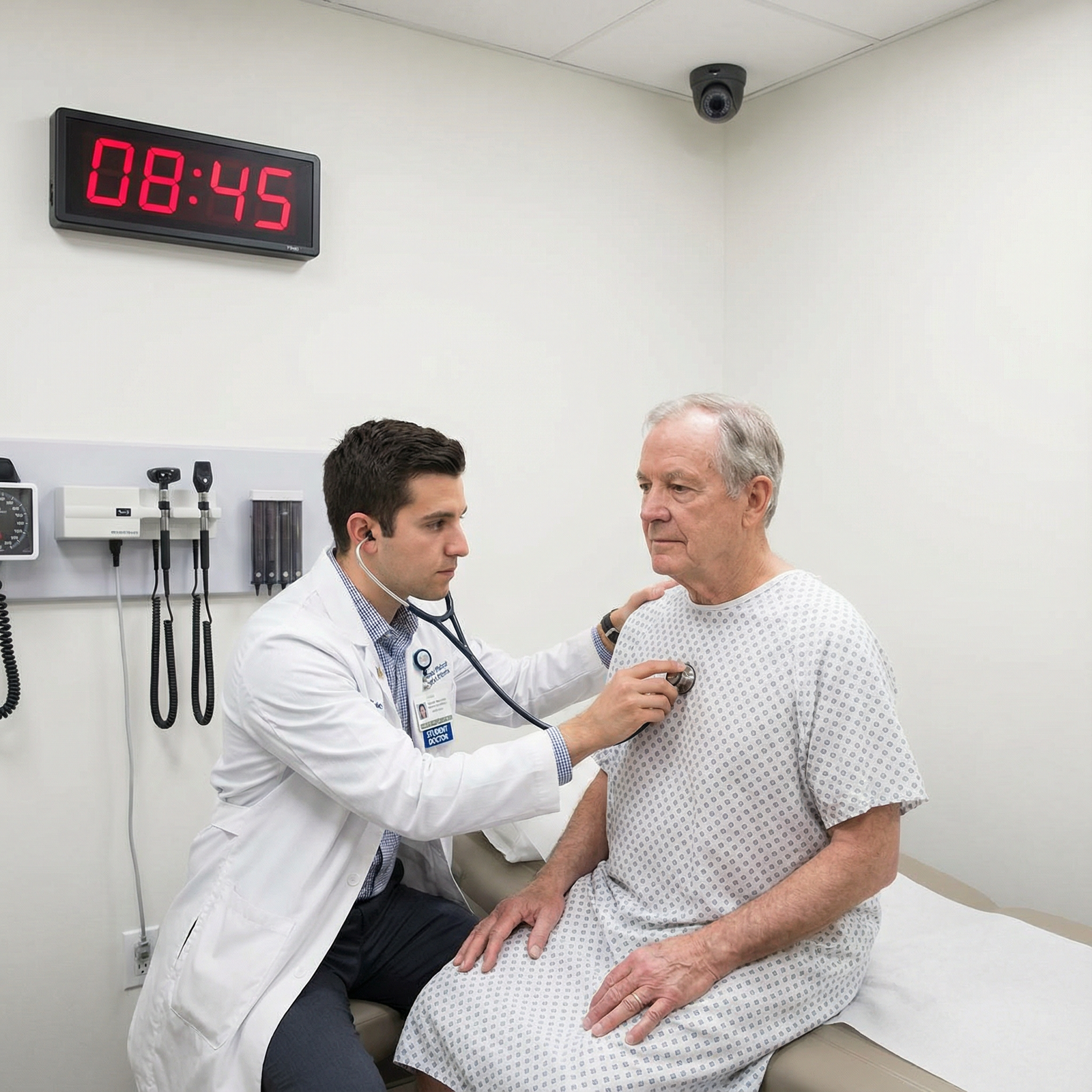
The way most students “wing” standardized patient encounters is wrong. Step 2 CS/PE style exams are not about being naturally charming. They are about running a tight, repeatable script under pressure.
You do not need to be a genius communicator. You need a scripted, standardized approach that you can run 25 times in a row at 8 minutes each, without thinking, even when your brain is fried.
Let me walk you through exactly how to build that.
The Core Idea: One Script, Many Patients
You should walk into every standardized patient (SP) room with one default script in your head:
- Same opening line
- Same identification + consent
- Same core history structure
- Same basic exam structure
- Same closing and counseling template
You then modify 20–30% based on the case. But 70–80% should be autopilot.
Stop trying to “customize” everything. Customization is where anxiety and omissions happen. The script is your safety net.
Here is the high-level skeleton:
- Doorway pause: 15 seconds of silent planning
- Entry script: Greeting, name, role, patient name, comfort, hand hygiene
- Three big questions: CC confirmation, patient goals, immediate red flags
- History script:
- OPQRST + 4–6 associated systems
- Past history, meds/allergies, social, family
- Focused review of systems
- ** Counseling check-in mid-encounter** (if needed)
- Exam script: Vitals (if given), general, focused system sequence you have memorized
- Closure script: Summary, most likely dx, differentials, tests, shared plan, final questions
We will build out each piece, with exact wording and behavior you can practice.
Step 1: Doorway Script That Prevents Panic
Most students blow this. They read the stem, feel rushed, burst into the room, and start asking random questions. That is how you miss key history elements and look scattered.
You need a doorway mini-script:
Time limit: 15 seconds. That is it.
Say this in your head each time, in this order:
- Name + age + sex + chief complaint
- One line DDx anchor (3 likely causes)
- Key must-ask questions (3–5 items)
- System you will focus exam on
Example: 52-year-old man, chest pain.
In your head:
- “52 M, chest pain.”
- “Most likely: unstable angina, MI, GERD. Must rule out PE, dissection.”
- “Must ask: exertion vs rest, radiation, SOB, diaphoresis, pleuritic, positional, risk factors.”
- “Exam focus: CV, pulm, peripheral pulses, JVD, edema.”
You are not solving the case here. You are giving your brain a checklist anchor before you attack.
Practice this with 20–30 random chief complaints until you can do this in 10–15 seconds.
Step 2: Entry Script That Works For Every Case
Your entry should be identical every time. No improvising. Here is the script:
- Knock. Wait 2 seconds. Enter.
- Smiling, gentle voice, eye contact.
Say:
“Hello, Mr./Ms. [Last Name]? My name is [Your Name]. I am a medical student working with the team today. How would you like me to address you?”
Shake hands if appropriate, sit down promptly at eye level.
- After they answer:
“Alright, [Preferred Name], I see you are here because of [chief complaint from door note]. I would like to ask you some questions, perform a focused physical exam, and then we will discuss what might be going on and next steps together. Does that sound okay?”
- Perform hand hygiene:
“I am just going to clean my hands first.”
Then move straight to the three big questions.
The Three Big Questions
Use this template on every case:
- Open-ended start
“Can you tell me more about what has been going on?”
Let them talk uninterrupted for 30–60 seconds. Do not interrupt unless they go wildly off track.
- Patient agenda
“What concerns you the most about this?”
“Is there anything in particular you were worried this might be?”
This is a communication and empathy point machine. Use it.
- Immediate red flag screen (quick)
For certain complaints, drop in very early:
- Chest pain / dyspnea: “Any severe trouble breathing right now? Any crushing pain right this second?”
- Abdominal pain: “Is this the worst pain of your life? Any fainting or blacking out?”
- Neuro: “Any trouble speaking, seeing, or moving one side of your body?”
You do not need to go overboard. One or two targeted red flag checks shows you are clinically safe.
Step 3: Scripted History – OPQRST + 4 Axes You Never Skip
You want a single history template that you can reuse.
Here is the template I recommend. Memorize the order.
- History of Present Illness (HPI) – OPQRST + relevant systems
- Past Medical / Surgical / Hospitalizations
- Medications / Allergies
- Social History (always: tobacco, alcohol, drugs, sexual, occupation, home)
- Family History
- Focused Review of Systems (ROS)
1. HPI: Your Default Script
After the open-ended question, you tighten it:
“I want to ask some more specific questions to better understand this.”
Then run OPQRST:
- Onset: “When did this start?”
- Progression: “Since it started, has it been getting better, worse, or about the same?”
- Position/Place: “Where exactly is the [pain/symptom]?”
- Quality: “How would you describe it – sharp, dull, burning, pressure?”
- Radiation: “Does it go anywhere else?”
- Severity: “On a scale from 0 to 10, where 0 is no pain and 10 is the worst pain you can imagine, what number would you give it now?”
- Timing: “Is it constant or does it come and go? How long does it last when it comes?”
- Triggers: “What makes it better or worse?”
- Associated symptoms: “Have you noticed [shortness of breath, nausea, sweating, fevers, weight loss, etc.]?”
Do not guess associated symptoms from memory under pressure. Build mini associated-symptom bundles for the top complaint types and memorize them.
| Chief Complaint | Ask About (Core Items) |
|---|---|
| Chest Pain | SOB, diaphoresis, nausea/vomiting, palpitations, cough, pleuritic, positional |
| Shortness of Breath | Cough, sputum, wheeze, chest pain, orthopnea, PND, leg swelling, fever |
| Abdominal Pain | Nausea/vomiting, bowel changes, urinary sx, fevers, food relation, weight loss |
| Headache | Vision changes, neuro deficits, neck stiffness, fever, trauma, photophobia |
| Dizziness/Syncope | Palpitations, chest pain, SOB, positional, hearing changes, neuro deficits |
Print this, carry it while practicing, then discard once internalized.
2–5. The Four Fixed Blocks
After HPI, use the exact same phrasing every time. Speed and consistency.
- Past Medical / Surgical:
“Have you had any medical conditions diagnosed in the past, like high blood pressure, diabetes, heart or lung problems?”
“Have you ever had any surgeries or been hospitalized before?”
- Medications / Allergies:
“What medications do you take, including over-the-counter or herbal supplements?”
“Do you have any allergies to medications, foods, or anything else? What happens when you are exposed?”
- Social History:
“Do you smoke or use any tobacco products?”
“How often do you drink alcohol, if at all?”
“Do you use any recreational drugs?”
“What kind of work do you do?”
“Who do you live with at home?”
“Are you sexually active with men, women, or both? Do you use any protection, like condoms?”
You adjust level of detail by case, but the order stays identical.
- Family History:
“Are there any medical conditions that run in your family, like heart disease, diabetes, cancer, or strokes?”
“How are your parents’ health? Siblings?”
6. Focused ROS: One or Two Targeted Systems
You do not have time for a full 14-point ROS. Focus on:
- The system of the chief complaint
- One adjacent system that is clinically relevant
Example: Chest pain → Cardiovascular + Pulmonary.
Example: Abdominal pain → GI + GU (urinary/gynecologic as relevant).
Script:
“I am going to quickly ask about a few other symptoms.”
[Run yes/no list based on system bundles you memorized.]
Do not waste time on irrelevant ROS unless you have extra minutes.
Step 4: Communication Add-Ons That Score Big
The exam is not only clinical reasoning. It grades how you talk like a human.
You can script empathy and patient-centered communication. Yes, literally script it.
Use stock phrases like:
When they express fear:
“I can see this has been really worrying for you. We will work through this together and make sure you are safe.”
When they look frustrated:
“I am sorry this has been so frustrating. Let me make sure I understand what you have been dealing with.”
When they mention a serious loss or big stressor:
“I am very sorry you had to go through that. Thank you for sharing it with me.”
You do not need to invent 20 variations. Three or four sincere-sounding lines used appropriately will carry you.
Also script:
“Do you have any questions for me so far?”
“Is there anything we have not talked about that you think I should know?”
Drop these once or twice per encounter.
Step 5: Exam Script – Default Flow You Can Run in Your Sleep
Students lose massive points by doing choppy, incomplete exams. The solution is not “do a full physical” on everyone. You do not have time.
You want a default exam routine plus a focus module per complaint.
General Default Exam Steps
After history, say:
“Thank you for answering all of those questions. I would like to perform a physical exam focused on your concerns. I will wash my hands and then we can begin.”
Then:
- Hand hygiene (again).
- Explain what you are doing throughout. Simple phrases:
- “I am going to listen to your heart now.”
- “I am checking your legs for any swelling.”
- “Let me know if anything is painful.”
- General inspection:
- Mental status, distress, color, breathing effort
- Core vitals if provided on the sheet – comment mentally but you do not have to speak them out unless interpretation is needed during closure.
Build 3–4 “Exam Modules” To Memorize
You do not need 20. You need a few polished ones for the most common complaint groups.
Example set:
- Chest pain / Dyspnea: CV + Pulm + Extremities
- Abdominal pain: Abdominal + GU/Rectal if indicated (usually verbalize)
- Neuro (headache, dizziness, weakness): Cranial nerves + Motor + Sensory + Cerebellar + Gait (if possible)
- Joint / MSK pain: Inspection + ROM + Strength + Special tests for that joint
For chest pain / dyspnea, your exam script might be:
“I am going to check your heart, lungs, neck, and legs.”
Sequence:
- Inspect chest, breathing effort
- Auscultate heart (A, P, T, M)
- Auscultate lungs front and back
- Check JVD (verbalize if time is short)
- Check peripheral pulses and pedal edema
- Press on chest wall quickly to check for reproducible tenderness
Do it in the same sequence every time. Muscle memory saves you on test day.
For abdominal pain:
“I am going to examine your abdomen now. Let me know if anything is tender.”
Sequence:
- Inspect
- Auscultate (bowel sounds all quadrants)
- Light palpation then deep palpation (watch face)
- Percuss if time
- Check for rebound / guarding (only if appropriate)
- Verbalize: “I would perform a rectal exam / pelvic exam if appropriate and with a chaperone.”
Do not actually do rectal/pelvic on the SP unless the exam explicitly calls for it; usually, you just verbalize.
Step 6: Closure Script That Hits Every Scoring Box
Most people ramble at the end. Or they skip the diagnosis discussion entirely because they feel unsure.
You can script this tightly. Use this structure:
- Transition
- Summary + Ask for confirmation
- Most likely diagnosis in plain language
- Top 2–3 differentials (brief)
- Immediate plans: tests + treatment approach
- Address patient concerns / fears
- Check understanding + questions
- Close with safety net
The Closure Template
Use something like this, adapted to the case:
“Thank you for speaking with me and allowing me to examine you. Let me summarize what I have heard to make sure I am understanding correctly.”
[Summarize in 2–4 sentences max.]
“Is that accurate? Did I miss anything important?”
Then:
“Based on your symptoms and the exam today, my main concern is that this could be [most likely diagnosis, in simple language]. Other possibilities include [differential 1] and [differential 2].”
Then outline the plan:
“To figure this out and make sure we keep you safe, I would like to order [list 3–5 key tests: for chest pain, maybe EKG, blood tests including cardiac enzymes, chest X-ray, etc.]. Depending on those results, treatment might include [general idea: medications for your heart, something for pain, or admission to monitor you].”
Tie it back to their concern:
“You mentioned you were worried about [heart attack / cancer / stroke]. These tests will help us see whether that is happening and guide how we treat you.”
Then closing questions:
“How does that sound to you?”
“What questions do you have for me?”
Finally, safety net:
“If your symptoms suddenly get worse – for example, severe pain, trouble breathing, confusion, or you feel like you might faint – you should seek immediate medical attention. For now, we will start with these tests and go from there.”
Stand up, thank them, handshake if appropriate, leave.
Script the phrases, then practice until you can say them without sounding like a robot.
Step 7: Writing the Note – Scripted Structure, Not Freestyle
Most Step 2 CS/PE-style exams include a written note. The grading favors structure and inclusion of key elements, not literary talent.
Use the same sections every time:
- DDx (3) – ranked
- History & Exam Supporting Each Dx – bullet style or short phrases
- Workup / Management Plan – specific tests
Here is the note structure you should memorize.
Diagnosis Section
- Diagnosis 1: [Most likely diagnosis]
- Diagnosis 2: [Second possibility]
- Diagnosis 3: [Third possibility]
Under each, in 2–4 bullets, list:
- 2–3 supporting positives
- 1–2 key negatives that help rule out alternatives
Example for chest pain case:
Dx 1: Unstable angina
- Supporting: Exertional chest pressure; relief with rest; multiple cardiac risk factors
- Against others: No pleuritic pain, no reproducible chest wall tenderness
Dx 2: Gastroesophageal reflux disease
- Supporting: Burning, postprandial; worse when lying down; partial relief with antacids
- Against: Pain with exertion less typical
Keep it short and specific.
Workup / Plan Section
List 5–8 key items. Not 20 random tests. Prioritize:
- Essential labs
- Essential imaging
- One or two key consults if appropriate
- Basic initial therapy (O2, ASA for high-risk chest pain, etc.)
Example:
- EKG
- Cardiac enzymes (troponin)
- Chest X-ray
- Basic labs (CBC, BMP)
- Lipid panel, HbA1c (for risk stratification)
- Aspirin, nitroglycerin (if no contraindications)
- Telemetry monitoring
Do not write paragraphs. List form is faster and cleaner.
Step 8: Practice Protocol – Turn Your Script Into Muscle Memory
Reading this once does nothing. You need reps.
Use this structured practice schedule for 2–3 weeks.
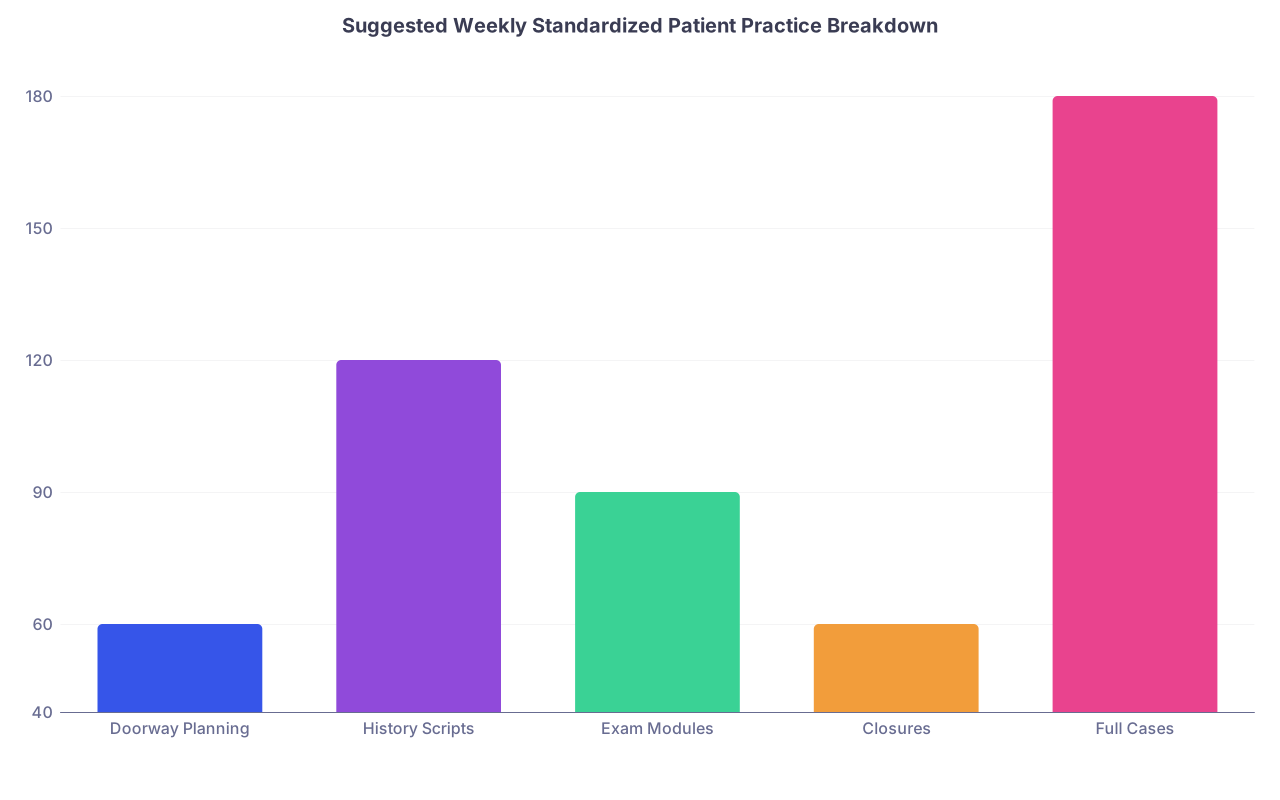
| Category | Value |
|---|---|
| Doorway Planning | 60 |
| History Scripts | 120 |
| Exam Modules | 90 |
| Closures | 60 |
| Full Cases | 180 |
Numbers above are minutes per week. That is 8.5 hours total. Manageable but serious.
Week 1: Script Installation
Goal: Get the words and sequence into your head.
Day 1–2:
- Stand in your room and say the entry + history script out loud 10 times.
- Use random fake names. Vary the chief complaint, but keep the structure.
Day 3–4:
- Practice the exam modules on a friend, pillow, or just in the air.
- Speak as if to a patient: “I am going to listen to your heart now.”
- Repeat chest pain + abdominal modules 10 times each.
Day 5–6:
- Practice the closure script on 3 different fake cases each day.
- Timer: 2 minutes per closure. No rambling.
Week 2: Full Cases With Timer
Goal: Integrate history + exam + closure in 15 minutes.
- Use any Step 2 CS-style case book or online prompts.
- For each case:
- 15-second doorway script out loud.
- 10-minute simulated encounter (set phone timer).
- 5-minute note writing.
Record yourself (audio is enough) for at least 1–2 encounters:
- Check: Did you ask baseline social history?
- Did you summarize at the end?
- Did you state a likely diagnosis and alternatives?
Week 3: Pressure Testing
Goal: Remove training wheels.
- Do mixed cases back-to-back with only 2 minutes break between.
- Alternate complaint types to force mental flexibility: chest pain → abdominal pain → neuro → joint.
Add one more layer:
- Have a friend watching with a checklist:
- Introduced self, asked preferred name
- Washed hands
- Patient agenda asked
- Past medical, meds/allergies, social, family
- Reassured patient, checked for questions
- Clear closure with diagnosis possibilities and plan
You want 80–90% consistency on these checklist items.
Step 9: Troubleshooting Common Failure Patterns
Let me fix a few recurring problems I have seen.
1. Talking Too Much, Exam Too Short
If you are not starting the physical exam by minute 6–7, you are behind.
Solution:
- Use a watch or clock.
- Give yourself a hard rule: History must wrap by 6–7 minutes.
- If you are still in HPI at minute 5, cut short ROS and move to exam.
2. Freezing On Diagnosis
You will occasionally have no clue what the “right” diagnosis is. That is fine. The exam cares more that you:
- Recognize sick vs not sick
- Have a reasonable differential
- Order sensible tests
So in closure, say:
“There are a few possibilities we are considering, including [Dx 1] and [Dx 2]. The tests we discussed will help us narrow this down and make sure we are not missing anything serious.”
Do not say, “I have no idea what this is.” Ever.
3. Robotic Affect
Ironically, heavy scripting can make people sound stiff. Fix is simple: build pauses and micro-reactions.
- Nod when they talk about pain or fear.
- “Mm-hmm, I see.”
- Short natural responses: “That sounds really uncomfortable.”
You do not need to overdo it. Three or four moments of human reaction during an encounter is enough to offset the script feel.
4. Forgetting To Ask About Safety / Red Flags
Create a mental bookmark:
- For any case involving chest, breathing, neuro, severe pain → always ask at least one red flag question early.
If you struggle to remember, put a sticky note during practice: “Red flags?” and glance at it until it is automatic.
Step 10: Day-of-Exam Routine
Finally, run a structured protocol on test day. Not vibes. Protocol.

| Step | Description |
|---|---|
| Step 1 | Doorway: 15 sec plan |
| Step 2 | Enter & Intro Script |
| Step 3 | Open-ended Question |
| Step 4 | Structured History |
| Step 5 | Focused ROS |
| Step 6 | Focused Physical Exam |
| Step 7 | Closure Script |
| Step 8 | Write Note |
Before First Case
- Run one complete script in your head: greeting → history questions → closure phrases.
- Take 3 slow breaths before walking into the hall.
Between Cases
- Do not autopsy your last encounter. That is how you tilt yourself.
- Use those 2–3 minutes to reset the script in your head:
- “Entry, OPQRST, PMH/PSH, meds/allergies, social, family, ROS, exam, closure.”
If You Mess Up
You will forget something at some point. Everyone does.
Do not apologize excessively to the SP.
If you realize within the same encounter, just say:
“I forgot to ask you earlier – do you take any medications regularly?”
If you realize after leaving the room: let it go. Nail the next one.
Two Visual Tools To Cement This
Use these while studying.
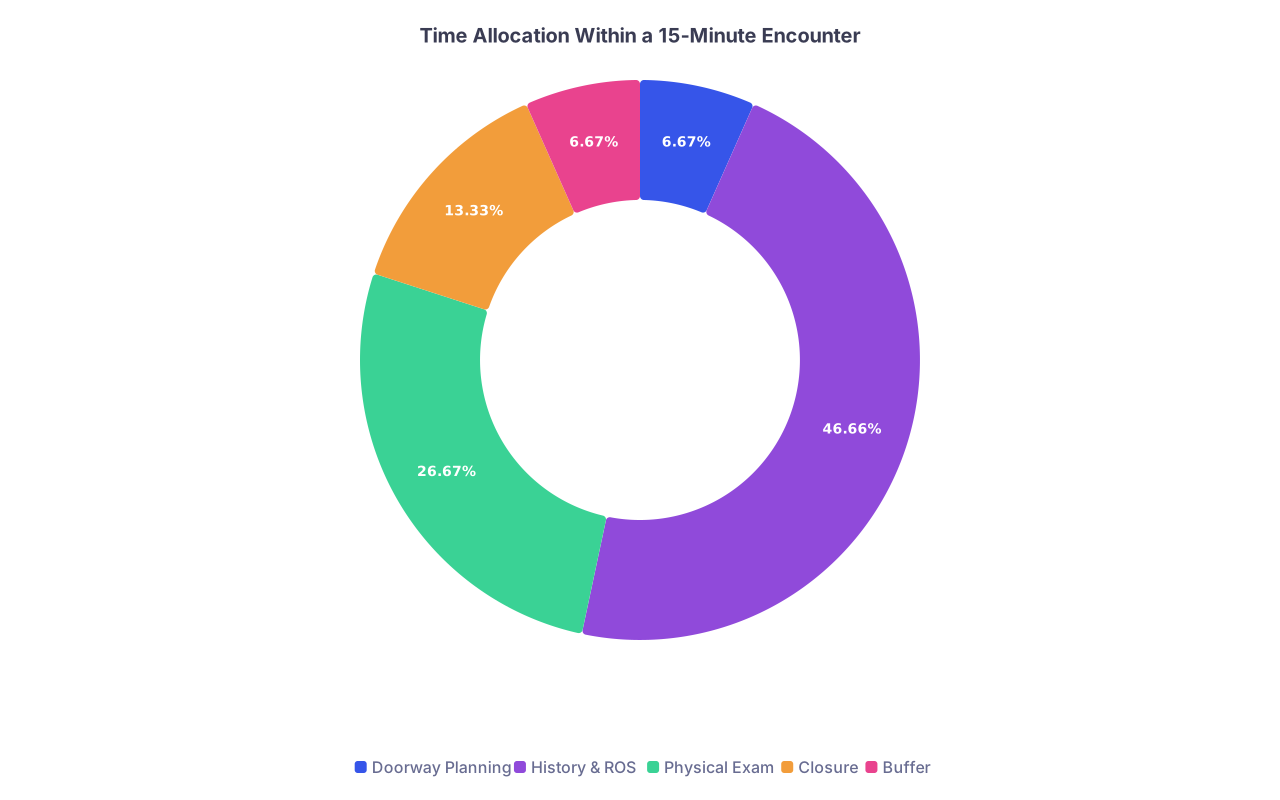
| Category | Value |
|---|---|
| Doorway Planning | 1 |
| History & ROS | 7 |
| Physical Exam | 4 |
| Closure | 2 |
| Buffer | 1 |
Aim roughly for:
- 1 minute doorway / entering / greeting
- 6–7 minutes history + ROS
- 3–4 minutes exam
- 2 minutes closure
- 1 minute buffer for slippage
And a mental map of what you are actually scripting:

Print this mindmap or redraw it from memory until it feels obvious.
Final Tightening: What Success Actually Looks Like
On exam day, success does not feel like brilliance. It feels boring and repetitive.
You will:
- Say almost the exact same opening in every room.
- Ask the same skeleton of questions every time.
- Run the same exam modules.
- Close with the same 6–8 sentences, with minor edits.
That is what you want.
If you are “being creative” in each encounter, you are adding variability where you do not need it.
Key Takeaways
- Standardize 80% of every SP encounter using fixed scripts for doorway planning, entry, history, exam, and closure. Save your brainpower for the 20% case-specific details.
- Practice the script out loud and under time pressure until it becomes muscle memory. Repetition beats talent in this exam.
- Hit the scoring boxes every time: empathic phrases, safety checks, brief focused exam, clear differential, and a plain-language plan. Boring, consistent, and safe will pass this exam.