
It’s late June. You just finished your last core rotation, your ERAS personal statement is a mess of half-sentences, and your friends are debating whether to take Step 2 CK in July or push to September.
You’re staring at the Prometric scheduling page, one hand on the calendar, one eye on Reddit horror stories. The question is simple but brutal: when should you take Step 2 CK so it actually helps you get interviews instead of silently killing them?
Let me tell you what really happens on the other side of the ERAS portal—inside program director meetings, selection committees, and those “informal” ranking discussions you never see.
Most students think Step 2 timing is just about “having a score before ERAS opens.” That’s naive. The timing of your Step 2 CK—month by month—shifts how your application is screened, which piles you land in, and whether someone even opens your file long enough to see that shiny letter from the chair.
The Real Calendar in PDs’ Heads
Forget what your dean’s office says. Program directors don’t care about your school’s academic calendar. They live on a very particular timeline built around ERAS and score releases.
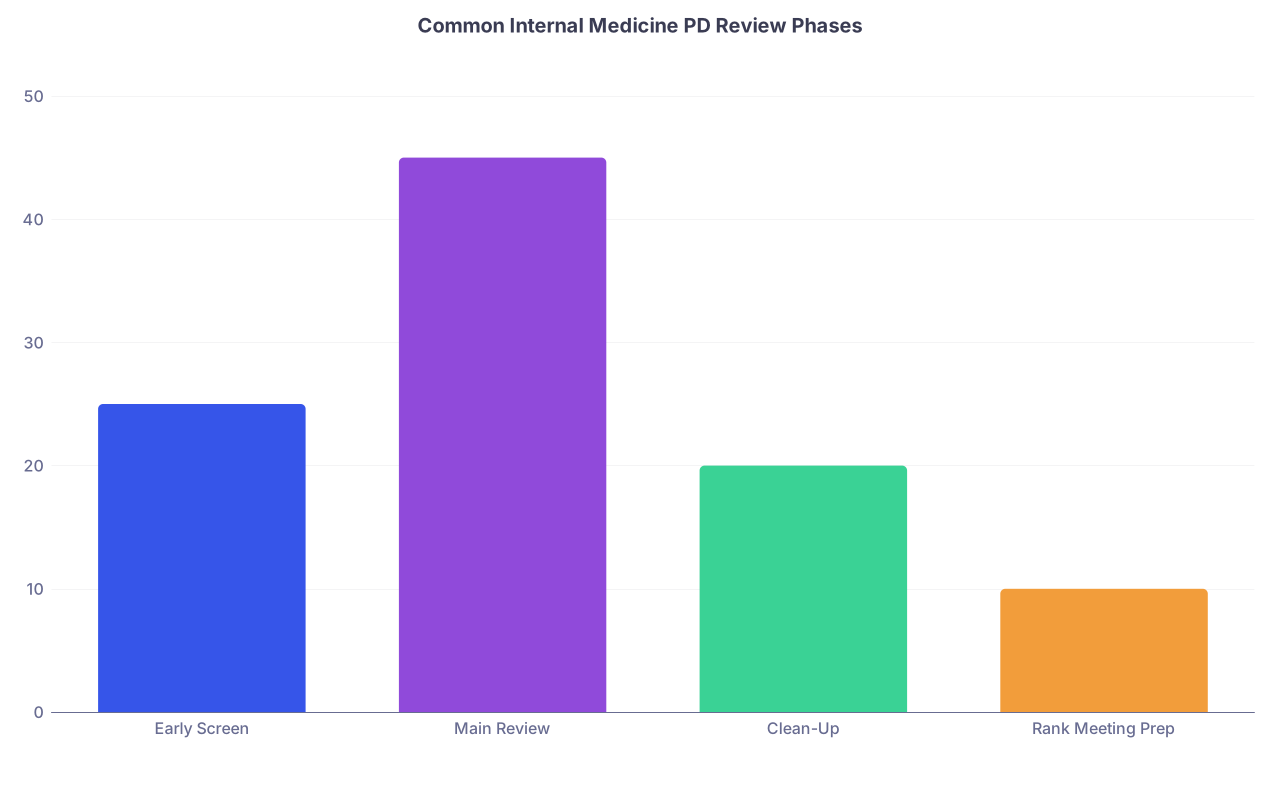
Here’s the mental model many PDs actually use, across IM, peds, EM, psych, neuro, and even some surgical subspecialties:
| Category | Value |
|---|---|
| Early Screen | 25 |
| Main Review | 45 |
| Clean-Up | 20 |
| Rank Meeting Prep | 10 |
Those “phases” usually map roughly like this:
- Mid‑September to late September: first-pass screen
- October: full-file review + early interviews sent
- November–December: clean-up, second-wave invites, gaps filled
- January: rank list work
Now overlay Step 2 CK timing on top of that.

| Period | Event |
|---|---|
| Step 2 Dates - Late May | Step 2 Exam |
| Step 2 Dates - June | Step 2 Exam |
| Step 2 Dates - July | Step 2 Exam |
| Step 2 Dates - August | Step 2 Exam |
| Step 2 Dates - September | Step 2 Exam |
| Score Releases - Late June | Score Released |
| Score Releases - July | Score Released |
| Score Releases - August | Score Released |
| Score Releases - September | Score Released |
| Score Releases - October | Score Released |
| ERAS/Programs - Mid-Sep | ERAS Release to Programs |
| ERAS/Programs - Sep-Oct | First-Pass Screening |
| ERAS/Programs - Oct-Nov | Main Interview Wave |
| ERAS/Programs - Dec-Jan | Second-Wave Invites and Rank List Prep |
Now the uncomfortable truth: for many programs, if your Step 2 CK isn’t visible by the time they do their first-pass sort, you’re already behind. Not out—just behind.
The “sort by score” problem nobody says out loud
Here’s something I’ve heard with my own ears in multiple selection meetings:
“Filter: Step 2 ≥ 240, Step 1 pass. Sort descending. Start from the top 200.”
A lot of faculty want to pretend they “holistically review.” Some try. But when 4,000 applications show up on day one, the first move in many offices is a crude filter. On Step 2. Not your heartfelt PS. Not your glowing dean’s letter.
So if you’re taking Step 2:
- In May/June: your score is in that first-pass filter. You’re in the game from the start.
- In late July: your score hits right around ERAS release. Still okay for most.
- In late August/September: now you’re gambling with the first-pass screen, especially for competitive or big-name programs.
- After October 1: a chunk of places will have already built most of their interview list before your score appears.
Four Common Timing Strategies – What Really Happens to Each

Let’s strip this down. I’m going to categorize the common timing strategies I see and tell you how committees actually treat them.
| Timing | Score Visible By | PD First Reaction | Risk Level |
|---|---|---|---|
| Late May | Late June | Full data from day 1 | Low |
| Late June | Late July | Full data from day 1 | Low |
| Late July | Late August | Borderline but fine | Moderate |
| Late Aug | Late Sept | May miss first-pass | Higher |
| Sept/Oct | Oct/Nov | Many decisions already | High |
1. Early exam (late May–June): the “known quantity”
If you’re done by late May or June, your score lands by late June or July. When ERAS opens to programs mid-September, you’re a known quantity:
- Step 1: pass/fail
- Step 2: numeric signal, already in the filter
- Core clerkship grades: mostly done
- Narrative comments: there
What happens behind the scenes?
I’ve seen PDs in IM, EM, and neurology say things like:
“If they crushed Step 2 early, it tells me they can handle residency. I don’t care that their preclinical narrative had some ‘needs to speak up more in small groups’ nonsense.”
Early Step 2 with a strong score does three concrete things for you:
Resets a mediocre Step 1 story
Borderline pass on Step 1? 227 when scores still mattered? A 246 on Step 2 taken early makes a lot of PDs shrug and move you into the “interview” pile.Prevents auto-defer
Some programs literally tag applications as “wait for Step 2” if it isn’t in yet. You are invisible until you have that number. If it’s already there, no such problem.Signals confidence and planning
They will not say this in public, but in the workroom you will hear: “I like that they took it early and did well. Means they weren’t scrambling or hiding.”
If you’re reasonably prepared by May/June and you expect to score in your practice range, this is the power position. There’s almost no downside unless:
- Your practice tests are tanking and you rush into a bad score.
- You’re using it to dodge studying for shelf exams and blowing both.
2. Mid‑summer exam (late June–July): usually safe, with one catch
This is the most common pattern I see among sane students: take it after core rotations when knowledge is peak, but before the real ERAS madness. You test late June or July, score comes in late July or August. Programs see it on day one.
What PDs think:
- They don’t flag this timing as “late” at all. It’s standard.
- If your score is decent, you go right into their usual sort.
The catch: if Step 1 was weak and there’s a comment “must see Step 2” in your MSPE draft, taking in July is risky if you cut it too close. A few schools mention expected test dates in the MSPE preview. Programs will see “Step 2 planned: July 28” and some will quietly hold your file until they see the score.
I’ve watched coordinators mark applicant records as:
“Hold – low Step 1, awaiting Step 2 score.”
That stamp means you’re not in the first wave of invites. You might still get one, but you just moved from “early October e-mail” to “maybe November, if we have spots left.”
Mid-summer is fine—good, even—if your result hits at least a couple of weeks before ERAS release. Don’t book July 30th with an August 28th score if you’re relying on that exam to reassure programs.
3. Late summer (August): where hidden damage starts
August is where students lie to themselves.
They say, “It will still be in before interviews start.”
They forget interviews are often built off September–October lists created using whatever data is available then.
You take Step 2 on August 15th. Score comes out around mid-September. ERAS releases to programs mid-September. If the timing lines up perfectly, you’re fine, right?
Not exactly.
Here’s what I’ve seen many programs do, especially big academic ones:
- Week 1 after ERAS opens: run filters on all complete applications.
- “Complete” in their mind often means: LORs + MSPE pending + Step 1 + Step 2 if they care about Step 2.
- If you’re missing Step 2 and your Step 1 is weak…you may get shoved into a “review later” bucket that never fully recovers.
This hurts the most in these scenarios:
- You’re applying to competitive specialties (EM, rads, anesthesiology, derm-adjacent, etc.) where Step 2 is the new “academic screen.”
- Your home school sends a quiet heads-up: “Please prioritize this student, their Step 2 should be strong,” but the score’s still not in. It’s hard for advocates to push too hard without the number.
Are you doomed with an August test? No. But you did this to yourself:
- You decreased your chance of being in the first wave of invites at some programs.
- You increased the weight of your narrative red flags and clerkship noise, because they don’t have your strongest objective metric yet.
4. September or later: now timing actively blocks you
September and beyond, you move from “suboptimal” into “this will change which doors even open.”
This is where I see the worst behind-the-scenes comments:
“Step 1 pass, no Step 2 yet, plans to take in October? We’ll pass. We have too many complete applicants already.”
Or:
“We can put them on hold, but realistically we’ll be full by the time that score comes out.”
Students tell themselves: “It’s fine, once my strong Step 2 drops, I’ll get a second wave of interviews.” Sometimes that happens. But more often, you end up in this pattern:
- Very limited early invites (or none) at the stronger and mid-tier places.
- Some late invites in December/January, often from less competitive programs trying to round out lists.
- A lot of “if only we had seen this score earlier” vibes that no one will actually tell you.
For certain groups, late Step 2 is catastrophic:
- IMG/FMGs needing a clear numeric signal early
- US MD/DO with marginal academics trying to prove they’re not a risk
- Anyone applying to fields that explicitly lean on Step 2 now that Step 1 is pass/fail (IM, EM, anesthesia, rads, some surgical prelims)
If you must take it late—failed shelf, personal/family crisis, genuine underpreparedness—you can still strategize, but understand: timing is no longer neutral. It is part of your risk profile.
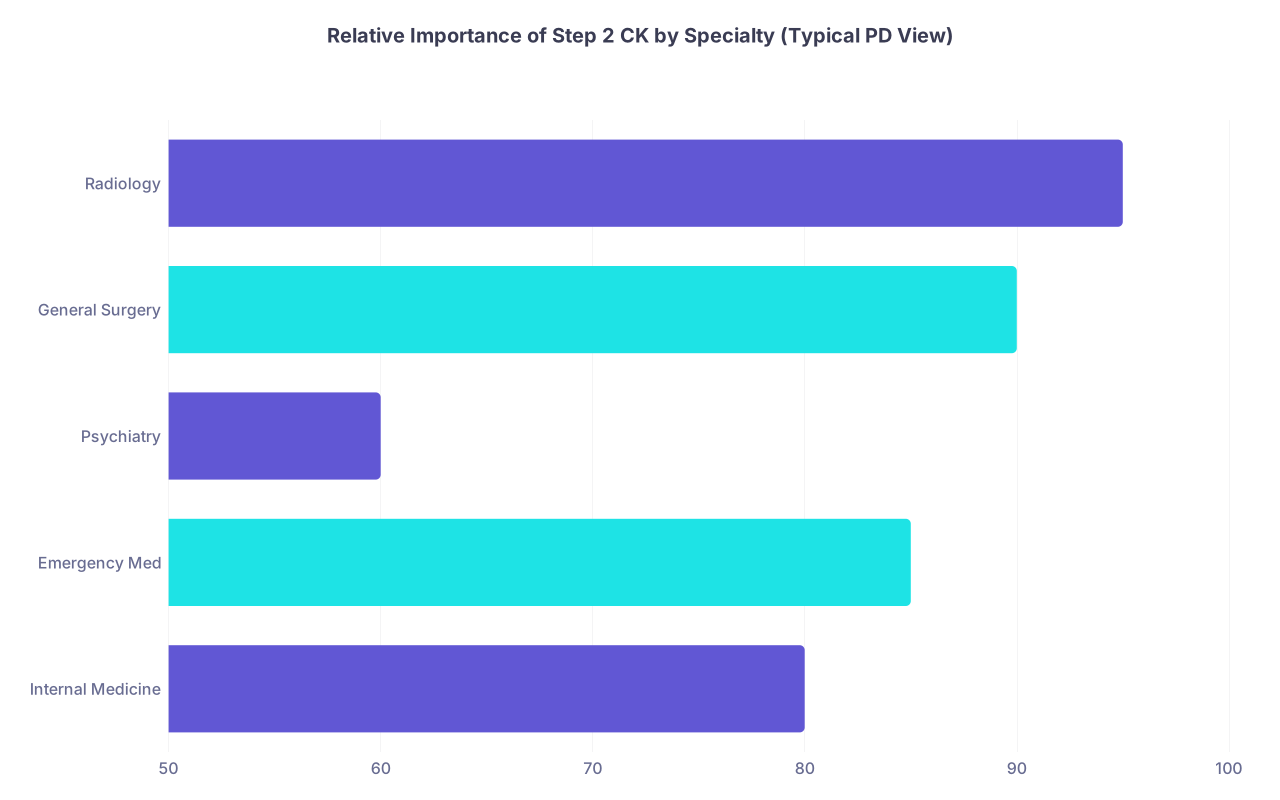
How Programs Actually Use Step 2 Across Specialties
| Category | Value |
|---|---|
| Internal Medicine | 80 |
| Emergency Med | 85 |
| Psychiatry | 60 |
| General Surgery | 90 |
| Radiology | 95 |
Those numbers aren’t from a formal study; that’s roughly how many PDs, in my experience, treat Step 2 as “heavily important” in their screening.
A few patterns you won’t hear in polite brochures:
Radiology / Anesthesia / Derm / Ortho: If they cared a lot about Step 1 before, they now care a lot about Step 2. These programs are more likely to filter early and aggressively. Late Step 2 = you’re invisible during prime time unless your letters are from royalty.
Internal Medicine / EM / Neuro: Heavily use Step 2 to stratify. They still read applications, but higher Step 2 shifts you into the “safer, more capable” mental pile. Early strong score buys you earlier looks and more benefit of the doubt.
Psych / FM / Peds: More forgiving, more truly holistic. But even here, I’ve sat in review meetings where someone squinted at a borderline record and said, “If their Step 2 is solid and we can see it now, I’m fine interviewing them.” Timing decides whether that sentence is possible during October meetings.
There’s also a very simple psychological effect: fresh numbers feel more real.
If your Step 2 is right there in bold on the screen the day the PD is building their first invite list, it anchors their impression of you. If it shows up two months later, it becomes an asterisk:
“Yeah their Step 2 is 252, but we already ranked our top 40. Nice number though.”
The “Should I Delay?” Trap
This is the question that spirals people into bad decisions: “My NBMEs are low. Should I delay Step 2 even if it means my score might not be in by ERAS?”
You’re trading two different kinds of damage:
- A lower score that’s visible early
- A potentially higher score that arrives after the most important screens
Let me be blunt: if your predicted score is catastrophically low for your target specialty (e.g., practice tests in the 210s and you’re aiming for rads), delay. A visible 212 in September does more damage than a solid 238 showing up in November for many programs. You’d be screened out on raw number anyway.
But that’s the extreme.
The more common scenario is this: your practice scores are 225–235, improving, you’re not thrilled, and you’re thinking about pushing from July to September to “get into the 240s.”
Behind the scenes, that’s a sucker’s move for most core specialties.
A 232–238 with a July test and August score:
- Gets you into the early sort piles.
- Looks fine or better-than-fine for IM, peds, psych, FM, neuro in the vast majority of programs.
- Lets you apply explaining, “Steady upward trend, shelves solid, ready to work.”
Delaying to chase a hypothetical extra 5–10 points may:
- Push your score past the first review cycle.
- Make committees judge you without your strongest metric.
- Get you fewer interviews overall, even if the number is slightly prettier.
I’ve personally watched applicants with a 233 Step 2 taken in July end up with more interviews than classmates who delayed, scored 245 in October, and spent November praying for second-wave invites that never came.
Hidden Signals Your Timing Sends to PDs

This is the part nobody tells you: timing itself becomes a narrative about you in many PDs’ minds.
Here are some interpretations people actually voice in committee rooms:
Early Step 2 with strong score (May–June):
“Organized. Academically strong. Probably won’t be a remediation problem.”Mid-summer Step 2 (July) with decent score:
“Normal. Fine. No drama.”Late August Step 2, middle-of-the-road score:
“Cut it close. Maybe needed more time. Not fatal, but eh.”September/October Step 2 with good score but late:
“They pulled it off, but I worry about their timing and planning. Why did they push so far into application season? Shelf failures? Personal issues?”
Remember: PDs are risk managers. They’re not just looking at your top number; they’re sniffing for patterns that scream “intern who will fail Step 3 or struggle with in-service exams.”
Your Step 2 timing plus your Step 2 outcome plus your clerkship timeline all blend into a story. You want that story to be: “Steadily competent and prepared, not a rescue mission.”
Practical Timing Advice by Applicant Type
Let’s be concrete. Here’s how I’d advise different profiles if I were sitting with you in a cramped dean’s office.
Strong student, decent Step 1 (or early pass), shelves solid
Target timing: late June or July
Your goal is to:
- Confirm your trajectory
- Maximize early visibility
- Not burn extra months chasing marginal gains
You take it in late June/July, you’re done, you walk into ERAS with your full stats on the table. PDs love this category: easy to trust, low risk.
Average student, Step 1 pass but not impressive, mixed shelves
Target timing: July (early August at the latest)
You need Step 2 to rescue the story, but you also need it visible:
- Schedule for mid‑July if possible.
- If your practice tests are truly disaster-level (<215 repeatedly), okay, push a bit, but then accept that some doors will be closed just by timing.
The worst thing you can do here is keep kicking the can because “another 2 weeks will fix everything.” It rarely does. Structured 4–6 weeks of focused study and a July/early August exam usually beats perpetual delay.
IMG / FMG / non-traditional with red flags
Target timing: as early as you can safely get a strong score, ideally May–June
For you, Step 2 is not just another piece of data. It’s your currency. US grads get some slack on timing; you don’t.
Programs that are IMG-friendly often have hard internal filters. If your number isn’t there early, you often don’t exist to them.
Applicant changing specialties late
If you decided in June that you’re actually going into EM instead of FM, or rads instead of IM, Step 2 becomes your fresh “I belong here” signal.
Do not take it too late.
Better to take it in July with a solid, good-enough score that shows you’re viable for the new specialty than drift into September chasing a tiny bump while your new target programs finish building their interview rosters.
How to Use Timing Aggressively (Without Being Stupid)
Last thing: timing can be used as a weapon if you understand how PDs build lists.
Here’s a pattern I’ve seen win:
- Student takes Step 2 in late June, score releases in late July.
- They use August to line up targeted away rotation and get face time.
- By the time ERAS hits in September, PDs at those aways have already quietly heard: “Their Step 2 is a 248, they’ve been great on service.”
Those students:
- Get early invites at their away sites.
- Have PDs more willing to advocate for them in committee.
- Don’t have to explain weird timing, because everything looks clean and planned.
Contrast that with the student who:
- Takes Step 2 in early September,
- Spends their away saying, “Yeah, I’m taking Step 2 next week,”
- Has no score during the first round of reviews,
- Then e-mails “update: my Step 2 is a 251!” in November when the program has already handed out 90% of their invites.
One of those strategies treats Step 2 as part of a coordinated campaign. The other treats it like a separate exam that lives in a vacuum. Guess which one wins.