
The official line that “Step 2 CK is just pass/fail for screening” is a lie in competitive specialties.
Program directors in derm, ortho, plastics, ENT, urology, neurosurgery, and certain academic IM programs absolutely have numbers in their heads. They do not publish them. They do not say them on webinars. But they use them. Quietly. Consistently.
Let me walk you through what actually happens behind those closed-door ranking meetings and spreadsheet marathons—and where the real Step 2 CK benchmarks live.
The Quiet Shift: Step 1 Died, Step 2 Took Its Place
When Step 1 went pass/fail, everyone said, “We’ll just do holistic review.” Sounds nice. Also not what happened.
Here’s what actually occurred:
Faculty who used Step 1 as a blunt tool suddenly needed another number. They were not going to start reading 3,000 applications line-by-line. So Step 2 CK quietly became the new numeric gatekeeper.
I’ve sat in meetings where the PD projected an Excel sheet on the wall. Columns: school, class rank, AOA, Step 2, publications, letters. Then the filter clicks: “Sort by Step 2, descending.” That’s the first move. Not “open the personal statement.” Not “look at leadership.” Sort. By. Score.
They still say they’re holistic. And within the filtered pile, they often are. But the unspoken thresholds for even entering that pile are very real.
Let’s put some actual numbers to this.
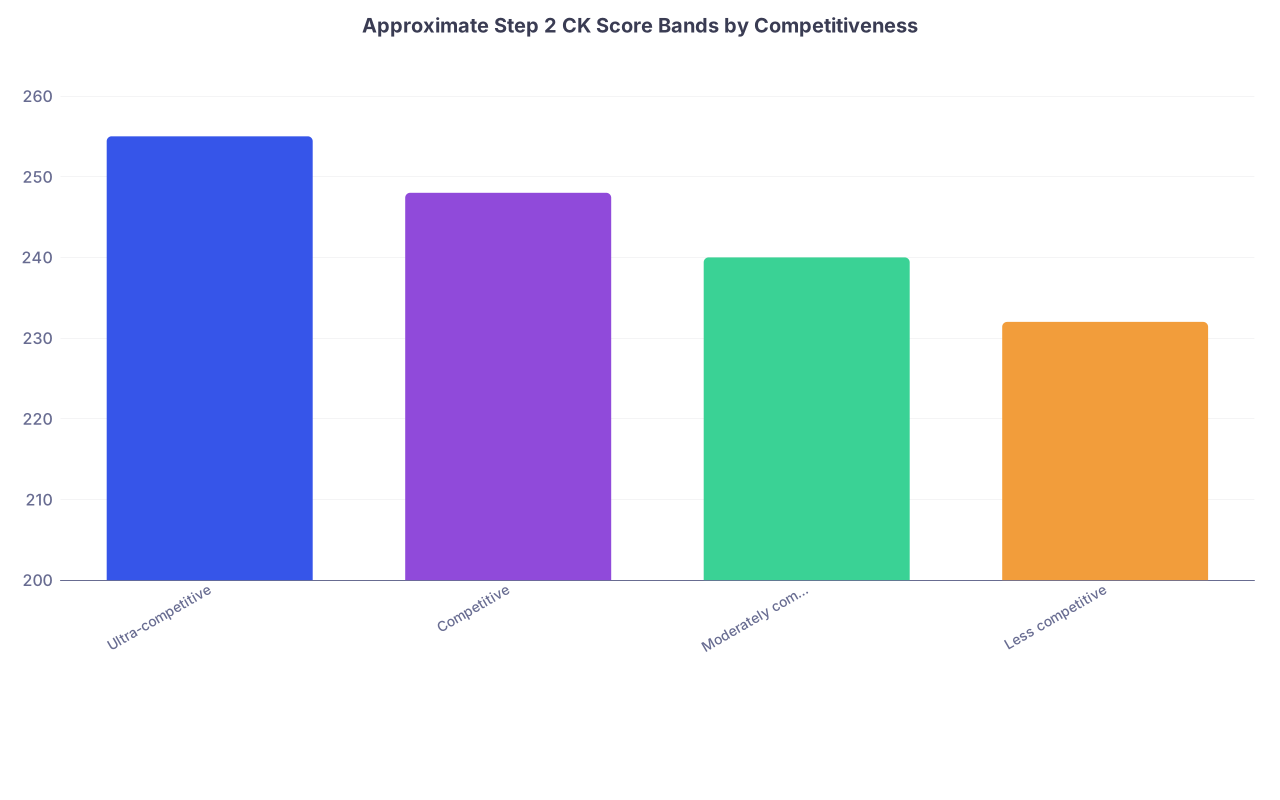
| Category | Value |
|---|---|
| Ultra-competitive | 255 |
| Competitive | 248 |
| Moderately competitive | 240 |
| Less competitive | 232 |
Those are not “requirements.” They’re the center of gravity. The benchmarks that make faculty say, “Okay, keep looking” vs “Eh, move on unless there’s something insane on their CV.”
The Unspoken Benchmarks By Specialty
These ranges are not made up. They come from what faculty say when they think only other faculty are listening.
Dermatology
Derm is ruthless with numbers because they can be. The applicant pool is small and very high-yield.
Here’s the unofficial truth I’ve heard across several derm programs (mid-tier academic and top-tier):
- Below ~245: You’re in serious trouble unless you have truly elite research (think multiple derm pubs, known PI, connections), home program advocacy, or come from a top 10 med school with a derm chair going to bat for you.
- 245–255: You can match derm, but you’ll lean heavily on research, away rotations, and institutional connections. You’re not auto-screened but you’re not “score-flex” either.
- 255–262: This is where PDs start calling applicants “strong on paper” without hesitation. With a sane CV, you’re in the normal “we should probably invite” bucket.
262: This is “we’ll tolerate a few weirdnesses” territory. Red flags can be softened. A slightly light research portfolio may be forgiven, especially at mid-tier places.
What they never say publicly: a 235 with solid research is not equivalent to a 258 with no research. That’s the polite fiction told on panels. Behind the scenes, the 258 gets a much longer look.
Orthopedic Surgery
Ortho PDs care about three things: scores, letters from known surgeons, and perceived grit. Step 2 is again a front-door filter.
Unspoken ortho benchmarks:
- <240: You’re probably dead in the water at most academic ortho programs unless your letter writers are heavy hitters and you’ve got multiple ortho publications.
- 240–248: Viable at many community and some academic programs if the rest of your app is strong and you’ve done aways that went well.
- 248–255: This is “safe to interview” range for a lot of mid/high-tier programs if your rotation performance and letters are solid.
255: You’re above the “silent cutoff” at most places. They can’t ignore you unless there’s a real problem (failed clerkship, professionalism issue, repeated exams).
I’ve seen an ortho department chair say in a meeting: “We aim for >250; below that we want a reason to still read them.” That’s how it’s framed. The burden of proof flips around that 250-ish zone.
Plastic Surgery (Integrated)
Plastics is insane in terms of expectations. They want Step 2, research, and polish.
Insider plastics ranges:
- <245: You’re essentially banking on being a research monster with dedicated time, top-tier PI, and home program pulling strings.
- 245–255: You can be viable, but only with heavy research output and strong, specific letters from plastic surgeons. Random generic “hard-working” letters will not save you here.
- 255–260: This is closer to the middle of the interviewed pool at many academic programs.
260: Now attendings start saying, “Okay what’s the story here?” in a positive way. They’re curious, not skeptical.
A plastics PD once told a room of faculty during a rank meeting: “We have enough people >260 that we don’t need to reach down unless there’s an exceptional reason.” That’s the mindset.
ENT (Otolaryngology)
ENT sits between ortho and plastics in neuroticism about scores.
Typical internal benchmarks:
- <240: They might read you if you’re from their med school and they know you personally. Otherwise? Almost invisible.
- 240–248: Realistic only with substantial ENT exposure, home rotation, and faculty advocacy.
- 248–255: Most programs will consider you if the rest is solid.
255: You’re in the competitive interview range, assuming you didn’t sleepwalk through your clinical years.
Same pattern: Step 2 doesn’t “get you in” by itself— but it absolutely keeps you out below a point.
Neurosurgery
Neurosurgery cares about raw horsepower, at least in how they justify their choices. Step 2 is weaponized as a proxy for that.
Silent neurosurg zones:
- <245: Now you’re relying on major research, institutional pull, or being in someone’s lab for two years.
- 245–255: You’ll be looked at closely if you have research and strong neurosurg letters. More reach than safety.
- 255–260: Very solid footing for interviews at many programs, particularly if your CV shows consistency and resilience.
260: Nobody’s tossing your application casually. They may pass if you’re otherwise weak, but someone will definitely read it thoroughly.
I’ve seen a neurosurg faculty member say out loud, “If they can’t break 250 on CK, I worry about them handling boards later.” That’s an exaggeration, but it sticks in people’s heads.
Urology
Urology is a bit more personality- and fit-driven, but the filters are still there.
Rough urology bands:
- <238–240: Tough unless your away rotations were rock-solid and you’ve got strong “I will rank this person high” type letters.
- 240–248: Viable with good performance and some scholarly work.
- 248–255: Noticeably strong. This is where you blend stats + personality and become easy to invite.
255: You’ll be on a lot of interview lists unless there are other major weaknesses.
The Shadow Cutoffs: What PDs Will Never Put in Writing
The language they use in meetings is different from what they put on their website.
Public language:
“We do not have strict cutoffs. We review applicants holistically and value diverse experiences.”
Private language:
“Let’s start by filtering below 240 and see how many we have left.”
Here’s how those shadow cutoffs actually work:
A rough number is set based on applicant volume that year.
High volume year? They’ll be harsher. Low volume? They dip lower.Below that number, applications are technically accessible but rarely deeply read—unless:
- You’re from their own school
- You rotated there and left a strong impression
- Your chair or a known faculty emails the PD directly saying, “Please take a look at this one”
- You have that freakish research or advocacy story that makes you stand out
Above a second, higher number, you gain “benefit of the doubt” status.
People assume you’re capable. They look for reasons to keep you, not reasons to dump you.
Here’s a simple way to visualize how many programs treat Step 2 in their own heads:
No one writes this on their website. But they build their spreadsheet around it.
How Far Can Other Strengths Compensate?
Here’s the uncomfortable truth: compensation is real, but not symmetrical.
High score + mediocre everything else is more forgiving than low score + fantastic everything else. That’s just how human bias works in these decisions.
Think of it in buckets:
| Step 2 Band | Research/Letters | Outcome Tendency |
|---|---|---|
| <240 | Weak/Average | Almost no interviews |
| <240 | Exceptional | Selective reads, mostly where known |
| 245–255 | Average | Interviews at less competitive programs |
| 245–255 | Strong | Broad interview set, mix of mid & some top |
| >255 | Average | Many interviews despite so-so CV |
| >255 | Strong | Top-heavy interview list, including elite programs |
Three behind-the-scenes patterns I’ve seen repeatedly:
A 258 with zero publications will still get a shot at places that reject a 242 with multiple mid-tier publications. Faculty assume the 258 “can always do research later” but doubt whether the 242 can pass boards easily.
A really strong letter from a known attending can partially neutralize a lower score, but it rarely flips the script completely. The letter gets you “out of the discard pile” and into the “at least take a look” zone.
Coming from a well-known med school buys you a longer review, not a different standard. I’ve watched faculty say, “They’re from [top school], why did they only get a 238?” That question alone already biases them.
Strategy: What These Benchmarks Should Actually Change for You
You can’t retroactively fix your Step 2 score. But you can absolutely adjust tactics based on where you land.
If You’re Below ~240 and Targeting a Competitive Field
This is where you need brutal honesty with yourself and with mentors who will tell you the truth, not what sounds nice.
Options that actually match what PDs think:
- Seriously consider a change in specialty. I’ve watched students save themselves years of unnecessary suffering by pivoting to fields where 230s are completely fine—and then thriving.
- OR commit to a multi-year rebuild: dedicated research time, strong networking, home program infiltration, and away rotations where you absolutely destroy it clinically.
What does not work is magical thinking: “But they said they’re holistic and I love derm so much.” Programs are not going to lower their Step 2 expectations because you’re passionate.
If You’re in the Middle Band (245–255)
This is the “workable but not gifted by God” range.
Here’s how faculty actually view this group: “Show me who you are clinically and academically, and I’m persuadable.”
You need:
- Stellar clinical narratives in your MSPE and letters. Comments like “one of the best students I’ve worked with in years” matter more in this band.
- Focused, coherent research story. Not random posters. Work that tells a story: consistent interest, same field, continuity with mentors.
- Smart application strategy: mix of reach, realistic, and safety programs. I’ve seen 250s overreach with only top 10 programs and then wonder why they got burned.
If You’re >255
You’re not automatically safe. But the doors are a lot less locked.
Common self-sabotage patterns I’ve seen in this group:
- No real specialty commitment shown besides the score. PDs side-eye the “tourist” who aced the test but never put in work in the field.
- Arrogant interview behavior. You’d be shocked how fast “great score” becomes “rank list anchor” when you come across as entitled.
- Shallow, generic letters. PDs expect substance and specifics if you’re that strong on paper.
Use your score as leverage to secure aways, research spots, and mentorship. Not as a reason to coast.
When To Take Step 2: The Unspoken Timing Games
Here’s the conversation attendings have when you’re not in the room:
“Should we tell them to delay Step 2 until after their big rotation so the letter writer can massage their grade if Step 2 tanks?”
Or:
“They already crushed clinicals. If they take it early and do well, it solidifies their file by ERAS opening.”
Three practical truths:
- For competitive specialties, earlier Step 2 (with a strong score) is powerful. Programs can use it for early screening and are more willing to offer interviews before MSPE drops.
- If you expect a big score jump compared to Step 1 (or you have no Step 1 number), aim to have Step 2 in by late July–early August at the latest.
- If you’re struggling on practice tests, some advisors will quietly suggest delaying — not to “hide” the score, but to avoid torpedoing your file right before applications.
I’ve seen at least two students each year in competitive fields whose advisors basically said: “If your NBME practice doesn’t get into the mid-240s, we should talk about plan B before you sit.”
That conversation happens more than anyone admits.
How Programs React to a Low Step 2 in an Otherwise Strong Applicant
This is where the “holistic review” script and the actual off-mic reactions diverge.
What they say out loud in public spaces:
“We understand tests aren’t everything and we look at the whole person.”
What I’ve actually heard in committees:
- “Did they just get lucky on Step 1?”
- “I don’t want to be the one explaining why our board pass rate dropped.”
- “We can maybe take one or two lower scores if they’re truly exceptional in other ways, but not ten.”
Programs do sometimes take a chance. Especially on applicants they know in person, or those who’ve done away rotations with outstanding clinical performance. But they ration those chances. You don’t want to rely on being someone’s “one exception this year.”
Reality Check: There Is No Single “Safe” Number
You will never get a straight answer from a PD if you ask, “What Step 2 do I need for derm/ortho/ENT/etc.?” And they’re not lying when they say “there’s no cutoff.”
What they mean is:
- Different faculty have different personal comfort zones.
- Different years have different applicant pools.
- Different programs have different risk tolerance for “borderline” scores.
But behind all that variation, the truth is simple:
- Below ~240 in highly competitive specialties, you’re an exception case.
- Mid-240s to mid-250s, you’re in the game if everything else is sharp and your strategy isn’t delusional.
- Upper 250s and above, you’ve removed a major obstacle but still need a coherent story.
It’s messy, but it’s not random.
FAQs
1. If I’m set on a competitive specialty but my Step 2 is low, is a research year actually worth it?
Sometimes. But only if it’s targeted and high-yield. A “research year” where you’re doing low-impact busywork that never gets published doesn’t magically erase a 235. What moves the needle is: multiple first- or second-author papers in that specialty, strong relationships with well-known attendings, and concrete advocacy from those people. If you can plug into a productive lab with a recognized name in your field, a research year can convert you from “probably no interviews” to “selectively viable.” If you’re just begging random faculty for projects with no track record of output, you’re wasting time.
2. How many practice NBMEs should I use to predict my Step 2 for these benchmarks?
Programs don’t see your NBME scores, but you should treat them brutally. Most students land roughly within ±5 points of their recent NBME average if they’re not burned out or sick on test day. If your last two practice tests are circling 240–245 and you want derm/ortho/plastics/ENT/neurosurg, that’s a huge decision point. This is where you either push the exam back and fix gaps—or start recalibrating your specialty targets with someone who will be honest with you.
3. Does being from a top medical school lower the Step 2 bar for me?
Slightly, but not as much as people think. Top schools mostly buy you a longer, more serious read. Faculty have internal narratives like “They trained at [X], they’ve probably seen a lot, maybe the test day was off.” But they’re also sensitive to their own board pass stats. I’ve watched PDs reject 230-ish applicants from elite schools and rank 255s from mid-tier schools above them. Name brand helps at the margins. It doesn’t rewrite the scoring equation.
4. Are there programs that truly don’t care about Step 2 CK scores?
In the ultra-competitive fields? No. They all care. Some are less rigid, some are more open to exceptions, but none are blind to that column on the spreadsheet. The only places that come close to “we don’t care” are lower-volume, less competitive community programs in non-competitive specialties, and even there, if you show up with a 260 vs a 220, they notice. The difference is they’re more willing to take a chance on a lower score if you interview well and fit their culture. In derm/ortho/plastics/ENT/neurosurg/urology, Step 2 is always part of the conversation, whether they admit it publicly or not.
Two things to walk away with.
First, Step 2 CK is the new numeric religion in competitive fields. Pretending it’s not will only hurt you. Second, your score doesn’t write your entire story—but it absolutely decides which rooms your story gets told in. Act accordingly.