
The most common Step 2 CK problem is not low scores. It is scores that refuse to move.
You grind UWorld. You finish another 40-question block. Your percentage barely budges. Your NBME/CCSSA is the same within a couple of points. Again. That is not “just how it goes.” That is a systems failure. And you can fix it in 4 weeks if you stop doing what feels productive and start doing what actually moves your score.
This is your 4-week rescue protocol. Not vibes. Not hope. A structured, aggressive, fix-the-leaks plan for a Step 2 plateau.
Week 0: Diagnose Why You Are Stuck (No Guessing)
Before you “work harder,” you need to know what is actually broken. Most students plateau for one (or more) of five reasons:
- You are doing questions, not learning from them.
- Your test-taking process is sloppy or inconsistent.
- Your knowledge gaps are deeper than you think.
- You have no real review system (everything is one-and-done).
- Your energy / schedule is sabotaging your brain, especially on rotations.
You are going to confirm which ones apply to you in 48 hours.
Step 1: Hard Data Snapshot (Day 1–2)
You need a baseline that is not just “my UWorld percentage feels low.”
Do this:
Pull Qbank performance data (UWorld, AMBOSS, etc.):
- Last 400–600 questions (about 10–15 blocks).
- Look at:
- Overall % correct.
- Timed vs tutor mode.
- By system and by discipline (IM, Surgery, Peds, OB, Psych, Neuro, EM).
- “Questions flagged” list, if you use it.
Take one standardized assessment (if not done in the last 10 days):
- NBME/CCSSA: 9, 10, 11, 12 or 13 (depending on what you have not used).
- Or UWSA2 if you are late in prep and have already used early NBMEs.
- Do it:
- In one sitting.
- Strict timing.
- Test-like conditions (no phone, no snacks outside breaks).
Score + Section review (not full explanation binge):
- For the practice exam, look at:
- Block-by-block scores.
- Content categories: especially IM vs everything else.
- Repeated weak topics (e.g., heart failure, acid-base, psych meds, prenatal care).
- For the practice exam, look at:
Now classify yourself.
| Profile | Typical Pattern |
|---|---|
| The Volume Grinder | 60–65% Qbank, 3,000+ Qs done, minimal notes |
| The Knowledge Leaker | High yield topics forgotten repeatedly, poor recall |
| The Process Mess | Reads full stem, changes answers frequently, timing issues |
| The Over-Reviewer | Spends 3–4 hours reviewing 40 Qs, low total daily volume |
| The Exhausted Clerk | On busy rotation, wildly inconsistent scores |
You are probably a mix of 2–3. Good. You will target each one with specific fixes in this protocol.
The Core Rule for the Next 4 Weeks
From now until test day, everything you do must satisfy 2 conditions:
- It directly improves exam performance (not generic knowledge, not “feels productive”).
- You can track it objectively (questions done, concepts captured, timing, scores).
If a task fails either condition, you drop it. That includes random YouTube binges and passive reading you never revisit.
Week 1: Fix Your Question Process (The Engine)
If you do not change how you handle individual questions, your score will not move. You are not allowed to “just do more questions” with the same broken process.
You are going to build a rigid question protocol. Then drill it.
Step 1: Standardize Your Question Flow
For every timed block (40 Q), you follow this structure. No exceptions.
Per question (average ~1 minute 18 seconds):
Read the last line first (the ask).
- Example: “What is the next best step in management?”
- Translate it: diagnosis? initial test? best confirmatory test? first-line treatment?
Skim vitals and bold/high-yield data fast.
- Age, sex, pregnancy status.
- Vitals.
- Critical labs (Na, K, Cr, Hb, troponin, ABG, etc.).
Read stem once with a job: exclude wrong diagnoses.
- As you go, mentally eliminate impossible categories:
- “Not sepsis (afebrile, stable).”
- “Not ACS (normal EKG, no risk factors, atypical pain).”
- When done, voice what you think it is in a short phrase:
- “This is decompensated systolic heart failure.”
- “This is preeclampsia with severe features.”
- “This is serotonin syndrome.”
- As you go, mentally eliminate impossible categories:
Go to answer choices with a prediction already formed.
- If your predicted answer is there, it is usually right.
- If not there, ask: “What step of management is this question targeting?”
- Diagnosis vs next test vs treatment vs disposition.
Eliminate using hard rules, not vibes.
- For each option, force yourself to say a short reason:
- “Wrong: used only if X fails.”
- “Wrong: contraindicated in pregnancy.”
- “Wrong: used for chronic, not acute.”
- For each option, force yourself to say a short reason:
Commit, click, move.
- You are allowed one revisit flag per block if absolutely necessary.
- No multiple passes through every question “just to be sure.”
This is tedious to set up. Then it becomes automatic. That automaticity is where raw score jumps come from.
Step 2: 3–Block Drill Day (End of Week 1)
Pick a day in Week 1 and run:
- 3 timed blocks of 40 (120 questions total).
- Strict timing. Short break between each (5–10 min max).
- Apply the question protocol above to every single question.
During review, do not start by reading the explanations. Start with:
- “What did I think this was?”
- “Where in my process did I fail?”
- Misread the ask?
- Jumped to answer without prediction?
- Knew the concept but forgot a key contraindication?
- Timed out and panicked?
Write down 3 recurring process errors you see. Example:
- “I keep ignoring the specific wording around ‘best initial test’ vs ‘most accurate test’.”
- “I do not account for pregnancy enough; keep choosing teratogenic meds.”
- “I am weak on what to do when vitals are unstable (always resuscitation first).”
Those errors inform your target drills for Week 2.
Week 2: Convert Questions into a Memory System
You think you have a “content problem.” Often you really have a leakage problem. You learn something Monday, forget it by Friday, and step questions hit that same concept over and over.
We are going to lock concepts in.
Step 1: Build a Lean, Aggressive Review Pipeline
You need a system more powerful than “read explanations carefully.” Here is a pipeline that works:
During review, for each missed or guessed question:
- Ask 3 questions:
- “What single concept did this question test?”
- “Why did I actually miss it?” (knowledge gap vs misread vs reasoning error).
- “How will I prevent this specific miss again?”
- Ask 3 questions:
Create 1–2 high-yield artifacts per important question:
- Small Anki card (cloze or Q/A, not paragraphs).
- One-line note in a running document (organized by system).
- Tiny decision algorithm written out as text or sketched.
Good Anki-style card vs bad:
Bad:
- Front: “Heart failure management?”
- Back: Paragraph with all of ACC/AHA guidelines.
Good:
- Front: “First-line drug classes for HFrEF mortality benefit?”
- Back: “ACEI/ARB/ARNI + beta-blocker (carvedilol, metoprolol succinate, bisoprolol) + MRA (spironolactone, eplerenone) ± SGLT2 inhibitor.”
You target exam-level granularity, not textbook-level detail.
- Daily structured review:
- Anki cards: 45–75 minutes max. Hard cut-off.
- Running document: skim sections of your main weak systems daily (e.g., IM and OB).
Step 2: Topic Clusters, Not Random Facts
Step 2 loves clusters: the same syndromes in different clothing. You need “if -> then” chains, not scattered trivia.
For major clusters you keep missing, you build mini-algorithms. Examples:
- Chest pain (stable angina vs unstable vs NSTEMI vs STEMI vs noncardiac).
- Abdominal pain in pregnancy.
- AKI with different BUN:Cr and urine findings.
- Fever in post-op day 1–5 vs 5–10.
- Pediatric rashes by distribution and associated symptoms.
Use very short flowcharts or text algorithms:
“Post-op fever:
- POD 1–3: atelectasis / pneumonia → CXR, incentive spirometry.
- POD 3–5: UTI → UA, culture.
- POD 5–7: DVT/PE → duplex or CT angio.
- POD 7+: wound infection / abscess → exam, CT if deep, drain + abx.”
You are training your brain to recognize patterns and choose the next appropriate step reflexively.
Here is where people finally see traction: when they stop memorizing lists and start encoding management pathways.
Step 3: Quantify Knowledge Gains
End of Week 2, you should have:
- ~800–1000 new questions done over two weeks.
- A growing deck or note set with:
- 150–300 new high-yield items (yes, this is realistic).
- Visible change in weak system performance in your Qbank stats.
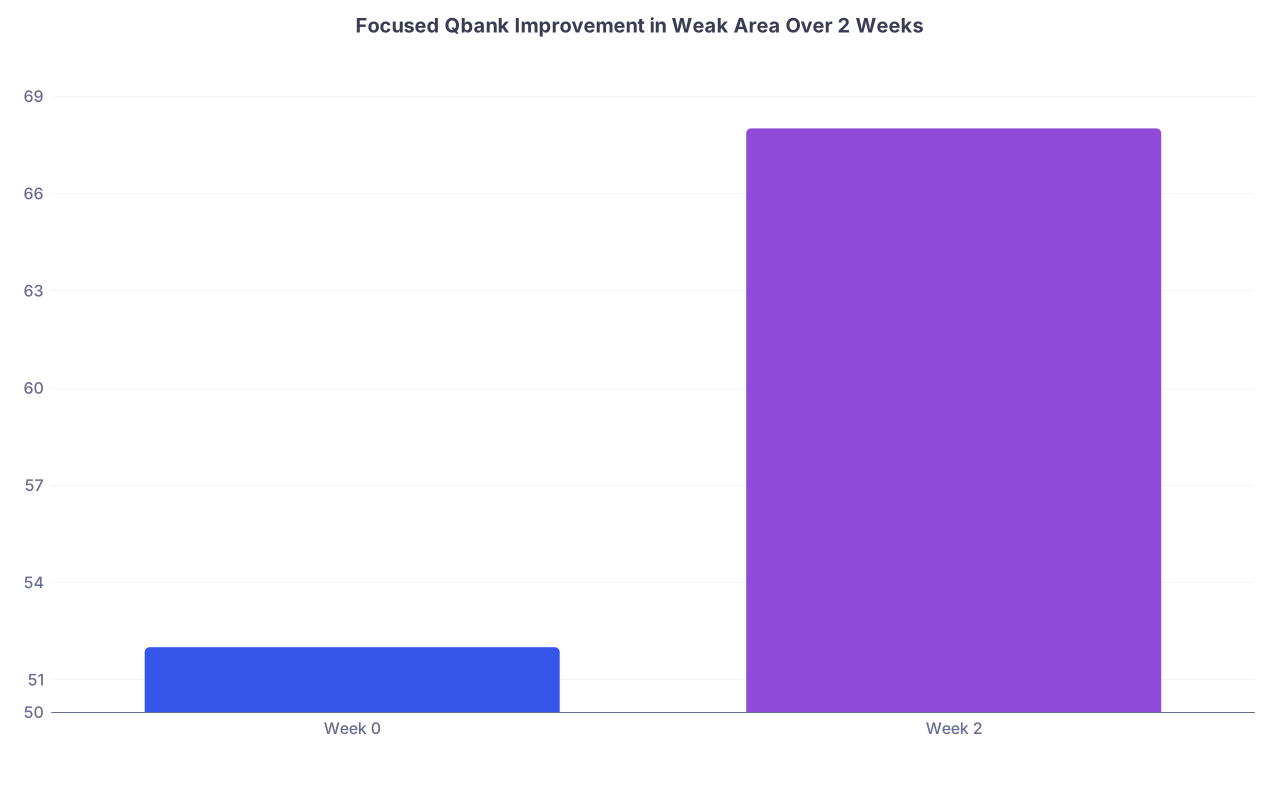
You are going to check that with data: run 2 focused blocks in your previous weak subject (e.g., OB, Psych). Compare:
| Category | Value |
|---|---|
| Week 0 | 52 |
| Week 2 | 68 |
If you are not seeing at least ~8–10 percentage-point gain in the focused area, you are not reviewing aggressively enough. Or you are overcomplicating your notes.
Week 3: Simulate the Exam and Fix Endurance
A plateau at 57–65% on random blocks usually exposes a second problem: you cannot hold your performance across multiple hours. You do fine for one block, then fatigue, anxiety, and sloppy reading drag down the rest.
Week 3 is where you stress-test your system.
Step 1: Full-Length or Near Full-Length Simulation
You will do at least one near full-length practice this week:
- 6–7 blocks of 40 questions (NBME/CCSSA or mix of Qbank blocks).
- Structured like test day:
- Blocks: 60 minutes each.
- Breaks: 45–60 minutes total for the day.
During this, you track only three things:
-
- Aim: finish with 4–7 minutes left in most blocks.
- If you are finishing with 0–1 minute left, you have a reading/overthinking problem.
- If you are finishing with >10 minutes left, you are rushing.
Energy and focus rating per block (1 to 5).
- After each block, quickly note:
- “Block 3: focus 3/5, started re-reading stems.”
- “Block 6: 2/5, brain fog, guessing more.”
- After each block, quickly note:
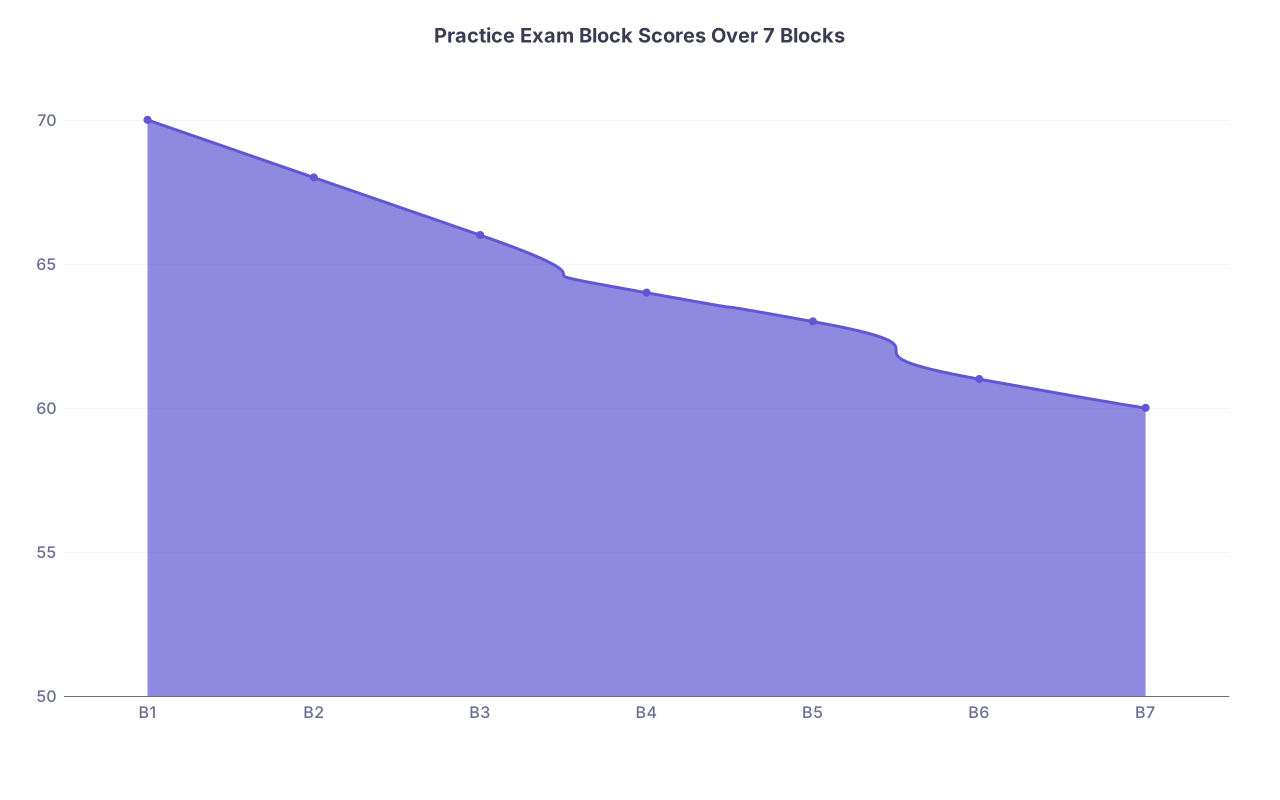
Accuracy trend by block.
- Are blocks 1–3 solid, 4–7 worse? That is endurance.
- Are specific systems tanking late? That is cognitive fatigue on complex material like IM.
You want something like:
| Category | Value |
|---|---|
| B1 | 70 |
| B2 | 68 |
| B3 | 66 |
| B4 | 64 |
| B5 | 63 |
| B6 | 61 |
| B7 | 60 |
This slow downward slide is extremely common. The solution is not more random studying. It is targeted endurance rebuilding.
Step 2: Fix Timing and Endurance Problems
Here is the protocol.
If you are timing out / rushing late:
For 3–4 days, run:
- 2 back-to-back timed blocks daily.
- Strict question protocol (last line first, quick skim, one pass).
During review, mark:
- Questions where you changed your answer from right to wrong.
- Questions you got wrong due to last-minute panic switches.
Pattern: students who constantly review mid-block (scrolling up and down) burn time and second-guess themselves into wrong choices. You will deliberately avoid this.
If your brain dies after Block 4:
You do not fix that with more coffee on test day. You fix it by training.
2 days this week:
- 4 consecutive timed blocks (4 hours of testing).
- Exactly one 10–15 minute break in the middle.
You practice:
- Starting each block with the same calm process.
- Micro-resets: close eyes for 20 seconds before each block, 3 deep breaths, restart.
This is athletic training. Not “studying.” Treat it like prepping for a marathon.
Week 4: Sharpen, Do Not Panic-Cram
Last 7 days are where people destroy months of work by changing everything. New resources. New strategies. That is how you turn a plateau into a drop.
You will narrow, not expand.
Step 1: Final Assessment and Reality Check (Day 1–2 of Week 4)
Take one more major assessment:
- If you have a fresh NBME/CCSSA left, use it.
- Otherwise, UWSA2 is acceptable for trajectory-check.
Then accept the data:
- Scores trending up 8–15+ points from your starting baseline over 4–6 weeks? You are on track.
- Stagnant? There is still room to salvage, mainly with test-taking discipline and error reduction.
Do not reschedule in panic based on one bad day unless your assessment is catastrophically below passing. Most plateaus break later than people want if the process is right.
Step 2: Tighten High-Yield Systems and Weak Spots
In Week 4, your study time shifts:
- ~40–50%: Qbank (random, mixed, timed).
- ~30–40%: focused review of:
- IM (always heavily tested).
- OB, Peds, Psych – whatever your worst section was.
- ~10–20%: Anki / notes review.
You are looking for fast-turnaround improvements:
Fix the 3–5 topics that consistently burn you:
- Acid-base interpretation.
- Arrhythmia management.
- Prenatal screening and pregnancy complications.
- Sepsis and shock types.
- Diabetes management (DKA vs HHS vs outpatient titration).
For each of these:
- Spend 30–60 minutes once doing a deep dive:
- Review UpToDate/AMBOSS summary.
- Work 10–20 targeted questions.
- Create 5–10 tightly written cards or mini-algorithm notes.
- Then let your spaced review (Anki / notes) reinforce.
- Spend 30–60 minutes once doing a deep dive:
You are not trying to rebuild all of medicine in one week. You are attacking the highest-yield, most error-prone clusters.
Step 3: Lock in Test-Day Routines
Your score will not reflect your knowledge if your brain is fried on exam day. You need a boring, repeatable system for the 72 hours pre-exam.
Three days out:
- Last moderately heavy study day.
- 3–4 blocks max.
- Normal review.
- Sleep as close to your test-day schedule as possible.
Two days out:
- 2 blocks, max. Preferably earlier in the day.
- Only light review of mistakes.
- No new resources. No new huge decks.
- Evening: walk, light exercise, early wind-down.
Day before exam:
- No full blocks.
- Optional:
- 10–20 very easy warm-up questions in the morning just to keep the pattern.
- Quick look over your own high-yield notes (OB algorithms, ABGs, rashes).
- Afternoon and evening: non-medical. Protect your head.
If you cannot help yourself, cap all studying at 2–3 hours, finished by early afternoon.
A Realistic Daily Template (For the Busy Clerk)
If you are on rotation, you do not have 10 hours. You need ruthless prioritization.
Here is a realistic weekday structure for someone on a medium-intensity rotation:
Morning (pre-round): 45–60 min
- 1 mini-block (10–15 timed questions, mixed).
- Very quick review of only:
- Clearly missed concepts.
- Process errors.
Post-clinic / evening: 3–4 hours total
Questions: 2 full blocks (80 Q total)
- Timed, random, mixed.
- Treat this as non-negotiable.
Review: 1.5–2 hours
- For each block:
- Review misses and close guesses first.
- Create 5–10 cards or notes from each block. No more.
- For each block:
Maintenance review: 30–45 minutes
- Anki / notes rotation of your weakest systems.
On weekends, stretch:
- 3–4 blocks per day.
- One near-exam simulation day every 1–2 weeks.

| Step | Description |
|---|---|
| Step 1 | Week 0: Diagnose Plateau |
| Step 2 | Week 1: Fix Question Process |
| Step 3 | Week 2: Build Memory System |
| Step 4 | Week 3: Endurance & Simulation |
| Step 5 | Week 4: Sharpen & Stabilize |
Choosing and Using Resources Intelligently
If you are plateaued, the default move—adding another full resource—is usually wrong.
You need fewer tools, used better.
Baseline stack that is enough for almost everyone:
- Qbank #1: UWorld (core).
- Qbank #2 (optional): AMBOSS for extra volume / targeted topics.
- Reference: AMBOSS or UpToDate for clarifying guidelines.
- Memory tool: Anki or your own notes document.
What is usually not necessary this late:
- Brand-new video series.
- Another huge commercial “comprehensive” textbook.
- Switching Qbanks entirely because you feel “burned out” on one.
Your plateau is almost never because you chose the “wrong” main resource. It is because you have been using it passively.

Mental Game: Handling Anxiety and Perfectionism
There is one more reason scores stall: fear. The “I must understand everything about this topic before moving on” trap. That is how you review 40 questions in 4 hours and do almost no new questions.
You correct that by enforcing brutal caps:
- Max 2–3 minutes review per question on average.
- Stop deep-diving every distractor unless:
- It is a repeat weak area.
- It appears in multiple questions over a few days.
Perfectionism feels like diligence. It is often sabotage.
You are training to pass a standardized exam, not to be the world’s expert in every nuance of lupus nephritis. The exam rewards:
- Recognizing patterns quickly.
- Knowing first-line management.
- Knowing “what to do next” when vitals are unstable.
- Avoiding dangerous/contraindicated actions.
Aim for competent and consistent, not flawless.

A Concrete 4-Week Sample Plan
Let me put it all together in one look. This is an aggressive but realistic 4-week rescue plan if you have already been studying and are plateaued.
| Week | Main Focus | Daily Qbank Target |
|---|---|---|
| 0–1 | Diagnose + Process | 80–120 Q/day |
| 2 | Memory System + Weak Areas | 80–120 Q/day |
| 3 | Simulation + Endurance | 120–160 Q on sim days |
| 4 | Sharpen + Stabilize | 60–120 Q/day |
Week 1 (after 2-day diagnosis)
- 5 days:
- 2–3 timed mixed blocks daily (80–120 Q).
- Rigorous process protocol.
- 1 day:
- 3-block challenge with close process review.
- 1 lighter day:
- 1–2 blocks + organization of your notes/Anki.
Week 2
- Maintain 2–3 blocks per day.
- For each block:
- 45–60 min to do.
- 60–90 min to review with active capture (cards/notes).
- Focused topic sessions 3–4 times:
- IM, OB, Peds, Psych – your worst.
Week 3
- Early in the week:
- Full or near full-length sim (6–7 blocks).
- Next day light review, then back to 2–3 blocks.
- Later in week:
- Two “endurance” days with 4 consecutive blocks.
Week 4
- Day 1–2:
- Final NBME/UWSA2.
- Remaining days:
- 1–2 blocks/day, heavily reviewed.
- Targeted repair of your top weak topics.
- Last 2 days before exam: ramp down volume, focus on stability.
| Category | Value |
|---|---|
| Baseline | 225 |
| Week 2 | 236 |
| Week 3 | 240 |
| Final | 245 |
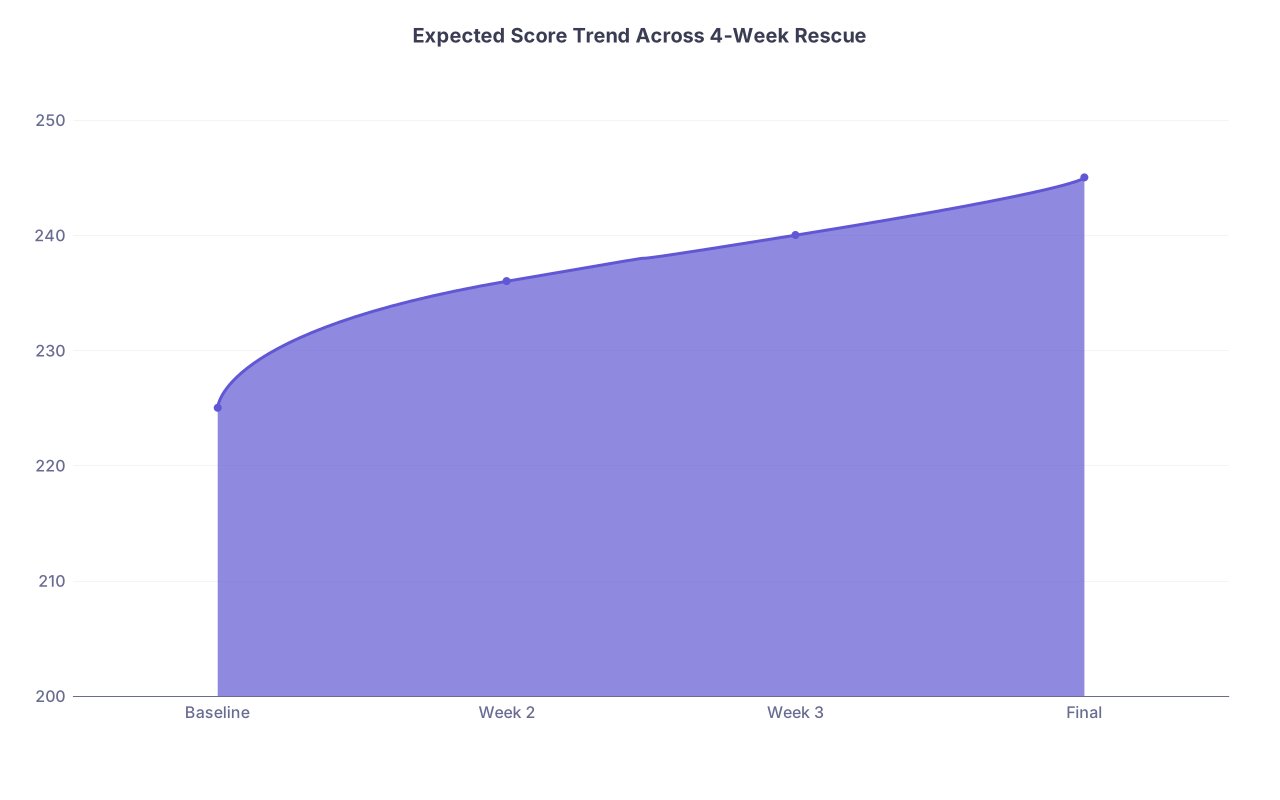
Will everyone get exactly this bump? Of course not. But this is the shape you are chasing: clear, data-backed improvement, not random hope.
The Bottom Line
You are not stuck because you are “bad at tests.” You are stuck because your system is sloppy, passive, or both. Fixable problems.
Three key points to remember:
- Change the process first, not the resource. Standardized question protocol, timed blocks, and aggressive review move scores. New videos do not.
- Force your learning into a system. Every missed question becomes a card, a note, or an algorithm. No more “I’ll remember that” lies.
- Train like an athlete, not a crammer. Full and partial simulations, strict timing, and controlled pre-exam days protect you from brain-melt on test day.
You have four weeks. Use them like someone who expects their score to move. Because if you follow this protocol, it will.