
The biggest mistake people make with Step 2 CK prep is starting with the wrong Qbank.
You don’t start with UWorld. You finish with UWorld.
If you remember nothing else from this article, remember this:
Use Amboss (or a second-tier qbank) to learn. Use UWorld to sharpen and predict your score.
Let me break it down properly.
The Short Answer: Start With Amboss, Then Move to UWorld
If you’re early in your dedicated or still on rotations and asking, “Which Step 2 CK Qbank should I start with first?” the answer is:
Start with: Amboss
Then move to: UWorld as your “exam simulation” and score predictor.
If you don’t have Amboss and can only afford one Qbank, then yes, pick UWorld. But if you have access to both, starting Step 2 CK studying directly with UWorld is a bad strategy for most students.
Why?
Because UWorld is best used when:
- Your knowledge foundation is decent
- You’ve seen most of the core internal medicine/peds/OB/psych/surg once
- You’re ready to train test-taking, not just flail around trying to remember basic guidelines
Amboss, on the other hand, is perfect when:
- You still feel rusty on rotations
- You need in-question explanations and quick article lookups
- You want to build a framework for each subject without getting demoralized by UWorld difficulty curves
So the order that works for most people:
- Phase 1 (Foundation / Early Prep): Amboss (or similar)
- Phase 2 (Dedicated / Final 6–8 weeks): UWorld as your primary Qbank
- Phase 3 (Final 1–2 weeks): UWorld incorrects + NBME-style review
Let’s walk through this like adults instead of pretending all Qbanks are created equal.
What Each Step 2 CK Qbank Is Actually Good For
Here’s the truth nobody on Reddit explains clearly: Qbanks have different jobs. If you use them wrong, you waste time and wreck your confidence.
| Qbank | Best Use | When to Use First | Style vs Real Exam |
|---|---|---|---|
| UWorld | Exam simulation | No | Closest |
| Amboss | Learning + review | Yes | Slightly harder |
| Kaplan | Content building | Optional | More wordy |
| OnlineMedEd Qbank | Reinforcement | Early rotations | Simpler |
| NBME Forms | Assessment only | Never first | Actual style |
UWorld Step 2 CK
Use UWorld like this:
- As your primary dedicated-period Qbank
- To calibrate how you think under timed pressure
- To see how you’d likely perform on the real exam
Pros:
- Closest to real exam style and difficulty
- Excellent explanations & diagrams
- Great for pattern recognition and “USMLE logic”
Cons:
- Painful if you’re not ready; you’ll score 40–50% and panic
- Easy to burn through too early and have nothing “fresh” for dedicated
- Not built as an encyclopedia; it assumes baseline knowledge
UWorld is like your last 6–8 weeks coach. Not your first-year teacher.
Amboss Step 2 CK
Amboss is the right Qbank to start with if you have it.
Pros:
- Strong integration of questions + articles + charts
- Good for learning and reviewing on the fly
- Nice for on-rotation quick lookup and Step-style thinking
- You can learn from the questions without feeling like you’re getting hit by a truck
Cons:
- Slightly more “clinical guideline heavy” and can feel pickier
- Not as predictive of final score as UWorld
- Interface and question style are a touch less like the real deal
Amboss is where you build your base:
“How do I think through chest pain? Headache? Vaginal bleeding? Pediatric fever? Post-op complications?”
That’s the level you want dialed in before you go near UWorld in a serious way.
When To Start Which Qbank: A Practical Timeline
Here’s what a sane Step 2 CK prep sequence looks like for most med students.
Big Picture Flow

| Step | Description |
|---|---|
| Step 1 | Start Clinical Rotations |
| Step 2 | Light Amboss Usage |
| Step 3 | Dedicated Prep Starts |
| Step 4 | Finish Amboss / Core Topics |
| Step 5 | Start UWorld Timed Blocks |
| Step 6 | NBME Practice Exams |
| Step 7 | UWorld Incorrects + Weak Topics |
| Step 8 | Step 2 CK Exam |
Phase 1: On Rotations (3–9 months before exam)
Goal here: build clinical reasoning and basic guideline knowledge.
Best moves:
- Use Amboss as your main Qbank
- Do 10–20 questions/day on the rotation relevant to your current block
- Use “learning” or “tutor” mode here; slow and thoughtful is fine
- Read the associated Amboss articles on topics you constantly miss
During IM: hypertensive emergencies, DKA vs HHS, COPD exacerbations, pneumonia, GI bleed management.
During OB: prenatal care, hypertensive disorders of pregnancy, fetal heart tracing basics.
You get the idea.
Phase 2: Early Dedicated (8–10 weeks out)
This is where things shift.
If you’ve done a decent amount of Amboss:
- Try to finish or mostly finish Amboss first on weaker areas (peds, psych, OB, surgery)
- Start lightly introducing UWorld blocks, but don’t go full send yet
- Example: 1 UWorld block/day, 1 Amboss block/day
If you didn’t use Amboss earlier, you’ve got two realistic options:
You only have budget/time for one Qbank:
→ Go straight to UWorld, suck it up, and use it for both learning and assessment.You have access to both and 8+ weeks:
→ Spend 2–3 weeks hitting Amboss hard for weaker subjects, then transition into UWorld.
Phase 3: Main Dedicated (Last 6–8 Weeks)
Now UWorld becomes king.
This is where you:
- Switch primarily to UWorld, timed, random, test mode
- Aim to finish 100% of UWorld at least once
- Review explanations carefully, write down patterns, not paragraphs
You can still use Amboss here but in a targeted way:
- Look up articles for topics that keep burning you on UWorld
- Do small Amboss blocks for very weak domains (e.g., biostatistics, ethics)
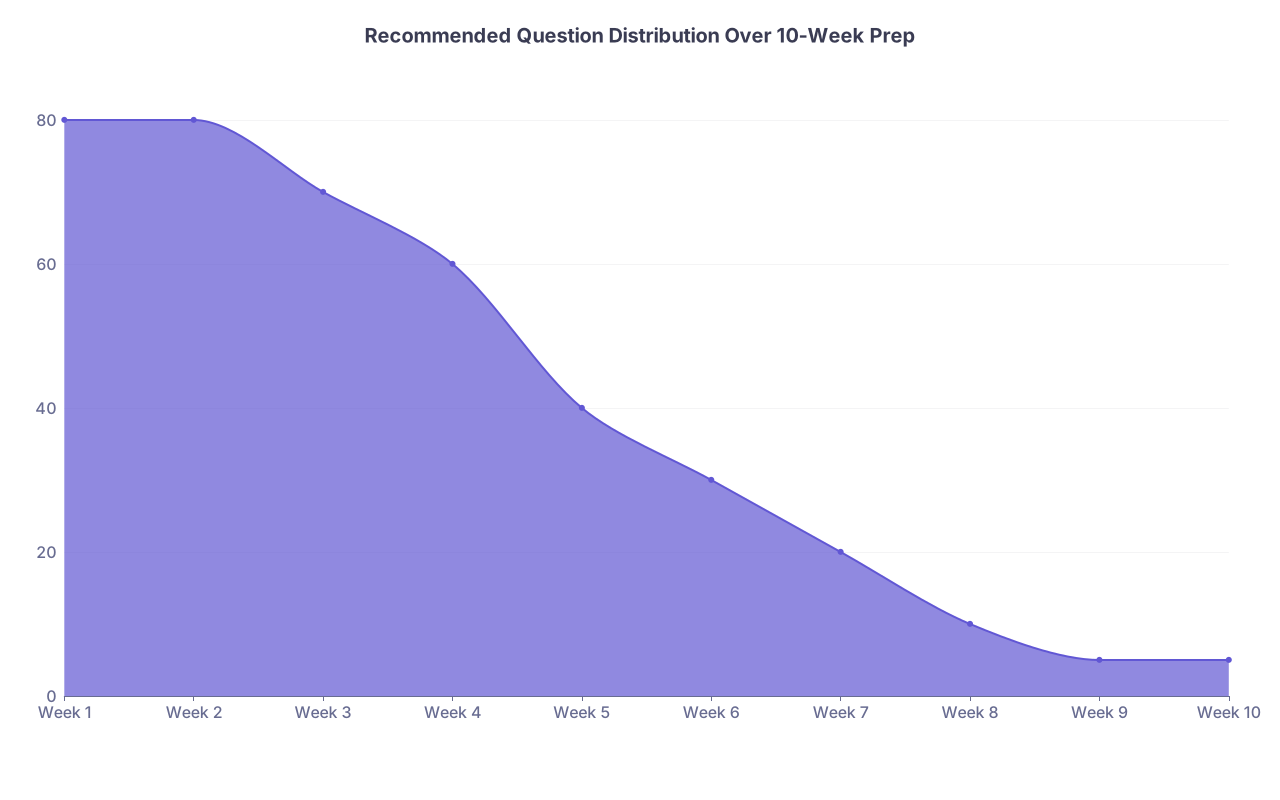
| Category | Value |
|---|---|
| Week 1 | 80 |
| Week 2 | 80 |
| Week 3 | 70 |
| Week 4 | 60 |
| Week 5 | 40 |
| Week 6 | 30 |
| Week 7 | 20 |
| Week 8 | 10 |
| Week 9 | 5 |
| Week 10 | 5 |
Interpretation: early weeks = more Amboss (learning), later weeks = more UWorld (testing). Numbers are “% of Qbank questions that are Amboss,” not raw question counts.
Phase 4: Final 1–2 Weeks
This is clean-up and confidence time.
Main priorities:
- UWorld incorrects (focus on: repeated misses, classic Step 2 topics)
- NBME question style via practice exams (not a Qbank, but crucial)
- Quick Amboss searches for topics you still can’t explain out loud
This is not the time to start a brand-new Qbank.
What If You Can Only Afford One Qbank?
Then the answer is simple: UWorld.
If you have to choose one Qbank for Step 2 CK, it’s UWorld every time. Even though I don’t think it’s the best starting bank, it’s still the most important one for:
- Score prediction
- True exam-style questions
- Building comfort with weird USMLE phrasing
In that case, here’s how to “fake” the Amboss role without actually having Amboss:
- Use UWorld in tutor mode at first
- Do system-based blocks (e.g., all IM cardiology) for the first 2–3 weeks
- Pause after each question and review WHY the wrong answers are wrong
- Supplement with free resources (e.g., guidelines summaries, OnlineMedEd videos, NBME sample questions)
Then transition to:
- Timed, random UWorld blocks
- Use at least 2 full passes of your incorrects
- Take NBME practice exams to adjust your strategy
How Many Total Questions Should You Aim For?
People obsess over total question counts. The number matters less than how you use them, but ballpark ranges help.
Realistic, not-flex numbers:
- Amboss: 1,000–2,000 questions
- UWorld: Ideally 100% of the Step 2 CK bank (usually ~3,000+ questions)
- Total: ~3,500–5,000 questions across everything
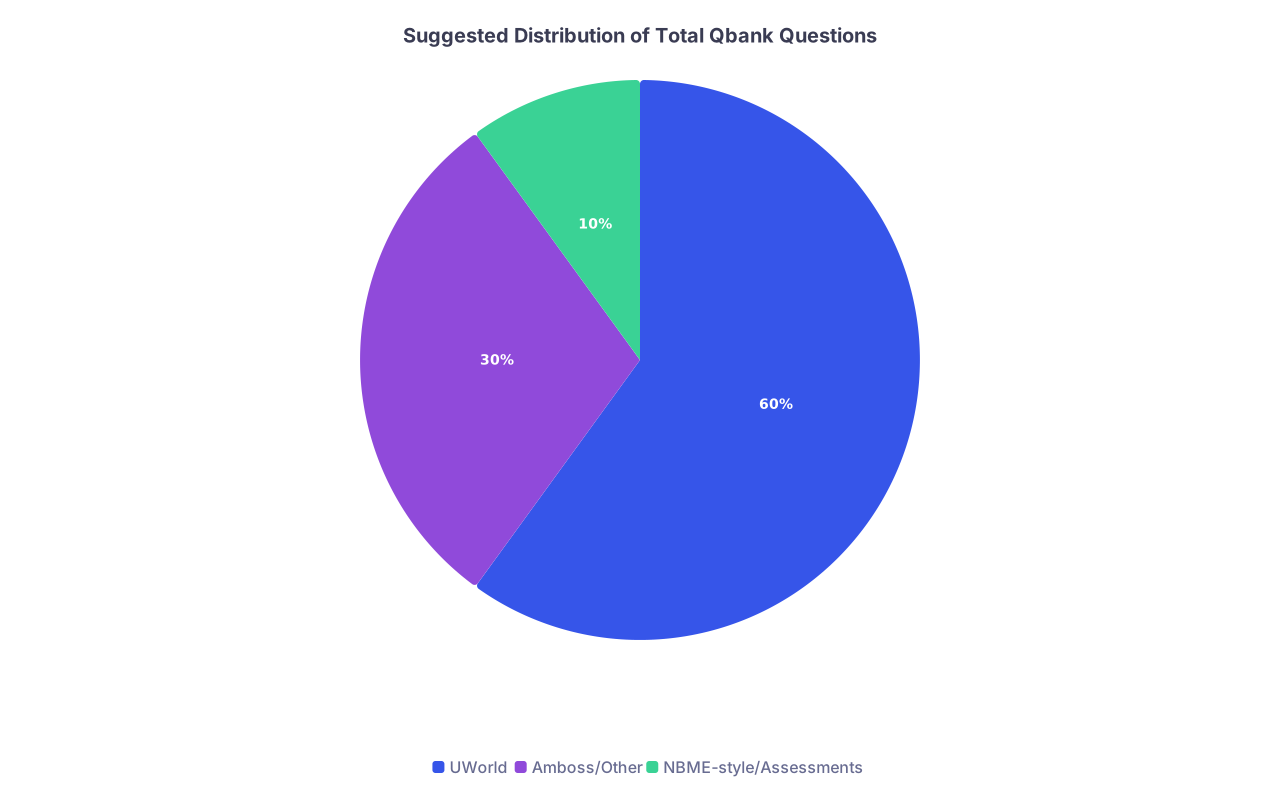
| Category | Value |
|---|---|
| UWorld | 60 |
| Amboss/Other | 30 |
| NBME-style/Assessments | 10 |
Translation:
60% of your Qbank energy should go into UWorld.
30% on Amboss or a similar foundational bank.
10% from practice/NBME-style assessments and review.
If you’re doing 1,500 UWorld and 500 Amboss but actually learning from them, that beats 7,000 mindless questions every time.
Common Bad Strategies (And What To Do Instead)
Let me call out a few patterns I’ve seen tank people’s scores.
1. Burning UWorld Too Early
Scenario: Start UWorld Day 1 of MS3, finish it months before dedicated, then panic because you have nothing “fresh” left.
Better:
Use Amboss on rotations, save UWorld for the 8–10 weeks before your test date so the content and question style are still fresh when it counts.
2. Hoarding UWorld Until the Last Minute
Other extreme: you keep thinking “I’m not ready yet,” and don’t touch UWorld until 3–4 weeks before your exam.
Now you’re rushing, barely reading explanations, and not giving your brain time to adapt.
Better:
- Ramp into UWorld around 8 weeks out
- Hit your stride with 2–3 blocks/day + good review
- Use the last 1–2 weeks for incorrects and consolidation
3. Using 3+ Qbanks and Finishing None
More Qbanks ≠ more points if you’re half-finishing all of them.
Do this instead:
- Pick one learning bank (Amboss / Kaplan / school bank)
- Pick one exam bank (UWorld)
- Do them well. Finish what you start. Review mistakes twice.
How to Decide If You Personally Should Start With Amboss or UWorld
Let’s make it very concrete. Ask yourself:
Did you honor most core rotations and feel solid clinically?
- Yes: You might be able to start with UWorld earlier.
- No / mixed: Start with Amboss first.
How far are you from your exam?
- 3+ months: Start with Amboss, then UWorld around the 8–10 week mark.
- 6–8 weeks: If you’re behind, you may have to start straight with UWorld.
- <6 weeks: UWorld only. No time to split banks.
How did you perform on Step 1 (or shelf exams)?
- Strong pattern-recognition and test-taking skills: You’ll benefit more from earlier UWorld.
- You needed more repetition and content review: Start with Amboss to build that base.
FAQ: Step 2 CK Qbanks
1. Should I do all of Amboss before starting UWorld?
No. That can backfire if it delays UWorld too much. A good balance:
Cover your weakest systems and high-yield topics in Amboss first, then move into UWorld around 8–10 weeks before your exam. You can still dip back into Amboss articles for clarification while you’re deep into UWorld.
2. Is it ever okay to start with UWorld as my first Qbank?
Yes, in two situations:
- You can only afford one Qbank.
- You’re within ~8 weeks of your exam and don’t have time to do a full Amboss run. In that case, start with system-based UWorld blocks in tutor mode to make it more “learning friendly,” then transition to timed random once you’re more comfortable.
3. Are NBME forms a replacement for a Qbank?
Not even close. NBME forms are assessments, not a learning tool. Use them to gauge readiness and adjust, not as your main source of practice questions. You still need a real Qbank (UWorld, Amboss) for reps and feedback.
4. Should I reset UWorld and do a full second pass?
Usually no. A full reset second pass is low-yield for most people. Instead, focus on:
- All your incorrects (1–2 passes)
- Questions you flagged as tricky
- Fresh NBME/assessment material
If you reset, you also lose the data on what you previously missed, which is gold.
5. What if my UWorld percentages are low after starting with Amboss?
That’s normal at first. UWorld is harder, and the style shift catches people off guard. The metric that matters more is: Is your percentage trending up over 3–4 weeks, and are your NBME scores improving? Use your early low scores as a diagnostic: where are you missing patterns, not just facts?
Key Takeaways:
- Start Step 2 CK prep with a learning bank like Amboss, then transition to UWorld as your primary exam-simulation Qbank.
- Don’t burn UWorld too early or hoard it too long—aim to live in UWorld for the final 6–8 weeks before your exam.
- One foundational Qbank + one primary Qbank, done well and reviewed properly, beats juggling three half-finished banks every time.