
One bad shelf exam does not ruin your Step 2 CK. The fear around this is louder than the evidence.
Let me be blunt. The culture of medicine has trained you to catastrophize every data point: one low quiz means you’re dumb, one pass on Step 1 means no derm, one 220 on Step 2 means fellowship is over. The same hysterical thinking gets applied to shelf exams. I have watched otherwise strong students spiral because of one 15th percentile surgery shelf like it was a terminal diagnosis.
It is not.
What Shelf Exams Actually Measure (And What They Don’t)
Shelf exams are standardized subject exams created by NBME. Same company that helps build Step 2 CK. That’s where the myth starts: “If I bombed OB/GYN shelf, I’m doomed for OB/GYN questions on Step 2.”
Reality is less dramatic.
Shelves measure three things reasonably well:
- How much subject-specific content you retained at that moment
- How comfortable you are with NBME-style questions
- How much you were willing or able to study during that rotation
They do not measure:
- Your overall test-taking ceiling
- Your ability to recover and build over time
- What a dedicated 6–8 week Step 2 CK push will do to your knowledge base
- Your general medicine foundation across systems
And the scoring environment is noisy. Rotation schedules, malignant services, call racks, preceptor personalities, and sheer fatigue can wreck a shelf far more than your actual ability.
I’ve seen students score:
- 40th percentile on surgery shelf
- 60th on medicine
- 25th on OB
- …and then walk into Step 2 CK and hit 245–255.
Not “exceptional unicorns.” Just people who didn’t confuse one rough data point with their destiny.
What the Data Actually Says About Shelves and Step 2 CK
Let’s talk correlation rather than vibes.
Studies from multiple med schools have looked at this: aggregate NBME subject exam performance is modestly correlated with Step 2 CK scores. Correlation coefficients often land around 0.5–0.7 when you use average shelf score or cumulative score across multiple rotations.
Translation in normal-human language:
Better shelf performance overall tends to go with better Step 2 CK performance. No surprise there. More studying, better fundamentals, better test comfort → better on everything.
But note the key word: overall.
One low shelf is statistical noise. The correlation gets useful only when you’re looking at patterns:
- Three or four shelves consistently low → that’s a signal
- Mixed performance with one true outlier → that’s life
Here’s the rough pattern I’ve seen, and it fits the published data:
| Shelf Pattern | Typical Step 2 CK Range | Interpretation |
|---|---|---|
| All shelves ≥75th percentile | 250–265+ | High ceiling, strong base |
| Mixed shelves, mostly 50–75th, 1–2 low | 235–255 | Good base, fix weak areas |
| Consistently 25–50th percentile | 220–240 | Solid, needs tuning |
| Multiple shelves <25th percentile | <225–235 | Systemic gap, but workable |
Notice what’s not in that table: “One 10th percentile psych shelf → automatic 220.” Because that pattern simply does not exist in any reproducible way.
Also: Step 2 CK is more internal medicine-heavy than any single shelf. A disaster in a niche-heavy rotation (surgery with weird rare topics, psych with esoterica) doesn’t dominate your total Step 2 experience the way med knowledge does.
The Psychological Damage of a Single Low Score
This part is more dangerous than the actual number.
I’ve watched this sequence play out over and over:
- Student gets one low shelf (say 15th percentile in OB/GYN).
- Immediate narrative: “I am bad at OB. I am bad at standardized tests. Step 2 will crush me.”
- Next rotation, they over-study that one prior weak area to “prove” themselves and neglect others.
- Their global prep becomes fear-driven rather than strategic.
- Practice NBMEs for Step 2 are clouded by anxiety, not knowledge gaps.
The low shelf itself isn’t the problem. The story you attach to it is.
The honest way to treat a bad shelf is almost boring:
- What type of questions did I miss?
- Was I underprepared or just overwhelmed that month?
- Is this a conceptual gap (e.g., fluid/electrolyte, OB triage) or time/stress issue?
You’re a scientist. Act like one about your own performance. One data point ≠ theory of everything.
How Much Does a Single Bad Shelf Predict Your Ceiling?
Let’s be clinical.
If I’m sitting with a student and they show me their shelves:
- IM: 70th percentile
- Surgery: 55th
- Peds: 60th
- OB: 10th
- Psych: 45th
I do not say, “You’re doomed.” I say, “You were tired, unlucky, or underprepared on OB. The trend still tells me you’re roughly a 230–245 Step 2 candidate before dedicated studying. Above average foundation.”
The mistake is anchoring your self-assessment to the one ugly number instead of the median of your scores.
Here’s another way to visualize the gap between fear and reality:
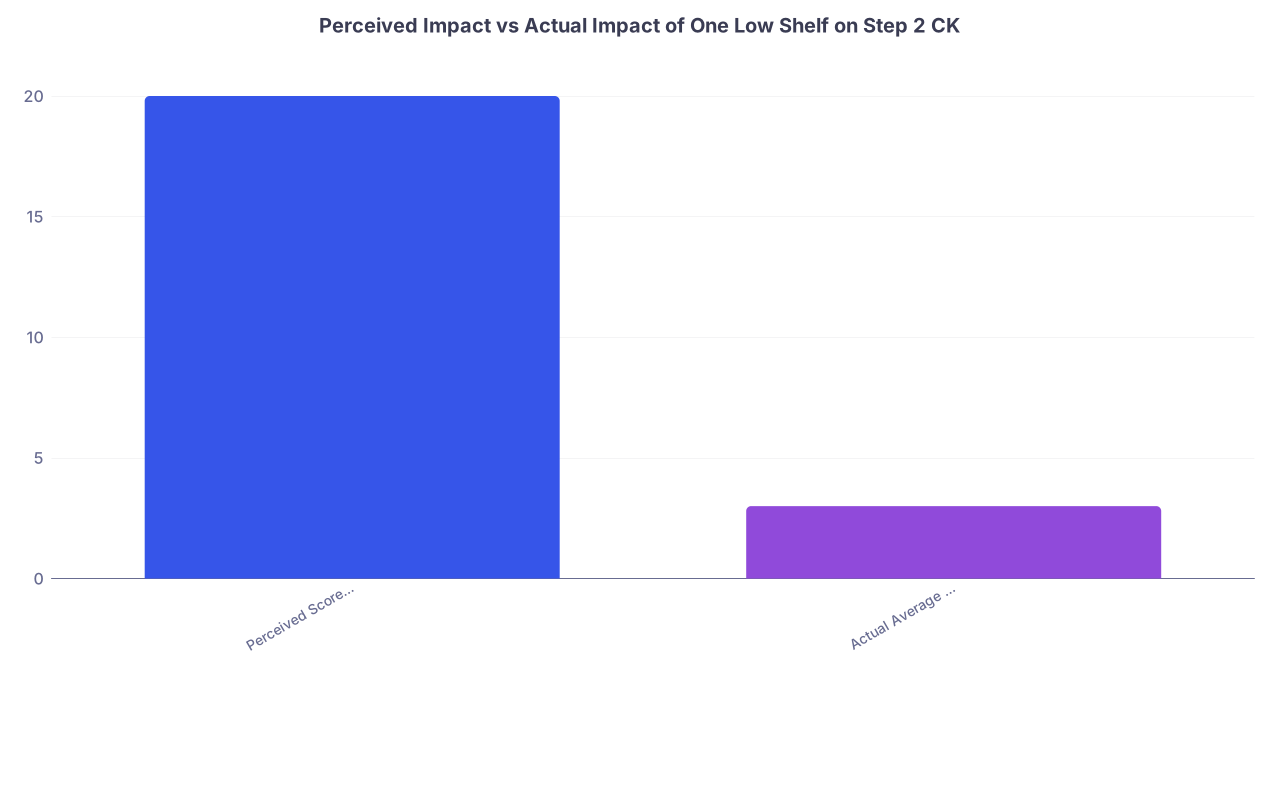
| Category | Value |
|---|---|
| Perceived Score Drop | 20 |
| Actual Average Drop | 3 |
When students talk, they act like one low shelf will drop their Step 2 CK by 15–20 points. In practice, if you correct the underlying weaknesses, the “penalty” is close to zero. Maybe a few points if you never touch that content again. That’s it.
The key phrase there: if you correct the underlying weaknesses. The bad shelf is just a highlighter telling you where to look.
When a Low Shelf Does Matter for Step 2 CK
There are a few situations where a bad shelf is not harmless. You need to know which category you’re in.
1. It’s Not an Outlier – It’s the Pattern
If your “one low shelf” is actually the third exam below the 25th percentile, that’s not a fluke. That’s a trend.
- IM: 20th
- Surgery: 30th
- Peds: 22nd
- OB: 18th
Now we’re not talking about doom. We’re talking about a foundation that needs more than polishing. This is the student who can still do well on Step 2 CK, but they cannot coast into it. They need a plan.
2. The Content Area Is Core to Step 2 CK
A low psychiatry shelf? Annoying, but fixable. You can brute-force psych content in a few weeks.
A truly low internal medicine shelf? That deserves attention. IM is the backbone of Step 2 CK. So is anything heavily medicine-adjacent: cards, renal, ID.
If your only low shelf was:
- IM below 20th while everything else was 50–75th,
then I care more. Not because you’re doomed, but because Step 2 CK will double down on those topics.
The good news: core medicine content is the easiest to reinforce with Question Bank exposure and NBMEs. You’ll see it repeatedly.
3. Low Shelf + Weak Practice NBMEs + No Dedicated Time
One bad shelf plus mediocre NBMEs plus minimal dedicated = problem. But that’s not the shelf’s fault. That’s just three weak inputs.
The shelf in this case is just early evidence of an overall trajectory. Fix the trajectory, not the shelf.
How to Use a Low Shelf Score to Your Advantage
Here’s where you stop making the shelf a boogeyman and start using it like data.
First, break down the poor performance. Not “I suck at OB.” That’s not granular enough to be useful.
Look at your score report (or reconstruct from memory if your school is stingy) by content bucket:
- OB triage & management
- Prenatal care
- High-risk pregnancy
- Gynecologic oncology
- Benign GYN
- Reproductive endocrinology/infertility
Usually the carnage is not uniform. More often, it’s something like:
- Missed almost every triage admit/discharge decision
- Guessed on all the cancer staging and treatment questions
- Confused when to do C-section vs induction vs expectant management
Now that’s actionable. You don’t need to fear OB; you need to understand algorithms.
Rotate that logic to any shelf. For each low exam, ask:
- Was I underprepared because of the rotation (call, burnout, personal crisis)?
- Was my issue test stamina or content?
- Which 2–3 content domains were truly weak?
Then your Step 2 CK plan isn’t “relearn OB.” It’s:
- Do 100–150 NBME-style questions in that subject from UWorld or AMBOSS, tagged by weakness
- Make a 1–2 page “triage + pregnancy complications” sheet
- Revisit those notes 3 times in the 2 weeks before your exam
That’s maybe 5–10 hours of focused work. In return, you erase the shelf’s predictive power over that about-to-be-weak area.
Step 2 CK Is a Cumulative Exam, Not a Shelf Compilation
Here’s a myth that quietly fuels all this panic: “Step 2 CK is just all the shelves smashed together.”
No. It is not a Frankenstein of your worst rotation moments.
Step 2 CK:
- Is more medicine-heavy than any one shelf
- Integrates multi-system thinking (renal failure affecting dosing in surgery patients, psych meds complicated by pregnancy, etc.)
- Rewards pattern recognition and rapid triage more than obscure facts from your surgery call nights
Shelves are snapshots with narrow lenses. Step 2 CK is a panoramic shot of your entire clinical reasoning skillset.
I’ve seen students with:
- Decent shelves across the board but terrible Step 2 because they never learned how to think across systems, just memorize per-rotation
- Rocky shelves but strong Step 2 because they finally had a focused window to build integrated understanding after the chaos of clinical year
Your trajectory during dedicated Step 2 prep matters more than one month of chaos from your OB or surgery rotation.
Here’s what that typically looks like when it goes right:

| Step | Description |
|---|---|
| Step 1 | Low Shelf Score |
| Step 2 | Gap Analysis by Content Area |
| Step 3 | Targeted Question Blocks on Weak Topics |
| Step 4 | First NBME Practice Exam |
| Step 5 | Reinforce Strengths & Maintain Pace |
| Step 6 | Adjust Study Plan & Increase Focused Review |
| Step 7 | Final Weeks: Mixed Blocks & Timed Review |
| Step 8 | Step 2 CK Exam Day |
| Step 9 | Score Above Baseline? |
Notice: the shelf is just the starting node. Everything that follows determines the real outcome.
The Real Red Flag Isn’t One Low Shelf
Let me tell you what I actually worry about more than a 10th percentile shelf:
- Student refuses to look at their score breakdown (“It’s too depressing”)
- They respond to the low shelf by doing less NBME-style practice (“I just need to read more BRS/FA/online notes”)
- They avoid timed blocks because “they make me feel dumb”
- They cling to the idea that they’re “just bad at standardized tests” and stop experimenting with strategies
That mindset will hurt your Step 2 CK far more than a single ugly bar on your performance dashboard.
The students who win this game do something different. They say:
“That shelf sucked. But it’s the clearest map I’ve got of where I’m weak. I’m going to weaponize it.”
And then they do.
A Practical Way to Interpret Your Shelves for Step 2 CK
If you want a simple rule set, here it is.
Look at all your shelf scores and ask:
- What’s my median percentile? That’s your true baseline, not your worst score.
- Do I have ≥3 shelves below the 25th percentile? That suggests a global issue.
- Is my internal medicine shelf significantly lower than the others? That raises the priority for that content in your Step 2 prep.
Then convert that into a plan:
| Shelf Profile | Step 2 CK Strategy Focus |
|---|---|
| Mostly 60–80th, one <20th | Target that subject for 5–10 focused hours |
| Mixed 30–70th, no true outliers | Global UWorld + 2–3 NBMEs |
| Several <25th + weak IM | Extra IM questions + longer dedicated time |
| Strong shelves but poor timed blocks | Work on speed, endurance, and test strategy |
You’ll notice “panic about one score and consider delaying graduation” doesn’t appear. Because it usually shouldn’t.
So, Are You Doomed?
No. A single low shelf does not doom your Step 2 CK. It does not write your score. It does not automatically lock you out of competitive scores or specialties.
What it does do—if you’re willing to be a grown-up about it—is give you one of the few honest diagnostic signals you get before the real thing.
You can weaponize that or worship it. Those are your options.
Years from now, you won’t remember the raw percentile from your worst shelf. You’ll remember whether you let that one bad number shrink your ambition—or used it as kindling for the fire that carried you through Step 2 CK.