
It is 9:15 p.m. You are on your third UWorld block of the day. Your eyes are burning, your coffee is cold, and you just missed another question that “should have been easy.” Not on some rare vasculitis. Not on an obscure enzyme deficiency. On postpartum contraception. Or aspirin use in pregnancy. Or which imaging test to order next.
You scroll through the explanation and feel that familiar sting: “I have literally seen this ten times. Why am I still missing it?”
Here is the uncomfortable truth: most students do not fail Step 2 CK because of exotic diseases. They bleed points on the boring, everyday medicine baked into question blocks. The stuff everyone assumes they “know,” so they never formally study. That is the mistake that quietly wrecks otherwise solid scores.
Let me walk you through the high‑yield topics Step 2 loves that students routinely neglect inside question blocks—and how to stop handing away points.
1. Guidelines and “Next Best Step” You Keep Half-Remembering
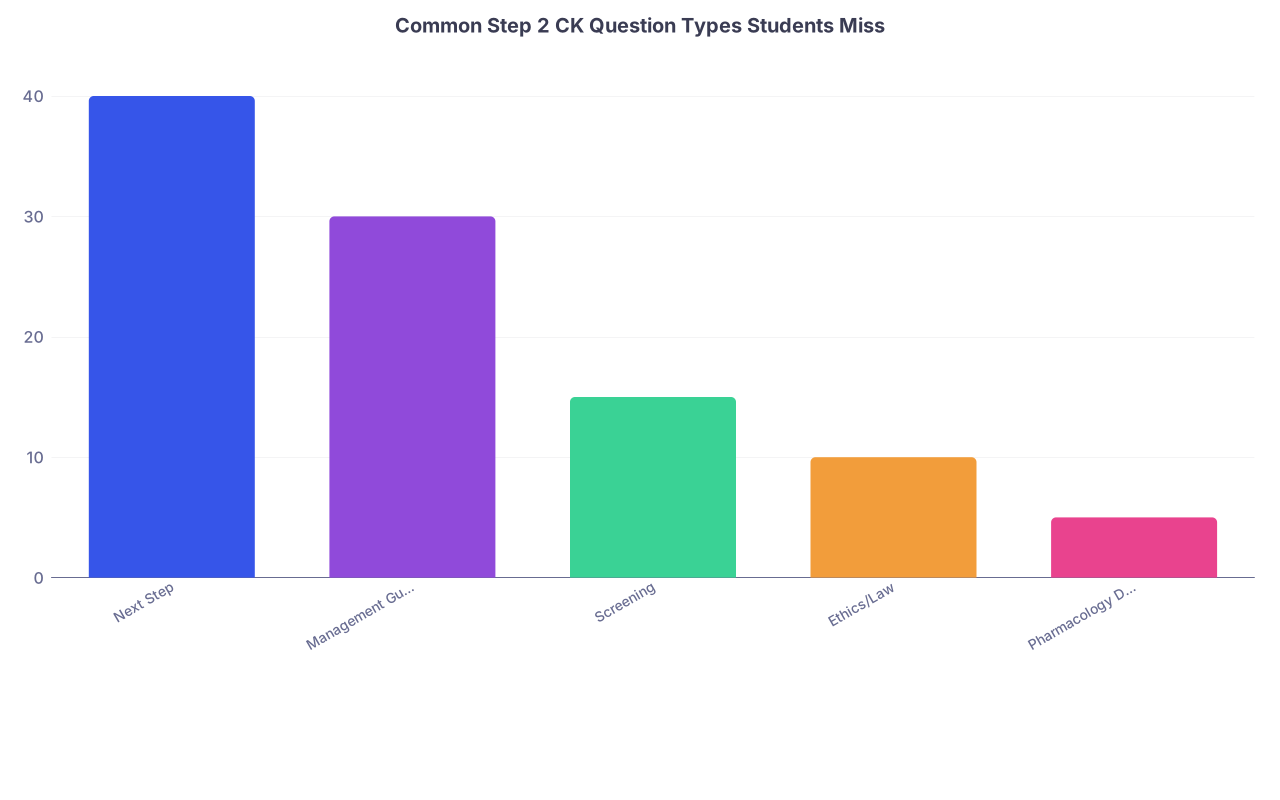
| Category | Value |
|---|---|
| Next Step | 40 |
| Management Guidelines | 30 |
| Screening | 15 |
| Ethics/Law | 10 |
| Pharmacology Details | 5 |
You have seen this scenario:
A 52-year-old with atypical chest pain, normal EKG, slightly elevated troponin, hemodynamically stable. You vaguely recall something about TIMI scores, stress tests, early invasive vs conservative strategy. You click what “feels right.”
And you get it wrong. Again.
The mistake: treating guideline-based questions like common sense instead of defined, testable algorithms.
Step 2 CK is obsessed with:
- ACS management sequences (MONA is not the answer)
- Stroke timelines (thrombolysis vs thrombectomy windows)
- VTE workup and treatment (D-dimer vs imaging vs anticoagulation)
- Diabetes management algorithms (A1c-based therapy escalation)
- Hypertension thresholds and drug choices by comorbidities
- Heart failure staging and treatment steps (ACEi/ARB/ARNI, beta-blocker, MRA, SGLT2)
Students skim these in review books and then “hope pattern recognition will kick in.” It does not. The exam punishes fuzzy recall.
What you are likely doing wrong on blocks:
- Rushing past management tables in explanations.
- Saying “yeah, yeah, I know how to treat NSTEMI” without forcing yourself to articulate:
- Step 1: immediate stabilization
- Step 2: antiplatelet/anticoagulant strategy
- Step 3: early invasive vs noninvasive risk-based decisions
- Not memorizing time cutoffs (tPA window, colonoscopy intervals, postpartum hemorrhage escalation).
How to fix it:
During question blocks:
- Every time you miss or guess a “next best step” question, write the algorithm. Literally.
- Convert it into a simplified decision tree on paper:
- “If hemodynamically unstable → do this”
- “If symptoms > 4.5 hours → no tPA, consider thrombectomy if large vessel”
- Revisit these trees weekly. Not someday. Weekly.
This feels tedious. It is also exactly what separates a 230 from a 255+ on Step 2 CK.
2. Boring but Lethal: Preventive Care, Screening, and Vaccines

If there is one category where I see strong students hemorrhage points, it is preventive medicine. Because it feels non-clinical. Not glamorous. Not “real” doctor work.
On Step 2 CK, that mindset is a score killer.
Commonly overlooked subtopics:
- Exact age ranges and intervals for:
- Mammograms
- Pap/HPV co-testing
- Colon cancer screening (including when to stop)
- Lung cancer screening with low-dose CT
- Primary vs secondary vs tertiary prevention examples in clinical vignettes.
- Adult vaccine schedules:
- Pneumococcal vaccines (PCV13 vs PPSV23) by disease and age
- Tdap vs Td boosters
- When to give zoster, when not to
- Post-splenectomy vaccines and timing
- Post-exposure prophylaxis (PEP):
- HIV needle-stick protocols
- Rabies exposures based on animal and vaccination status
- Hepatitis B exposure based on HBsAg/HBsAb status of both source and patient
Students commonly think, “I’ll memorize the tables the week before the exam.” That is the error. These topics live inside question blocks right now. You are already missing them while telling yourself you will fix it later.
On blocks, the typical mistakes:
- Choosing “reassurance” instead of appropriate screening.
- Under-screening older adults because “they are old, leave them alone.”
- Over-screening when the patient’s life expectancy is limited.
- Forgetting the exact criteria for lung cancer screening (age, pack-years, quit timeline).
Stop this pattern:
- When you see a screening or vaccine question:
- Do not just read the explanation. Rebuild the table in a notebook from memory.
- Mark each table as:
- “Fluent” (can write it cold)
- “Shaky” (need prompt)
- Prioritize shaky tables for 5-minute daily drills. Yes, five minutes. Daily. That is how you avoid missing a free 10–15 questions on test day.
3. OB/GYN: The Land of Repeated, Avoidable Errors
| Topic Area | Typical Missed Detail |
|---|---|
| Fetal monitoring | Variable vs late decels |
| Induction decisions | Bishop score implications |
| Preeclampsia spectrum | Severe features cutoffs |
| Contraception | Postpartum timing/contraindications |
| Early pregnancy | Ectopic vs normal vs miscarriage workup |
OB/GYN on Step 2 is not random. It is a tight cluster of recurring situations, and students routinely under-prepare them because they “never liked OB” or “that rotation was months ago.”
Let me list the recurrent disasters:
Fetal heart rate tracings
Students look at an FHR description, see a few words (“late decelerations,” “minimal variability”), and click something that sounds like “do something.” They forget the basic pattern:- Variable decels → cord compression → change maternal position, amnioinfusion if persistent.
- Late decels → uteroplacental insufficiency → intrauterine resuscitation, consider delivery if recurrent and unresponsive.
- Prolonged decel / bradycardia with non-reassuring pattern → urgent C-section.
The key mistake: not having a fixed, memorized response for each pattern.
Hypertensive disorders of pregnancy
Students confuse:- Gestational HTN
- Preeclampsia without severe features
- Preeclampsia with severe features
- Eclampsia
- Chronic HTN with superimposed preeclampsia
And then they blow the management:
- When to deliver (≥37 weeks vs earlier with severe features)
- When to start MgSO₄
- Which antihypertensives are appropriate in pregnancy.
Postpartum contraception
Quietly tested. Quietly butchered.- Estrogen-containing methods contraindicated immediately postpartum (VTE risk), especially if breastfeeding.
- Progestin-only methods are fine and can often be started immediately.
- IUD timing: when it is safe after delivery, post-abortion, after STI treatment.
Early pregnancy bleeding
Students half-remember beta-hCG discriminatory zones and ultrasound findings. They forget:- When to suspect ectopic even if ultrasound is “indeterminate.”
- How frequently to repeat beta-hCG.
- When to give methotrexate vs when surgical management is required.
On your question blocks:
If you are “gut feeling” more than 20–30% of OB/GYN questions, you are neglecting a high-yield chunk of points.
Fix it by building one-page sheets for:
- Hypertensive disorders of pregnancy (definitions/management).
- FHR patterns → specific escalation.
- Postpartum contraception timing by method.
- Ectopic pregnancy algorithm (hCG + TVUS + symptoms).
You should not be improvising OB/GYN. You should be pattern-matching to memorized algorithms.
4. Behavioral, Ethics, and “Soft” Questions That Are Not Actually Soft

| Step | Description |
|---|---|
| Step 1 | Clinical Scenario |
| Step 2 | Respect decision |
| Step 3 | Identify surrogate |
| Step 4 | Follow directive |
| Step 5 | Best interest standard |
| Step 6 | Adult has capacity? |
| Step 7 | Advance directive? |
Plenty of smart students roll their eyes at ethics and behavioral science questions. They assume they are obvious. Then they get blindsided.
Common traps:
- Capacity vs competence
Mixing them up and ignoring the actual capacity criteria in the vignette. - Refusing life-saving treatment in a capacitated adult → you must respect it, even if you disagree.
- Minors:
- When they can consent alone (STIs, contraception, pregnancy care, substance use) vs when they cannot.
- When parents refuse life-saving care for a child.
- Confidentiality:
- What you can share with family.
- When you break confidentiality (suicidality, homicide risk, abuse).
- Difficult interactions:
- Drug-seeking behavior.
- “Doctor-shopping.”
- Nonadherence and frustrated families.
The mistake: students rely on vague personal ethics instead of learning what the test considers correct medical-legal behavior.
You really do not have the luxury of winging these.
On your current blocks, warning signs:
- You frequently narrow it to two ethics answers and then pick the “nicer” sounding one instead of the legally correct one.
- You miss questions about parental refusals of vaccines, blood transfusions, or surgery.
- You mis-handle requests for undisclosed diagnoses (e.g., family asks you not to tell the patient about cancer).
You need to:
- Write out simple rules:
- “If adult has capacity → respect decision.”
- “If minor needs life-saving care and parents refuse → treat, then involve courts.”
- “Confidentiality can be broken when X, Y, Z.”
- Practice these consciously on questions. Do not shrug off ethics misses. Each one is low-hanging fruit you chose not to pick.
5. Bread-and-Butter Inpatient Medicine Nobody Studies Properly

Students love rare diseases. They will memorize every feature of Goodpasture or Lambert-Eaton, then miss a straightforward question on:
- DKA vs HHS management (insulin, fluids, electrolytes, when to add dextrose).
- Sepsis bundles (fluids, antibiotics timing, vasopressor choice).
- Upper vs lower GI bleed approach (resuscitation, PPI, octreotide, endoscopy timing).
- AKI vs CKD management and basic fluid/electrolyte decisions.
The exam is not impressed by your knowledge of zebra syndromes if you keep missing:
- When to give IV vs oral antibiotics.
- When to admit vs discharge.
- Initial orders for common conditions (pneumonia, cellulitis, pyelonephritis, COPD exacerbation).
Patterns I see repeatedly:
- Student nails rare autoimmune disease.
Same student botches the management of an uncomplicated NSTEMI because they cannot recall when to start heparin, beta-blockers, or high-intensity statin. - Student recognizes pancreatitis but forgets:
- NPO, aggressive fluids, pain control.
- When to do ERCP (gallstone pancreatitis with cholangitis or worsening obstruction).
These are “question-block killers” because they come up constantly, and the exam expects automatic, protocol-level thinking.
On your next few blocks, watch for:
- How many questions you get wrong that start with routine admissions: fever, hypotension, abdominal pain, dyspnea.
- Whether you can immediately list first 3–5 orders for:
- DKA
- Sepsis
- Acute GI bleed
- COPD exacerbation
- Decompensated CHF
If you cannot write those sequences cold, you have a gap that UWorld alone will not patch unless you deliberately extract and memorize management steps.
6. “Details That Don’t Matter” in Pharm and Micro… That Actually Matter
Some of you have quietly decided that Step 2 will not care about drug mechanisms, side effects, or micro minutiae as much as Step 1.
That assumption is how you miss questions about:
- Antibiotic selection:
- Knowing which drug covers Pseudomonas in a neutropenic fever.
- Choosing the right UTI treatment in pregnancy vs non-pregnant.
- Avoiding fluoroquinolones in certain age groups / tendon issues.
- Drug side effects with management:
- Clozapine and agranulocytosis monitoring.
- Lithium and kidney/thyroid function.
- Amiodarone and lung/thyroid toxicity.
- TB treatment tweaks:
- Latent vs active TB regimens.
- HIV coinfection nuances.
- Perioperative medication management:
- Which medications to stop before surgery (e.g., SGLT2 inhibitors, certain anticoagulants).
- Which to continue (beta-blockers in chronic use).
The trap: you tell yourself “I know the big picture.” Step 2 will test the small-but-decisive detail.
For example:
- Which antidepressant is best for a patient with insomnia and weight loss?
- Which antihypertensive fits a patient with BPH?
- Which antipsychotic minimizes metabolic effects in an obese patient?
This is targeted pharm, tightly integrated with clinical vignettes. If you skip digging into explanations on these, you are repeating the same blind spot.
7. Logistics, Discharge, and “Systems” Questions That Feel Like Afterthoughts
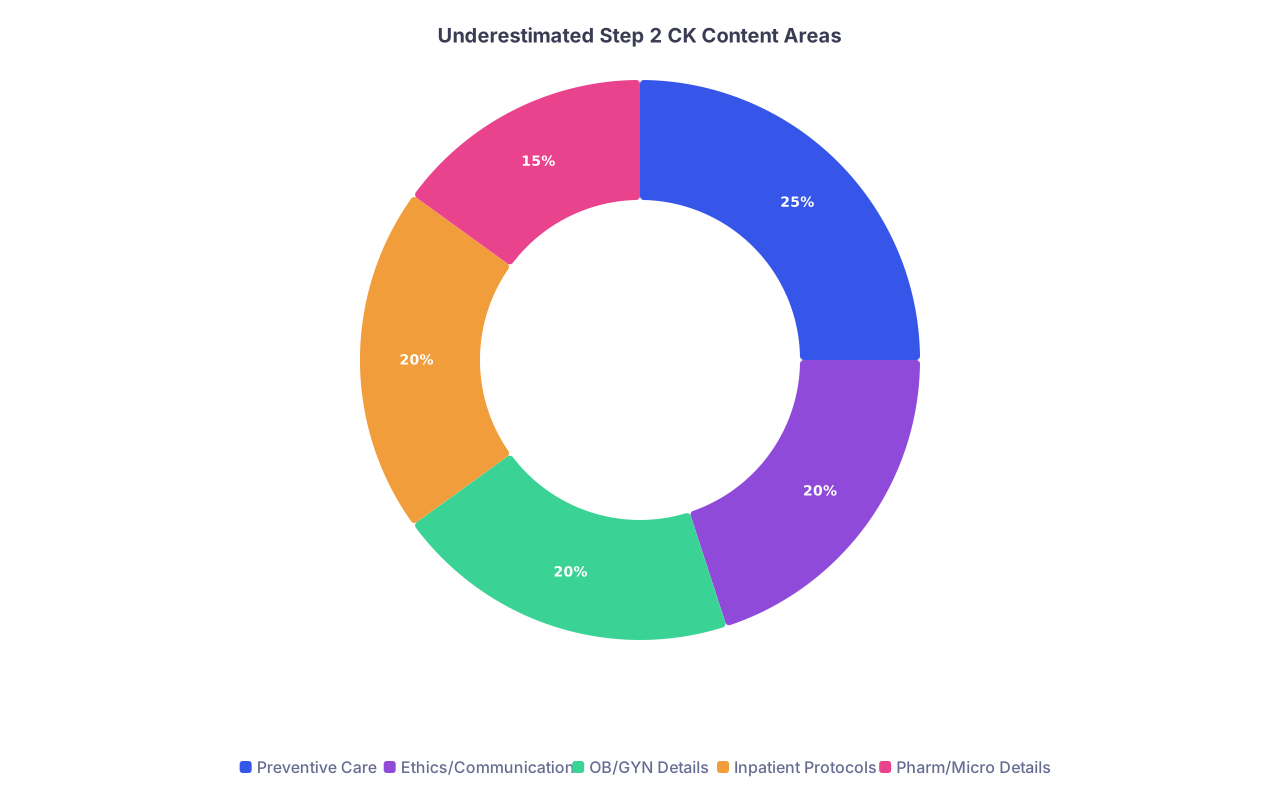
| Category | Value |
|---|---|
| Preventive Care | 25 |
| Ethics/Communication | 20 |
| OB/GYN Details | 20 |
| Inpatient Protocols | 20 |
| Pharm/Micro Details | 15 |
Step 2 is not just disease + treatment. It cares about:
- Discharge planning:
- Who needs home health?
- Who needs rehab vs SNF vs acute rehab?
- What follow-up is appropriate and when?
- Systems-based practice:
- Handoffs.
- Reporting errors.
- Recognizing impaired colleagues.
- Quality & safety:
- Central line precautions.
- Preventing hospital-acquired infections.
- DVT prophylaxis decisions.
Students wave these off as “common sense.” Then choose the answer that sounds most dramatic instead of the one that reflects real-world policies and safety.
You should know, for instance:
- When to file an incident report vs when to just apologize.
- What to do when a surgeon is impaired post-call and wants to operate.
- How to respond if you give the wrong medication dose but the patient is fine (you still report).
These are not trick questions. They are checking if you think like a safe, system-aware physician. If you treat them casually, you lose easy points.
Your Next Step: Fix One Leak Today
Do not try to “fix everything” in one go. That is how people read an article like this, nod, then do nothing.
Pick one blind spot. Just one. Today.
Here is how:
- Open your last 2–3 question blocks (UWorld, AMBOSS, NBME—whatever you are using).
- Make a quick tally:
- How many misses were:
- Preventive/screening/vaccine?
- OB/GYN?
- Ethics/behavioral?
- Guidelines/“next best step”?
- Inpatient protocols (DKA, sepsis, GI bleed, CHF, COPD)?
- How many misses were:
- Circle the category with the highest count.
Then:
- Spend 45–60 minutes today building a one-page cheat sheet for that category:
- If it is screening: write out the full table for mammogram, Pap/HPV, colonoscopy, lung CT, DEXA.
- If it is OB: build your preeclampsia, FHR, and postpartum contraception algorithms.
- If it is ethics: list your rules for capacity, minors, confidentiality, and refusals of care.
- Tape that sheet somewhere you will see it daily. Review it for 3–5 minutes before your next block.
Do not wait until “dedicated.” The mistakes you are making on Step 2 CK question blocks right now are practice for more of the same on test day.
Open your last block’s review tonight and find the first question you got wrong that “should have been easy.” That is your starting point.