
What if failing Step 1 once means every Step 2 CK question is basically deciding whether you ever match?
I know that’s what it feels like. Like you’re walking into this exam with a target on your back and every program director already hates your file and they just don’t know your name yet.
Let me say the scary part out loud so we’re on the same page:
You failed Step 1.
You can’t undo it.
You’re heading toward Step 2 CK, and it feels like your only shot at redemption.
You’re not overreacting. This is a big deal. But it’s not the automatic death sentence your brain is telling you it is.
How Bad Is a Failed Step 1… Really?
Here’s the ugly truth first, because pretending it’s “no big deal” is insulting.
A failed Step 1 attempt:
- Will be seen by every residency program.
- Will hurt you more for competitive specialties (derm, ortho, ENT, plastics, neurosurg, etc.).
- Will raise a red flag that says: “Is this person risky on high‑stakes exams?”
Not “this person is dumb.”
Not “this person can’t be a good doctor.”
But: “Will they pass boards on the first try as a resident?”
Programs care about that. A lot. Their accreditation rides on it.
Now the part your catastrophizing brain keeps skipping:
Plenty of people with a failed Step 1 have:
- Passed Step 1 on the second attempt
- Then crushed Step 2 CK
- And matched. In solid, sometimes even great, programs
I’ve watched it happen at mid-tier schools, at DO schools, at Caribbean schools. I’ve also watched people with a fail plus a mediocre Step 2 score get quietly screened out.
So how worried should you be?
Worried enough to treat Step 2 CK like a must-win playoff game.
Not so worried that you melt down and sabotage yourself.
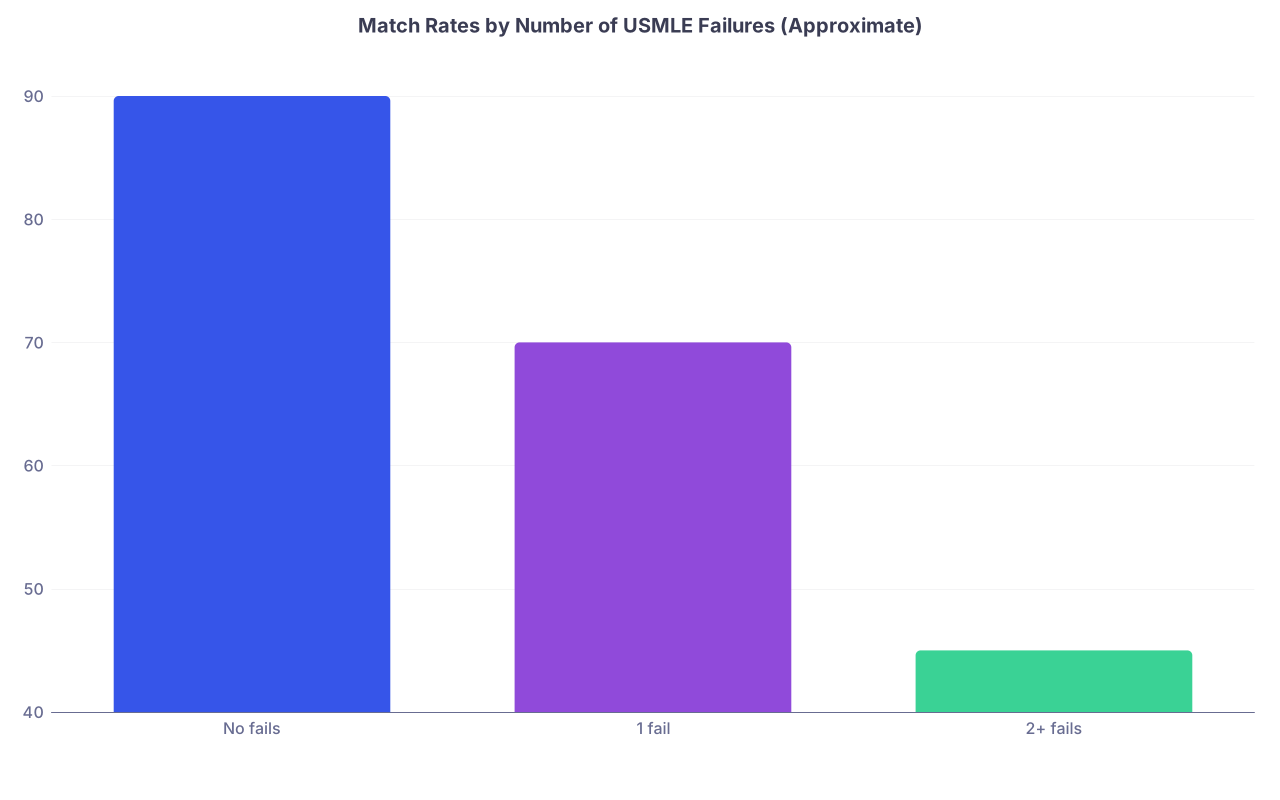
| Category | Value |
|---|---|
| No fails | 90 |
| 1 fail | 70 |
| 2+ fails | 45 |
Those numbers aren’t exact, but they’re in the ballpark of what NRMP data trends show: each fail hurts, but one fail is not the end if everything else is strong, especially Step 2 CK.
What Step 2 CK Means After a Step 1 Fail
If Step 1 is now pass/fail, why does this still feel so high stakes? Because for you, it is.
For someone with a clean record, Step 2 CK is important.
For someone with a Step 1 fail, Step 2 CK is critical.
Here’s how programs think when they see your application:
- “They failed Step 1. Did they fix it on the retake?”
- Then: “What did they do on Step 2 CK? That’s the real signal.”
If Step 2 CK is strong, the narrative becomes: “They had a rough start, but they figured it out and now they’re good.”
If Step 2 CK is weak or borderline, the narrative becomes: “They struggle with standardized exams. Risky.”
That’s the game. It’s unfair, but it’s not mysterious.

What Score Do You “Need” on Step 2 CK After a Fail?
Your brain probably wants a magic number. It’s not that simple, but I’ll give you realistic targets.
Forget “just pass.” That’s not enough with a prior fail.
Think about these rough ranges (US MD/DO context):
| Specialty Type | Risk Level After Fail | Target Step 2 CK (Approx) |
|---|---|---|
| Highly competitive | Very high | 250+ |
| Moderately competitive | Medium-high | 240+ |
| Primary care / IM / Peds | Moderate | 230+ |
| FM / Psych / IM (community-heavy) | Lower | 225+ |
Are there exceptions? Of course.
Can someone match IM with a 220 after a fail? Yes.
Is that the safe plan? No.
Your mindset should be:
“I’m going to study like I need 10–15 points higher than what I think is ‘good enough’ for my specialty.”
Because Step 2 CK isn’t just a test now. It’s your rehab.
The Mental Spiral: “What If I Fail Step 2 CK Too?”
Here’s the fear you probably haven’t said out loud:
“What if I fail Step 2 CK and that proves I really can’t do this?”
That’s the monster under the bed. And if you don’t drag it into the light, it runs the show.
Let me break that worst-case scenario down:
- A second USMLE fail absolutely tanks your application competitiveness.
- Some programs will auto-screen you out immediately.
- For highly competitive specialties, it’s almost a brick wall.
- For less competitive ones, you’d need an insanely strong story, connections, and likely a backup plan.
So yes, you really, really don’t want to fail again.
But here’s the piece your anxiety conveniently ignores:
You’re not walking into Step 2 CK as the same person who failed Step 1.
You’re someone who:
- Knows what “not enough” studying actually looks like now.
- Has felt what real burnout or panic in an exam feels like.
- Understands your weak spots more clearly (timing? foundations? test anxiety?).
If you treat Step 2 CK like Step 1 v2.0 — same habits, same procrastination, same half-structured schedule — then yeah, I’d be terrified.
But if you rebuild your approach, your odds go up dramatically.

| Step | Description |
|---|---|
| Step 1 | Step 1 Fail |
| Step 2 | Honest Postmortem |
| Step 3 | Identify Causes |
| Step 4 | Build New Study Plan |
| Step 5 | Dedicated Prep Period |
| Step 6 | NBME + UWSA Benchmarks |
| Step 7 | Adjust & Remediate Weaknesses |
| Step 8 | Test Readiness Decision |
| Step 9 | Take Step 2 CK |
Step 1 Fail Autopsy: Why You Actually Failed
You can’t fix what you pretend isn’t broken.
If your explanation for failing Step 1 is “I’m just not good at tests,” that’s lazy and dangerous. That mindset is a straight line to a Step 2 CK disaster.
You need a blunt, detailed postmortem. Think back:
- Did you actually finish UWorld properly? Or did you blast through questions without reviewing?
- Did you start dedicated already behind on content from second year?
- Was your NBME/UWSA performance honestly signaling “not ready,” and you ignored it because your test date was booked and everyone else was taking it?
- Were you dealing with unaddressed depression/anxiety, family issues, health issues?
- Did you have a timing problem on the real exam? Or panic? Or blanking?
Most Step 1 fails I’ve seen come from some mix of:
- Poor structure (no real plan, just vibes and question banks)
- Denial about NBME scores
- Underestimating how different “studying” is from “learning to answer USMLE-style questions”
- Burnout and mental health issues being shoved to the side
If you don’t name those clearly, you’re going to unconsciously repeat them during Step 2 CK prep.

How Step 2 CK Prep Must Be Different This Time
You don’t get to “kind of” change things. Not with a prior fail. You need obvious, trackable differences.
Here’s what that looks like in real life, not brochure-language:
You live inside a question bank.
UWorld (and maybe Amboss as a second pass) isn’t optional. You’re not just doing questions; you’re dissecting them. Why is each wrong option wrong. What’s the “hidden” teaching point. How does this map to real clinical thinking.NBMEs and UWSA are not suggestions. They’re guardrails.
You don’t take Step 2 CK “hoping” it goes better than your practice tests. You want repeated practice scores comfortably above your target, not flirting with the passing line.You build exam endurance on purpose.
No more doing 10 questions here and there and calling it a day. You simulate test blocks. Timed. No pausing. Accept the discomfort now instead of being surprised on test day.You fix your life logistics ahead of time.
If your Step 1 dedicated was a mess of “I’ll just figure it out,” then this time you need:- A written weekly plan
- Protected time carved out with your rotation seniors/attendings (yes, it’s awkward, do it anyway)
- Sleep that is non-negotiable, not a luxury
You actually address your anxiety.
If you had panic symptoms on Step 1 — blanking, sweating, tunnel vision, losing time — you need help now. Therapy, coaching, possibly meds. Not the night before the exam. Not “I’ll see how it goes.”
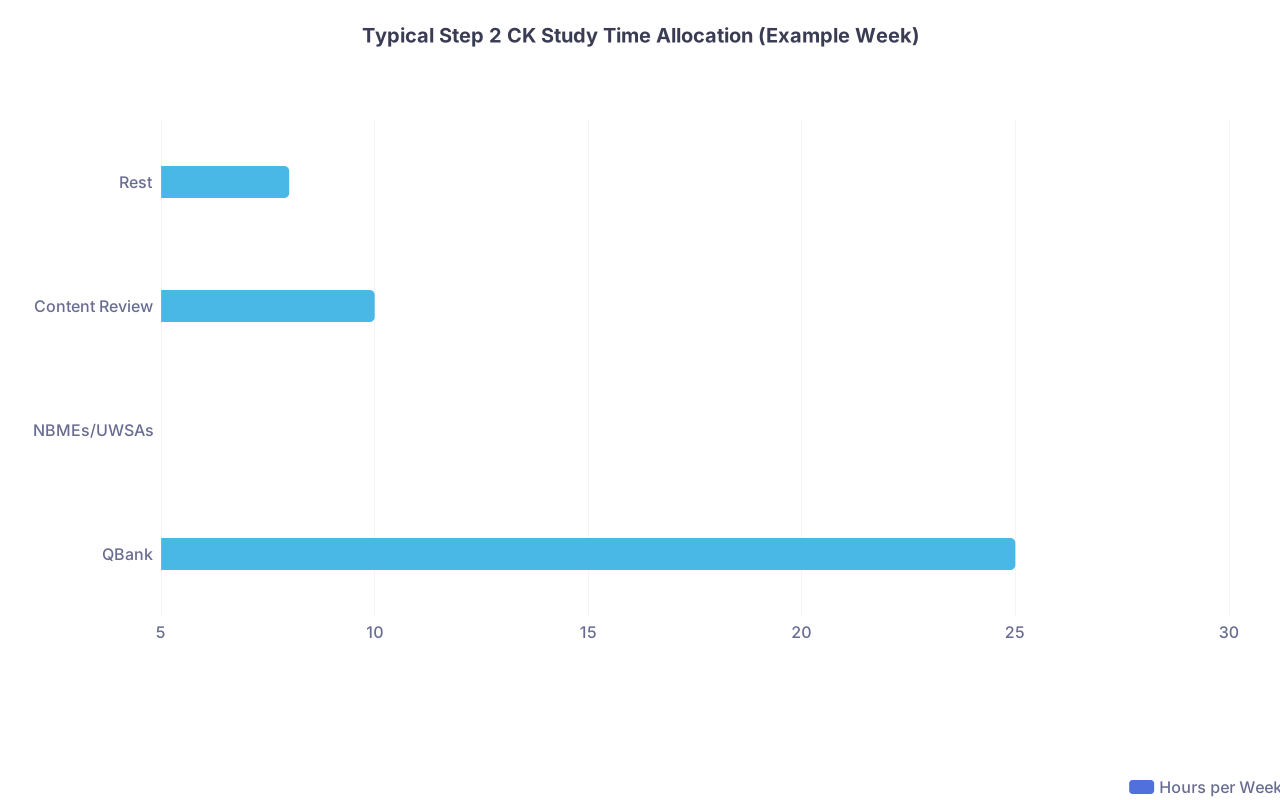
| Category | Hours per Week |
|---|---|
| QBank | 25 |
| NBMEs/UWSAs | 5 |
| Content Review | 10 |
| Rest | 8 |
This doesn’t mean you study 16 hours a day until your brain leaks out. It means the hours you do study are intentional, not chaotic.
Timing: When Should You Take Step 2 CK After a Fail?
Another anxious loop: “If I delay, I’ll be behind for applications. If I rush, I’ll fail again.”
You’re not crazy — timing actually matters. But here’s the uncomfortably honest rule:
It’s way better to be a bit late with a strong score
than “on time” with a weak or failing score.
If your practice tests aren’t where they need to be, you push the exam. Even if ERAS is opening. Even if your classmates are taking it in June. They don’t have your red flag. You do.
Your basic readiness checklist should look something like:
- Multiple NBMEs / UWSAs consistently above 230–240 (or whatever your realistic target is)
- No single NBME scraping the passing line and making you say “maybe the real thing will be better”
- You can get through full-length test days without falling apart mentally
If Step 1 taught you anything, it should be this: hope is not a strategy.

| Step | Description |
|---|---|
| Step 1 | Recent NBME/UWSA |
| Step 2 | Delay exam, add 2-4 weeks focused prep |
| Step 3 | Proceed with scheduled test date |
| Step 4 | Score at or near target? |
| Step 5 | Scores consistent on 2+ exams? |
How Honest Should You Be About the Fail?
This part makes everyone squirm: talking about your Step 1 fail in your personal statement, interviews, or advisor meetings.
Here’s my take: hiding it looks worse than owning it.
In a personal statement or interview, the right tone is:
- Brief
- Direct
- No excuses
- Concrete about what changed
Example structure:
- “I failed Step 1 the first time I took it.”
- “I realized I had treated it like another school exam and hadn’t built real test-taking skills or endurance.”
- “I changed my approach by [specifics: dedicated question practice, NBME tracking, fixing anxiety/sleep/structure].”
- “Those changes are reflected in my Step 2 CK performance and in how I now handle complex clinical situations.”
You don’t spend 4 paragraphs crying over it. You also don’t pretend it was “no big deal.” You frame it as a turning point, not a permanent label.
And if some interviewer still treats you like you’re defective because you failed one exam once? That’s not a place you want to train anyway.
So… How Worried Should You Be?
Let me put it plainly.
If you:
- Failed Step 1
- Don’t change your approach
- Treat Step 2 CK like “more of the same, but I’ll try harder”
You should be very worried.
If you:
- Failed Step 1
- Did a brutally honest postmortem
- Built a structured plan with lots of questions and real practice tests
- Are willing to delay your exam if your numbers don’t support taking it
- Are actively dealing with your mental health and anxiety
Then you’re allowed to be worried.
But not doomed.
Your anxiety is trying to tell you: “This matters. You can’t phone this in.”
Listen to that part. Ignore the part that says: “You already failed once, you’re broken, why bother.”
The people I’ve seen turn this around weren’t the smartest in their class. They were the ones who finally got sick of half-measures and decided, “I’m not letting one exam define my whole career.”
You don’t control every outcome here. But you absolutely control whether Step 2 CK is a repeat of the same mistakes or a very loud, very clear “I’m not that student anymore.”
Today, right now, open your calendar and block the next four weeks with specific Step 2 CK tasks — which days are for NBMEs/UWSAs, which are for timed blocks, which are for deep review — and if it’s not written down, don’t pretend it’s part of your plan.
FAQ (Exactly 6 Questions)
1. Is failing Step 1 once a dealbreaker for residency?
No, not by itself. It’s a red flag, not an automatic rejection. Programs will look for evidence that you’ve corrected course — mainly through a strong Step 2 CK score, solid clinical grades, and no pattern of repeated failures. For ultra-competitive specialties, it can be nearly fatal unless your Step 2 is outstanding and you have strong connections. For primary care and many IM/peds/FM/psych programs, one fail + strong Step 2 can absolutely still match.
2. What Step 2 CK score should I aim for if I failed Step 1?
Aim higher than “average.” For most non-super-competitive specialties, you should be targeting at least the low 230s–240s to offset a prior fail. For competitive ones (radiology, EM at strong programs, academic IM), you’ll want to push toward mid/high 240s+. The exact number depends on your specialty choice and the rest of your application, but the mindset is: don’t shoot for “barely okay.” You want your Step 2 score to change the conversation.
3. Should I delay my Step 2 CK exam if my practice tests are low?
If your NBME/UWSA scores are hovering near passing or significantly below your target, yes — you should seriously consider delaying. Another low or failing score is far worse for your application than taking Step 2 CK a few weeks or even a couple months later. Programs would much rather see a later application with a strong Step 2 score than an early one with a weak or failing attempt. Timing matters, but score and pass status matter more.
4. Do I have to talk about my Step 1 fail in my personal statement or interviews?
You don’t have to write an essay about it, but you shouldn’t pretend it didn’t happen. A brief, honest acknowledgement paired with clear, specific changes you made is usually best. Something like: “I failed Step 1 on my first attempt. I realized X/Y/Z was wrong with my preparation and corrected it by doing A/B/C, which is reflected in my Step 2 CK and clinical performance.” In interviews, answer directly if they ask, then pivot to what you learned and how you’ve improved.
5. What if I’m genuinely scared I’ll fail Step 2 CK too?
That fear is rational. Use it as fuel, not as proof you’re doomed. Translate it into concrete action: get objective data from NBMEs/UWSAs, build a structured question-heavy schedule, talk to an advisor or mentor who’s seen students in your position match successfully, and address anxiety with real support (therapy, medication management, test-taking coaching). If your practice numbers are still weak close to test day, that’s not a character flaw — it’s a signal to delay and revise your plan.
6. Is it still worth aiming for a competitive specialty after a Step 1 fail?
It depends how honest you’re willing to be with yourself. If you failed Step 1 and then score below average on Step 2 CK, the odds for derm/ortho/ENT/plastics/neurosurg are extremely low. If you repair things with a very high Step 2 CK (250+), outstanding clinical performance, strong research, and mentors who will go to bat for you, there’s still a shot — but it’s an uphill climb. It’s not delusional to try, but it is risky to have no backup plan. A lot of smart people in your position pivot to less competitive specialties and end up very happy with that choice.