
It’s 7:55 AM on your Step 2 CS exam day (or OSCE day, or clinical skills final), and you’re standing in front of that fake clinic door. Your heart is slamming. Your palms are soaked. You know the “patient” is an actor, you know this isn’t real life, and somehow that makes it worse. You’re convinced they’re judging every word, every hesitation, every time you forget a stupid acronym you’ve drilled 500 times.
You’re not scared of real patients. You’re scared of standardized ones. Of the script. Of being watched. Of being graded on your humanity.
Let’s talk about that.
Why Standardized Patients Feel So Much Worse Than Real Patients
Here’s the part no one says out loud: a lot of us are more terrified of standardized patients than of actual sick humans in the ED.
Real patients are messy. They forget details, they ramble, they’re grateful if you listen at all. Standardized patients? They’re literally paid to notice everything you do wrong.
You walk in and your brain starts this:
- “They’re rating my eye contact.”
- “Did I wash my hands long enough?”
- “Did I say ‘What brings you in today?’ or did I sound robotic?”
- “They’re definitely writing ‘awkward’ on the form right now.”
And because you know there’s a checklist, you start performing instead of connecting. You start thinking about talking instead of just talking. That’s when your mind blanks. You forget basic stuff you’ve done 200 times on the wards.
I’ve watched strong clinical students completely melt in an OSCE room. Students who run codes. Students who can talk to a real patient’s family about bad news. But in front of a 55-year-old actor with chest pain and a clipboard hidden under the bed? Total shutdown.
You’re not broken. The test is unnatural. You’re being graded on being “naturally” empathetic in a totally artificial environment, under constant surveillance and time pressure. Of course your anxiety spikes.
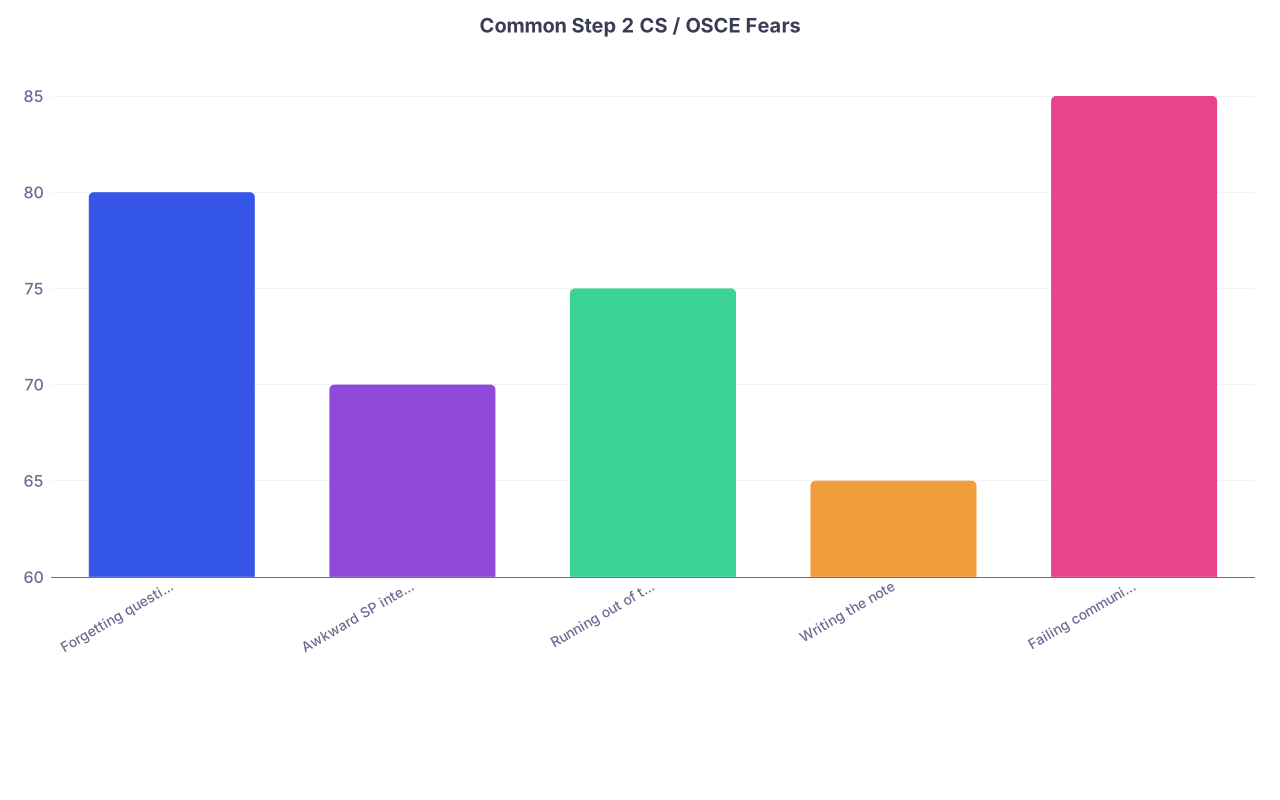
| Category | Value |
|---|---|
| Forgetting questions | 80 |
| Awkward SP interactions | 70 |
| Running out of time | 75 |
| Writing the note | 65 |
| Failing communication | 85 |
The Specific Nightmares You’re Playing in Your Head
Let me call out the exact fears, because they’re not vague. They’re very specific and very loud.
“What if my mind goes blank and I just stand there?”
You’re imagining walking into the room, introducing yourself, and then…nothing. No HPI, no ROS, no questions. Just internal screaming.
I’ve seen this happen. A student walked in, said hello, then froze for what felt like an hour. They still passed. Why? Because “blanking” is usually 10–15 seconds, not an eternity, and they recovered.
You’ve blanked before and still functioned on wards, right? Same brain. Different lighting.
“What if the SP hates me and tanks my score?”
You’re picturing an SP walking out, rolling their eyes, and circling 1’s on everything.
Reality: SPs are trained not to tank you for vibes. They follow scripts and checklists. They’re not asked “did you like this student?” They’re asked, “Did the student do X, Y, Z?”
This isn’t a popularity contest. You can be a little awkward and still pass. You can even feel like the encounter was trash and still pass.
“What if I forget a huge, obvious question and miss the diagnosis?”
You’re catastrophizing: chest pain and you forget to ask about exertion. Abdominal pain and you never ask about last menstrual period. Headache and you don’t ask about red flags. Then you imagine an automatic fail.
That’s not how it works.
The exam isn’t “one miss, you die.” It’s cumulative. It’s pattern-based. If overall your encounters are safe, decently structured, and your notes make logical sense, one missed question in one room isn’t your death sentence.
“What if I cry. Or visibly shake. Or have a panic attack.”
I’m not going to lie and say no one’s ever cried in an OSCE. It happens. People shake. Voices crack. I’ve seen students wipe their eyes, apologize, and keep going.
You don’t fail for being anxious. You fail if your anxiety completely blocks your ability to gather enough information and communicate anything coherent. That’s different. And you can train for that.
Why Your Brain Freaks Out Specifically In These Rooms
There’s a reason you might be fine on wards but crumble with standardized patients: it’s a performance test, not a care encounter.
Your fear isn’t “I might miss something and hurt a patient.” It’s “I might miss something and they will document the failure, score the failure, permanent-record the failure.”
Standardized patient exams trigger:
- Performance anxiety (like public speaking, but trapped in a room)
- Social evaluation anxiety (“they’re judging my personality”)
- Perfectionism (“if I don’t hit every bullet, I fail”)
And yeah, worst-case: you picture yourself failing, delaying graduation, not matching, explaining to PDs why you blew a communication exam.
Your brain is trying to protect you by running the absolute worst scenario. Problem is, it doesn’t then balance that with probability. It just loops the horror reel.
So instead of “I’m nervous but prepared,” it becomes “This is the single point of failure that can destroy my entire career.”
No wonder your heart rate is 150 in a fake clinic.
What Actually Matters on These Exams (vs. What You’re Overrating)
Let me be blunt: you’re probably studying the wrong things for your anxiety level.
You’re obsessing over perfect differentials and obscure questions. The exam is more basic than that.
The big pillars:
Structure and safety
Can you do a focused, logical H&P for the chief complaint? Can you ask safety questions when needed (SI/HI, red flag symptoms)? Can you rule out immediately dangerous stuff enough to sound like a responsible future intern?Communication and rapport
This is huge. Do you introduce yourself clearly? Wash your hands? Ask open-ended questions? Summarize? Ask if they have questions? Use lay language? That’s what SPs are scoring obsessively.Reasonable plan, not perfect genius plan
In the note: does your assessment sound plausible? Do your tests fit the story? You don’t need to be a diagnostic prodigy. You need to sound like someone I’d trust to pre-round on my patients.
Stuff you are massively overrating:
- Having the perfect, textbook differential every time
- Doing a full neuro exam on every headache because you’re panicking
- Memorizing 10 different mnemonics per complaint
- Sounding like an attending instead of a student
Standardized patients aren’t there to see if you’re brilliant. They’re there to see if you’re safe, coherent, and not a robot.
| What Feels Huge to You | How Much It Actually Matters |
|---|---|
| Forgetting one ROS question | Low |
| Slightly awkward small talk | Low |
| Skipping hand hygiene | High |
| No summary or closure | High |
| Minor exam step out of order | Low |
How to Train Specifically for “Standardized Patient Terror”
You don’t fix this type of anxiety by just “knowing more medicine.” You train the situation.
Script the first 90 seconds until it’s automatic
The first minute is where most people implode. So you remove the decision-making from that part.
You should be able to do this half-asleep:
- Knock. “Hello, Mr./Ms. ___?”
- Enter, close door. “Hi, my name is ___, I’m a medical student working with Dr. ___. I’ll be talking with you today and, if it’s okay, doing a brief exam to understand what’s going on.”
- Hand hygiene.
- “How would you like me to address you?”
- “What brings you in today?” then shut up and listen.
Practice that opening 50 times in your room. Out loud. Until you can say it even when your heart’s pounding.
Your goal: you can be anxious and still run the script cleanly.
Reduce the chief complaint chaos
You don’t need a custom approach for 100 complaints. Group them:
- Pain (chest, belly, head, joint)
- Shortness of breath / cough
- Fever / infection
- Neuro symptoms (weakness, numbness, dizziness)
- Psych (mood, anxiety, substance, sleep)
- Routine / check-up / counseling
For each bucket, have 5–10 must-hit questions in your head. Not 30. Not a novel. Just the high-yield stuff.
Then drill them in low-stakes settings:
- With a friend pretending to be “generic abdominal pain”
- Talking to your wall
- Recording yourself on your phone and watching how weirdly you speed up when you’re nervous
Is it awkward? Yup. But it makes game day feel like the 20th time, not the first.

| Step | Description |
|---|---|
| Step 1 | Knock & Enter |
| Step 2 | Introduction & Hand Hygiene |
| Step 3 | Open-ended Chief Complaint |
| Step 4 | Focused HPI & ROS |
| Step 5 | Focused Physical Exam |
| Step 6 | Summary & Assessment |
| Step 7 | Plan & Check Understanding |
| Step 8 | Thank & Exit |
Dealing With Anxiety During the Encounter
You’re not going to magically be calm. Let’s assume you’ll be anxious and work with that.
Use “visible” anxiety to your advantage
You’re worried they’ll see your shaking hands or hear your quivering voice. Good. Use it.
You can literally say:
“I’m sorry if I seem a little nervous, but I really want to make sure I understand what you’re going through.”
Actors are human. Most of them soften when you’re honest like that. On their form, that usually reads as “caring,” not “disaster.”
Build 3 micro-pauses into every encounter
Instead of white-knuckling through 15 minutes at full speed, deliberately insert:
- After the chief complaint: “Let me take a moment to make sure I’ve got this so far…” (You breathe.)
- Before the exam: “Okay, I’m going to think out loud for a second about what I want to examine…” (You breathe.)
- Before closing: “Let me just summarize what I’ve heard…” (You breathe.)
These are legal, professional pauses. You look thoughtful, not panicked. And your nervous system gets three chances to downshift.
Accept “imperfect but safe” in real time
You will miss things. You will remember later, in the hallway, that you never asked about travel, or surgeries, or something else you love.
You cannot fix that by going back in time. Don’t spiral mid-exam.
Mentally say: “Okay, that wasn’t perfect, but it was safe. Keep going.”
Safe > perfect. Every time.

What If I Actually Fail? The Worst-Case You Keep Replaying
Let’s walk straight into the nightmare, because your brain is already living there.
You fail Step 2 CS / your OSCE / your clinical skills exam. What happens?
- You get an email that feels like a gut punch.
- You’re embarrassed. You don’t want to tell your friends.
- You have to repeat it, or do remediation, or delay something.
All true. It sucks. I’ve watched people go through it.
But here’s what doesn’t happen:
- You’re not automatically blacklisted from medicine.
- You’re not the only one. Lots of very competent people fail once.
- You don’t have a permanent scarlet letter on your forehead every time you walk into residency.
Programs care a lot more if you fail and then refuse to address why, or if you blame everyone else. If you fail, own it, fix it, and move on.
Also: your odds of failing are probably way lower than your anxiety is telling you. You, the person worried enough to be reading this, are rarely the one phoning it in.
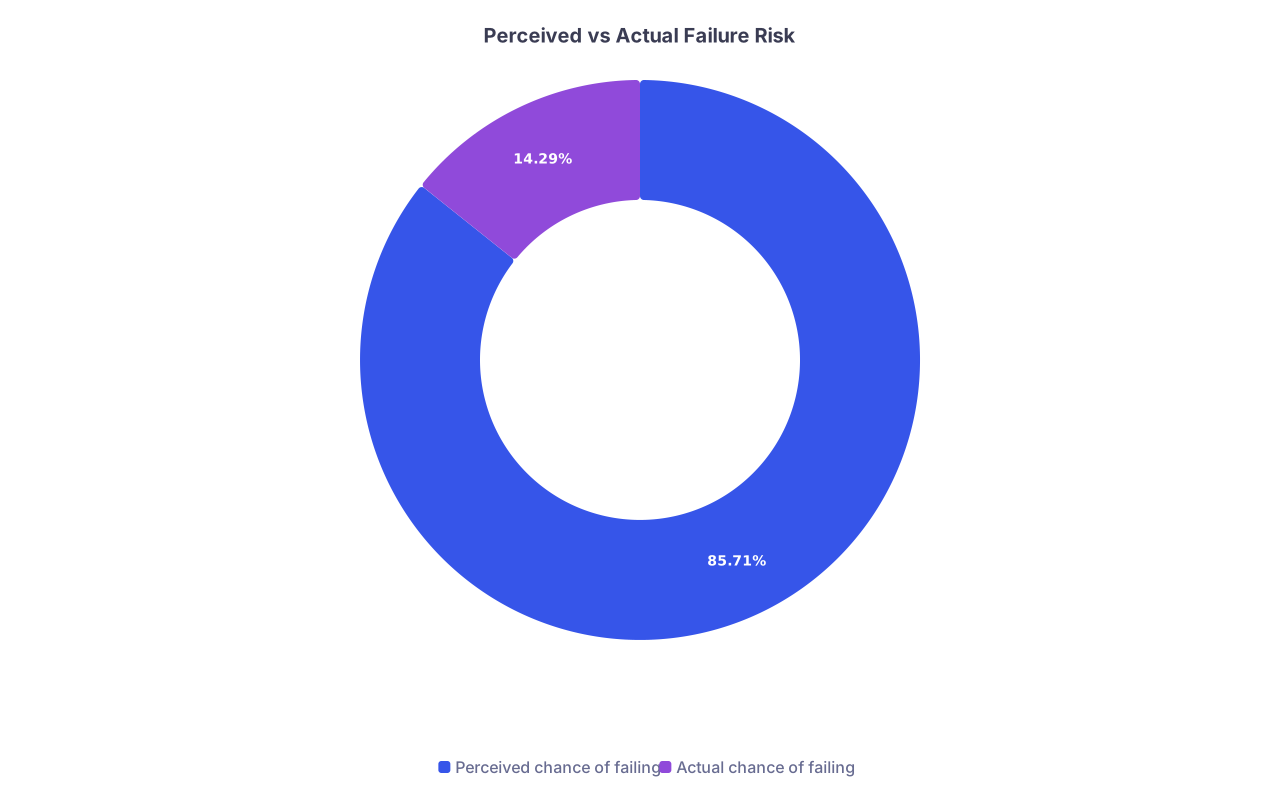
| Category | Value |
|---|---|
| Perceived chance of failing | 60 |
| Actual chance of failing | 10 |
Tiny Reframes That Actually Help
A few mental shifts that aren’t cheesy and actually change how this feels:
- You’re not “proving you’re a good human.” You’re demonstrating basic clinical competence under surveillance. Those are different.
- The SP isn’t out to catch you. They’re out to follow their script. Your job is to run your script.
- This isn’t your last chance to show you can talk to patients. It’s one data point in a career full of them.
And the big one: you don’t have to feel calm to perform well. You just have to keep behaving like a competent student while feeling like a wreck inside. That’s basically the entire job of being a doctor.
You’ve already done this on wards. Pre-rounding when you’re exhausted. Presenting when you’re scared. Talking to that hostile family. You already know how to function scared.
This is just a more artificial version of what you’ve already lived.

FAQ: Standardized Patient & Step 2 CS Anxiety
1. What if I’m terrible at small talk and feel fake with standardized patients?
You don’t need to be charming. You need to be respectful, clear, and non-robotic. Ditch the idea of “small talk” and focus on “human talk.” Simple stuff like, “That sounds really uncomfortable,” or “I can see this has been worrying you,” is enough. SPs aren’t grading you on being witty, they’re grading whether you acknowledge emotions, listen, and explain things without jargon. Awkward but kind beats slick and detached every single time.
2. How many full practice encounters should I do before my exam?
Enough that the format feels boring. For most anxious students, that means at least 10–15 full timed encounters (with note-writing) before the real thing. Not all in one weekend—spread them over a few weeks. Mix solo practice (talking out loud, recording yourself) with partner practice (classmate or tutor acting as patient). The goal isn’t to memorize cases; it’s to make the open–history–exam–close rhythm so familiar that anxiety has less room to hijack you.
3. I totally blew one OSCE station. Does that mean I’m doomed?
No. Everyone has at least one station that feels like it went off a cliff. You hyper-focus on it because it’s emotionally loud. Graders and exam systems look at the whole batch. If the rest of your stations are decent—safe, structured, and reasonably communicative—one disaster doesn’t tank you. The students who end up failing typically have consistent patterns across multiple rooms: chronically disorganized, repeatedly missing basic safety checks, or completely skipping closure and explanation.
4. Should I tell someone (faculty, SP, proctor) that I have severe anxiety?
If your anxiety is high enough that you’re losing sleep, vomiting, or having panic attacks, yes, loop in someone. Student health, counseling, or your dean’s office can help with accommodations if appropriate—extra time, breaks, whatever your school allows. You don’t need to overshare with SPs, but you can be honest in small ways like, “I’m a bit nervous, but I want to make sure we take good care of you today.” That kind of vulnerability doesn’t hurt you; it usually helps your rapport score.
Here’s your next step today:
Open your notes app or a blank doc and write out your exact 60–90 second room entry script—the words you’ll say from knock to first open-ended question. Then stand up, close your door, and run it out loud five times in a row. No edits, no perfection. Just get your mouth used to saying the words while your heart races.