
The biggest lie students tell each other about Step 2 failures is this: “If you just pass on the second try, programs will understand.”
They do not “just” understand. They dissect it. They explain it to each other. And in rank meetings, they talk about it out loud in ways most applicants would not want to overhear.
Let me walk you into that room.
What Actually Happens in Rank Meetings
Here’s the part no one writes on official program websites: rank meetings are not some sterile, purely objective algorithm discussion. They’re messy, political, and very human.
Picture this. It’s January. Conference room. Coffee gone cold. Half the faculty want to go home. A spreadsheet is projected with applicant names and a dozen columns: school, class rank, Step scores, red flags, interview evaluations, “concern” notes.
You hit your row.
Someone says, “This is the one who failed Step 2 on the first attempt.”
Everyone pauses just a second longer.
Your file is no longer neutral. It’s a case.
I’ve sat in those rooms. I’ve heard the exact phrases:
- “What happened with the first attempt?”
- “Was Step 1 low too, or is this new?”
- “Did they explain it in the personal statement or MSPE?”
- “Any other issues on rotations?”
- “Can we trust they’ll pass boards on time?”
This is what you’re up against—not vague “consideration.” Very specific, very concrete risk assessment.
How a Failed Step 2 Flags Your File Before You Even Walk In
You need to understand the pipeline before the rank meeting, because by the time they’re talking about your failed attempt in January, the damage (or mitigation) is mostly baked in.
The pre-screen reality
At many programs, especially in competitive specialties (derm, ortho, ENT, EM at top places, anesthesia at big names, and even some “normal” IM programs), the following happens months before interviews:
A coordinator or chief resident runs a filter on ERAS:
- Pass vs fail any USMLE attempt
- Step 2 score thresholds (even in the pass/fail Step 1 era)
- Number of attempts
Then they start slashing.
If there are 2,000 applications for 12 spots, some programs will auto-screen out any Step 2 failures. Not every program. But more than you think. And they’ll never admit that publicly.
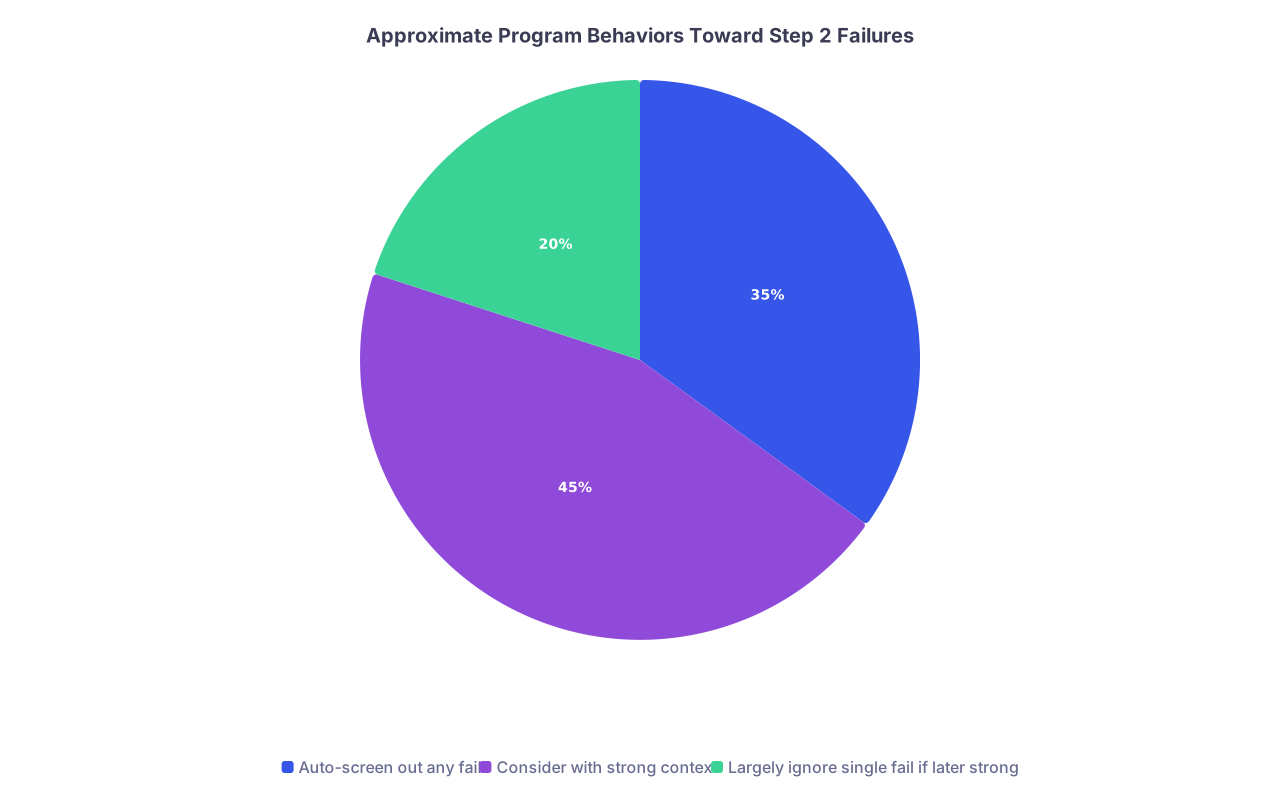
| Category | Value |
|---|---|
| Auto-screen out any fail | 35 |
| Consider with strong context | 45 |
| Largely ignore single fail if later strong | 20 |
So if you failed Step 2 and still got an interview, understand this:
You already passed an invisible filter. Someone chose to keep you in the pool. That’s good. But it also means your failure is known, flagged, and will be revisited.
They don’t forget it.
The Three Ways Your Failure Gets Framed in the Room
By the time the committee meets to rank, there’s usually some shorthand “story” about your failure baked into your file. It tends to fall into one of three buckets.
1. The “Pattern of Concern” Story
This is the worst category. This is how it sounds behind closed doors:
“Step 1 barely passed on first try, then failed Step 2 once, passed on second try with just an okay score, plus some borderline clerkship comments. I’m worried this is a pattern.”
They’re looking for patterns, not single data points. A failed Step 2 becomes especially toxic when coupled with:
- Marginal or barely-passing Step 1
- Shelf exam failures or remediation
- Comments like “needs close supervision,” “below level,” “requires redirection”
- Any professionalism concerns
I’ve watched PDs say this verbatim:
“I don’t want to be discovering academic problems in February of intern year when the board deadline is looming. We can’t take that risk.”
That is the real fear: you not passing your in-training exams, then failing your board exam, delaying graduation or board eligibility. It screws the program, not just you.
2. The “Context and Redemption” Story
This is where you want to land if you’ve already failed.
This sounds like: “They failed Step 2 once the month their parent was in the ICU, then crushed the retake with a 250+ and have strong comments on medicine and surgery. Looks like a rough patch, not a chronic problem.”
Notice what changed:
- There’s a specific and credible reason
- There’s a clear rebound in performance
- Clinical evals support that you function at or above level
Programs will still be cautious. But they have a narrative where your failure is a contained event, not a sign of who you are.
3. The “Data Point, Not Dealbreaker” Story
You only see this at more forgiving or less competitive programs, or for candidates who are otherwise stellar.
Example: “Yeah, they failed Step 2 once, but now they have a 245, AOA, strong research, and everyone loved them on interview day. I can live with that.”
Translation: your other strengths buy you forgiveness. Not fairness. Forgiveness. This is not a level playing field. A failure is a drag you must compensate for somewhere else.
Exact Questions They Ask About a Failed Step 2
Let me give you the actual checklist-style thinking many PDs and core faculty use. They won’t tell you this explicitly, but you can recognize the pattern.
When your name comes up and someone sees the failed Step 2, they silently run through:
- Is there a documented explanation?
- MSPE? Personal statement? LOR mention? Dean’s note?
- Did they clearly rebound?
- Step 2 retake score reasonably strong?
- Any later exams (COMLEX, in some cases) look better?
- Is this consistent or inconsistent with the rest of the file?
- Clerkships strong or weak?
- Shelf exams? Honors pattern?
- Did they own it on interview day?
- Did you dodge the question?
- Did you give a vague “personal issues” excuse with no structure?
- What’s our risk tolerance as a program?
- Small community program in a state system? Usually more forgiving.
- Prestigious academic program with 1,500+ applicants? Much less.
| Scenario | Typical Committee Reaction |
|---|---|
| Fail + Low Retake + Weak Clinicals | High risk, often dropped or pushed low on rank list |
| Fail + Strong Retake + Strong Clinicals | Discussed, sometimes accepted, needs a champion |
| Fail + Step 1 Pass with Margin | Interpreted as pattern, harder to overcome |
| Fail + Clear Life Crisis + Recovery | Depends on how well it’s documented and explained |
| Fail + No Explanation Anywhere | Seen as evasive or concerning, major red flag |
If you don’t give them a coherent story, they invent one. And they’re not especially generous when they do.
How Your Explanation Helps or Hurts You
Here’s the brutal part: the single worst thing you can do with a Step 2 failure is pretend it doesn’t matter or think you can just “not bring it up.”
Faculty hate that.
The bad explanation
“I had some personal things going on and I just didn’t do as well as I wanted.”
I’ve watched PDs react to that with visible annoyance.
One of them said exactly this after an applicant walked out:
“If you fail Step 2, you owe me a better explanation than ‘personal things.’ That tells me nothing and doesn’t reassure me at all.”
Vague, evasive, rehearsed-sounding answers make them think:
- You haven’t reflected on what went wrong
- You may not have actually changed your habits
- You’ll probably repeat this when the pressure ramps up again
The strong explanation
The candidates who survive a Step 2 failure do something different. Their explanation has three parts:
- Clear, specific context (without melodrama or oversharing)
- Concrete changes in process
- Evidence of sustained improvement afterward
For example:
“During my initial Step 2 attempt, my studying was fragmented between clinical responsibilities and a serious family illness. I underestimated how much that would affect my focus. After failing, I met with our academic support office, structured a strict 6-week dedicated period, used question banks more systematically, and did three full-length practice exams under test-like conditions. My retake score of 245 reflects that new approach, and since then my shelf exams and clinical evaluations have been consistently strong.”
That’s the kind of thing a PD can repeat in the rank meeting when someone says, “What happened with the fail?”
They need talking points to defend keeping you on the list.
What Different Specialties Really Do With Step 2 Failures
Not all specialties treat a failed Step 2 the same way. The rumors you’ve heard are half-true at best.
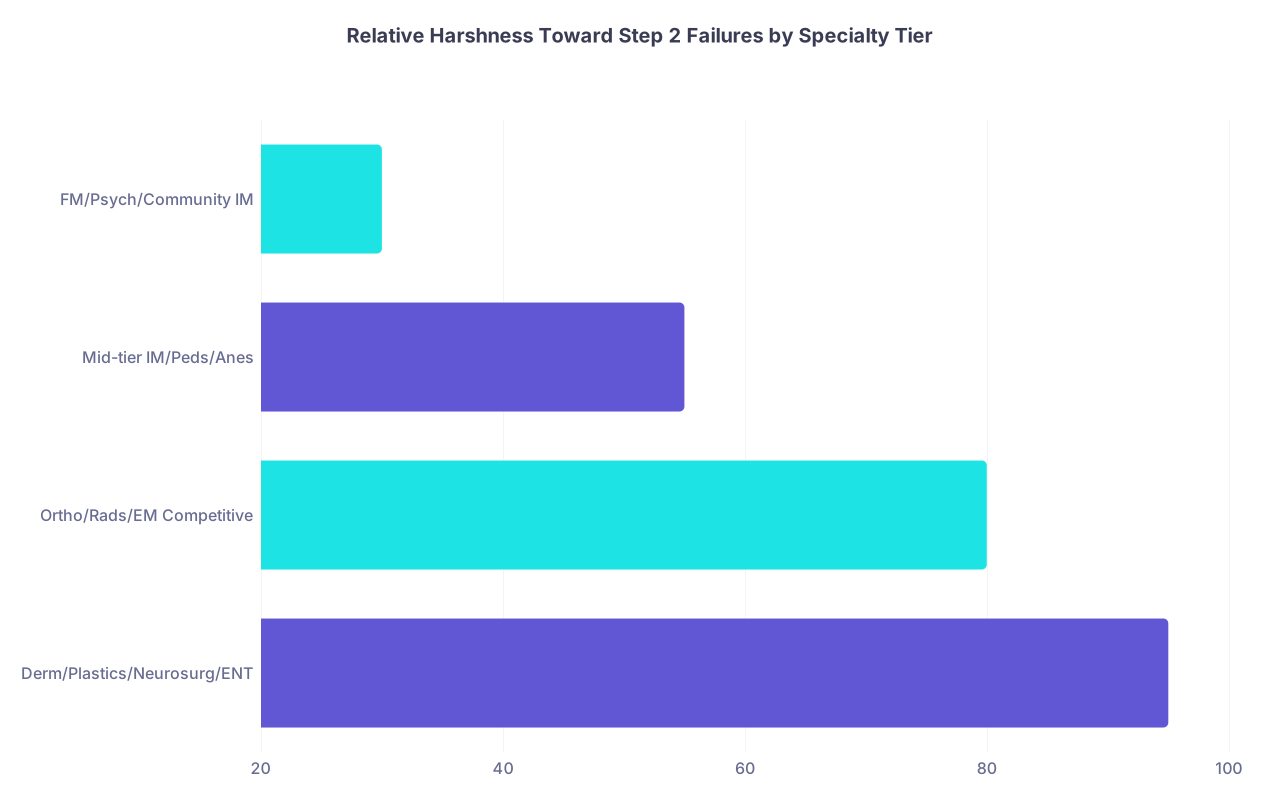
| Category | Value |
|---|---|
| Derm/Plastics/Neurosurg/ENT | 95 |
| Ortho/Rads/EM Competitive | 80 |
| Mid-tier IM/Peds/Anes | 55 |
| FM/Psych/Community IM | 30 |
The higher the number, the more likely a single failed attempt knocks you out at many programs.
Hyper-competitive specialties
Derm, plastics, neurosurgery, ENT, some ortho and IR.
Common reality:
- Many programs quietly auto-screen out any exam failures
- If you’re not bringing in something absurdly exceptional (R01-level research, home program connection, famous mentor), a failure is effectively a nonstarter at top places
- At rank meetings, if a fail gets noticed, the question is usually “Why are we taking this risk when we have so many clean files?”
Competitive but more variable specialties
EM, anesthesia, radiology, academic IM, OB/Gyn at strong places.
Here the failure isn’t necessarily fatal, but:
- You need a strong retake score and strong clinicals
- You need faculty champions (“I’d be comfortable with them as my intern”)
- At rank meetings, you’re often in the “middle third” discussion, not top
One EM PD I know literally said during a meeting:
“I like this applicant a lot, but with a Step 2 fail, I’m not putting them in the top 10. If they end up mid-list, fine.”
So you might get ranked. Just not where you dreamed.
More forgiving fields and programs
Family medicine, psych, community-based IM or peds, some state-affiliated programs.
These programs:
- See more non-traditional paths and academic bumps
- Often have explicit experience supporting residents through boards
- Weigh personality, fit, and clinical performance heavily
Here, a Step 2 fail becomes background noise if you’ve shown sustained improvement and handled it maturely.
But do not kid yourself. Even in these settings, someone will say,
“We need to be sure they can pass boards. Are there any other academic red flags?”
How Step 2 Failures Change Your Position on the Rank List
Let’s talk concrete impact.
In many meetings, each faculty member submits a preliminary rank list. Then they go through tiers: “top group,” “middle group,” “backup group.”
Where do Step 2 failures land?
Typical pattern I’ve watched over and over:
- Almost never in the very top tier, even if everything else is solid
- Frequently placed in the “middle but acceptable” zone if explanation + retake are good
- Dropped into “backup/low tier” if explanation is weak, retake marginal, or other concerns present
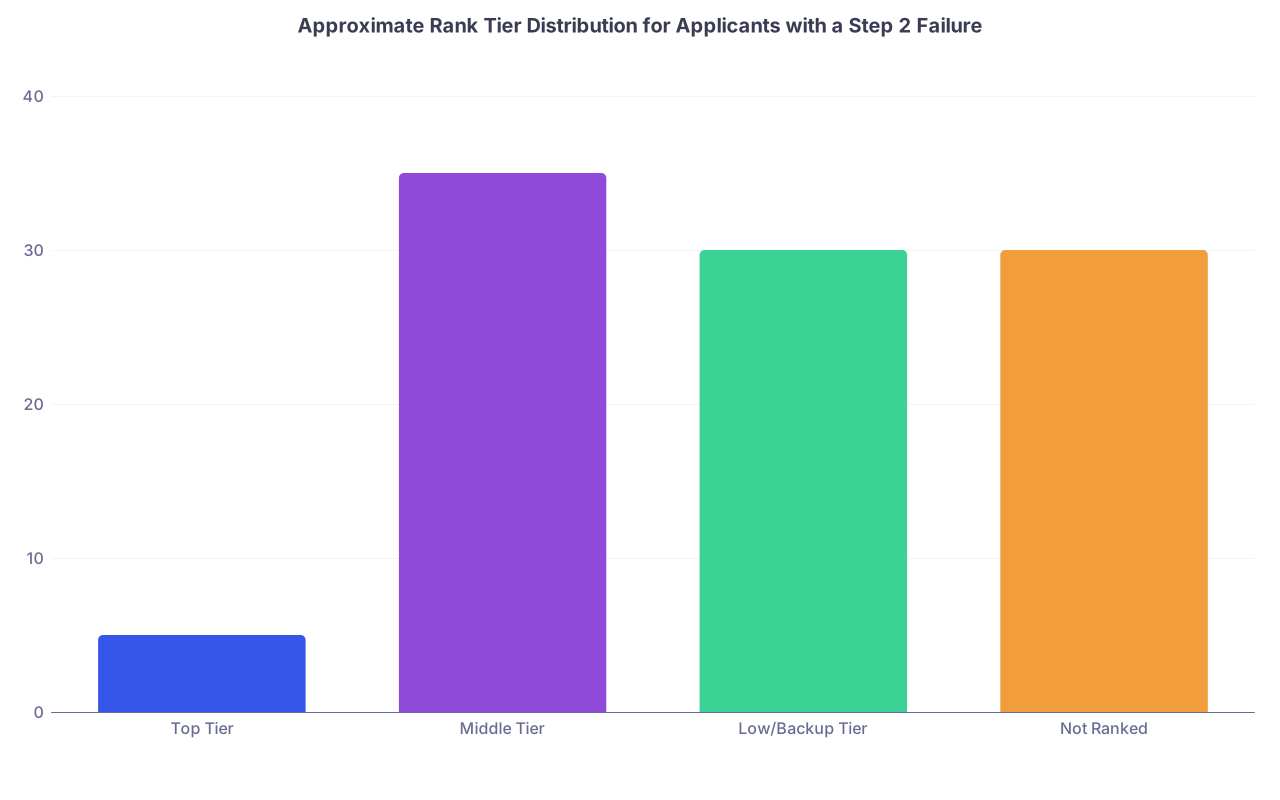
| Category | Value |
|---|---|
| Top Tier | 5 |
| Middle Tier | 35 |
| Low/Backup Tier | 30 |
| Not Ranked | 30 |
The actual distribution varies by program, but the pattern is real: your ceiling is lowered at many places.
There’s also a less talked about thing: tie-breaks.
When two applicants are similar in personality, interview strength, and letters, the “clean file” almost always wins over the one with a Step 2 failure. Faculty literally say:
“Between these two, let’s go with the safer choice.”
You don’t hear that line unless you’re in the room. But it gets said. A lot.
If You Haven’t Taken Step 2 Yet: How to Avoid Becoming “That Discussion”
Let me be blunt. If you haven’t tested yet and you’re worried you might fail, your priority is not ego. It’s not the schedule. It’s damage control before damage exists.
You absolutely do not want to be the person whose name prompts:
“Remind me, didn’t they fail Step 2?”
Some hard truths:
Testing underprepared is worse than delaying
- A one-month delay in your schedule is annoying
- A failed attempt will follow you for every residency and most fellowship applications
- Many programs don’t care that you “wanted to stick to your original plan” if the result is a fail
Practice NBME scores matter more than your feelings
- If your practice exams are consistently below passing, you’re gambling your career trajectory, not just this month
- I’ve watched people ignore 195–205 practice scores, test anyway, fail, and then spend a whole year paying for that one stubborn choice
You must earn the right to sit for that exam
- “I just want to get it over with” is not an acceptable justification
- You need repeated, consistent practice scores above passing with margin
If you’re on the edge, the smarter, more strategic move is delay + structured prep. Programs are much more forgiving of a later Step 2 result than of a failed attempt.
If You’ve Already Failed: How to Limit the Damage
If the attempt is already on your record, your game is different. You’re no longer trying to prevent the red flag. You’re building the strongest possible story around it.
You focus on three fronts:
1. Crush the retake—no half measures
You want your retake score to visibly say, “This is not my real level.”
That doesn’t always mean a 250+, but it should be:
- Comfortably above passing
- Preferably above your Step 1 if you can swing it
- Supported by improved shelf scores if you still have those coming
A marginal retake (like 215–220, depending on historical context) after a fail forces the committee to assume your ceiling is low.
2. Get your dean and letter writers on the same narrative
The MSPE and letters can help you or bury you.
Behind the scenes, strong dean’s offices do this:
- Explicitly acknowledge the failure briefly
- Emphasize your improvement and professionalism
- Mention how you responded maturely and sought help
Some deans will even say in their private calls with PDs: “This student hit a bump with Step 2 but has been solid clinically, and I’d trust them as an intern.”
Your job is to:
- Meet with your dean
- Be honest, reflective, and specific about what changed
- Ask them, directly but respectfully, to help contextualize the failure in your MSPE
3. Own it calmly on interview day
When they ask—and they will—your tone matters as much as your words.
You want:
- Zero defensiveness
- Zero blame-shifting
- Clear insight and concrete process changes
If your answer sounds like: “Life was hard, things happened, but I’m fine now,” they won’t buy it.
If it sounds like: “Here’s exactly what went wrong, here’s what I changed, here’s how I’ve proven that change over time,” they’ll nod and move on.
That “move on” is what you are fighting for.
Final Perspective
Behind closed doors, Step 2 failures are not whispered about delicately. They’re debated like a risk management decision. “Can we trust this person to pass their boards?” isn’t personal. But it is decisive.
The good news is this: faculty are not monsters. I’ve seen programs rally behind an applicant who failed Step 2 because everything else screamed resilience, maturity, and growth. I’ve seen PDs say, “I’d rather have the person who failed once and figured it out than the perfect-score robot who can’t talk to patients.”
The bad news is that you don’t get that grace automatically. You have to earn it—with your retake performance, with your story, and with how you show up on the wards and at interviews.
Years from now, you’ll barely remember your exact Step 2 score. But the way you responded—to fear, to failure, or to the pressure of avoiding both—will shape how you see yourself in medicine a lot longer than any exam ever will.