
Your shelf scores are tattling on you long before Step 2 CK does.
Program directors may never see the raw numbers, but they see the patterns—and those patterns are what really shape how they predict your Step 2 performance.
I’ve sat in those meetings. I’ve watched clerkship directors flip through grade reports and say, “This person is going to crush Step 2,” or “I don’t care what their Step 1 score was, this trajectory worries me.” None of that comes from a single exam. It comes from trends across your shelves and clinical evaluations.
Let me walk you through what actually happens behind the curtain and how you can use that to shape your Step 2 strategy—before it shapes you.
What PDs Actually See (And Care About) From Your Shelves
First misconception: “It’s pass/fail, no one cares about the exact shelf score.” Wrong.
Even when schools hide raw numbers, they convert them into something. Honors/High Pass/Pass. Percentiles. “Top 25% of class.” Those conversions are enough for faculty to infer where your Step 2 CK might land.
Different schools package it differently, but from the PD side, what matters is this cluster of signals:
- How did you perform across all core clerkships relative to your peers?
- Did you improve across the year, plateau, or fall off?
- Are there specific weak systems (neuro, OB, renal) that keep showing up as problems?
- Do your clinical comments match your exam performance—or is there a mismatch?
- How did you do on Internal Medicine in particular?
Let me be explicit: Internal Medicine shelf + aggregate pattern across other shelves = the quiet prediction line for your Step 2 CK.
Here’s the part students don’t realize: PDs have seen thousands of applications. They’ve developed internal heuristics:
- “Multiple High Pass/Honors in shelf-heavy clerkships → usually Step 2 ≥ 245–250+.”
- “Pass-level shelves with no upward trend → usually Step 2 sits near or just above national mean.”
- “Erratic pattern (one or two great shelves, a few weak, no clear improvement) → volatility risk.”
No one writes this in an official handbook. But they talk about it openly in selection meetings.
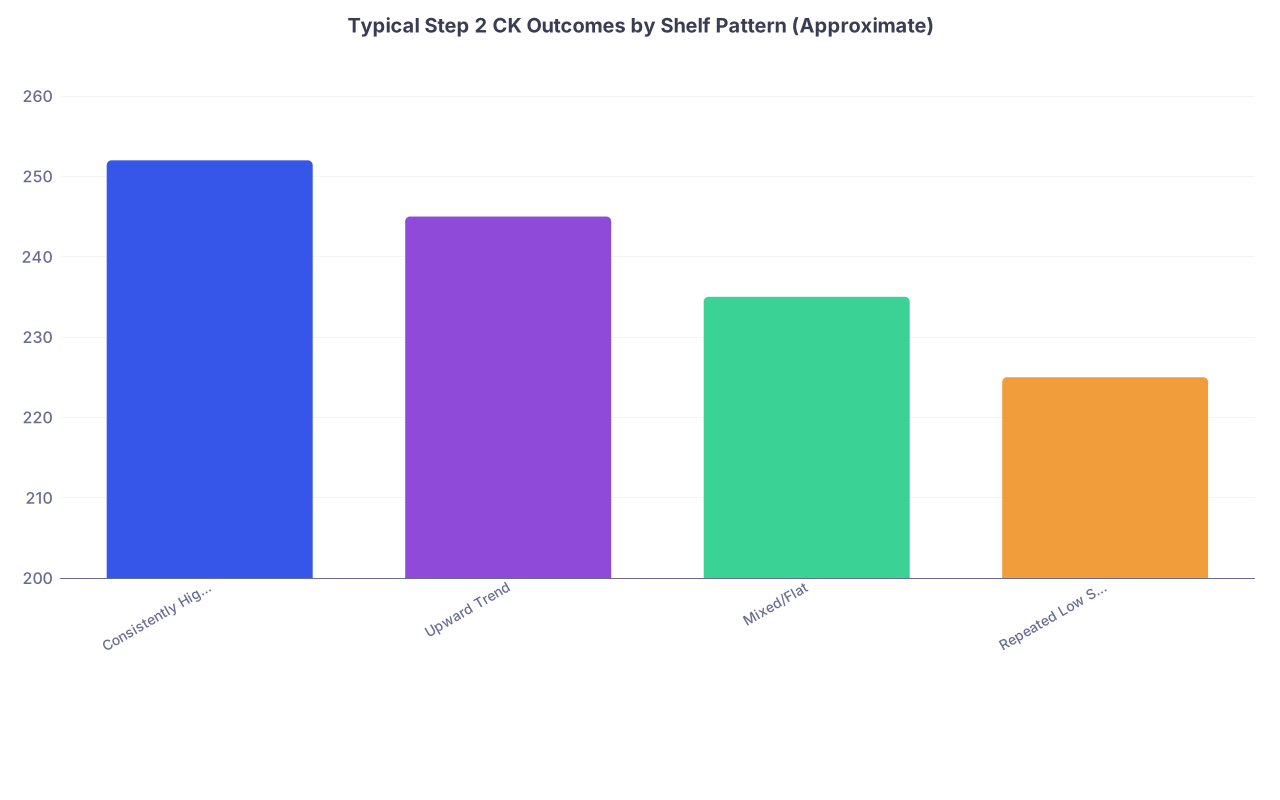
| Category | Value |
|---|---|
| Consistently High Shelves | 252 |
| Upward Trend | 245 |
| Mixed/Flat | 235 |
| Repeated Low Shelves | 225 |
These numbers aren’t gospel, but they’re close enough to how PDs mentally classify you.
The Three Shelf Patterns That Make PDs Talk About You
There are three patterns that consistently come up in conversations. Two are good. One is not.
1. The “Consistent Killer” Pattern
This is the student who quietly destroys every shelf. Maybe not 99th percentile every time, but reliably High Pass/Honors with no real weakness.
A clerkship director will say something like:
“She’s been in the top quartile on every shelf. Medicine, surgery, OB, peds. Step 2 will not be an issue.”
Translation: they are done worrying about your exam performance. You’ve proven you’re a strong standardized test taker in clinical context. If your Step 1 was average, they assume Step 2 will bail you out. If Step 1 was strong, they assume Step 2 will match it.
What gets you into this category isn’t perfection; it’s boring reliability. No ugly outlier failures, no “barely passed” shelves in core rotations.
2. The “Ugly Start, Strong Trajectory” Pattern
This one gets more respect than you think.
The story is predictable: early shelves (often Surgery or OB/GYN if they hit first) are rough. Low Pass or borderline. Then family med or peds bumps up. Internal Medicine and later rotations finally click: High Pass, maybe Honors.
In meetings you’ll hear:
“He started shaky, but look at his Medicine shelf and later rotations. Figured it out. He’s going to be fine for Step 2.”
Programs absolutely notice directionality. Upward trend suggests:
- You learned how to study from UWorld/NBME-style questions.
- You learned to manage clinical time and still prep for exams.
- You’re coachable and adaptable.
For Step 2 prediction, an upward trend can be more reassuring than someone who was “okay” but flat all year.
3. The “Strong Clinician, Weak Tester” Pattern
This one hurts people the most because it feels unfair.
You’ve seen it or lived it: glowing clinical evaluations, patients love you, attendings write “one of the best students I’ve worked with”… then your shelf is in the bottom half or barely passing. More than once.
What directors say:
“Great on the wards, but I’m worried about their Step 2. Look at those shelf scores.”
They’re not ignoring your clinical strengths. But residency is saturated with standardized exams (in-training exams, boards), and PDs know they suffer when residents cannot pass those. That memory is burned into them. So shelf underperformance triggers a defensive reaction.
Here’s the truth: if this is you, you must treat Step 2 as a salvage and showcase exam. PDs are basically waiting to see if your Step 2 proves the shelves were noise or confirms the pattern.
Internal Medicine Shelf: The Hidden Step 2 Proxy
Ask any serious PD or clerkship director: the IM shelf is the one they care about most as a predictor.
Why?
Step 2 CK is, fundamentally, a giant Internal Medicine exam with guest appearances from OB, surgery, psych, peds, and ethics. When someone scores strongly on the IM shelf, especially after they’ve done a few other rotations, it usually means:
- Their UWorld-style reasoning is solid.
- They can handle multistep diagnostic and management questions.
- They can integrate multi-system disease (which Step 2 loves to test).
I remember one IM clerkship director who basically had a script:
“If you’re hitting ≥75–80th percentile on the IM shelf at our school, you’re in the Step 2 245+ conversation unless you self-sabotage.”
Not exact math. But directionally accurate.
| IM Shelf Performance (relative) | PD’s Mental Prediction for Step 2 CK |
|---|---|
| Top quartile / Honors | 245–255+ range |
| Solid High Pass / ~60–75th % | 235–245 range |
| Just above pass / mid-pack | 225–235 range |
| Barely passed / near fail | Sub-225 risk |
Again, this isn’t an official scale. It’s the back-of-the-envelope reasoning they do while scrolling your MSPE or transcript.
If your IM shelf went poorly, all is not lost—Step 2 has more questions, more breadth, and you have more time to prep. But from the program side, a strong IM shelf buys you the benefit of the doubt months before your Step 2 score drops.
The Sequence PDs Look At: Step 1 → Shelves → Step 2
Here’s the behind-the-scenes mental flowchart that rarely gets said out loud.

| Step | Description |
|---|---|
| Step 1 | Step 1 Result |
| Step 2 | Check Shelves for Consistency |
| Step 3 | Check Shelves for Redemption |
| Step 4 | Expect Step 2 to Match Step 1 |
| Step 5 | Step 2 Will Decide the Story |
| Step 6 | Optimistic Step 2 Projection |
| Step 7 | Concern for Step 2 Risk |
| Step 8 | Strong or Weak? |
| Step 9 | Shelves Match? |
| Step 10 | Upward Shelf Trend? |
What actually happens in discussion:
- Strong Step 1 + strong shelves → “They’ll be fine on Step 2, next.”
- Weak/Pass Step 1 + strong shelves → “They’ve grown, Step 2 may be solid, worth a closer look.”
- Strong Step 1 + weak shelves → “Huh. Maybe Step 1 was content cramming; Step 2 may surprise in the wrong direction.”
- Weak Step 1 + weak shelves → “We have to see Step 2 before we can seriously consider this applicant.”
That last group is why your third-year matters so much more now that Step 1 is pass/fail. Shelves are often the first quantitative hint PDs get after that binary Step 1.
Shelf-to-Step 2 Conversion: What Actually Carries Over
Here’s the part you can actually control: the overlap between shelf skills and Step 2 CK performance.
The biggest myth is “I’ll figure out Step 2 later, right now I’m just trying not to fail the shelf.” That mindset is how people stay stuck in the 220s.
What actually transfers from shelves to Step 2:
Question style recognition.
NBME and UWorld-style vignettes reward pattern recognition. The student who seriously reviews every missed shelf question, writes down why they missed it (not just the fact), and revisits that log is quietly training their Step 2 brain.Temporal spacing of learning.
If all of your OB knowledge was crammed in one brutal week and then never touched again, Step 2 will punish you. Shelf-to-shelf reactivation (touching OB again while on peds, reviewing psych on IM) builds the long-term retrieval Step 2 demands.Weak system repair.
PDs look for patterns like: low OB shelf, then later okay performance on multidisciplinary vignettes including OB topics. That tells them you actually shored up the gap.Test-day behavior.
Students underestimate this. Panicking at the midpoint of a shelf, rushing the last block, not taking breaks—these bad habits do not magically vanish for Step 2. If your NBME shelves are littered with “I ran out of time on the last 10 questions,” Step 2 will multiply that pain by eight blocks.
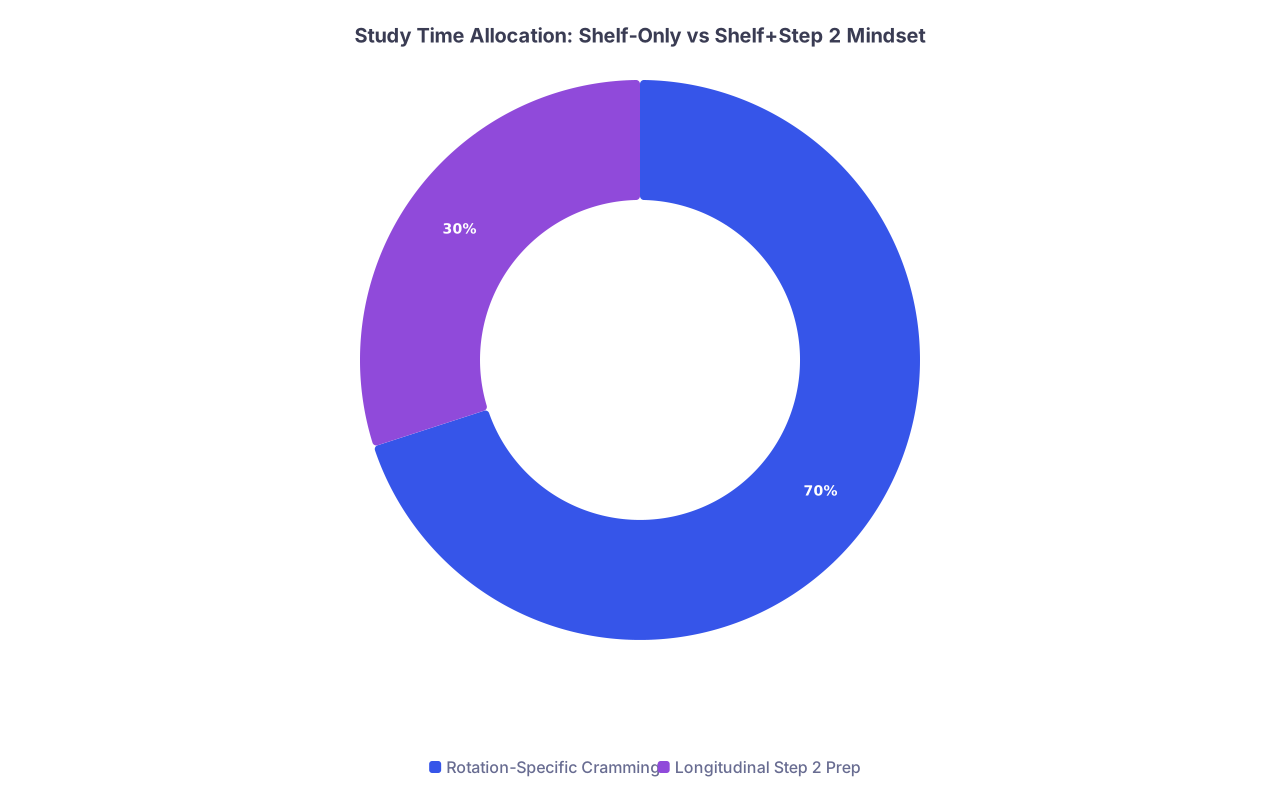
| Category | Value |
|---|---|
| Rotation-Specific Cramming | 70 |
| Longitudinal Step 2 Prep | 30 |
The students who do best on Step 2 flip those numbers by mid–third year. They’re still respecting shelves, but they’re using them as structured checkpoints toward the main exam, not isolated crises.
Red-Flag Shelf Patterns That Make PDs Nervous
Let me be direct—there are certain patterns that draw a red pen circle on your file.
1. Repeated Barely-Passes Without Improvement
One low shelf, fine. Everyone has an off month. But three or four shelves where you scrape by just above the passing cutoff, with no upward trend?
Faculty talk about this bluntly:
“If they’re struggling this much as a student with mostly exam-focused responsibility, how will they keep up as an intern with 60–80 hour weeks and in-training exams?”
The concern isn’t just knowledge. It’s bandwidth. Resilience. Adaptability.
2. Massive Discrepancy: One Stellar Shelf, Rest Mediocre
Another common pattern: Honors on surgery, everything else Pass. Or crushed psych, but IM, OB, peds all weak.
What this tells PDs:
- You might have self-selected into one thing you cared about and blew off the rest.
- Or your knowledge base is narrow and you haven’t learned to generalize.
Program directors don’t want a resident who only functions in their favorite rotation. Step 2 CK will punish lopsided depth.
3. Failures or Remediations of Shelves
You’re not dead in the water if you failed a shelf—but you do not get to ignore it.
Here’s what faculty look for if there’s a failure:
- Did the repeat shelf score jump substantially?
- Did you change your study approach, or did you just grind more hours of the same thing?
- Did your later shelves show improvement—especially in related content areas?
If the answer to those is “yes,” many PDs will label it a “growth story” and wait to see if Step 2 confirms the turnaround. If you fail and then hover near pass the rest of the year, they assume Step 2 is a liability.
How To Use This Knowledge To Shape Your Step 2 Prep
Enough about what PDs see. Here’s how you turn shelves into a weapon for Step 2 instead of a warning sign.
1. Treat Each Shelf as a Step 2 Block, Not a Separate Exam
On every rotation, you should be asking one question during your study time:
“How will this help me on Step 2?”
That means:
- Anchoring your prep in UWorld Step 2-style questions, even while doing rotation-specific resources.
- Building a single, ongoing notebook or digital log of missed questions that spans all rotations. No more separate psych binder, separate OB notes, etc. One integrated Step 2 brain.
2. Track Your Own Patterns The Way PDs Will
You should have your own “shelf trajectory” chart long before anyone else does. If you see:
- OB low, surgery low, IM low → this is not “bad luck.” It’s a systems problem.
- OB low, peds mid, IM decent → that’s an upward trajectory. Lean into what changed.
Ask yourself after every shelf:
- Was this content, question style, or discipline?
- Did I run out of time?
- Did I miss a lot of management questions vs diagnosis vs basic recall?
That level of honesty gives you a self-correcting mechanism that PDs wish more students used.
3. Front-Load Fixing Your Weak Systems
If you’ve already identified recurring weak areas—renal, neuro, OB—you cannot save those in the last 2–3 weeks before Step 2. That’s fantasy.
Use lighter rotations, research months, or elective time to do targeted:
- UWorld blocks by system
- Anki or your preferred spaced repetition on those topics
- 1–2 NBME “mini-blocks” specifically focused on your worst domains
You want your last 4–6 weeks before Step 2 to be global integration, not emergency remediation.
4. Use NBME Shelf-Like Assessments as Dress Rehearsals
When schools offer NBME practice exams, most students treat them as annoying extra hoops. Smart ones treat them as extremely expensive (but useful) Step 2 diagnostics.
Every NBME that looks, feels, and hurts like a real test gives you three advantages:
- You refine your timing strategy.
- You stress-test your stamina.
- You get another snapshot of your performance pattern.
The students who jump 10–20 points above their “predicted” Step 2 outcome are almost never the ones ignoring these opportunities.
FAQs
1. If my early shelves were weak but my later ones improved, will PDs still hold the early scores against me?
Not the way you fear. What matters more is the direction of the curve. If your first couple of shelves were rough and then you started consistently landing High Pass/Honors—especially on IM—that’s actually a positive narrative: you adapted, learned how to study, and grew. PDs are very open to “late bloomers” when the trajectory is convincing and Step 2 ultimately aligns with that improvement.
2. My school only reports clerkship grades, not raw shelf scores. Do PDs still infer Step 2 potential from that?
Yes. They don’t need the raw number. If every shelf-heavy clerkship (IM, surgery, peds, OB) is Honors or High Pass, that’s enough to label you a strong test taker. If you’ve got a mix of Pass and High Pass with no clear trend, they see you as mid-range with some volatility. The exact percentile isn’t required for them to build a working prediction of your Step 2 range.
3. How much can I realistically outperform my shelf pattern on Step 2 if I “finally take studying seriously”?
You can beat your pattern, but not by magic. If you’ve been mid-pack on all shelves and suddenly decide to grind for 6 weeks, you might jump 10–15 points above what your trajectory predicts—especially if your issue was discipline, not ability. But if your shelves showed deep content gaps across multiple systems for a full year, expecting a 30‑point leap on Step 2 is fantasy. Consistent work across third year sets your ceiling; dedicated prep helps you hit the top of that range, not teleport beyond it.
4. I failed one shelf but passed the repeat and did okay on others. Will that single failure kill my chances?
No, not by itself. What PDs look for is the pattern around the failure. If you retook the shelf and your score clearly improved, and your later shelves—especially IM—were solid, they’ll usually interpret that as a stumble, not a fundamental limitation. The real problem is when a failed shelf sits in the context of multiple barely-passing performances and no stepwise improvement. In that scenario, they’ll be worried until your Step 2 score proves otherwise.
Bottom line:
Your shelf exams are not isolated storms; they’re the weather pattern PDs use to forecast your Step 2 CK.
Internal Medicine and your overall trajectory carry far more weight than any single ugly month.
Use shelves deliberately—as early, smaller versions of Step 2—and you can turn what PDs see as “prediction” into proof that you’re exactly the kind of resident they want.