
The way most students “fix” a bad internal medicine rotation is wrong—and Step 2 CK punishes them for it.
You do not fix weak IM performance with vague promises to “study more.” You fix it with a clear, ruthless repair plan that targets exactly what Step 2 will test: reasoning with messy medicine, not memorizing lists.
Here is how to do that.
1. Get Honest About What “Weak IM” Actually Means
“Internal medicine was rough” is useless. You need a diagnosis, not a vibe.
Break your weak performance into specific failure modes. Step 2 CK hits all of them.
A. Identify Your Failure Pattern
Sit down with a sheet of paper and answer, brutally honestly:
On the wards, I most often felt lost when:
- A. Presenting patients
- B. Choosing tests
- C. Interpreting labs/imaging
- D. Writing plans
- E. Managing multiple problems at once
On your shelf or IM exams, which feedback applied:
- “You miss next best step questions”
- “You’re too slow”
- “You know facts but can’t apply them”
- “You miss subtle but important abnormalities”
- “You do not know your guidelines”
Which topics repeatedly embarrassed you on rounds?
- Electrolytes
- Acid–base
- Chest pain / dyspnea
- Diabetes / DKA / HHS
- Sepsis
- Renal failure
- Anticoagulation
- Antibiotics
Circle what stung. That is your Step 2 risk profile.
Now quantify how bad this is.
| Domain | Rating 1–5 (1 = awful, 5 = strong) |
|---|---|
| History + focused exam | |
| Presentations (concise, logical) | |
| Diagnostic reasoning | |
| Management / next best step | |
| Reading EKGs | |
| Labs & acid–base interpretation |
Anything 3 or below needs active repair, not hope.
2. Set a 4–6 Week Internal Medicine “Boot Camp” Before CK
You do not need a 6-month reinvention. You need 4–6 brutal, structured weeks where IM is priority #1 inside your Step 2 prep.
Here is the basic architecture:
- Duration: 4–6 weeks
- Daily time: 4–6 focused hours on IM (within your CK prep), depending on rotation demands
- Main tools:
- One primary IM text resource (Boards & Beyond, OnlineMedEd, or NBMEs + UWorld explanations as your “textbook”)
- UWorld Step 2 CK (all IM questions, timed and random)
- Anki (or any spaced repetition system) for key guidelines and algorithms
- A problem list of your own weaknesses that you update daily
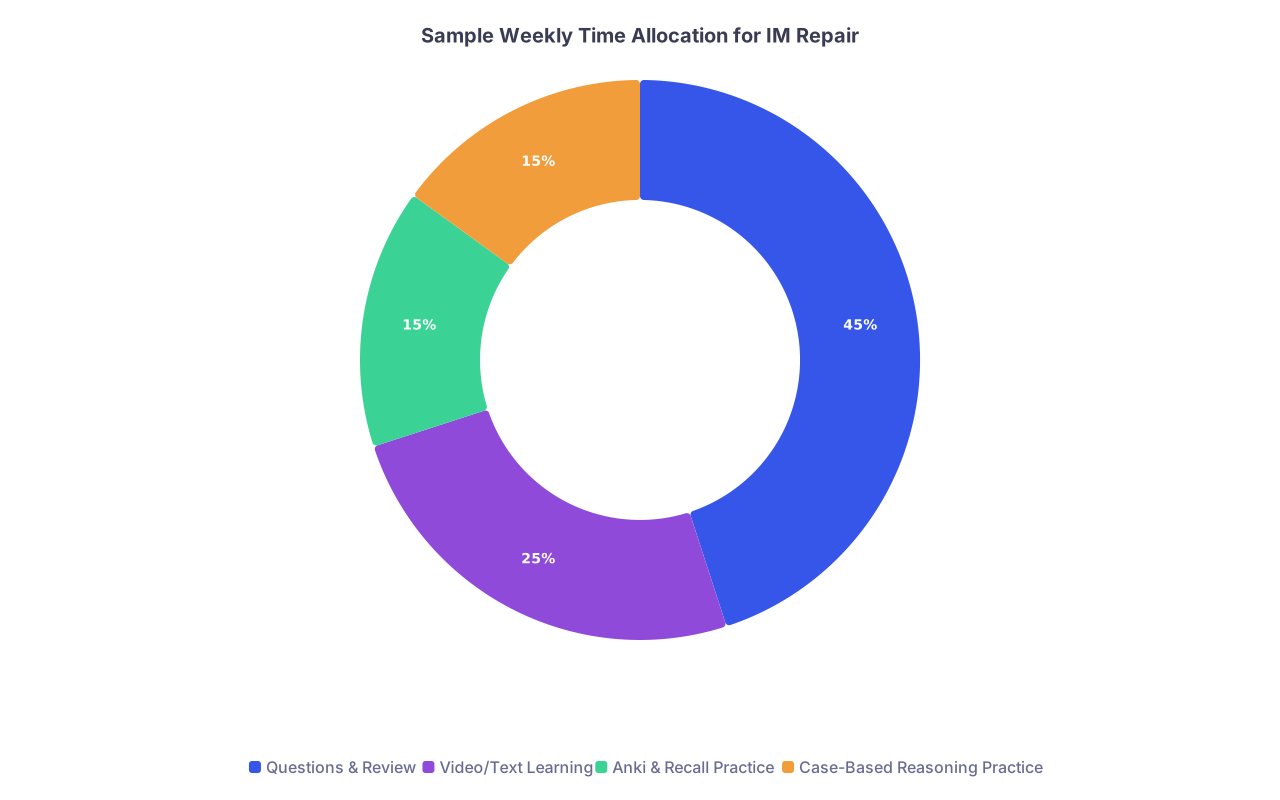
| Category | Value |
|---|---|
| Questions & Review | 45 |
| Video/Text Learning | 25 |
| Anki & Recall Practice | 15 |
| Case-Based Reasoning Practice | 15 |
The point is not to “get through resources.” The point is to train how you think on IM problems.
Weekly Structure (4–6 week block)
Every week:
- 300–400 UWorld IM questions (≈50–60 per day, 6 days/week)
- 3–5 high-yield video/topic blocks focused on your worst systems
- 1 focused “clinic note” session: practicing writing concise A/P for 3–5 cases
- 1 “charts & labs” session: acid–base, electrolytes, CBC/CMP interpretation, EKGs
If that sounds heavy, good. You do not fix a weak core discipline with half-effort.
3. Use UWorld IM Correctly (Most Students Don’t)
Most students “do UWorld” like this:
- Click through questions
- Glance at explanations
- Tell themselves “Ah yeah, I knew that”
That is not repair. That is self-soothing.
Here is the protocol I want you to use.
Step-by-Step UWorld IM Protocol
Timed, random IM blocks (no tutor mode)
- 40-question blocks when possible; minimum 20
- No pausing “to look something up”
- Force yourself to decide with incomplete info—like real medicine
On each question, explicitly name your failure (if you miss it):
- Misread the stem
- Missed key data point
- Knew diagnosis, missed next best step
- Did not know guideline
- Confused similar diagnoses (e.g., COPD vs CHF exacerbation)
- Management sequence error (e.g., imaging before stabilizing)
Write this in a narrow column on your scratch paper or a running log: Q# + failure type.
- In review, build “if–then” rules, not just flashcards
Bad: “Remember: for NSTEMI get heparin and aspirin.”
Better: “IF chest pain + troponin elevated + ST depressions or non-specific changes, THEN treat as NSTEMI: MONA + anticoagulation + beta blocker (if not contraindicated) + early cardiology.”
You want decision trees, not fact fragments.
- Tag and cluster questions by concept
At the end of each review session, write down 3–5 repeated concepts:
- “I keep messing up pneumonia severity scores and inpatient vs outpatient treatment.”
- “I mix up pre-renal vs ATN based on labs.”
- “I do not know when to cardiovert vs give meds in A-fib.”
Those become tonight’s or tomorrow’s short focused study targets.
- Spaced re-exposure
- Mark questions that represent “core errors” for you (even if you got them right by guessing).
- Re-do that subset every 1–2 weeks quickly to confirm that the rule stuck.
4. Patch the Core IM Content Gaps Fast
You probably do not need to re-learn “all of medicine.” You likely have 6–10 major leak points.
Here is a ruthlessly prioritized IM topic list for Step 2 CK, based on what I see students get hammered on:
| Priority | System / Topic Area | Why It Matters for Step 2 CK |
|---|---|---|
| 1 | Cardiology (ACS, HF, AF, valvular, HTN emergencies) | Constantly tested, heavy management |
| 1 | Pulm (COPD, asthma, PE, pneumonia, ARDS) | Diagnosis + acute management traps |
| 1 | Infectious disease (sepsis, meningitis, endocarditis, HIV basics) | Big “next best step” questions |
| 2 | Renal (AKI types, CKD, electrolytes) | Lab interpretation + treatment |
| 2 | Endocrine (DKA, HHS, thyroid storms, adrenal issues) | Emergency + outpatient decisions |
| 2 | Hematology/Onc (anemias, leukemias basics, transfusion) | Pattern recognition, algorithms |
| 3 | Rheum (SLE, RA, vasculitis basics, gout) | Less frequent but classic patterns |
| 3 | GI (GI bleed, liver disease, pancreatitis) | Workups + stabilization steps |
How to Fix a Weak Topic in 1–2 Days
Pick one topic cluster at a time (e.g., chest pain / ACS). Then:
Teach yourself a clean algorithm from one resource
- Example: Watch Boards & Beyond / OnlineMedEd ACS videos or read a concise section from a review book.
- Sketch the pathway:
- Risk factors → EKG + troponin
- STEMI vs NSTEMI vs unstable angina
- Acute management algorithm
Convert algorithm into 10–15 “if–then” statements
- IF STEMI + <90 min PCI available → immediate cath
- IF STEMI + no PCI → fibrinolysis within time window unless contraindicated
- IF NSTEMI → anticoagulation + risk stratify + early invasive
Do 20–40 targeted UWorld questions on that topic
- Review every explanation and test your algorithm.
- Update your if–then list after seeing actual question traps.
Create 5–10 Anki cards focused on decision points
- One card = one decision. Not an essay.
- “First test in suspected PE in low pretest probability but with risk factors?”
- “Management of AF with RVR in hemodynamically unstable patient?”
Next day: recall test without notes
- On blank paper, draw the algorithm from memory. Do 10 new questions on the same topic.
- If you cannot reconstruct the algorithm, you do not own it yet.
5. Fix the Two Huge IM Skills Step 2 Exposes: Labs & EKGs
Most “weak IM” students are actually bad at pattern recognition in objective data. Step 2 CK leans hard on this.
A. Labs & Acid–Base: A 3-Session Fix Protocol
You do not need an entire nephrology fellowship. You need to stop panicking when you see:
- Na: 121
- HCO3-: 16
- pH: 7.29
- BUN/Cr ratio: 25
Three 90-minute sessions can dramatically change this.
Session 1: Acid–Base
- Learn one simple method and stick to it (I prefer: stepwise interpretation with Winter’s formula).
- Practice:
- Identify: metabolic vs respiratory, acidosis vs alkalosis.
- Calculate expected compensation.
- Check for mixed disorders with 5–10 example ABGs.
Session 2: Electrolytes (Na, K, Ca)
- Make micro-algorithms:
- Hyponatremia:
- True hypo vs pseudohyponatremia
- Volume status (hypo / eu / hypervolemic)
- Treatment thresholds (severe symptoms → hypertonic saline)
- Hyperkalemia:
- EKG changes
- Stabilize (calcium) → shift (insulin + glucose, beta-agonists) → remove (diuretics, dialysis)
- Hyponatremia:
Session 3: AKI & Renal Patterns
- Pre-renal vs intrinsic vs post-renal:
- BUN/Cr, FeNa, urine osms, sediment clues.
- Build an if–then:
- IF FeNa <1% + high BUN/Cr + bland sediment → likely pre-renal.
Then hammer 20–30 UWorld questions or NBME-style questions focused on labs after each session.
B. EKGs: Stop Being Afraid of the Squiggles
You do not need to be a cardiologist. You do need to easily recognize:
- A-fib, A-flutter
- SVT
- VT/VF
- STEMI vs NSTEMI patterns
- Heart blocks (1st, 2nd Mobitz I/II, 3rd)
- Hyperkalemia pattern
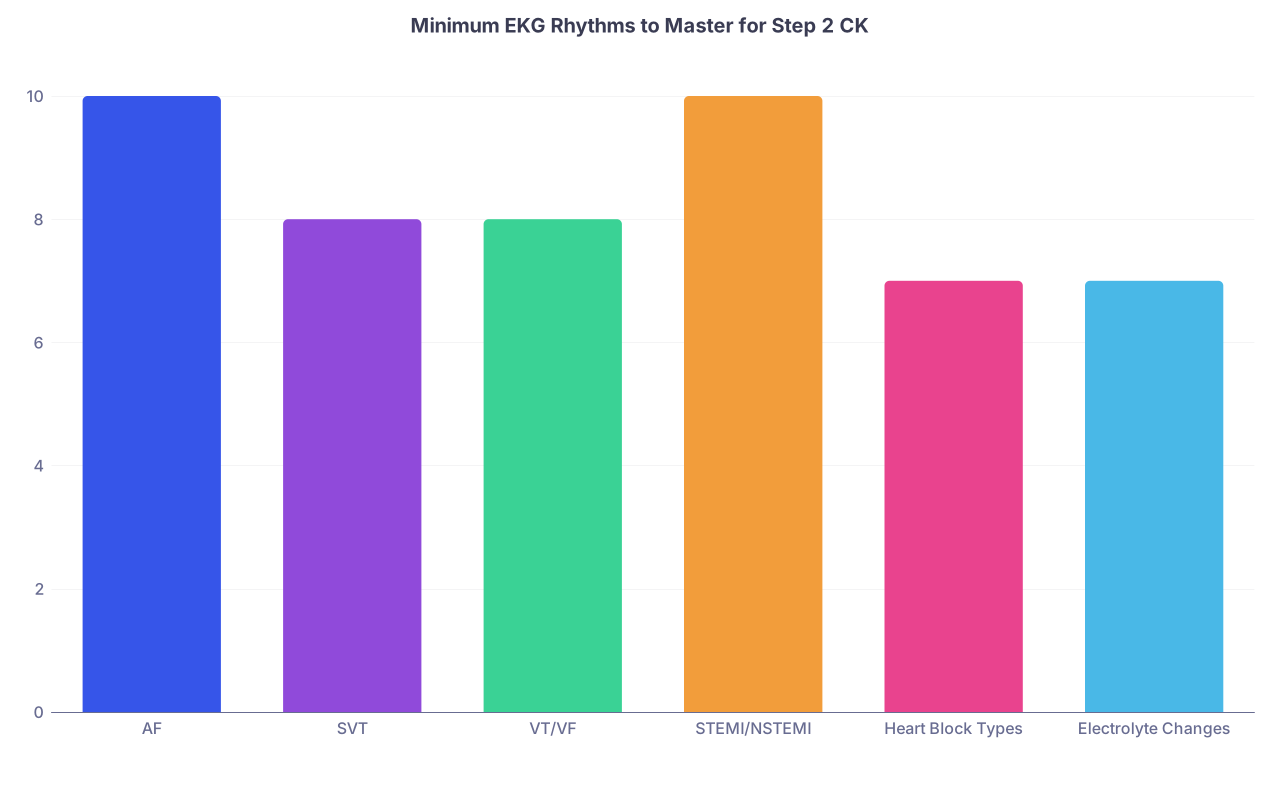
| Category | Value |
|---|---|
| AF | 10 |
| SVT | 8 |
| VT/VF | 8 |
| STEMI/NSTEMI | 10 |
| Heart Block Types | 7 |
| Electrolyte Changes | 7 |
Four short sessions:
- Session 1: Rhythm basics
- AF vs atrial flutter vs SVT vs sinus tachycardia.
- Session 2: Ischemia & infarct
- STEMI regional patterns, reciprocal changes.
- Session 3: Heart blocks
- One strip each; memorize the pattern and the associated management.
- Session 4: Electrolyte and drug effects
- Hyperkalemia, digoxin, QT prolongation.
Use a simple pocket EKG book, a dedicated EKG section in your review resource, or a curated online set. Then:
- Attach 1–2 EKGs to several UWorld cases per review session.
- Pause: identify rhythm before looking at explanation.
6. Turn Ward Weakness into Outpatient-Level Reasoning
Step 2 CK questions are not written like your inpatient sign-outs. They are written like “clinic physician reasoning under pressure”.
Your IM issues on the wards likely showed up as:
- Rambling presentations
- Over-ordering tests
- Weak prioritization of problems
You can fix a lot of this away from patients.
A. Practice “One-Sentence Diagnosis + Plan” Drill
Take 10 UWorld IM questions (even ones you have seen) or case vignettes. For each:
- Before looking at options, write:
- 1-line problem representation:
“65-year-old man with long-standing HTN and DM presenting with acute SOB, orthopnea, and bilateral leg edema suggesting decompensated heart failure.”
- 1-line problem representation:
- Then write a 3–5 bullet plan:
- Immediate management (O2, diuretics, nitrates if BP allows)
- Diagnostics (CXR, BNP, EKG, troponins, echo)
- Monitoring / disposition (admit to telemetry vs ICU)
Do this repeatedly. Your brain will start auto-generating structured plans on Step 2 questions.
B. SOAP Note Practice with Real IM Cases
Once a week, take 3 practice cases (e.g., from UWorld or casebooks) and write:
- S: Concise chief complaint + key positives/negatives.
- O: Vitals + 3–5 critical exam or lab findings.
- A: Problem list with working diagnosis and differential for each.
- P: Specific next steps (meds, tests, follow-up).
This rewires you to think like Step 2 CK wants: prioritizing and planning, not dumping facts.
7. Build a Focused IM Review Plan Inside Your CK Timeline
You are not studying IM in a vacuum; Step 2 is everything. The trick is: front-load IM early in your dedicated or pre-dedicated period, then maintain it.
Here is a sample 6-week before CK schedule where IM was your weak spot:
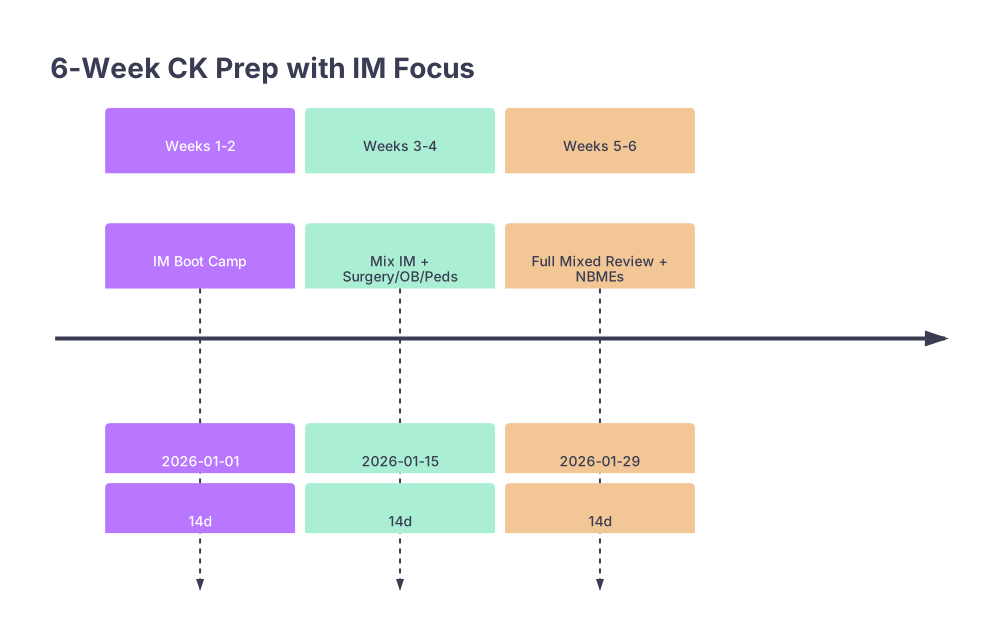
| Period | Event |
|---|---|
| Weeks 1-2 - IM Boot Camp | 2026-01-01 |
| Weeks 3-4 - Mix IM + Surgery/OB/Peds | 2026-01-15 |
| Weeks 5-6 - Full Mixed Review + NBMEs | 2026-01-29 |
Weeks 1–2: IM-heavy repair
- 60–70% of questions = IM
- Daily:
- 2 UWorld blocks (at least 1 pure IM)
- 1–2 hours of IM video/text on weak systems
- 30–45 min Anki focused on IM algorithms
Weeks 3–4: Integrated but IM-biased
- 40–50% IM, rest other specialties.
- Re-hit your worst IM systems with targeted practice.
- Take 1 NBME/CCS-style exam and scrutinize IM misses.
Weeks 5–6: Fully mixed, IM maintained
- Random blocks across all systems.
- Focus on test-taking, endurance, timing.
- For each practice exam, tag IM misses and do rapid-topic repairs.
Track your improvement objectively:
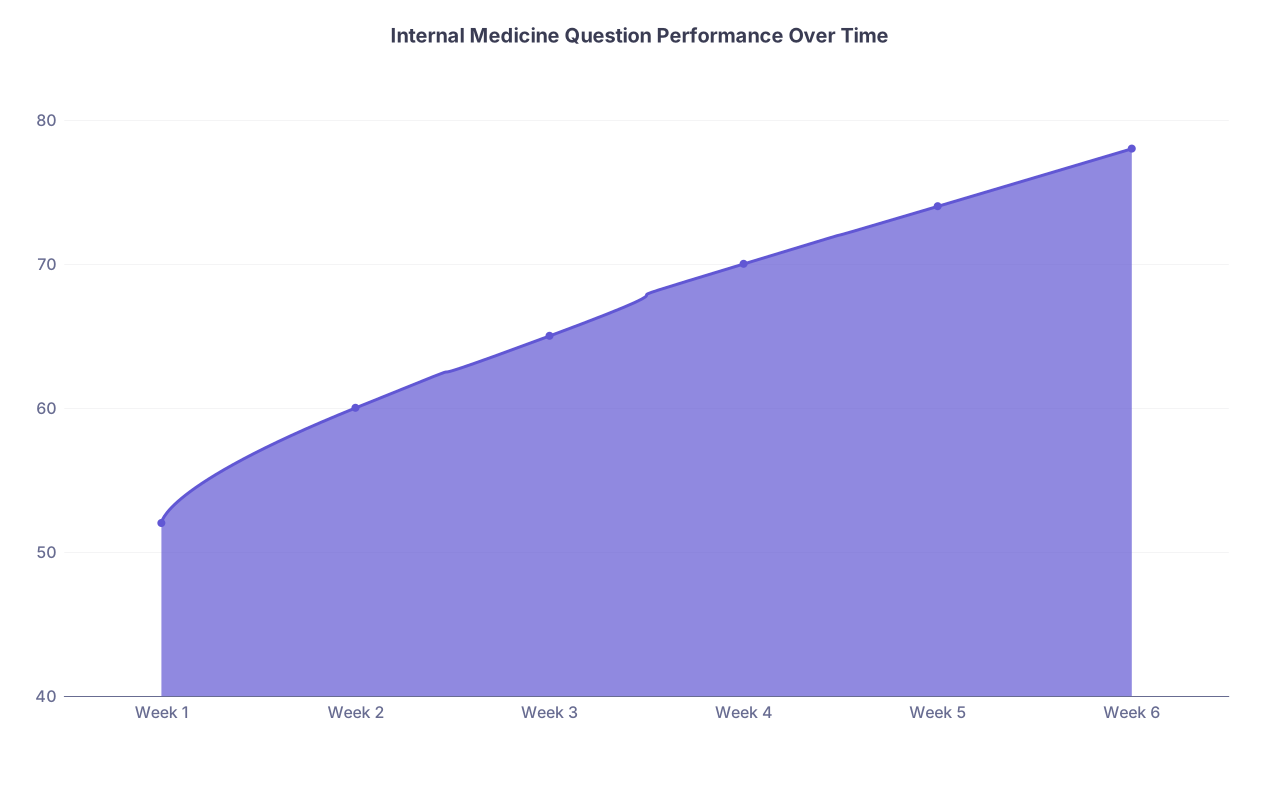
| Category | Value |
|---|---|
| Week 1 | 52 |
| Week 2 | 60 |
| Week 3 | 65 |
| Week 4 | 70 |
| Week 5 | 74 |
| Week 6 | 78 |
If your IM percentage is not moving up week to week, you are either:
- Not reviewing deeply enough, or
- Not targeting the specific failure modes you identified earlier
Adjust accordingly.
8. Fix Your Test-Taking Behavior, Not Just Your Knowledge
Weak IM performance is rarely just “not knowing enough.” It is often how you approach questions under time pressure.
You need to explicitly correct:
A. Anchoring and Premature Closure
Pattern I see constantly:
- You see “COPD, smoker, wheezing” and stop thinking.
- You miss the fact that the patient has fever, focal consolidation, and rusty sputum.
Drill: For each missed IM question, write:
- What early assumption did I make?
- What piece of data should have broken that assumption?
Put those on a one-page sheet titled: “My IM Cognitive Traps.” Read it daily for a week.
B. Not Using the Question Stem Fully
Too many students jump to options after 2–3 lines.
Fix:
- Force yourself to summarize the case before looking at choices.
- Cover the answer choices with your hand or a sticky note if you must.
- State out loud or in your head:
- “This is X-year-old with Y history, now Z presentation, most likely diagnosis is __, next step is __.”
Only then look at answers. You will be shocked how many “hard” questions become trivial when you do this.
C. Time Management Problems on IM-Heavy Blocks
Internal medicine vignettes tend to be long. If you are slow, you need a time discipline rule:
- If you hit 75 seconds and are still scanning the stem, stop reading and answer with best interpretation.
- If you do not know, pick and move on in under 15 seconds.
You salvage more points by finishing the block than by over-investing in one monster question.
9. Use Real-World Feedback If You Are Still on Rotations
If you have another IM or IM-adjacent rotation before Step 2, use it as a live-fire training ground.
A. Ask for Targeted Feedback, Not Vibes
Do not ask: “How am I doing?”
Ask: “On a scale of 1–10, how clear are my assessments and plans on our medicine patients?”
Then: “What is one concrete thing I could do tomorrow to make them a 9 or 10?”
Examples of what I have heard from attendings:
- “You present too much fluff. Get to problem and plan faster.”
- “You do not commit to a diagnosis; you list 12 possibilities.”
- “You order labs reactively; you do not know what you are looking for.”
Take that and build one-day micro-goals:
- Tomorrow’s goal: Every presentation ends with 1-line problem representation and 3 concrete plan steps.
B. Practice “Attending Hat” Once a Day
Pick one patient you are following:
- Imagine you are the attending.
- Without looking up anything, write:
- Final working diagnosis, top 2 alternatives, what you are treating with, and what would make you change course.
Later, compare to your attending’s actual plan. Where you differ is exactly where Step 2 will test you.
10. Stop the Psychological Bleed: Reframing “Weak IM” Before CK
You cannot go into Step 2 carrying a mental narrative of “I am bad at medicine.” That story will sabotage every long vignette.
You need to reframe deliberately:
A. Separate Past Performance from Current Trajectory
Your internal medicine clerkship grade was:
- Based on partial knowledge
- Under high stress
- Influenced by personalities, random patients, call schedules
Step 2 CK is:
- Standardized
- Objective
- 100% in your control from this point forward
If you are doing the work above and your question percentages are climbing, you are not “weak at IM.” You are “someone who was weak but is actively fixing it.”
B. Build Evidence of Competence
Once a week, write a short list:
- 3 IM topics I am clearly better at now:
- Example: “I can now confidently manage DKA step-wise.”
- “I do not confuse COPD vs CHF exacerbation anymore.”
- “I can interpret a basic ABG without panic.”
This is not fluff. It is how you override the “I suck at this” loop with actual data.
Today’s Action Step
Do not “bookmark” this and move on. You fix internal medicine weakness by turning this into concrete action today.
Right now, do these three things:
Write your IM failure profile
On paper, list:- 3 specific situations where you felt lost on IM
- 3 topic areas you consistently struggle with
- 3 test-taking habits that hurt you on IM questions
Build a 2-week IM repair mini-plan
For each of the next 14 days, schedule:- One 40-question UWorld IM block (timed, random)
- 45–60 minutes on ONE weak topic (videos + notes)
- 15–20 minutes of Anki or recall practice on IM algorithms
Choose one system to fix first and start tonight
Pick from: cardiology, pulm, renal, endocrine, or ID.
Open your resource of choice and sketch ONE algorithm (e.g., chest pain, dyspnea, sepsis) on paper. Tomorrow, test it with 20–30 targeted questions.
That is how you stop being the student who “struggled in internal medicine” and become the one who walks into Step 2 CK with IM as a strength, not a liability.