
The United States Medical Licensing Examination (USMLE) Step 2 Clinical Knowledge (Step 2 CK) is more than just another test—it’s a high‑stakes exam that showcases your ability to apply clinical knowledge in real-world scenarios. For residency program directors, Step 2 CK is increasingly important in evaluating applicants, especially since Step 1 became pass/fail.
With thoughtful planning, smart Study Strategies, and a sustainable mindset, you can transform anxiety into confidence and perform at your best. This guide breaks down how to prepare effectively, from understanding the exam blueprint to optimizing your clinical rotations and test‑day performance.
Understanding Step 2 CK: Format, Content, and Its Role in Medical Licensing
Before building a study plan, you need a clear view of what Step 2 CK is testing and why it matters for Medical Licensing and residency applications.
Exam Structure and Format
Step 2 CK is a one‑day, computer‑based exam designed to test your Clinical Knowledge and its application to patient care.
Key features:
- Question Type: Single‑best‑answer multiple‑choice questions (MCQs), often in the form of clinical vignettes.
- Length: Up to 9 hours total, including:
- Eight 60‑minute blocks
- Each block contains up to 40 questions
- Maximum of 318 questions in total
- Break Time: 45 minutes of break time plus 15 minutes for the tutorial (which you can add to break time if you skip or shorten the tutorial).
This structure makes stamina, focus, and time management just as crucial as content mastery.
Content Areas and Clinical Emphasis
Step 2 CK emphasizes the application of clinical science to patient management. Major tested disciplines include:
- Internal Medicine
- Surgery
- Pediatrics
- Obstetrics and Gynecology
- Psychiatry
- Emergency Medicine
- Preventive Medicine and Public Health
Cross‑cutting topics:
- Diagnostic reasoning and interpretation of labs/imaging
- Management plans (initial, next best step, long‑term)
- Ethics, professionalism, and patient safety
- Communication and informed consent
- Systems‑based practice and quality improvement
Questions are often multilayered clinical vignettes where you must integrate history, physical exam, and test results to determine the most appropriate next step in diagnosis or management.
Scoring and Why Step 2 CK Matters for Residency
- Score range: 1–300
- Passing score: Typically around 209 (check the USMLE website for current cutoffs)
- Competitive scores: Vary by specialty, but many applicants aim for 240+ to strengthen their applications for more competitive programs.
Residency programs increasingly use Step 2 CK scores to:
- Differentiate applicants in the absence of a numeric Step 1 score.
- Assess readiness for clinical responsibilities.
- Predict performance on in‑training exams and specialty board exams.
Your Step 2 CK performance is one of the few standardized metrics program directors can compare directly across schools and countries—making smart, strategic USMLE Preparation essential.
Building a High‑Yield Step 2 CK Study Plan
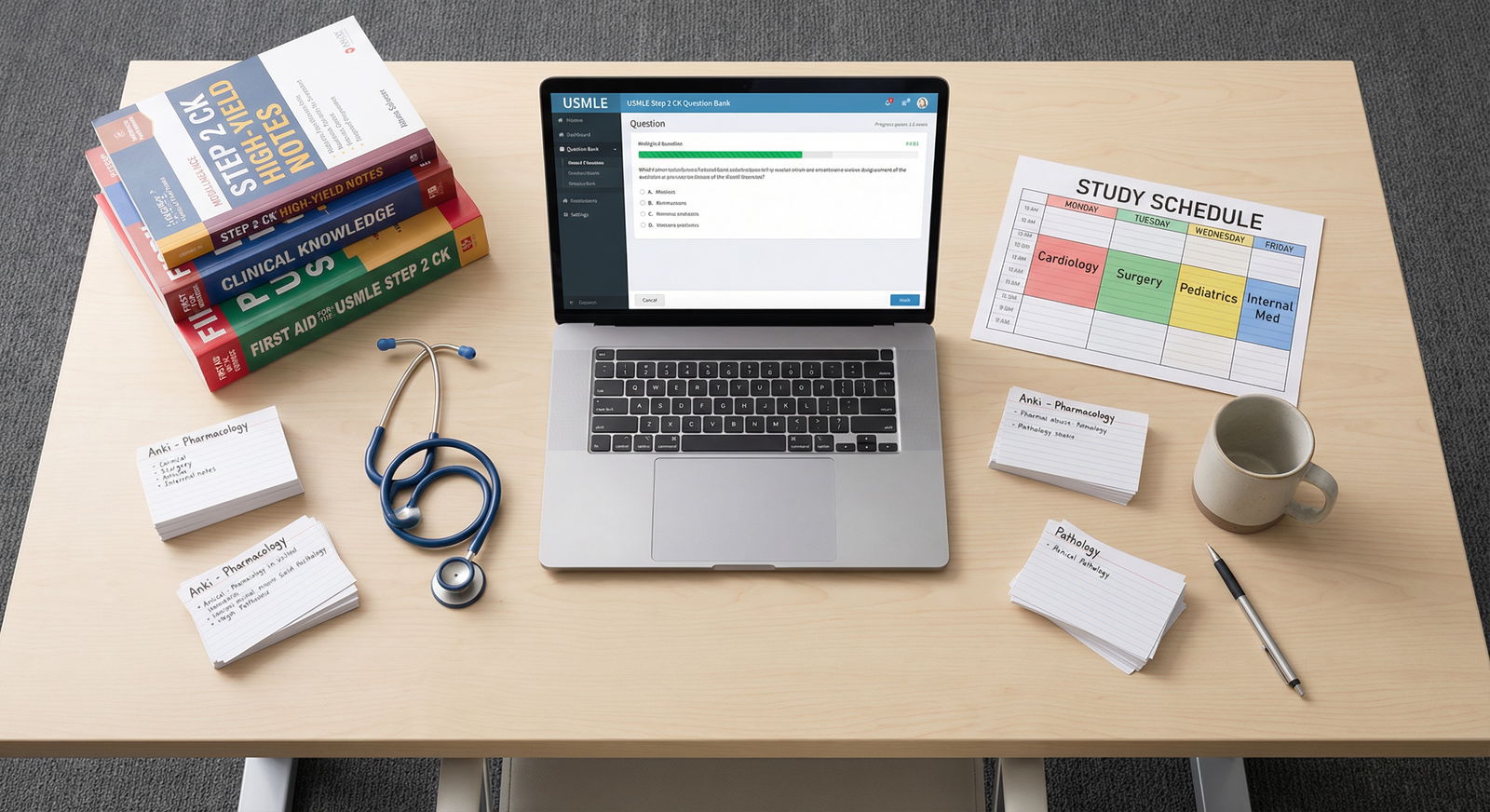
The most powerful Study Strategies start with a personalized, realistic plan. A good schedule balances clinical rotations, question banks, content review, and rest.
Step 1: Determine Your Timeline and Baseline
Your timeline depends on:
- Clerkship schedule
- Existing obligations (research, sub‑internships, family)
- Baseline performance (e.g., NBME or UWorld self‑assessment)
Typical dedicated study periods:
- 4–6 weeks of full‑time study after core clerkships for many students
- 8–12 weeks of combined “during rotations + shorter dedicated” time for those with heavier schedules or who prefer slower pacing
Start with a diagnostic assessment:
- Take an NBME Comprehensive Clinical Science Self‑Assessment or a UWorld Self‑Assessment early.
- Use the results to identify:
- Strong subjects (e.g., pediatrics, psychiatry)
- Weak areas (e.g., OB/GYN, infectious disease, biostatistics)
Step 2: Set Clear, Measurable Goals
Use concrete goals to guide your study days:
- Content goals
- Example: “Finish Internal Medicine and Pediatrics videos/chapters by week 2.”
- Question‑based goals
- Example: “Complete 80–120 UWorld questions per day during dedicated.”
- Score goals
- Example: “Increase self‑assessment scores by 10–15 points before test day.”
Keep goals adjustable—Step 2 CK preparation is iterative. Reassess weekly based on your progress.
Step 3: Design Your Weekly and Daily Study Structure
A balanced daily structure during dedicated might include:
- Morning (3–4 hours)
- Timed blocks of UWorld or AMBOSS questions (40–80 questions)
- Immediate review of rationales and notes
- Afternoon (3–4 hours)
- Targeted content review (videos, notes, or First Aid)
- Anki/flashcards using spaced repetition
- Evening (1–2 hours)
- Light review: missed questions, high‑yield tables, or short videos
- Planning next day’s focus
During rotations (pre‑dedicated):
- Aim for 20–40 questions per day, focusing on the subject of your current clerkship.
- Use short, high‑yield review resources during downtime or commute.
Choosing and Using Step 2 CK Resources Strategically
The strongest USMLE Preparation is not about collecting resources—it’s about mastering a few and using them well.
Core Question Banks: Your Primary Learning Tool
Question banks are the backbone of Step 2 CK preparation. Among the most widely used:
UWorld Step 2 CK
- Considered the gold standard for Step 2 CK.
- High‑quality clinical vignettes and detailed explanations.
- Built‑in biostatistics, ethics, and management scenarios.
How to use UWorld effectively:
- Complete 100% of the question bank, ideally once in timed, random mode.
- During dedicated, aim for 2 blocks (80 questions) per day with thorough review.
- For each question:
- Understand why the correct answer is right.
- Understand why each wrong option is wrong.
- Take concise notes or create Anki cards for concepts you miss.
AMBOSS
- Comprehensive library integrated with a high‑yield question bank.
- Excellent for quick reference on unfamiliar topics and “why” behind pathophysiology.
Best uses:
- As a secondary Qbank after or alongside UWorld.
- For targeted practice (e.g., OB/GYN, surgery, biostatistics) based on weak areas.
- During clerkships for just‑in‑time learning on specific clinical problems.
High‑Yield Content Review Resources
Use focused resources to consolidate and reinforce patterns you see in question banks.
Commonly used:
First Aid for the USMLE Step 2 CK
- Concise summaries and tables for rapid review.
- Best used to reinforce what you learn from questions, not as a primary text.
Online MedEd
- Structured video lectures organized by specialty.
- Excellent for building a solid conceptual foundation during or after rotations.
- Use videos + notes as a framework, then deepen with Qbank learning.
NBME Practice Exams
- Official test‑style questions and scaled scores.
- Use 2–3 forms spaced out during your prep:
- One at the start to set a baseline.
- One midway to gauge progress.
- One 2–3 weeks before test day to fine‑tune.
Supplementary Tools: Flashcards and Rapid Review
Anki / digital flashcards
- Perfect for spaced repetition of high‑yield facts, diagnostic criteria, and algorithms.
- Use premade Step 2 CK decks or create your own from UWorld mistakes.
Rapid‑review notes
- High‑yield lists (e.g., “next best step in management” tables, antibiotic choices, pregnancy medication safety).
- These are ideal for the last 1–2 weeks of review.
Active Learning Strategies to Deepen Clinical Knowledge
Step 2 CK rewards clinical reasoning over rote memorization. Your Study Strategies should prioritize active, application‑focused learning.
Mastering Practice Questions: Quality Over Quantity
Doing thousands of questions without reflection is inefficient. Instead:
Treat every question like a mini‑teaching session.
- Ask:
- “What is the underlying pathophysiology?”
- “What key findings pointed to this diagnosis?”
- “What are related conditions they could have asked about?”
- Ask:
Do blocks in timed mode.
- Simulates exam pressure and improves pacing.
- Aim for 60–75 seconds per question on average.
Review systematically.
- Focus most on:
- Incorrect questions
- Guesses that happened to be right
- Topics you have repeatedly missed
- Focus most on:
Tag or track weak topics.
- Keep a simple log: “Missed questions on asthma management, neonatal jaundice, anticoagulation bridging.”
- Revisit related resources or videos for those topics.
Leveraging Clinical Rotations to Strengthen Step 2 CK Prep
Your clerkships are live Step 2 CK study time. Integrating exam prep into daily clinical work can dramatically improve retention.
Practical strategies on rotations:
Pre‑round micro review
- If you know you’ll see COPD, CHF, or preeclampsia today, review 5–10 high‑yield facts or a short summary before rounds.
Use real patients as anchors
- For each interesting patient, later ask:
- “What would the Step 2 CK question on this case look like?”
- “What ‘next best step’ might they test?”
- For each interesting patient, later ask:
Ask targeted questions
- When unsure, ask your residents or attendings:
- “What is the best initial test in this scenario?”
- “How would this differ in pregnancy or pediatrics?”
- When unsure, ask your residents or attendings:
Keep a brief clinical learning journal
- Jot down:
- Diagnosis
- Key findings
- Management pearls
- Transfer important pearls into your flashcards or notes for long‑term retention.
- Jot down:
Active Recall and Spaced Repetition
These techniques are crucial for long‑term retention of Clinical Knowledge:
Active recall
- Instead of re‑reading, close your notes and ask:
- “What are the diagnostic criteria for major depressive disorder?”
- “What is the treatment sequence for STEMI?”
- Then check yourself.
- Instead of re‑reading, close your notes and ask:
Spaced repetition
- Schedule content to be revisited at expanding intervals (1 day, 3 days, 1 week, 2 weeks).
- Anki or similar apps automate this for you.
Teaching Others to Learn More Deeply
Explaining a topic forces you to clarify your own understanding.
- Form a small study group (2–4 people).
- Assign topics (e.g., hyponatremia, asthma, prenatal care).
- Have each person “teach” the others in 10–15 minutes, focusing on:
- Classic presentations
- Workup algorithms
- Most likely exam pitfalls
If you can teach it clearly, you’re much more likely to recall it under exam pressure.
Managing Stress, Maintaining Wellness, and Simulating Test Day
Step 2 CK is a mental marathon. Your performance depends on both knowledge and your ability to stay calm and focused for 9 hours.

Mindfulness and Mental Resilience
Chronic stress and burnout can undermine even the best study plan. Incorporate basic wellness strategies into your USMLE Preparation.
Mindfulness tools:
Short daily meditation (5–10 minutes)
- Apps like Headspace, Calm, or free YouTube sessions.
- Focus on breath awareness or body scan techniques.
Brief movement breaks
- Stand up, stretch, walk around your room or hallway every 60–90 minutes.
- Reduces fatigue and improves focus.
Journaling for perspective
- Once a week, write:
- What went well
- What you learned
- One specific thing you’ll do differently next week
- Once a week, write:
Physical Health and Sleep Hygiene
Your brain needs fuel and rest to consolidate all the Clinical Knowledge you’re absorbing.
Sleep
- Aim for 7–8 hours per night, especially in the final 2 weeks.
- Avoid all‑night cramming—sleep loss impairs decision‑making and recall.
Nutrition
- Prefer balanced meals with protein, complex carbs, and healthy fats.
- Stay hydrated; keep a water bottle at your desk.
- Avoid excessive caffeine and sugar spikes.
Exercise
- Even 20–30 minutes of walking, jogging, or yoga 3–4 times weekly can reduce anxiety and improve concentration.
Full‑Length Mock Exams: Crucial for Test‑Day Readiness
Simulating the real exam experience helps reduce anxiety and calibrate your pacing.
How to use mock exams:
Take at least one full‑length practice test (8 blocks) under realistic conditions:
- Quiet space
- Timed blocks
- Scheduled breaks only
Recommended practice tools:
- NBME forms (official style and feel)
- UWorld Self‑Assessments
After each mock exam:
Review all incorrect and guessed questions.
Identify patterns in your mistakes:
- Rushing?
- Misreading the question stem?
- Weakness in specific content areas (e.g., renal, OB, psych)?
Adjust your remaining study days based on these insights.
Test‑Day Strategies
On exam day:
Night before
- Avoid heavy new studying.
- Skim high‑yield notes if helpful, but prioritize sleep.
- Pack essentials: scheduling permit, ID, snacks, water, any allowed comfort items.
During the exam
- Pace yourself: 1 question per ~75 seconds.
- If stuck, make your best guess, mark the question, and move on.
- Use breaks strategically: short breaks after every 1–2 blocks to eat, hydrate, and reset.
Mindset
- Expect a mix of easy, moderate, and very hard questions.
- Do not panic if a block feels challenging; everyone receives challenging content.
- Focus on the present question, not past mistakes.
Conclusion: A Strategic, Sustainable Approach to Step 2 CK Success
Mastering Step 2 CK is not about memorizing every fact in medicine—it’s about building strong clinical reasoning, using targeted Study Strategies, and maintaining your mental and physical health throughout the process.
A successful approach includes:
- Understanding the exam format and what it truly tests
- Creating a structured, flexible study plan grounded in question‑based learning
- Choosing high‑quality, focused resources and avoiding resource overload
- Making your clinical rotations work for you by integrating real patients with exam‑style reasoning
- Practicing active recall, spaced repetition, and teaching to deepen understanding
- Prioritizing stress management, sleep, and wellness
- Using mock exams and NBME assessments to refine your test‑day performance
With consistent effort and thoughtful preparation, you can walk into your Step 2 CK exam feeling prepared, confident, and ready to perform at your best—bringing you one step closer to your Medical Licensing goals and the residency you want.

Step 2 CK FAQ: Common Questions Answered
1. How long should I prepare for Step 2 CK?
Most students spend 6–10 weeks in focused preparation, but the ideal length depends on:
- How strong your clinical rotation performance has been
- Your baseline NBME/UWorld self‑assessment scores
- How much time per day you can dedicate while on rotations
A common pattern:
- During rotations: 2–4 months doing 20–40 questions per day.
- Dedicated period: 4–6 weeks of full‑time USMLE Preparation with 80–120 questions per day plus content review.
Adjust this based on your progress and practice exam performance.
2. Is UWorld alone enough to do well on Step 2 CK?
UWorld is an essential resource and, for many, the single most important tool. However:
- UWorld alone may not fully address:
- Foundational understanding of weaker subjects
- Gaps in biostatistics, ethics, or rare topics
- Most students benefit from supplementing UWorld with:
- Online MedEd or equivalent videos for conceptual clarity
- First Aid or similar summaries for quick revision
- NBME practice exams to calibrate scoring and question style
Think of UWorld as the core, and other resources as supporting tools.
3. How many practice exams should I take before Step 2 CK?
Aim for 2–4 practice exams total, spaced through your prep:
- 1 early on (NBME or UWorld SA) for baseline
- 1 mid‑prep to evaluate improvement and adjust your plan
- 1–2 in the final 3–4 weeks to fine‑tune pacing and confirm readiness
The key is quality review of each exam, not just the number taken.
4. Should I focus more on my weak areas or strengthen my strong areas?
You need a balanced approach:
- Early in your prep:
- Emphasize weak areas to raise them to a safe baseline.
- Mid‑to‑late prep:
- Maintain your strong areas with periodic review.
- Continue targeted work on lingering weaknesses identified through question banks and NBME results.
Neglecting strong areas entirely can lead to unexpected drops in performance; don’t ignore what you’re already good at.
5. How can I balance Step 2 CK studying with busy clinical rotations?
Balancing clinical duties and exam prep is challenging but manageable with structure:
- Set a minimum daily study goal (e.g., 20–40 questions + 20–30 minutes of review).
- Use small pockets of time:
- Commute (audio lectures or key concept review)
- Lunch breaks (a few questions)
- Evenings (short, focused study blocks)
- Align your studying with your current rotation:
- On pediatrics rotation, prioritize peds questions.
- On OB/GYN, shift to OB/GYN‑heavy question sets.
Consistency, even with smaller daily doses, compounds over months and sets you up for a more efficient dedicated study period.
For more detailed guidance on Step 2 CK, other USMLE exams, and Medical Licensing pathways, explore additional resources and planning tools tailored to medical students and residency applicants.