
How many times have you heard a classmate say, “I’m doing UWorld, AMBOSS, and Kaplan… and maybe Boards & Beyond questions if I have time”? And how many of those people actually look less prepared and more burned out?
Let’s cut through the mythology: no, you do not need three or four question banks for Step 2 CK. In fact, for most people, that shotgun approach is objectively worse.
I’m going to walk through what we actually know from data, what NBME and score correlations suggest, and what I’ve seen over and over in real students’ score reports. And I’ll tell you bluntly where the multi-qbank religion comes from—and why it keeps getting repeated despite weak evidence.
What Step 2 CK Actually Tests (Not What Reddit Thinks)
Step 2 CK is not a scavenger hunt for obscure facts. It’s an applied reasoning exam built around patterns: diagnosis, next best test, next best step, management escalation, complications.
The National Board of Medical Examiners (NBME) publishes content outlines and practice forms. There’s no line in there that says:
“High scorers must complete 10,000+ mixed vendor questions.”
What the exam does reward consistently:
- Pattern recognition of common inpatient and outpatient scenarios
- Comfort with management guidelines and algorithms
- Stamina and timing across long, dense blocks
- Ability to filter noise from the stem and anchor to the key decision point
Notice something? All of these can be built with one well-designed, exam-style qbank plus targeted review. Multiple qbanks don’t magically create new patterns; they mostly repeat the same clinical scenarios with slightly different wording and UI.
The Step 2 CK curve punishes shallow repetition and rewards depth. And depth is exactly what many students sacrifice when they chase qbank quantity.
Where the “3+ Qbanks” Myth Comes From
This multi-qbank fetish didn’t appear out of nowhere. It’s a mix of:
Anecdotes from outliers
The 260+ person who says, “Yeah, I did UWorld twice, then all of AMBOSS and OnlineMedEd questions.” People copy the behavior without noticing the context:- They had strong Step 1 / shelf foundations.
- They often studied for much longer than you realistically can.
- They usually under-report how good their baseline was.
Confirmation bias
Someone uses three qbanks and scores well. They attribute causation: “It must be the number of qbanks,” not “I already knew most of this from strong clerkships and NBMEs.”Marketing and FOMO
Every commercial company has one job: convince you that their questions are the missing piece. Not “a” piece. The piece. Add Reddit echo chambers and you get the familiar vibe:“You’re not using AMBOSS? Bro, you’re leaving points on the table.”
Misinterpretation of test-retest anecdotes
You’ll hear: “I failed using only one qbank, then I used 3 and passed.”
What changed? Usually:- Time spent with dedicated review
- Doing incorrects properly
- More NBME practice and feedback
- Actually learning from explanations instead of plowing through blocks
But the student will say: “More qbanks fixed it.” Easy story. Wrong conclusion.
Let me be very direct: number of vendors used is one of the least meaningful predictors of Step 2 performance.
Time on task, quality of review, baseline clinical knowledge, and NBME performance? Those matter. A lot.
What the Evidence and Data Actually Show
We don’t have randomized controlled trials where one group uses UWorld only and another uses UWorld + AMBOSS + Kaplan. That would be nice. It doesn’t exist.
We do have:
- Correlation data between single high-quality qbank performance (mainly UWorld) and Step scores
- Correlations between NBME practice forms and Step 2 CK
- Program and school-level data on what actually predicts performance
And across those data sets, one pattern repeats: mastery of one high-yield, exam-style qbank plus NBME usage predicts score far better than the brand count of qbanks.
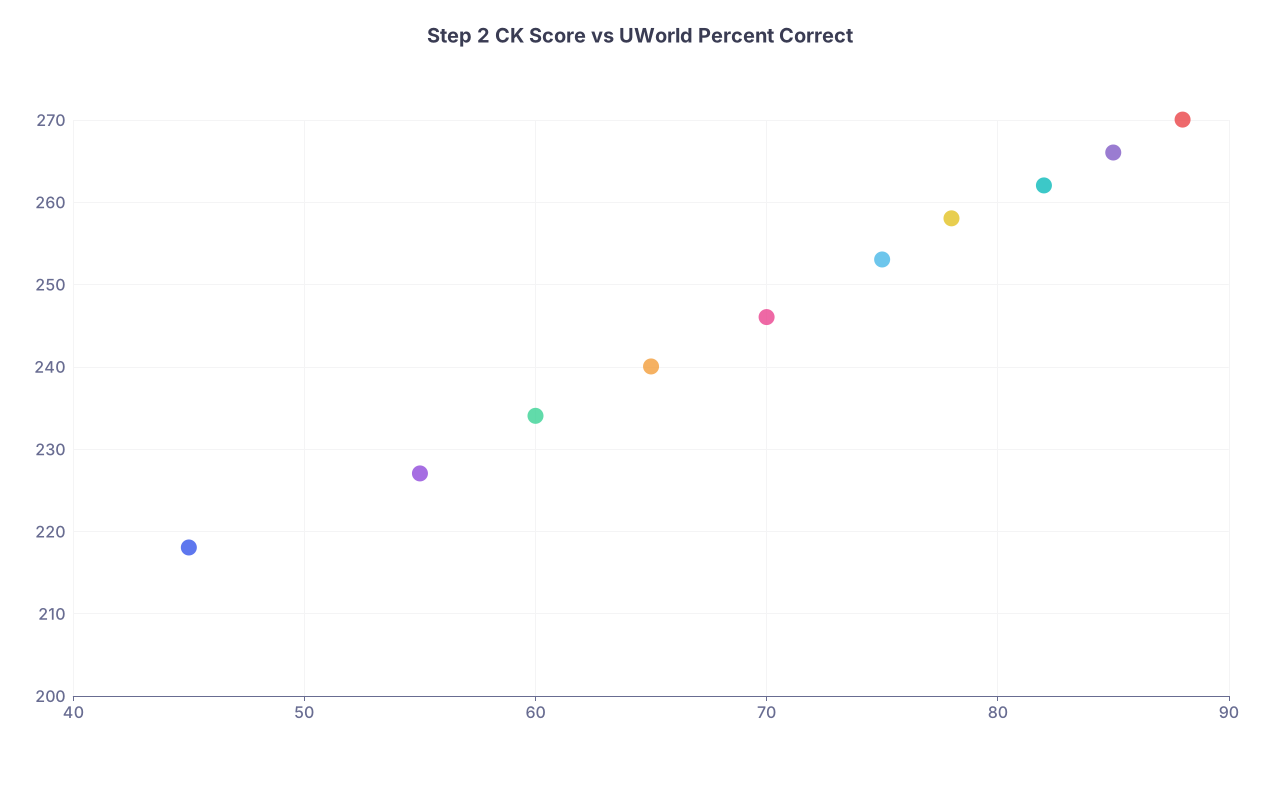
Here’s what’s usually seen in real cohorts:
| Category | Value |
|---|---|
| Student 1 | 45,218 |
| Student 2 | 55,227 |
| Student 3 | 60,234 |
| Student 4 | 65,240 |
| Student 5 | 70,246 |
| Student 6 | 75,253 |
| Student 7 | 78,258 |
| Student 8 | 82,262 |
| Student 9 | 85,266 |
| Student 10 | 88,270 |
That trend—higher UWorld percentages tracking with higher Step 2 scores—has been replicated across multiple schools. Not perfectly linear, but clearly correlated.
What does not show up in any robust way:
“Students who used three or more separate qbanks scored higher than those who thoroughly used one high-quality qbank plus NBMEs at similar percent-correct levels.”
When schools quietly analyze their own graduating classes, they typically find:
- Strong shelf scores
- High UWorld percent-correct (usually >65–70%)
- Doing at least 3–4 NBME forms
Those things predict Step 2 performance. Whether you also ticked “did half of AMBOSS” on some survey rarely matters.
The Real Cost of Juggling 3+ Qbanks
Let’s be blunt about trade-offs, because you don’t have infinite time or mental bandwidth.
Using multiple qbanks aggressively does a few predictable, harmful things:
Shallow exposure instead of deep learning
I’ve seen this pattern hundreds of times:- Student: “I did 6,000 questions.”
- Me: “Great. Show me how you review a question.”
- They skim the explanation, barely look at alternatives, and never review the question again.
Quantity masquerading as work. Not learning.
Fragmented mental models
Every vendor has slightly different styles, guideline adherence, and emphasis. So you end up with three slightly different algorithms for “new-onset AFib” or “sepsis fluid resuscitation” in your brain. On exam day, ambiguity kills time and confidence.Time theft from NBME and weak areas
Time you spend grinding through marginal-quality or lower-yield questions is time you’re not spending on:- NBME practice tests (the closest thing to the real exam)
- Deep review of repeated weak topics
- Re-doing missed questions until you can get them right for the right reasons
Burnout and diminishing returns
Past a certain point, more questions add noise, not signal. I’ve watched students plateau at 60–65% correct across three qbanks instead of pushing one to 75–80% with repetition and focused review.
This is the core myth to kill:
More vendors ≠ more learning. More high-quality repetitions with feedback = more learning.
One Qbank vs Several: When It Matters and When It Doesn’t
Let’s talk practical reality rather than ideology.
Scenario 1: You’re an average student with limited time
You have 6–8 weeks of dedicated, did okay on shelves, Step 1 was fine but not stellar.
In this universe, trying to “finish UWorld + AMBOSS + Kaplan” is self-sabotage. You’ll:
- Rush through questions
- Half-read explanations
- Rarely circle back to your weak areas
- Probably skip full review of incorrects
You’d be dramatically better off with:
- One high-quality core qbank (usually UWorld, sometimes AMBOSS if you’re already deep in it)
- Systematic review of every incorrect
- Re-do of marked/incorrect questions after a gap
- 3–5 NBMEs spaced out as checkpoints
Scenario 2: You’re a strong test taker with long prep time
You crushed Step 1, honored most shelves, and have 10–12+ weeks between rotations.
Now does a second qbank ever make sense? Possibly. But only after:
- You’re >70–75% correct on your main qbank
- You’ve finished it or nearly finished it
- You’re using the second qbank as a targeted supplement, not a whole second mountain
Even here, a second qbank is optional. Some of the highest scorers I’ve seen used one qbank + obsessive review + lots of NBMEs and UWorld incorrects. That’s it.

Scenario 3: You started with the “wrong” qbank
This is common: someone begins with Kaplan or a school-provided qbank in third year, realizes mid-clerkship that UWorld is more Step-aligned.
Here, adding UWorld is not “multi-qbank flex,” it’s course correction. Use:
- Your initial qbank as early exposure and concept-building
- UWorld as your main predictive, exam-style bank for Step 2
That’s not using three or four qbanks for fun. That’s restructuring around one primary bank once you know better.
Where Extra Qbanks Do Have a Legitimate Role
Extra doesn’t mean useless. It means conditional.
There are a few situations where a second qbank can be justified and rational:
Targeted gap-filling after primary mastery
Example: you’re repeatedly weak in OB/GYN and nephrology, even after finishing UWorld. You could:- Use AMBOSS purely for OB + renal blocks
- Combine that with reading their articles or a textbook chapter
- Track if your performance in those topics actually improves
Very early third-year prep
If you’re months out from Step 2 and just starting clerkships, an extra qbank sometimes works as a “learning mode” tool: slower questions, more teaching text, less exam-style pressure.
Then you transition to UWorld as you get closer to Step.Remediation after a weak NBME signal
If you’ve burned through your main qbank and NBME still shows you under target, you might use another qbank’s questions to get fresh practice. But again, you’re using it as a second pass at patterns, not as the core predictor.
In all these cases, the second qbank is deliberate, constrained, and focused. Not “I’m doing everything from everyone because more must be better.”
| Situation | Second Qbank Role |
|---|---|
| Strong primary qbank performance | Targeted supplement |
| Early third-year clerkship start | Teaching-oriented practice |
| Changing from weak to strong vendor | Re-orient with new primary |
| Post-NBME plateau | Fresh pattern exposure |
The Part No One Wants to Hear: Depth Beats Novelty
Students love new questions because they feel productive. “I’ve never seen this before; I must be growing.” That feeling is seductive and often wrong.
The more uncomfortable and less glamorous work is this:
- Opening a question you got wrong last week and forcing yourself to articulate why you picked the wrong option
- Writing out the algorithm for “post-op fever” or “chest pain in a 55-year-old smoker” until you can run through it in your sleep
- Not moving on from a topic until you can answer variants of the same clinical pattern correctly and quickly
It’s boring. It’s repetitive. It is also how you build the neural shortcuts that Step 2 CK requires.
I’ve seen two students with identical numbers of completed questions—say, 4,000. One scored 225. The other 260+. The difference wasn’t qbank brand diversity. It was:
- How thoroughly they reviewed explanations
- How aggressively they revisited missed questions
- How much they synthesized into notes or mental algorithms
- How much time they spent in “strain mode” instead of “scroll mode”
The 225 scorer usually says, “Maybe I should’ve added a third qbank.”
The 260 scorer says, “I just kept beating up my UWorld incorrects and hammering NBMEs until my weak areas moved.”
| Category | New Questions | Review Incorrects | NBME Review |
|---|---|---|---|
| Mid Scorers | 70 | 20 | 10 |
| High Scorers | 40 | 40 | 20 |
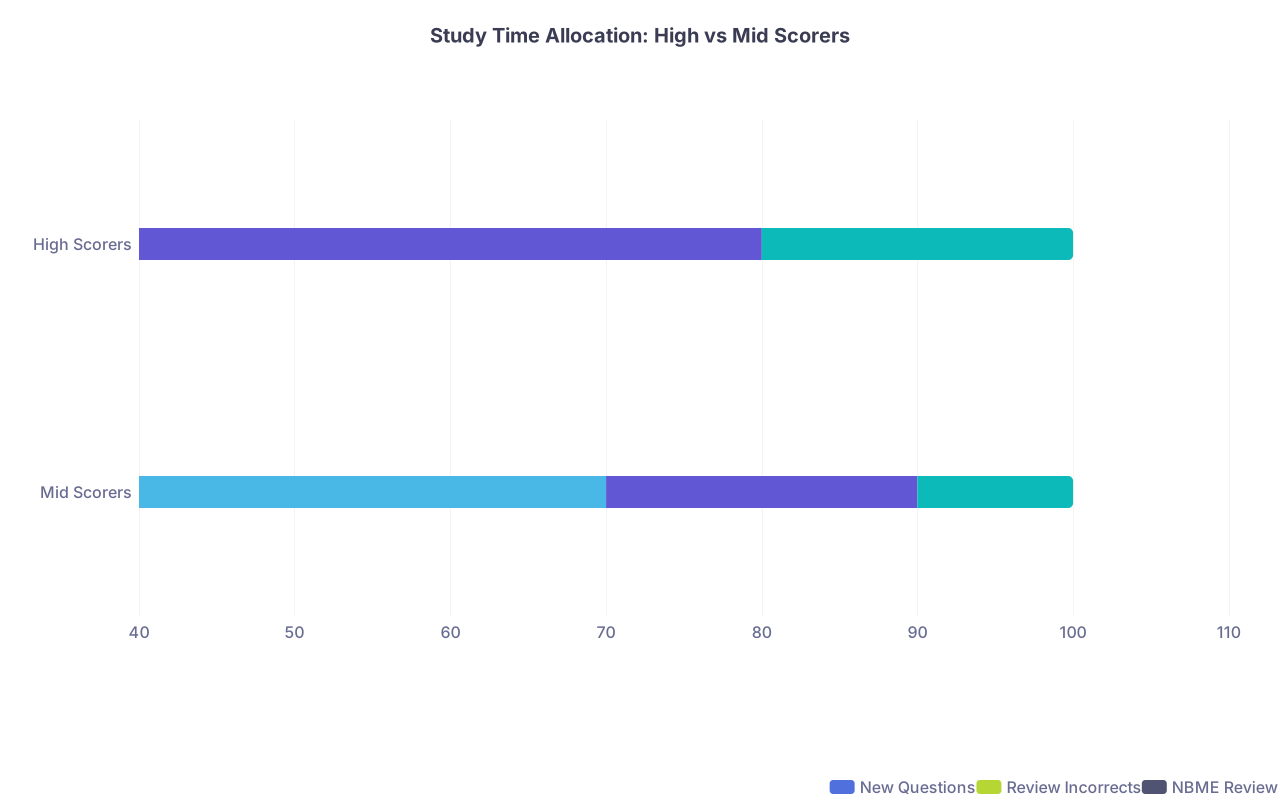
Look at what changes: high scorers spend less relative time on new questions and more on deep review and NBME analysis. Not more vendors.
How to Structure a Rational Step 2 CK Plan (Without Losing Your Mind)
You want something actionable, not just contrarian. Fine.
A sane, evidence-aligned approach for most students looks like this:
- Pick one primary qbank that’s strongly Step 2-aligned. Realistically, that’s usually UWorld.
- Aim to complete all of it once in timed, mixed blocks. Not just cherry-picking systems.
- Review every question thoroughly. Right and wrong. Understand why each distractor is wrong.
- Redo your incorrect/marked questions in a second pass. Watch your reasoning tighten.
- Use NBME practice tests regularly (at least 3–4): treat them as “mini-boards,” and review them like your life depends on it.
- Only after your primary qbank is mostly mastered, consider a targeted second source if a clear weakness remains.
You’ll notice this plan doesn’t once say:
“Make sure you buy at least three qbanks or you’re doomed.”
Because that isn’t how this exam works.

| Step | Description |
|---|---|
| Step 1 | Start Prep |
| Step 2 | Choose primary qbank |
| Step 3 | Do timed, mixed blocks |
| Step 4 | Deep review & notes |
| Step 5 | Redo incorrects/marked |
| Step 6 | Take NBME form |
| Step 7 | Targeted review +/- limited second qbank |
| Step 8 | Maintain with mixed blocks + NBMEs |
| Step 9 | Test Day |
| Step 10 | Weak areas? |
The Bottom Line
You don’t get extra points on Step 2 CK for how many companies you paid.
You get points for how many clinical patterns you’ve truly mastered, how cleanly you can run management algorithms under time pressure, and how often you’ve forced yourself to confront and correct your own reasoning errors.
So here’s the stripped-down truth:
- One high-quality primary qbank, done well and deeply, plus NBMEs, beats three half-finished qbanks every single time.
- A second qbank is a surgical tool, not a badge of honor—use it only for defined gaps after you’ve already mastered your main resource.
- Your score is driven far more by how you review and repeat than by how many vendors’ logos appear on your credit card bill.
Ignore the flex. Respect the data.