
What if I told you that memorizing UWorld explanations might actually be hurting your Step 2 CK score once you cross a certain point?
Everyone knows the script: “Do UWorld. Read every explanation. Memorize the tables. That’s how you crush Step 2 CK.”
I’ve watched students cling to this like religion. Highlighters. Anki decks made from every sentence in the explanation. Re-reading “marked” questions three, four, five times.
Then they walk out of Step 2 and say the same sentence:
“None of those UWorld questions were on the exam.”
Let’s be blunt: UWorld is essential. Treating it like a sacred text you must memorize line-by-line is not.
This whole “I just need to memorize all the UWorld explanations” culture is one of the most common—and damaging—myths I see in Step 2 prep.
Time to pull it apart.
What UWorld Actually Is (And What It’s Not)
UWorld is not the exam.
It’s a training environment that the examiners do not control.
The NBMEs (who design Step exams) do not sit in a room reading UWorld explanations and saying, “Yes, we shall now test that exact sentence.” They write questions based on content outlines, evidence-based guidelines, and psychometrics. Question banks then try to imitate that.
Here’s what data and pattern observation show UWorld really is:
A high-quality pattern generator
It shows you how clinical reasoning is tested: vague symptoms, distractors, small clues that point to the right diagnosis or next step.A coverage tool, not a crystal ball
It exposes you to a huge slice of the content universe you might encounter. Not all of it. Not the same phrasing. Not the same stems.A feedback mechanism
Every question is a diagnostic test: “Are you thinking like a Step 2 test writer yet?” The explanation tells you why your thinking did or didn’t match their logic.
What it is not:
- A script you can memorize and then regurgitate on exam day
- A complete or perfectly balanced representation of test content
- A replacement for understanding pathophysiology, basic management principles, or guideline-based care
Students who treat UWorld as a memorization item bank are using a scalpel like a hammer. Technically it’s a tool. You’re just using it in a dumb way.
The Memorization Trap: Why “Knowing Every Explanation” Backfires
I’ve seen this pattern so many times it’s boring:
- Student A: Does ~60–80 questions/day in mixed timed mode. Reviews explanations with focus on “What did I miss and why?” Scores go from 50–55% to mid 70s by the end of the block. NBMEs climb.
- Student B: Does ~40 questions/day, pauses after each question to read the explanation in detail, highlights 70% of it, makes 20 Anki cards from every block. UWorld percentage creeps up a little. NBME scores… barely move.
Same number of hours. Completely different use of UWorld.
The core problem: the human brain doesn’t like “context-stripped” memorization. Reading massively detailed explanations and trying to hold them all in working memory is cognitive junk food. Feels like work. Isn’t real learning past a certain point.
Here’s the specific failure modes I see when people “memorize UWorld”:
Stem familiarity instead of concept mastery
They “recognize” the question: “Oh, this is the one with the IV drug user and the tricuspid regurg murmur, answer was right-sided endocarditis.”
On Step 2, the same clinical concept shows up as “young woman with IVDU, septic pulmonary emboli, normal left heart exam, new murmur.” Different angle, same core idea. The memorizer misses it.Overfitting to trivia
UWorld explanations are loaded with high-yield plus medium-yield plus “this makes our product look thorough” detail.
People then spend a week memorizing minutiae like which exact complement levels drop in mixed cryoglobulinemia versus MPGN subtypes. Step 2? Might test: “Next best step in management for a patient with hepatitis C and purpura.” Completely different cognitive task.Illusion of competence
Re-reading your incorrect questions until you can recite the explanation doesn’t mean you improved your reasoning. It means you improved your memory of one sandbox’s answer key.Massive opportunity cost
Every extra hour you sink into memorizing an explanation is an hour you’re not:- Exposing yourself to new question stems
- Hitting another weak subject
- Learning broader algorithms and patterns
That last one is deadly. Step 2 is a breadth and reasoning exam, not a “who memorized the longest UWorld PDF” exam.
What Step 2 CK Really Rewards: Patterns, Not Paragraphs
The Step 2 content outline is brutally clear if you actually read it:
Tested skills = diagnosis + management + prognosis + next step logic.
Not “recall the 4th bullet point of a UWorld explanation.”
To see what the exam actually cares about, look at the style of NBME practice forms:
- Clinical vignettes that often don’t spell out the diagnosis
- Multiple answer choices that are all technically reasonable, but only one is most appropriate next step
- Lots of questions that hinge on guideline-based thresholds, red flags, risk stratification, and time-sensitive decisions
Memorization doesn’t handle this well beyond a low bar. Pattern recognition and algorithms do.
That’s why high scorers tend to show three things:
- They understand when to send home vs admit vs ICU
- They know which test changes management and which is just nice to have
- They can rule in/out dangerous diagnoses first before chasing zebras
You don’t build that by obsessively rereading micro-details about one vasculitis variant. You build it by repeatedly practicing “What would I do next for this human in front of me?”
That’s exactly where UWorld can shine—if you stop worshipping the explanations and start interrogating the logic.
Using UWorld the Right Way: Interpretation Over Recitation
If memorizing UWorld isn’t the play, what is?
You use UWorld as a clinical reasoning gym, not a trivia catalog. That means your review process should be built around questions like:
- What clues in the stem pointed to this diagnosis?
- What wrong assumption did I make when I chose my answer?
- Which few details in the explanation actually generalize to other patients?
Here’s a workflow that actually improves scores:
Do blocks in timed, random, mixed mode
Stop coddling yourself with “I’ll do all GI today.” Step 2 will not.After each block, review in this order:
- First, re-answer each incorrect question without looking at choices: “Okay, what do I think the diagnosis/next step should be now?”
- Then look at the correct answer and the explanation.
For each incorrect (and slower/unsure) question, you should be able to answer 3 things:
- What was the key testable concept here?
- What was my specific error (knowledge gap vs misreading vs reasoning flaw)?
- What 1–2 takeaway rules can I pull out that would help me on a different but related question?
If your review notes read like photocopies of the explanation, you’re doing it wrong.
If your review notes read like short rules, algorithms, and red-flag lists, you’re doing it right.
To drive this home, compare two styles:
| Question Type | Memorizer Note | Pattern-Builder Note |
|---|---|---|
| DVT treatment | “Use LMWH in this stem because patient had recent surgery and pain in leg + high D-dimer, and LMWH is first line in pregnancy etc.” | “Rule: Stable proximal DVT → anticoag; massive PE/hemodynamic instability → thrombolysis. Recent surgery is a bleeding risk but not absolute contra unless neurosurg/active bleed.” |
| Chest pain | “This question was unstable angina so the answer was heparin. I keep confusing this with NSTEMI.” | “ACS spectrum: UA vs NSTEMI both need anti-ischemic + anticoagulation; distinction is troponin. STEMI → immediate reperfusion. Don’t treat stable angina with anticoagulation.” |
| COPD exacerbation | “Remember this stem uses BiPAP because pH 7.28 and CO2 elevated.” | “Rule: Hypercapnic respiratory failure (acidosis + high CO2) → try BiPAP unless altered mental status, inability to protect airway, or shock → then intubate.” |
One of those students will recognize new variants of those scenarios on test day. The other one is praying for repeat stems.
How Much UWorld Is Enough? Data, Not Vibes
There’s another myth tangled into this:
“You must do every single UWorld question twice, or you’re doomed.”
No, you’re not.
Students who score 260+ do not magically unlock a second universe of time where they casually do 2 full passes of UWorld plus every NBME form while also existing as humans. What they usually do is:
- 1 solid pass of UWorld (often 70–85% of the bank)
- Very targeted second-pass work: only old incorrects, weak subjects, or mixed custom sets late in prep
- All or nearly all available NBME practice exams + Free 120
The gains from “UWorld pass #2 where I now know 80% of the answers from memory” are marginal. The gains from more independent exam-style stimulus (NBMEs, Free 120, AMBOSS or other Qbank) are larger.
To visualize the diminishing returns:
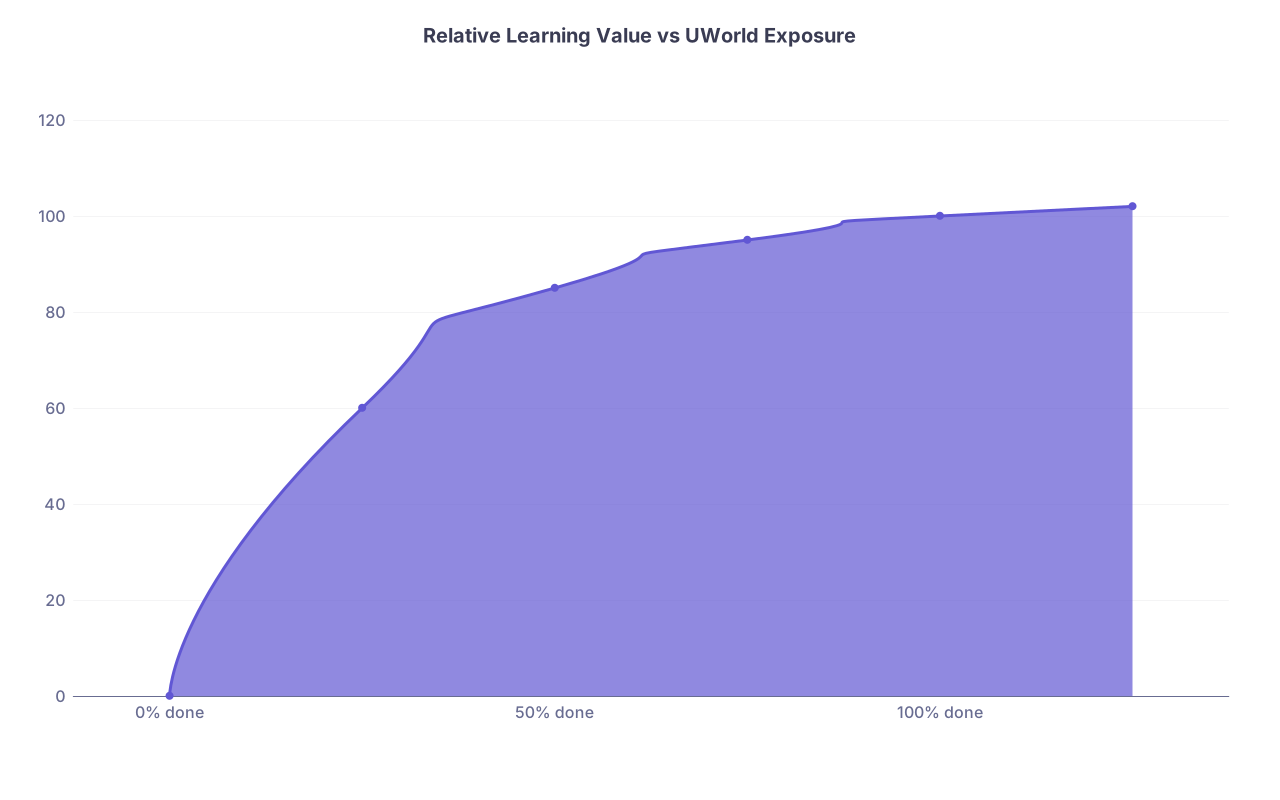
| Category | Value |
|---|---|
| 0% done | 0 |
| 25% done | 60 |
| 50% done | 85 |
| 75% done | 95 |
| 100% done | 100 |
| 125% (partial 2nd pass) | 102 |
Rough idea: the first 70–80% of UWorld, done well, gives you most of the benefit. Past that, you’re mostly polishing edges.
The exception: if your first pass was a trainwreck—untimed, subject-only, half-distracted in the hospital—then yes, a “real” pass in timed mixed mode might be needed. But again, that’s about how you use it, not how many times you read each explanation.
Where Memorization Does Help (But Still Isn’t “Explanations”)
There are narrow buckets where memorization is absolutely necessary for Step 2:
- Drug side effect clusters (e.g., lithium, amiodarone, clozapine)
- Classic triads and red-flag constellations (cauda equina, testicular torsion, ectopic pregnancy with shock)
- Management thresholds that are pure numbers (BP goals in pregnancy, age cutoffs for certain screenings, when to give anti-D)
- Basic scoring systems that show up repeatedly (APGAR, Wells, CHA₂DS₂-VASc, maybe CURB-65-ish logic even if not by name)
You can and should use UWorld explanations to find these patterns. But you don’t have to memorize the entire explanation to retain the 2–3 testable nuggets inside.
This is where a focused Anki approach actually helps:
Not “make a card for every vocab word in the paragraph,” but “1 card per real Step-style idea.”
Example:
Bad card: Front: “All features of lithium toxicity?” Back: huge text block.
Good card: Front: “Bipolar pt on lithium develops ataxia, nystagmus, confusion. Next step?” Back: “Suspect lithium toxicity → stop lithium + IVF, consider hemodialysis if severe/renal failure.”
If you’re going to memorize anything, memorize clinical pictures and decision points, not random fact dumps.
The UWorld → Step 2 Pipeline That Actually Works
Let me distill this into an actual prep strategy that respects both reality and your time.
1. Treat UWorld as simulation, not scripture
- Timed, random, mixed blocks
- Preserve exam-like conditions where possible
- Don’t pause after every item to “deep read” the explanation—that’s how you break the flow and teach your brain this is trivia, not a test
2. Review for transfer, not for comfort
For each block:
Quickly identify:
- Pure misreads (you’d get them right if careful)
- Real knowledge gaps
- Reasoning errors (“I jumped to CT before stabilizing ABCs,” “I ignored the age/red flags”)
For each important miss:
- Extract 1–3 portable rules or patterns
- Add only those to your notes or Anki
- Move on
3. Cross-check with NBME exams early enough
I’ve seen this mistake too often: students do UWorld for 6–8 weeks, avoid NBMEs “until I’m ready,” then get wrecked by their first NBME 10 days before their exam.
NBMEs tell you if your UWorld approach is translating to the real test.
Do at least one baseline NBME mid-way through your UWorld pass. Adjust.
4. Stop hoarding explanations as a security blanket
Scrolling through marked UWorld questions the night before your exam is psychological self-soothing, not learning. You will not brute-force memorize 600 explanations at 11 p.m. and convert that into a 20-point score bump.
Use your final days for:
- Reviewing your distilled rules/algorithms
- Re-doing only selected tricky questions or small mixed sets
- One more NBME or Free 120 for timing and vibe
The Bottom Line: What the Data and Experience Actually Say
Let’s cut it to the essentials:
UWorld is a tool for pattern building, not a sacred text to memorize. Your score improves when you learn how to think like the test writers, not when you can recite their product’s explanations.
Memorizing explanations creates an illusion of mastery and wastes time. Extract rules, patterns, and decision points instead—and verify them against NBME-style questions.
Breadth of exposure + quality of reasoning beat sheer volume of rereads. One high-quality pass of UWorld, used correctly, will take you farther than two or three anxious, explanation-memorizing passes.
If your Step 2 plan is “I’m going to memorize all of UWorld,” you don’t have a plan. You have anxiety dressed up as strategy.