
The idea that “Step 2 CK is easier than Step 1” is mostly wrong. What’s true is subtler and less comforting: Step 2 CK is different, the score scale misleads people, and a lot of students completely misread what the numbers actually mean.
Let me walk you through what the data actually say, not what you hear in group chats and Reddit threads.
The Myth: “Step 2 CK Is Easier, Everyone Scores Higher”
Here’s the usual story I hear from students:
- “Everyone jumps 10–20 points from Step 1 to Step 2 CK.”
- “Programs care more about Step 2 now, but it’s fine because it’s easier.”
- “The content is more clinical, so it’s more intuitive.”
Sounds nice. Also not really true in the way people think.
Historically (back when both were scored), Step 1 and Step 2 CK had different means and standard deviations and very different test-taker populations. Comparing your 250 on Step 1 to your 255 on Step 2 CK like they’re on a single ruler is statistically sloppy.
To see why, you need to stop thinking in raw scores and start thinking in percentiles.
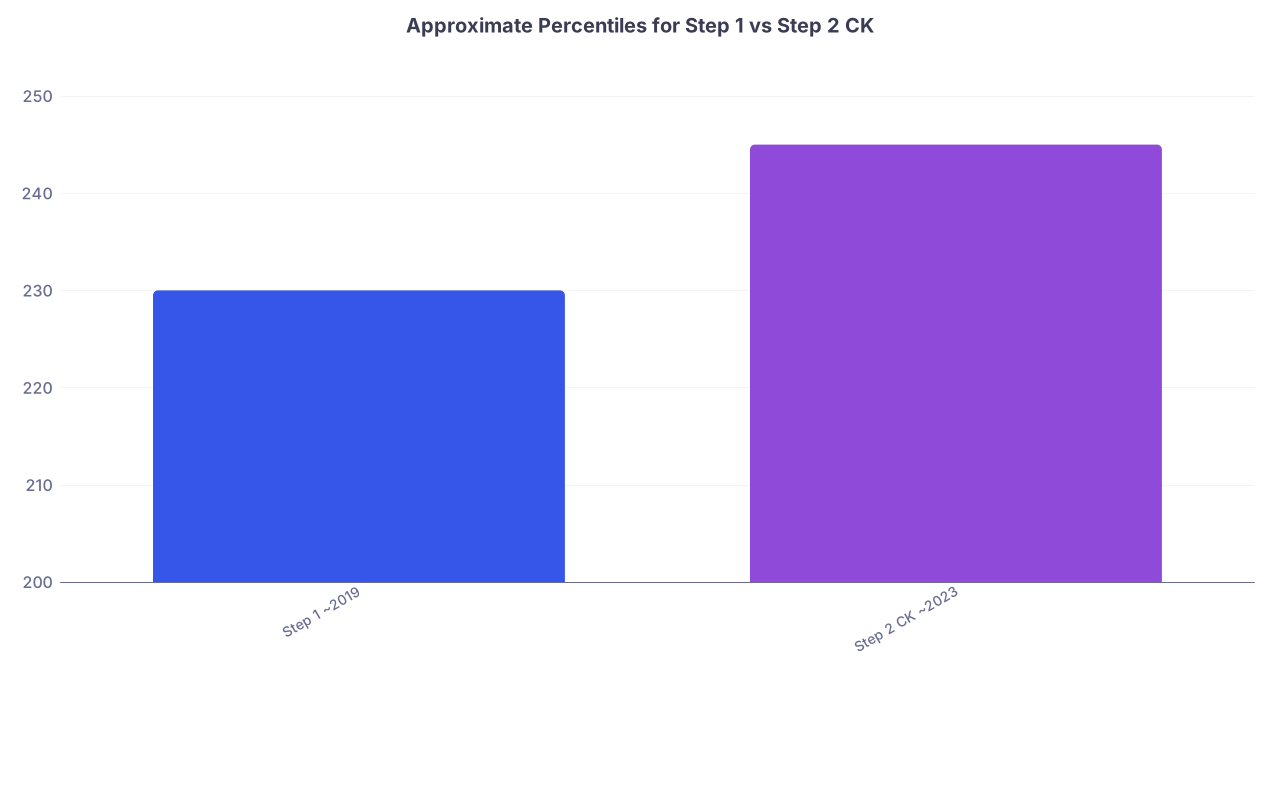
| Category | Value |
|---|---|
| Step 1 ~2019 | 230 |
| Step 2 CK ~2023 | 245 |
That chart is intentionally deceptive-looking if you don’t know what it represents. For many recent years, a score around 230 on Step 1 and around 245 on Step 2 CK both sat roughly in the same ballpark percentile-wise (somewhere near the 60–65th percentile depending on the cohort and year). The actual numbers change year to year, but the pattern is consistent:
A “higher” Step 2 CK score doesn’t automatically mean you performed better relative to your peers. It just means the scale is shifted.
So no, a 245 on Step 2 CK is not some massive improvement over a 230 Step 1 in competitiveness terms. They may be essentially the same performer, just on different exams.
How The Step 2 CK Scale Tricks People
Let’s get concrete.
NBME/USMLE periodically publish score distributions. They don’t hand you a clean spreadsheet every year, but we have enough data from score reports, specialty charts, and old NBME publications to see trends.
Step 2 CK:
- Mean is typically around 245.
- Standard deviation is roughly 15.
- Passing is somewhere in the low 200s (official passing standard historically around 214–216, adjusted occasionally).
Step 1 (before pass/fail):
- Mean historically hovered around 230.
- Standard deviation also roughly 20 early on, then around 15–20 in later years.
- Passing in the low 190s.
So the Step 2 CK scale is shifted upward. A typical, average student lands ~245 on Step 2 CK vs ~230 on Step 1. That alone creates the “Step 2 is easier, my number is higher!” illusion.
But test difficulty isn’t determined by where the mean sits. It’s determined by:
- How discriminating the questions are.
- How steep the curve is at the top.
- Who your competition is.
And Step 2 CK is brutal on those fronts.
Most weaker test‑takers have already washed out before Step 2 CK. People who failed Step 1 multiple times, or stepped away, or never made it to clinical years—many of them are gone from the pool. So you’re being compared against a more filtered, higher-performing population.
The result: a “bigger” number for the same relative ranking.
Score Distributions: What’s Actually Happening
Let’s lay out some approximate equivalences in terms of “how competitive this looks to programs,” not the raw number on the page.
| Competitiveness Tier | Step 1 (old scores) | Step 2 CK (roughly similar percentile) |
|---|---|---|
| Average U.S. MD student | ~230 | ~245 |
| Solid for mid-tier specialties | 240–245 | 250–255 |
| Competitive for most programs | 250–255 | 260–265 |
| Top 10–15% of cohort | 255–260+ | 265–270+ |
These are not official conversion tables. They’re approximate and they drift year by year. But they’re good enough to kill the “Step 2 is easy, everyone goes up 20 points” myth.
What actually happens to a lot of students looks more like this:
- Someone with a 230 Step 1 gets a 245 Step 2 CK.
- They think, “Wow, +15 points, I crushed Step 2!”
- In percentile terms, they’re sitting roughly in the same slice of the bell curve.
The other group nobody likes to talk about:
- The 250 Step 1 student who gets a 252 Step 2 CK.
- They feel like they “underperformed” because the raw jump was small.
- But a 252 on Step 2 can still be top‑tier depending on that year’s cohort.
Raw score worship is lazy. What matters is where you are relative to the distribution.
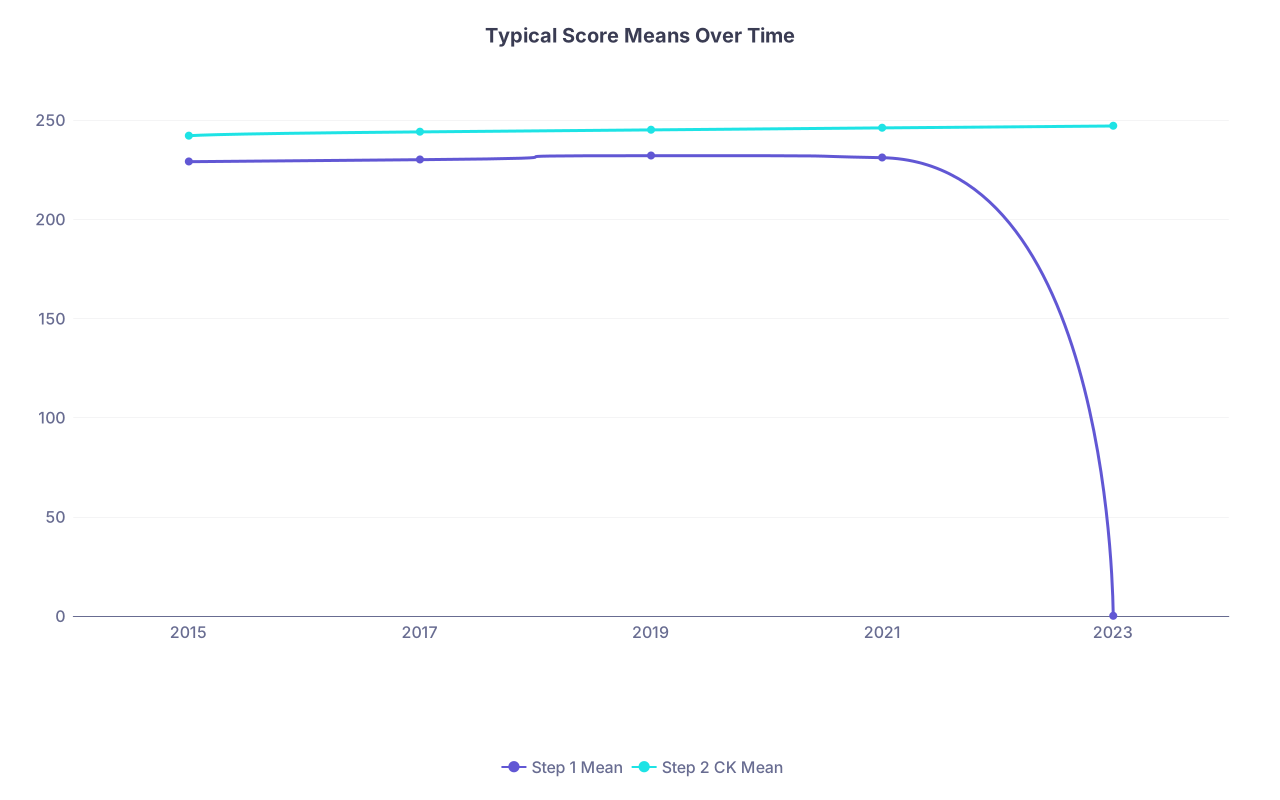
| Category | Step 1 Mean | Step 2 CK Mean |
|---|---|---|
| 2015 | 229 | 242 |
| 2017 | 230 | 244 |
| 2019 | 232 | 245 |
| 2021 | 231 | 246 |
| 2023 | 0 | 247 |
That line chart makes another thing obvious: Step 2 CK’s mean has been creeping up. At the same time, Step 1 has gone pass/fail. That pushes more competitive pressure onto Step 2 CK. The test isn’t getting “easier”; the expectations are getting higher.
Is Step 2 CK Easier Content-Wise?
Now let’s talk about the exam itself, not just the numbers.
Here is the part that confuses people: many students feel like Step 2 CK is more “intuitive” than Step 1. They say things like:
- “It’s clinical, so you can reason through it.”
- “Less random enzymes, more patient care.”
- “It’s like the shelf exams, just bigger.”
There’s some truth buried in that. Step 2 CK leans heavily on:
- Diagnosis and management.
- Clinical reasoning, next-best-step questions.
- Integration of multiple systems in a single long stem.
If you hated the mechanistic, basic science feel of Step 1, Step 2 CK can feel more natural. You’ve lived on the wards; you’ve seen COPD exacerbations, preeclampsia, DKA, septic shock. Those patterns are familiar.
But that doesn’t make the exam easier so much as differently punishing.
On Step 1, you could often survive with brute-force memorization and pattern recognition from UWorld. On Step 2 CK, vague understanding or cookbook thinking will absolutely hang you. The questions that separate a 240 from a 260 aren’t “What’s the best first-line treatment?” They’re:
- “What’s the most appropriate next step after you already did the first two basics?”
- “What subtle finding changes the management algorithm?”
- “What is the most likely diagnosis when several options are plausible?”
The test loves ambiguity, and it loves second-order thinking: not just what’s right, but what’s right now, for this patient, with these constraints.
So no, the content isn’t inherently easier. If anything, it requires more clinical nuance and stamina.
Why Some Students Jump and Others Crash
There is a real phenomenon: some students do much better (in percentile terms) on Step 2 CK than Step 1. But they’re not doing it because the test is easier. They’re doing it because the test aligns better with how their brain works and how they’ve spent med school.
The big group who often improves relatively:
- People who were mediocre memorizers but strong on the wards.
- Students who struggled with micro/biochem minutiae but excel in pattern recognition and clinical reasoning.
- Those who actually learned from every shelf, not just crammed.
The group who often drops relatively:
- Pure memorizers who never developed flexible reasoning.
- People who coasted on Anki for Step 1 and treated clerkships as box-checking.
- Students who barely engaged with shelf prep and assume “spreadsheet studying” will save them at the end.
I’ve seen 220 Step 1 → 250 Step 2 CK. I’ve also seen 250 Step 1 → 238 Step 2 CK. The second group is quieter on social media, but they exist. A lot.
If you had a weak foundation in medicine (not just basic science trivia) during pre-clinicals, you’ll pay for it on Step 2 CK. Because this time, the exam expects you to handle uncertainty and layers of detail.

Step 2 CK After Step 1 Became Pass/Fail
This is the other elephant in the room: Step 1 going pass/fail has changed how Step 2 CK functions in the ecosystem.
Programs now lean on Step 2 CK as:
- The only standardized numeric score for most US students.
- A fast filter for overfilled applicant pools.
- A way to stratify people who all have “P” on Step 1.
So what happens?
- More pressure.
- More focused prep earlier.
- More test-savvy students treating it like “the new Step 1.”
The downstream effect on score distributions is predictable: as more students train harder, earlier, the upper tail of the distribution thickens. That can shift cutoffs higher for competitive specialties.
Don’t believe me? Look at specialty charts from NRMP and program presentations over time. The “average matched Step 2 CK” score for competitive specialties like derm, plastics, ortho, ENT, and neurosurgery has been creeping up, often sitting in the 250s–260s.
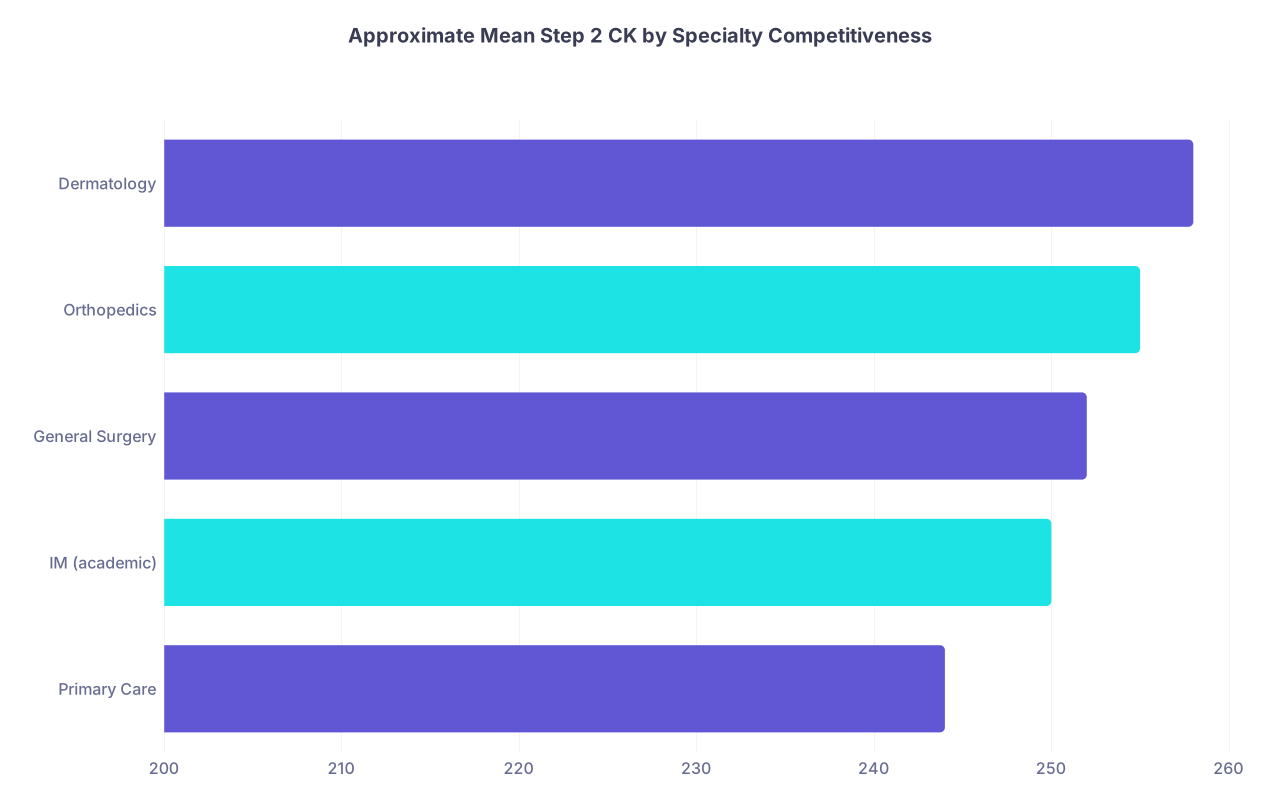
| Category | Value |
|---|---|
| Primary Care | 244 |
| IM (academic) | 250 |
| General Surgery | 252 |
| Orthopedics | 255 |
| Dermatology | 258 |
Again, the exact numbers move a bit year to year. But the hierarchy is consistent: the more competitive the specialty, the higher the typical Step 2 CK score among matched applicants.
Step 2 CK hasn’t become “easier.” It’s just become more central, and people are gunning for it.
What This Means For Your Prep Strategy
Here’s the blunt version: if you treat Step 2 CK like a “victory lap” after surviving Step 1, you’re going to get burned.
Stop focusing on the myth (“it’s easier”) and start thinking like someone trying to climb a distribution curve against heavily filtered peers.
A few non-fluffy realities:
Shelf exams matter more than you think.
Students who do well on shelves are basically doing a slow-motion Step 2 CK prep all year. If you blew off shelves and barely scraped by with UWorld in the last week, you’re already behind.UWorld for Step 2 CK isn’t optional, and you don’t “just do it once.”
The median student does most of the QBank once. High-scorers typically do:- A full run-through with thoughtful review.
- A partial second pass of weak areas or incorrects.
- Close tracking of why they miss questions (not just what fact they missed).
Timing is brutal.
Most people are taking Step 2 CK while exhausted from rotations, dealing with ERAS, letters, maybe research deadlines. The test isn’t easier; your life is harder.The exam punishes superficial algorithms.
Knowing that “chest pain + ST changes = cath lab” is fine for the easy questions. The harder ones will throw you curveballs: atypical patients, resource-limited settings, borderline cases. You must actually understand why.

The Honest Answer: Is Step 2 CK “Easier” Than Step 1?
No. That binary framing is lazy.
Here’s the more accurate statement:
- The Step 2 CK score scale is higher, so your number will often be higher than a hypothetical Step 1 score.
- The test-taker pool is more selected, so the competition is stronger.
- The content is more clinical, which can feel easier for some and harder for others.
- The stakes are higher now, because it’s the primary metric programs can use numerically.
If you really want a single takeaway: Step 2 CK is not your consolation prize or your “chance to easily redeem Step 1.” It’s a harder fight in a smaller, stronger arena, with a deceptively flattering score scale.
Stop asking if it’s easier. Start asking where you need to land on the distribution for your specialty and what it will actually take to get there.

FAQ (4 Questions)
1. If my Step 2 CK score is 10–15 points higher than my Step 1, does that mean I significantly improved?
Not necessarily. Because Step 2 CK’s mean is higher, a 10–15 point raw increase can simply reflect the shifted scale, not a real jump in percentile. To know if you truly improved, you’d need to compare your percentile rank on each exam, not just the number.
2. Can a strong Step 2 CK “fix” a mediocre Step 1 when applying to competitive specialties?
It can help, but it’s not a magic eraser. A high Step 2 CK (relative to your peers) absolutely makes programs take a second look, especially now that Step 1 is pass/fail for newer cohorts. But PDs still weigh the full picture: school, clinical performance, research, letters, and trends. A giant mismatch (e.g., 205 Step 1, 270 Step 2 CK) is rare and will also raise questions.
3. Are NBME practice exams accurate for Step 2 CK prediction?
They’re generally in the right neighborhood but not perfect. Many students find their real Step 2 CK is within about ±5 points of their later NBME/old CCSSA forms, if they take them close to the exam and continue serious studying. People who tank usually either: take NBMEs too early and ignore them, or let life/rotations derail their final month.
4. If I did poorly on shelves, am I doomed on Step 2 CK?
No, but you are behind. Shelf weakness usually means gaps in core clinical reasoning and knowledge. You’ll need a more aggressive catch-up plan: systematic review of weak subjects, heavy UWorld usage, and targeted work on your worst clerkship topics. You’re not doomed, but you do not have the luxury of a casual 3‑week “review and vibe” approach.
Key points in one breath: Step 2 CK isn’t “easier” than Step 1; the score scale just runs higher. What matters is percentile, not the raw number. And in a filtered, high-stakes, post–Step 1 pass/fail world, Step 2 CK has become the main battlefield, not the victory lap.