
The dirty secret: for a lot of program directors, your Step 2 CK score is your real transcript. Your clerkship grades are the decorative cover.
That sounds harsh, but I’ve sat in those ranking meetings. I’ve watched PDs scroll right past Honors/High Pass columns and stop dead on a 272. Or a 222. Then the room shifts. People suddenly care, or suddenly don’t.
Let me walk you through why that happens, what’s going on behind closed doors, and how you should play this if you’re still in the middle of clerkships and Step 2 prep.
The Hidden Hierarchy: What PDs Actually Look At First
Most students think the order is:
- Clerkship grades
- Letters
- Step 2
For many PDs, the real order—especially post-Step 1 pass/fail—is closer to:
- Step 2 CK
- School/reputation context
- Letters (especially from known faculty)
- Clerkship grades
Not everyone will say that out loud, but you’d be surprised how blunt people get once ERAS is closed and they’re in the conference room with coffee and a spreadsheet.
Here’s what routinely happens: PD opens your application, glances at your school and year, then their eyes go straight to one number. Step 2. If it’s strong for the specialty, they relax and start looking at the rest. If it’s borderline, they start digging for red flags. If it’s low, many apps never make it to the full committee conversation.
Why does a single exam outweigh a year of clerkships? Because PDs know what your clerkship grades really are.
Why Many PDs Don’t Trust Clerkship Grades
Clerkship grades feel “holistic” and “clinical,” but under the hood they are absolute chaos.
Here’s the background that students rarely see:
Wild inter-school variation
At one school, 70% of the class gets Honors in Medicine. At another, it’s capped at 15%. I watched one PD pull up a reference sheet they’d built over years: “School X – everyone gets Honors. Treat High Pass there like Honors elsewhere.” That’s how crude the adjustment is. Nobody has time to decode every school’s game.Rotation lottery nonsense
You know what PDs hear from faculty all the time?
“Grades depend on which resident they got stuck with.”
“That team gives everyone Honors if they show up on time.”
“If you’re on with Dr. __, forget Honors unless you walk on water.”
This is not hypothetical. Residents gossip, attendings complain, PDs listen. Over a few years, they realize your clerkship evaluation is a reflection of which team, which site, and which attending you randomly drew.Grade inflation and politics
Once a school starts competing for high-tier matches, grade inflation creeps in. Nobody wants to be the “stingy” school. Departments start pressuring clerkship directors quietly: “We’re under-matching compared to peer schools.” Translation: loosen the Honors criteria.
PDs see this trend across many schools. So they stop believing Honors = top 10%. Sometimes Honors just means “not a problem.”Narratives vs. numbers
The comments in your evaluations carry more weight than the label. “Pleasure to work with, diligent, kind to patients” means more to a lot of faculty than “High Pass.” But even those comments are influenced by who had free time to write them and who was burned out and rushed a generic line.
So while clerkship grades should be the best metric of your clinical ability, PDs know they’re noisy, biased, and hard to compare between schools. Step 2 CK, on the other hand, is brutally simple: same test, same curve, same score scale.
That’s why, for many of them, Step 2 becomes the anchor.
Step 2 CK as the New Step 1: The Great Recalibration
Once Step 1 went pass/fail, a lot of PDs quietly panicked. They lost the one standardized number they’d been leaning on for over a decade.
Here’s what happened inside departments the year after Step 1 went P/F:
- Some specialties—radiology, derm, ortho—immediately said in meetings: “We’ll just lean harder on Step 2.”
- Many internal medicine and surgery PDs nodded and said, “Yeah, we’re doing that too. At least until we figure out something better.”
- Very few programs had the infrastructure to pivot to sophisticated holistic scoring. Most are using hastily modified Excel sheets.
So Step 2 CK slid into the vacant throne. Not officially, not in public-facing websites, but in the actual rank-list meetings.
You can see it in the data: Step 2 CK score distributions now get passed around PD listservs and national meetings the way Step 1 charts used to.
To give you a sense of where you stand, this is roughly how some PDs finally think about score tiers in competitive specialties (this is not official, it’s how conversations sound in real life):
| Tier Description | Approx Step 2 CK Range |
|---|---|
| Automatic interest | 260+ |
| Strongly competitive | 250–259 |
| In the game | 240–249 |
| Needs something extra | 230–239 |
| Tough for competitive | <230 |
No one will put this on their website. But this is the mental sorting happening behind the scenes for the most cutthroat fields.
For less competitive fields, those numbers shift downward. But the logic is the same: Step 2 becomes the quick “is this applicant in our usual range?” filter.
What Step 2 Tells PDs That Clerkship Grades Don’t
From a PD’s point of view, Step 2 CK answers questions clerkship grades simply cannot.
Can you handle the cognitive load of residency?
Residency is pattern recognition under fatigue. Step 2 tests breadth of knowledge across core disciplines, and your ability to integrate information quickly. A 250 doesn’t mean you’ll be a great intern. But a 205 makes PDs worry you’ll drown under cross-cover calls.Can you pass boards on the first try?
This is huge and rarely talked about with students. PDs get audited and scrutinized on board pass rates. Failing boards hurts the program’s reputation, accreditation stress, and future recruitment. If your Step 2 is shaky, they worry you’re a board risk. They’d rather not gamble.How do you compare nationally, not just locally?
An Honors in Surgery at your school might put you in the top 10%. Or top 60%. Nobody knows. But a 248 is the same at Iowa, UCLA, and a new osteopathic school. That standardization is gold for them.Did you peak for Step 1 or are you on an upward trajectory?
For students who took Step 1 before it went P/F: PDs used to look closely at the Step 1 → Step 2 trajectory. Flat or rising? Good. Big drop? They start wondering what happened. Now with Step 1 pass/fail, they’ll look at NBME and COMLEX patterns if they have them, but Step 2 is still the anchor.
So Step 2 isn’t just “another exam” to them. It’s a risk assessment tool.
You’re not just a person in their mind; you are, bluntly, a potential board pass statistic.
Why Some PDs Care Less About Your Clerkship Grades Than You Do
Students obsess over every Honor. PDs don’t.
Here’s a conversation I’ve heard almost verbatim in a ranking meeting:
Faculty 1: “He has all Honors except one High Pass in OB.”
PD: “What’s his Step 2?”
Faculty 1: “252.”
PD: “He’s fine. Next.”
Or the opposite:
Faculty 2: “She’s clearly a star, Honors in everything, incredible comments.”
PD: “Step 2?”
Faculty 2: “232.”
PD: (pause) “Hmm. Let’s put her on the ‘interview if room’ list.”
On paper, those sound insane. Honors in everything should trump one test, right?
But PDs are juggling hundreds of applications, limited interview slots, and pressure from their chair to keep board pass rates high. That pressure quietly distorts priorities.
They know your school might be generous with Honors. They know certain clerkships have “everyone passes, everyone’s a rockstar” culture. They have no idea whether your comments came from the tough attending or the one who gushes over everyone.
They do know what a 232 looks like in their resident pool historically. Who struggles, who remediates. Those patterns are burned into their brains.
So they fall back on the standardized number, especially when they’re undecided.
The Real Role of Clerkship Grades (and When They Still Matter)
Do not misread this: clerkship grades are not irrelevant. They’re just not the universal trump card you think.
So when do they actually matter?
Borderline Step 2 cases
If your Step 2 is mid-range for a specialty, really strong clerkship grades can tip things your way. A PD may say: “Yeah, 238 isn’t amazing for us, but look at these Medicine and Surgery comments. Let’s bring them in.”Evidence of consistency
If your Step 2 is great but you have random Low Passes or failures, PDs will dig in. Was that a professionalism issue? A meltdown on one rotation? They’ll read the MSPE carefully. Consistent High Pass/Honors reassures them that you’re not volatile.Context for non-traditional or lower-ranked schools
If you’re from a less well-known school or a newer DO program and you crush your clinical rotations with strong comments and shelf scores, that helps a lot. But again, paired with a good Step 2, it becomes a powerful combo. Without the score, it’s harder for them to compare you to others.Differentiation among similar Step 2 scores
When PDs have a stack of 245–255s, clerkship performance, comments, and letters become the tiebreakers. But you have to clear the Step 2 bar first.
So clerkship grades are context. Step 2 CK is the threshold.
Why Some PDs Are Obsessed With Step 2 Timing
Another behind-the-scenes truth: the timing of your Step 2 matters almost as much as the number at some programs.
PDs pay attention to:
- Did you take Step 2 early and crush it? Signals confidence and good planning.
- Did you delay it into late fall? They’ll wonder if you were trying to hide a weak score or needed extra time because of poor content base.
- Was your score pending at the time of interview offers? Risky. For competitive specialties, many PDs are now requiring Step 2 before granting interviews, whether or not they put that in writing.
In some meetings, I’ve heard lines like:
- “If Step 2 isn’t in by October 1, we’re not ranking them high.”
- “We’ve been burned before by high-performing students who bombed Step 2. No more.”
They won’t always list these rules publicly. But application reviewers run informal filters all the time that never make it into ERAS descriptions.
How PDs Actually Use Step 2 and Clerkships Together
Let me show you the internal logic with a few archetypes PDs talk about, even if they don’t say this out loud in front of you.

Applicant A: Strong Step 2, Mixed Clerkships
- Step 2 CK: 255
- Medicine: High Pass, good comments
- Surgery: Pass, generic comments
- OB, Peds, Psych: Mixed HP/Honors
How PDs read this: “Smart, clearly can handle knowledge base. Surgery grade might be team-dependent. As long as there’s no professionalism red flag, I’m not worried.” They’ll often give this person the benefit of the doubt.
Applicant B: Stellar Clerkships, Modest Step 2
- Step 2 CK: 231
- Honors in Medicine, Surgery, OB, great narrative comments
- Strong letters from known faculty
How PDs read this: “Strong clinically, good work ethic, but borderline for our boards.” This is the one that sparks debate. Some faculty push hard: “This is exactly the kind of resident we want.” PD is doing mental math: “Will this person pass boards on first try? How have previous 230–235s done here?”
Some PDs will take the chance. Many in ultra-competitive specialties won’t.
Applicant C: Low Step 2, Great Story
- Step 2 CK: 221
- Mostly Honors, one Low Pass in Surgery explained by illness
- Powerful personal statement, non-traditional background
For community or less competitive programs, they might say, “Worth an interview, seems resilient.”
For high-tier academic programs, a lot of them will quietly say, “I just can’t take that risk. Put them lower or don’t rank.”
Again, not because clerkship grades do not matter, but because the Step 2 number triggers all their anxiety about accreditation and board pass statistics.
What This Means For How You Prepare for Step 2
If you’re still early enough in the process, here’s the uncomfortable but accurate hierarchy:
If you have to choose between:
- Perfecting every clerkship grade
- Or ensuring a strong Step 2 CK score
You lean toward Step 2.
That does not mean blow off rotations. It does mean being ruthless with your time allocations.
During core clerkships:
- Use shelf prep as Step 2 prep. Treat every shelf as a mini-Step 2 in that specialty.
- Pick 1–2 high-yield resources and get through them deeply rather than flirting with six different books. UWorld and one solid text/online resource beat scattershot studying.
- Protect your evenings on lighter rotations to build Step 2 foundation instead of chasing marginal clerkship points from busywork.
The best-positioned students I’ve seen:
- Study throughout third year as if Step 2 is just “all the shelves combined.”
- Take Step 2 early enough to have the score ready by application season, but not so early that they ignore half their rotations. Usually late spring to mid-summer before MS4.
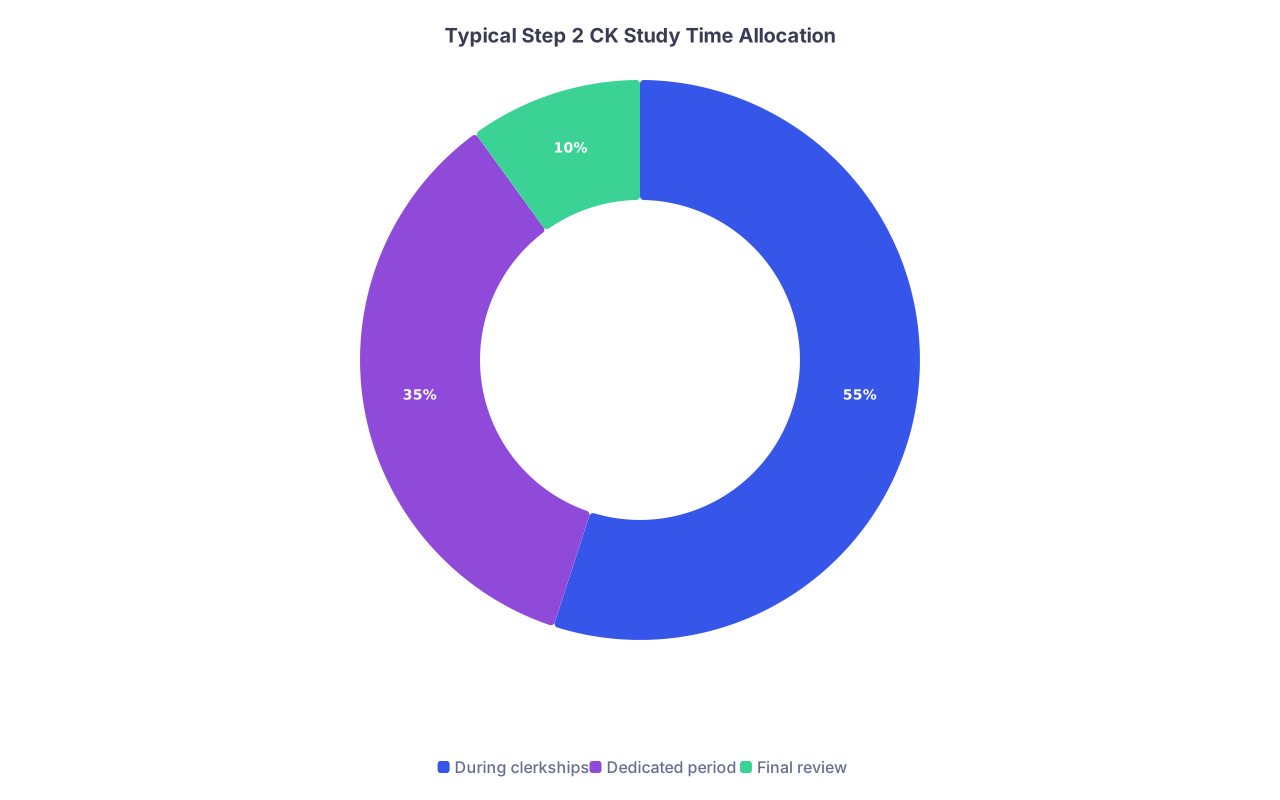
| Category | Value |
|---|---|
| During clerkships | 55 |
| Dedicated period | 35 |
| Final review | 10 |
Notice that the bulk of effective prep isn’t in some magical “dedicated” bubble after MS3. It’s built day by day while you do Medicine, Surgery, Peds, and OB.
When You Already Have Mediocre Clerkship Grades
If your MS3 transcript isn’t pretty—some Passes, maybe a Low Pass—you’re not dead. But you don’t have the luxury of a lazy Step 2.
Here’s how PDs think about you:
- If your grades are mediocre and your Step 2 is average → they assume that’s your true performance level. You get pushed down.
- If your grades are mediocre but your Step 2 is strong → they start thinking, “Maybe this student had rough rotations, poor luck with teams, or late blooming. But clearly, they can handle the knowledge.”
I’ve seen multiple cases where a student with a couple of ugly clerkship marks redeemed their entire application with a big Step 2 score. PDs literally said: “Look, 262. I’m not worried anymore.”
Your strategy in that position:
- Be honest about rough rotations in your MSPE or advisor letter if appropriate, but don’t make excuses.
- Crush Step 2. That’s your clean slate.
- Target programs that have historically taken a chance on upward trajectories (often mid-tier academic or strong community programs that value grit).

The Programs That Don’t Overweight Step 2 (And How Rare They Are)
Yes, there are PDs who genuinely care more about narrative performance and clinical impressions than Step 2. You’ll usually find them:
- In smaller, tight-knit community programs where they personally know most attendings who wrote your letters.
- In certain primary-care-heavy internal medicine or pediatrics programs that explicitly state “we look at the whole application first, scores second.”
- In some mission-driven programs (rural, underserved, safety-net hospitals) where commitment to the patient population and resilience carry unusual weight.
But even there, if your Step 2 is too low, they can’t totally ignore it. A single board failure can be a massive headache.
So yes, exceptions exist. Just don’t build your whole career plan assuming you’ll land at the one program in the country that doesn’t care about Step 2 while every other place quietly does.
How This Should Change the Way You Think About MS3 and Step 2
Strip away the noise and it comes down to three realities:
For many PDs, Step 2 CK is your only standardized, comparable number.
They’re not evil for using it. They’re under pressure, and the exam is the clearest signal they have.Clerkship grades are second-order: they refine the picture, but they rarely define it.
Honors might help, but they don’t erase a weak Step 2. Glitches in clerkships can be forgiven if Step 2 is strong and your narrative is solid.Your smartest move is to treat Step 2 like your primary clinical currency.
Use clerkships to build the knowledge and pattern recognition that will show up on Step 2. Protect your preparation time like your future depends on it—because at a lot of programs, it does.
If you remember nothing else, remember this:
A great Step 2 with decent clerkship grades opens more doors than perfect clerkship grades with a shaky Step 2.
Program directors will never say that on the brochure. But they say it—bluntly—when they’re sitting around the ranking table deciding your fate.