
The way attendings write about you is already whispering whether you’re ready for Step 2 – long before you ever sit for the exam.
Most students think attending letters and evaluations are about “being a good team player” or “getting honors.” That’s surface-level. The attendings who’ve been doing this for years are quietly signaling something else to program directors and clinical competency committees: your clinical reasoning maturity, your pattern recognition, and whether you can handle the Step 2 style of thinking under pressure.
I’ve watched attendings type up “nice” evaluations for students they’d never trust on call. I’ve also seen short, almost boring-looking letters that quietly scream: This student is going to crush Step 2 and residency. You need to learn to read that difference.
Let me walk you through what’s really going on.
The Hidden Link Between Attending Letters and Step 2
Here’s the unspoken truth: the way an attending describes you after a rotation and the way Step 2 questions “test” you are looking at the same underlying skill set.
Not how many UWorld blocks you’ve done. Not whether you annotated every page of UptoDate. They care about whether you can:
- Recognize classic and not-so-classic presentations.
- Prioritize problems when everything is on fire.
- Act without being spoon-fed.
Step 2 is basically: “Here’s a messy human, here’s limited time, what matters most right now?”
Strong attendings think the same way on rounds. So when they sit down to write about you, the language they use is a surprisingly accurate proxy for whether you’re hitting the Step 2 readiness threshold.
You’re going to see some patterns if you know what to look for.
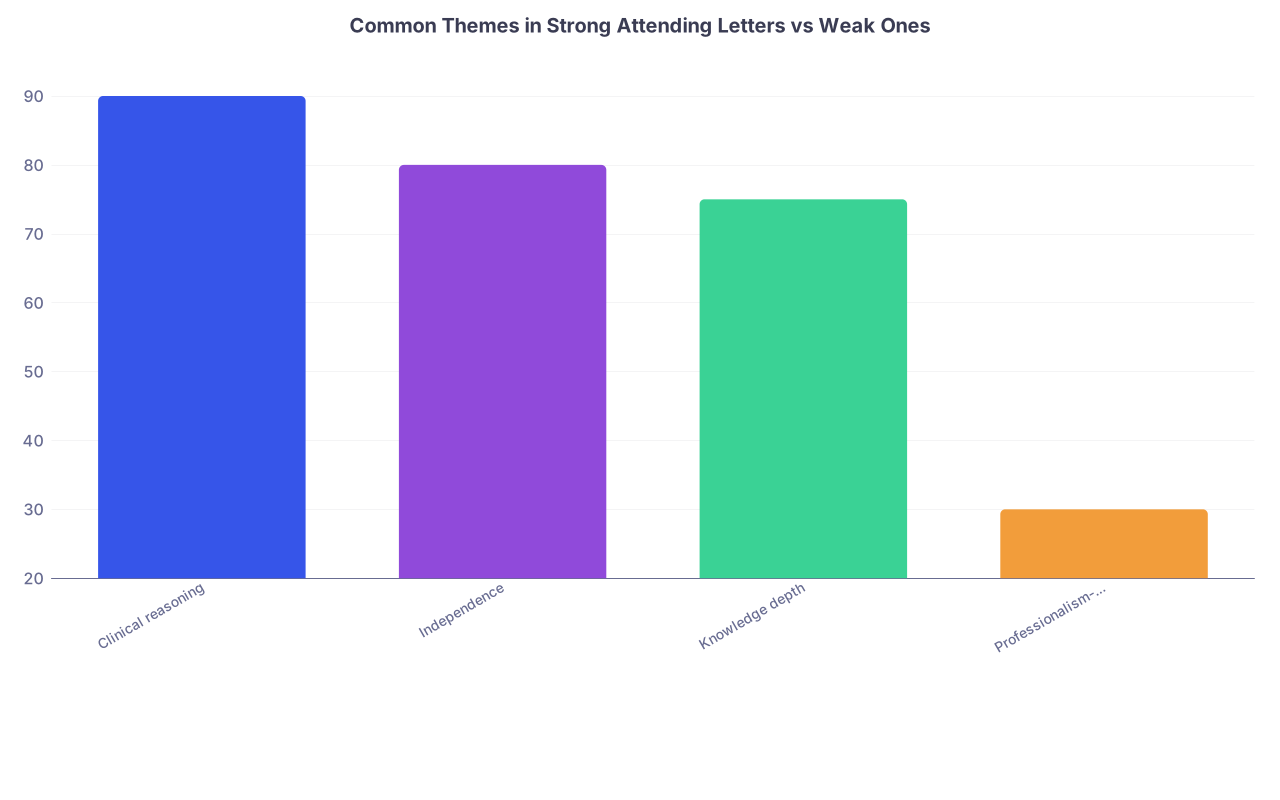
| Category | Value |
|---|---|
| Clinical reasoning | 90 |
| Independence | 80 |
| Knowledge depth | 75 |
| Professionalism-only focus | 30 |
Those numbers aren’t from some published study. They’re from sitting in rooms where faculty review student files and pass judgment. Over and over, the same features of letters keep coming up when people predict who will do well on Step 2 and beyond.
The Three Types of Attending Letters – And What They Really Mean
Every student believes their evaluations are “pretty good.” Most aren’t reading between the lines. Let me translate the three most common flavors I’ve seen.
1. The Polite, Useless Letter
You’ve seen this language:
- “Pleasure to work with.”
- “Always arrived on time.”
- “Eager to learn.”
- “Got along well with the team.”
On first read, it sounds positive. No red flags. But in a room of faculty, this is recognized immediately as a letter from an attending who either didn’t know you, didn’t trust you, or didn’t think there was anything clinically remarkable about you.
This is what’s not in that letter:
- No mention of your assessment or plan.
- No concrete clinical decisions you contributed to.
- No description of you managing uncertainty.
- No comment on how you handled acutely ill patients.
And that absence is loud.
When I see this type of letter for a student who’s about to take Step 2, I know one of two things is true:
- They’re still functioning at “good MS2” level – they can gather data, but they’re not yet synthesizing.
- They’re hiding. Standing in the back on rounds, taking notes, nodding politely, but never actually committing to an answer out loud.
Both are Step 2 problems. Because Step 2 doesn’t grade you on “eager to learn.” It grades you on, “Here are five reasonable-sounding answer choices. Which one is actually right and why?”
If one of your major core rotations ends with nothing more than “hard-working, pleasant, punctual,” that’s a signal: you’re probably not pushing your clinical reasoning far enough yet.
2. The “Competent But Passive” Letter
This is the most common evaluation I’ve seen for mid-tier Step 2 scorers. Not bad. Just… flat.
The language usually looks like this:
- “Solid fund of knowledge for level.”
- “Completed tasks reliably when assigned.”
- “Required some guidance on next steps in management.”
- “Will benefit from continued experience and supervision.”
That phrase: “will benefit from continued experience and supervision” is everywhere. It sounds benign. It’s not. It’s code for: not unsafe, but not ready to be left alone.
Here’s what that means for Step 2 readiness:
You probably recognize patterns when they’re obvious. You can list a differential, but someone else needs to tell you what to actually do first. On question stems, you probably narrow to 2–3 answers, then freeze.
This is the student who, on the wards, says things like:
- “For now, I’d continue current management” (because they don’t know what to change).
- “I’d monitor” (vague, nonspecific, and usually wrong for test purposes).
- “I’d ask the attending” (which is fine in life, but Step 2 wants your brain).
If more than one attending in your core clerkships is using this “competent but passive” language, I can almost predict your Step 2 score band: safe pass, maybe slightly above average, rarely outstanding. Unless you change how you practice clinical reasoning before the exam.
3. The “I’d Trust This Student on Call” Letter
This is the letter that quietly screams Step 2 readiness, even if it never mentions the exam.
The wording is very different:
- “Demonstrated strong clinical reasoning and independently generated accurate assessments and plans.”
- “Identified subtle clinical changes and escalated appropriately.”
- “Functioned at the level of a sub-intern by the end of the rotation.”
- “Frequently the first to propose the correct next diagnostic or therapeutic step.”
This is gold.
Notice what these letters do: they tie your thought process directly to patient care decisions. Not just that you “know facts,” but that you can connect history, exam, labs, imaging, and then make a move.
When faculty sit in promotions or residency selection meetings, this is the language they latch onto. I’ve heard lines like:
- “If Dr. X says this student functioned like a sub-I, I don’t worry about Step 2.”
- “They’re clearly thinking at the systems level; I’d be shocked if they struggled with CK.”
If you’ve got at least one of these letters from a core rotation (IM, surgery, peds, OB/GYN), your ceiling on Step 2 is high. But if you don’t have anything that sounds like this yet, that’s your red flag. Not to panic. But to change how you’re operating right now on the wards.
Specific Phrases That Reveal Your Step 2 Weaknesses
Let me be very direct. There are recurring phrases in attending comments that almost always correlate with the type of student who later tells me, “I was surprised I underperformed on Step 2.”
I’m going to translate a few.

“Knowledge appropriate for level.”
That phrase is a participation trophy. It means you answered enough basic questions to not embarrass yourself, but you didn’t demonstrate depth. Step 2 punishes superficial knowledge. It’s not asking, “What is CHF?” It’s asking, “This patient with CHF and CKD – what drug will secretly kill them if you choose it?”
“Quiet but hardworking.”
Here’s the uncomfortable truth: if the team doesn’t hear you reason out loud, they assume you can’t. Quiet students often tell me, “I knew the answer, I just didn’t speak up.” Great. Step 2 doesn’t accept telepathy either. You’re training a habit of non-commitment, and that bleeds into your test-taking. You read a question, half-recognize the pattern, but don’t fully commit. That’s how borderline scores happen.
“Improved over the course of the rotation.”
That’s fine if it’s followed by something like, “…and by the end was independently managing common conditions.” If it just ends there, it usually means you started behind and barely got to average. That’s not a disaster. But if this is showing up late in third year, you’re behind the Step 2 curve.
“Will be an excellent resident with continued guidance.”
That “with continued guidance” is doing a lot of work. It means: needs handholding for next steps. On Step 2, you don’t get that. You are the guidance.
How Faculty Actually Use These Letters Behind Closed Doors
Students wildly underestimate how much weight narrative comments carry, especially once Step 1 went pass/fail and Step 2 became the big filtered number.
In many schools, there’s a promotion or clinical competency committee that reviews:
- Your clerkship evaluations
- Narrative comments
- Shelf exam scores
- Any remediation or professionalism issues
I’ve sat in these rooms.
Here’s what happens more than you’d like to know: someone pulls up a borderline student. Maybe their early shelf scores were shaky. Maybe they barely passed a rotation. Then someone reads out loud:
“Required frequent redirection on basic management decisions.”
And the room collectively goes: “Yikes.”
You know what nobody says? “But they were very eager to learn.”
When we see:
“Frequently anticipated next steps and appropriately escalated concerns.”
We stop worrying. Even if your first shelf was mediocre. Because that phrasing tells us your brain is oriented correctly. You’ll grow into the test and into residency.
So yes, these letters are supposed to be about your clinical performance, not your exam performance. But anyone honest will tell you: they’re using them as a proxy for whether your Step 2 score is going to be an asset or a liability to the school’s statistics.
| Phrase in Letter | Silent Interpretation for Step 2 Readiness |
|---|---|
| “Knowledge appropriate for level” | Average, may struggle with complex questions |
| “Strong clinical reasoning skills” | Likely above-average Step 2 potential |
| “Needed frequent guidance on management” | At risk for borderline Step 2 performance |
| “Functioned at sub-intern level” | High likelihood of strong Step 2 score |
| “Quiet but diligent worker” | Unknown reasoning capacity, possible underperformer |
How to Read Your Own Evaluations Like an Insider
Most students skim their evaluations for the grade and move on. That’s a mistake. Your evaluations are a real-time mirror of your Step 2 readiness.
Here’s how you actually use them.
First pass, ignore the numeric grade. Honors, HP, Pass – all that is school-dependent noise. Read only the free-text comments. Ask yourself three blunt questions:
- Do they talk about my thinking, or just my behavior?
- Do they mention specific clinical decisions, or just “worked hard”?
- Do more than one attending independently say anything about independence, anticipation, or strong reasoning?
If your comments are 80% about attitude, professionalism, and being “nice to patients,” you’re not in trouble yet. But you are under-developed.
I’ve seen this pattern too often:
- Student is beloved by nurses, attendings like them.
- Evaluations: “Compassionate, kind, great rapport.” All wonderful things.
- Step 2: 10–20 points below what they need for their dream specialty.
Why? Because everyone assumed the “nice, hardworking” student was also clinically sharp. But the comments never said that. And the exam exposed the gap.
On the other hand, if you see phrases like:
- “Regularly presented thorough assessments and plans.”
- “Evidence-based in their approach.”
- “Effectively prioritized acutely ill patients.”
You’re being trained by the environment in the same way Step 2 will test you. That’s what you want.
Turning Weak Letters into a Step 2 Wake-Up Call
If you’re reading this after already collecting a few lukewarm evaluations, good. You’re catching it early enough to do something.
The worst move is pretending it doesn’t matter and retreating into pure question-bank mode. You can grind UWorld for 3 months and still score below your potential if your real-time clinical reasoning is timid and reactive.
You need to change how you operate on the wards, not just at your desk.
Here’s the shift that attendings immediately notice – and that directly maps to Step 2 thinking:
Stop being a “data collector.” Become a “plan generator.”
That means:
On every patient you see, before rounds, you force yourself to write:
- Problem list in order of acuity
- One-line assessment for each
- Concrete next step: specific test, med change, or consult
Then you commit. Out loud.
That last part is where most students fail. They think privately, then quietly wait for the intern to talk. That’s how you end up with those “pleasant, eager, appropriate” letters. The noise around you drowns out your thinking.
You have to say things like:
- “For her chest pain with normal ECG and negative troponins, I think this is low-risk and we should focus on outpatient risk stratification rather than more inpatient imaging today.”
- “For his hyperkalemia at 6.2 with peaked T waves, I’d prioritize IV calcium and insulin with glucose now, and then consider Kayexalate or dialysis depending on response.”
You’ll be wrong sometimes. Good. That’s how attendings calibrate you. When they see you improve and refine your pattern recognition, that’s when the language in your letters upgrades from “appropriate” to “strong” or “impressive.”
And that language change is your true Step 2 readiness signal.
When a Strong Letter Doesn’t Match Your Practice Scores
There’s one more scenario I’ve seen more than once: a student with glowing, legitimate letters from hard-grading attendings… and mediocre practice UWorld or NBME scores.
That mismatch almost always comes down to one of three issues:
You’re underestimating content gaps.
On the wards, you can sometimes skate by on pattern recognition and charisma. On Step 2, if you never truly learned certain bread-and-butter topics (OB complications, psych meds, heme-onc), no amount of “good instincts” will save you.You’re reading questions too passively.
In real life, you can talk through a case. Ask for more data. On paper, you get one shot. If you’re skimming, not annotating key details, or second-guessing every choice, you’ll underperform what your attendings think you’re capable of.Test-day anxiety or self-sabotaging timing.
I’ve seen sharp, sub-I level students get paralyzed on long stems. That’s a skill problem, not an intelligence problem. You have to train under exam-like constraints to let your clinical brain show up on the screen.
But here’s the good news: strong letters are usually right about your ceiling. If multiple seasoned attendings have essentially said, “I’d trust this student,” then you have the wiring to do very well on Step 2. You just need to align your test-taking behavior with the way you actually think clinically.

| Step | Description |
|---|---|
| Step 1 | Clerkship Performance |
| Step 2 | Attending Evaluation Language |
| Step 3 | Signals of Reasoning & Independence |
| Step 4 | Realistic Step 2 Readiness |
| Step 5 | Targeted Study & Ward Behavior Changes |
| Step 6 | Improved Step 2 Performance |
What To Do Tomorrow Morning
Not three months from now. Tomorrow, on your next shift.
Before rounds, for each patient, write down a prioritized problem list and a plan. Then on rounds, pick at least one patient where you say, before the intern does:
“I’d like to propose an assessment and plan.”
Will it feel awkward? Yes. Will some interns cut you off? Yes. Do it anyway. You’re not doing it to impress them; you’re doing it to force your brain into the same mode Step 2 will demand.
Then, when your next evaluation comes in, read the free text like someone who’s sitting on a promotions committee. Look for:
- Mentions of your “assessment and plan.”
- Words like “independent,” “anticipated,” “prioritized,” “clinical reasoning.”
- Specific scenarios where you influenced actual patient care.
If you start seeing that language shift over your next 1–2 rotations, you can be almost certain your Step 2 ceiling is rising, even before your practice scores fully reflect it.
Because attendings aren’t just commenting on whether they like you. They’re unconsciously grading whether your brain has crossed the line from “student who knows stuff” to “junior clinician who can decide.”
Step 2 is simply the standardized, impersonal version of that same judgment.
Years from now, you won’t remember the exact phrasing in those attending comments. But you will remember the moment you stopped hiding behind “hardworking and eager” and started letting your clinical judgment be seen, corrected, and sharpened. That shift – not a question bank, not a flashcard deck – is what quietly moves you from hoping to pass Step 2 to quietly expecting to crush it.