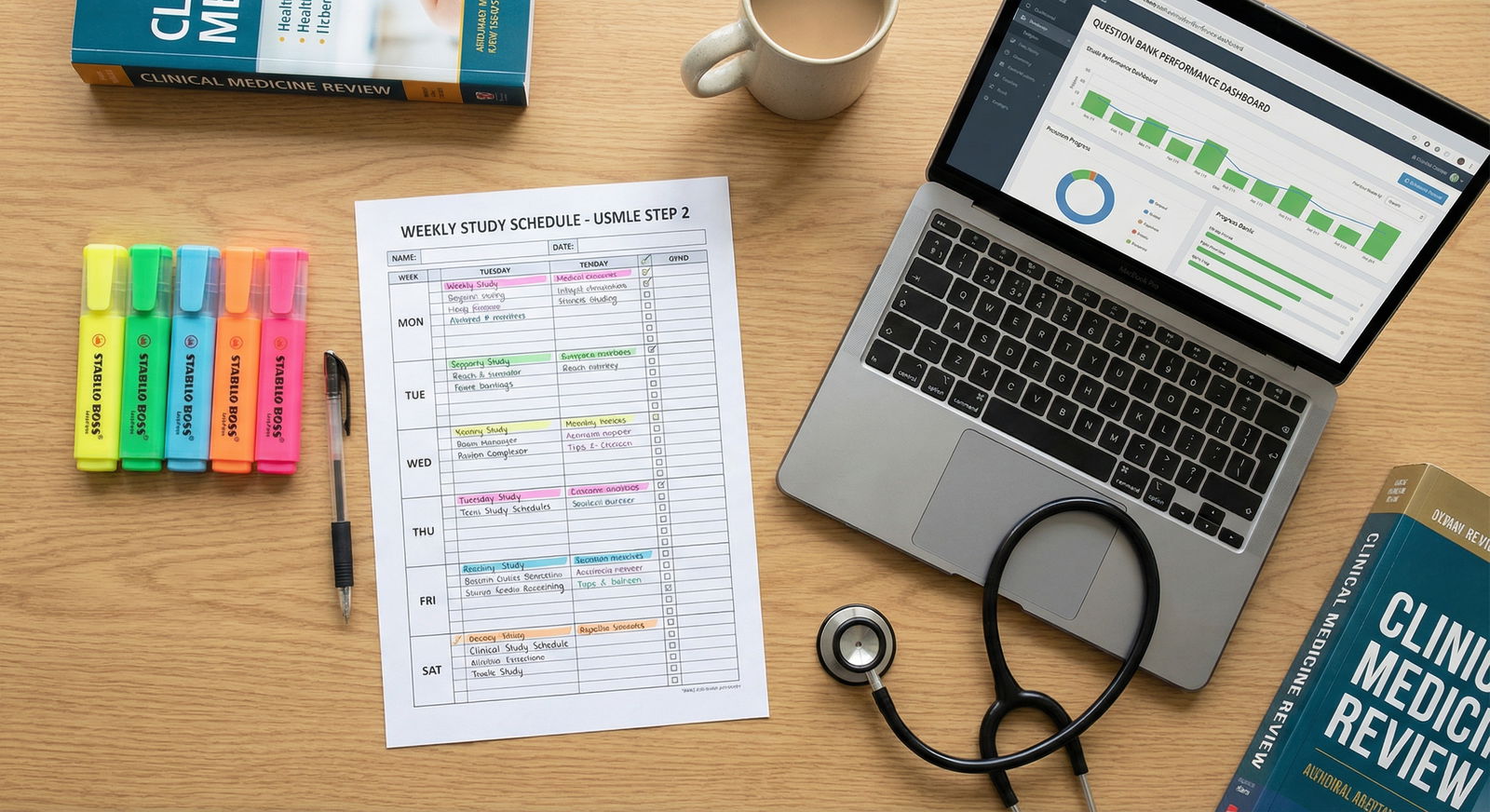
What if your Step 2 CK score gets killed not by “not studying enough,” but by the way you’re studying every single day without realizing it?
I’ve watched solid students – people who should be 250+ material – walk out with very average scores or worse. Not because they were lazy. Because they fell into predictable Step 2 traps that quietly drained points for months.
Let’s go through the big 11. If you catch even 2–3 of these in your own prep and fix them now, you’ll probably save yourself a full test’s worth of regret.
1. Treating Step 2 Like “Easier Step 1” Instead of a Different Exam
This is the first landmine almost everyone steps on.
They think: “Step 1 was brutal, but Step 2 is just more clinical. I’ll just do questions and I’ll be fine.”
Then they sit for NBME 9 or 10 and get smacked with a score 20–30 points below what they expected.
The mistake:
You’re assuming Step 2 rewards the same kind of thinking as Step 1. It doesn’t.
Step 1 = pathophysiology, mechanisms, buzzwords.
Step 2 CK = management decisions, prioritization, knowing what not to do.
You tank your score when you:
- Obsess over rare diseases but can’t choose the next best step for common ones
- Memorize treatment lists but can’t triage an unstable patient
- Treat every question like a pathophys puzzle instead of a real patient scenario
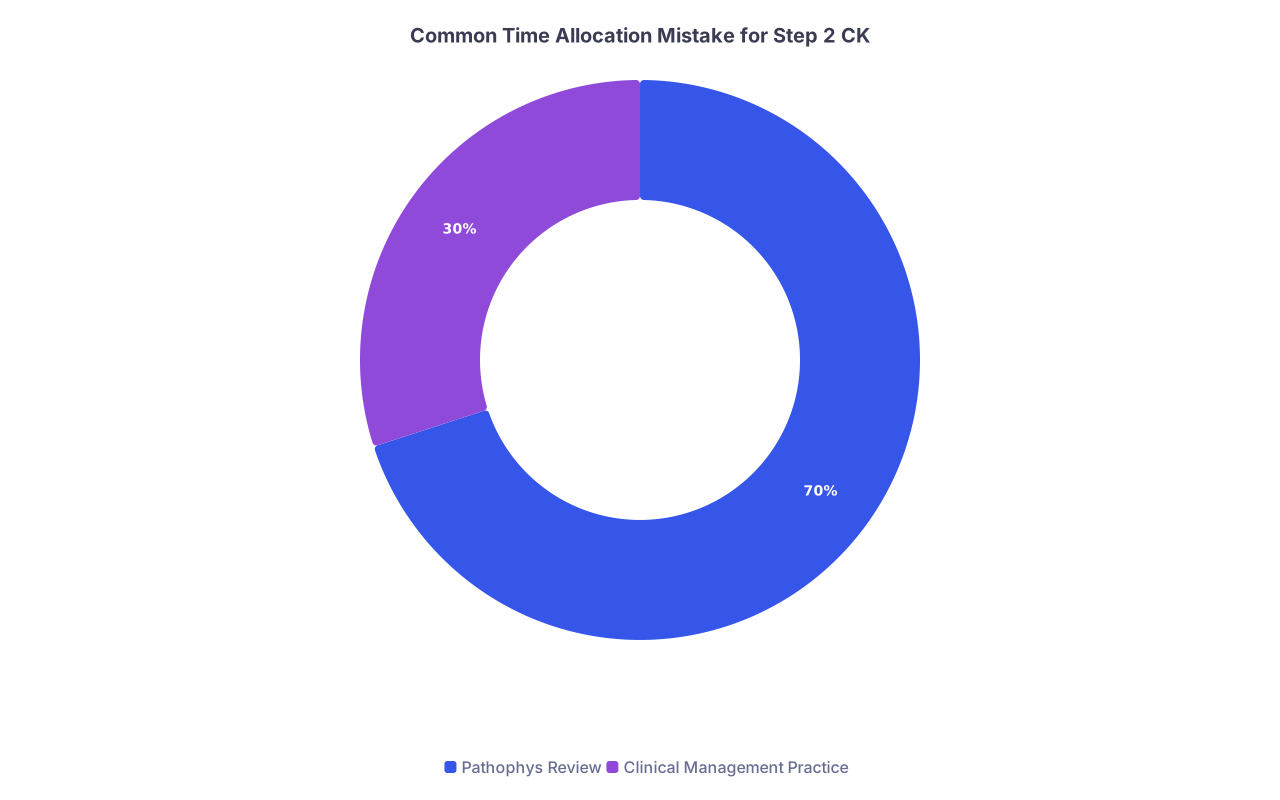
| Category | Value |
|---|---|
| Pathophys Review | 70 |
| Clinical Management Practice | 30 |
What to stop doing:
- “Just reviewing Step 1 stuff quickly” without deliberately shifting to management-heavy resources
- Ignoring guidelines (e.g., ACC/AHA, IDSA-style logic) and thinking “I’ll just go with my gut”
What to do instead:
- When reviewing questions, always ask:
“What’s the decision point here? Stabilize? Diagnose? Treat? Screen? Follow up?” - Force yourself to say the actual guideline-style answer out loud:
“Hemodynamically unstable + suspected ectopic pregnancy = straight to laparotomy, not ultrasound.”
If your explanations sound like random reasoning and not structured logic, you’re still in Step 1 mode. And Step 2 will punish you for it.
2. Doing Questions Like It’s a Video Game, Not a Learning Tool
I’ve literally heard students say, “Yeah I’m almost done with my second pass of UWorld.”
Then I ask what their review process looks like.
Silence.
If you’re rushing through questions for completion, you’re burning the most valuable part of Step 2 prep: the post-question learning.
The trap:
- You focus on number of questions per day as success
- You skim explanations, only read the bolded bits, and tell yourself you’ll “come back later”
- You spend 1–2 minutes per explanation because you’re eager to see your percent correct
That’s exam-score suicide.
The question isn’t “How many questions did you do?” It’s “How many mistakes did you actually understand and fix?”
Here’s the ugly pattern I’ve seen:
- 80 questions/day
- < 1 minute per explanation
- No tracking of repeat errors
- No synthesis or notes
- Result: practice scores flat for weeks
Compare that to:
- 40–60 questions/day
- 3–6 minutes per explanation for missed or guessed questions
- Simple error log (I’ll get to this later)
- Result: practice scores creep up, then jump

Here’s how you know you’re doing questions wrong:
- You can’t explain why all the wrong options are wrong
- You keep missing the same diagnosis or management step in different disguises
- You’re proud of your “QBank completion percentage” instead of your NBME score trend
Fix it:
- Cap your daily questions where you can still do real review. For most people, that’s 40–60/day.
- For every missed/guessed question, write a one-sentence takeaway:
- “Always stabilize before imaging when unstable.”
- “Painless jaundice + weight loss in older smoker → pancreatic cancer until proven otherwise.”
- If you can’t teach the question to someone else in 30–60 seconds, you don’t own it yet.
3. Over-Relying on Passive “Review” Instead of Active Retrieval
The lie you tell yourself: “I’m reviewing all day. I’m working hard.”
You’re watching videos, scrolling Anki on autopilot, reading notes. It feels like work. But your brain is staying lazy.
Step 2 CK is a cold test of recall and decision-making under fatigue. Passive review builds neither.
The trap versions:
- Playing YouTube review videos in the background “while doing chores”
- Re-reading the same Step 2 review book three times
- Passively flipping through someone else’s Anki deck without truly testing yourself
You’ll know you’re in this trap if:
- You “know” a topic while reading, then forget everything when faced with a new question on it
- You keep saying, “I’ve seen this before” but still get it wrong
Active vs passive isn’t abstract. It looks like this:
| Behavior | Passive or Active | Score Impact Trend |
|---|---|---|
| Watching videos at 1.75x | Passive | Neutral/Negative |
| Doing timed, mixed QBank blocks | Active | Positive |
| Re-reading class notes | Passive | Weak |
| Writing 1-sentence error takeaways | Active | Strong |
| Explaining answers out loud | Active | Strong |
If 70–80% of your day is passive, don’t be shocked when you stay stuck in the 220s.
Shift your ratio:
- Anchor each day with questions first, review second, anything else last
- Use Anki or flashcards as retrieval, not as reading material
(If you’re just rapidly hitting “Good” and “Again” without effort, you’re wasting time.)
Try this test:
Close your resources. Set a 5-minute timer. List everything you remember about “asthma management in adults.” If your page is nearly empty, your “review” has been passive. Fix that.
4. Studying in Silos Instead of Building Systems
Step 2 CK doesn’t care that you “finished cardiology” and “moved on to GI.”
Real questions blend:
- Cardio + nephro (HTN in CKD patient)
- OB + psych (postpartum depression vs baby blues)
- ID + heme (fever in neutropenic patient with recent chemo)
The trap:
You study by organ system in a super rigid way and never come back to integrate them. It gives you the illusion of mastery while your brain has no idea how to juggle multiple problems at once.
I’ve watched this play out on practice exams:
- Student finishes “OB” section of boards resource
- Crushes OB-only questions
- Completely falls apart when OB is mixed into a multi-problem internal medicine case
Step 2 is a mixed exam. Your studying should reflect that at least half the time.
Fix it before you’re the person complaining online that “NBMEs feel so different than UWorld”:
- Do timed, mixed blocks at least 3–4 days a week, even early on
- When you review a question, ask:
- “What other system is part of this scenario?”
- “What co-morbidities would change this answer?”
- Build mini systems in your notes:
- “Dyspnea”: cardiac causes, pulmonary causes, anemia, psych, PE, pneumonia, CHF, etc.
- “Chest pain”: ACS, PE, dissection, pericarditis, costochondritis, GERD, etc.
If all your knowledge lives in isolated boxes, Step 2 will break you with multi-problem patients.
5. Ignoring Timed Practice Until It’s Too Late
You’d think people would learn this from Step 1. They don’t.
A very common disaster story:
- First 4–6 weeks: untimed, tutor mode, carefully reading everything
- Last 2 weeks: panic, switch to timed blocks
- Realize you can’t finish blocks on time without your accuracy tanking
You basically trained your brain to take the exam at half speed. Then expect it to double pace overnight.
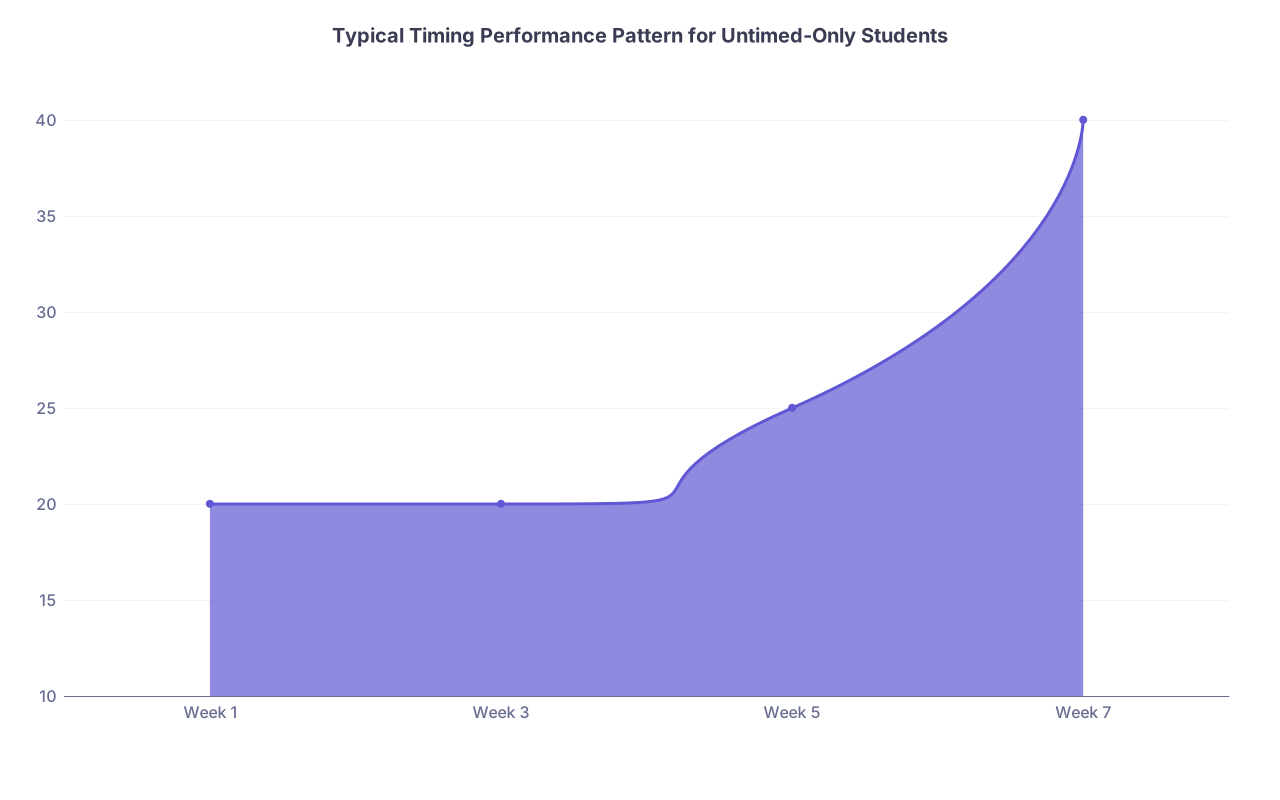
| Category | Value |
|---|---|
| Week 1 | 20 |
| Week 3 | 20 |
| Week 5 | 25 |
| Week 7 | 40 |
Numbers represent “questions still unanswered” when 60 minutes ends on timed blocks. I’ve seen worse.
If you’re not regularly doing:
- 40-question timed blocks (or more)
- Mixed subjects
- Minimal “cheating” (no pausing the clock, no looking up mid-question)
…you’re training for a different exam than the one you’ll take.
Avoid this really simple but destructive mistake:
- Don’t stay in tutor mode longer than 1–2 weeks
- By mid-prep, at least half your blocks should be timed
- In the last 3–4 weeks, the majority should be timed, test-like conditions
If you currently need 90 minutes to do 40 questions “carefully,” you’re in trouble. Fix it now.
6. Hiding from Weaknesses Behind “Comfort Topics”
Here’s a very human trap:
You’re good at cardiology. You suck at psych. Guess which one you keep “reviewing” when you’re tired or stressed?
I had a student who could recite every ACS management step cold. But missed straightforward questions on depression, bipolar, and substance use because she “hated psych.” Her NBME breakdown looked exactly like you’d expect – psych was tanking her composite score.
Step 2 doesn’t care what you like. It cares what you know.
Red flags you’re falling into this:
- Your QBank performance by subject is wildly unbalanced, but you keep hammering your top subjects
- You say “I’ll fix that later when I have more time” about the same 1–2 weak areas for weeks
- You rationalize: “Well, that topic isn’t that high-yield anyway”
Spoiler:
Anything that shows up on NBMEs repeatedly is high-yield, whether you like it or not.
| Subject | Correct % | Study Focus So Far |
|---|---|---|
| Cardiology | 78% | High |
| Pulm | 72% | Moderate |
| Psych | 48% | Low |
| OB/GYN | 55% | Low |
| Pediatrics | 60% | Moderate |
If your table looks like this and you’re still reading about murmurs daily, you’re sabotaging yourself.
Fix the avoidance:
- Once a week, sort QBank by weakest subject and do a block in that area
- Don’t end your day on your best subject. End on your worst. It forces exposure under fatigue.
- Set a very low bar: “Today I’ll fix one psych diagnosis pattern I keep missing.” Then actually do it.
Your score is capped by your worst domains, not your best ones.
7. Collecting Too Many Resources and Mastering None
You don’t need me to tell you this, but a lot of you will still do it.
You buy:
- UWorld
- Amboss
- Online MedEd
- Sketchy
- 2–3 Step 2 “bibles”
- Random third-party notes from classmates
- Anki decks made by seven different strangers
And then you wonder why everything feels scattered and shallow.
You’re making the classic “resource hoarder” mistake:
- You keep adding resources whenever you feel anxious
- You never fully commit to one primary and one backup
- You “switch” when something feels hard, instead of pushing through
Here’s the pattern of people who burn out:
- Try to “finish” two QBanks → get to 60–70% of each → rush the last month
- Skim multiple review books → can’t remember which one said what
- Watch endless videos instead of actually doing hard questions
Stop.
You need:
- 1 primary QBank (usually UWorld)
- 0–1 supplemental QBank (Amboss if you have the bandwidth)
- 1 main short reference (Notes/handbook style, if you really want one)
- NBMEs and/or UWSAs for assessment
Anything more needs a very specific reason, not just FOMO.
If you currently have 5+ active resources, you’re not “working harder.” You’re multiplying your cognitive load and diluting your learning.
8. Misreading Your Practice Scores (And Either Panicking or Getting Cocky)
Another sneaky trap: you treat every single practice score like a prophecy instead of a data point in a trend.
I’ve seen both extremes:
- The student who gets a 225 on their first NBME 8 weeks out and spirals into anxiety, then starts changing everything randomly
- The student who hits one high UWSA score, gets complacent, and coasts into a real score that’s 10–15 points lower
The mistake:
- You look at absolute numbers instead of direction and consistency
- You don’t track them on paper/spreadsheet
- You change strategies impulsively after each test
You should have something like this written down:
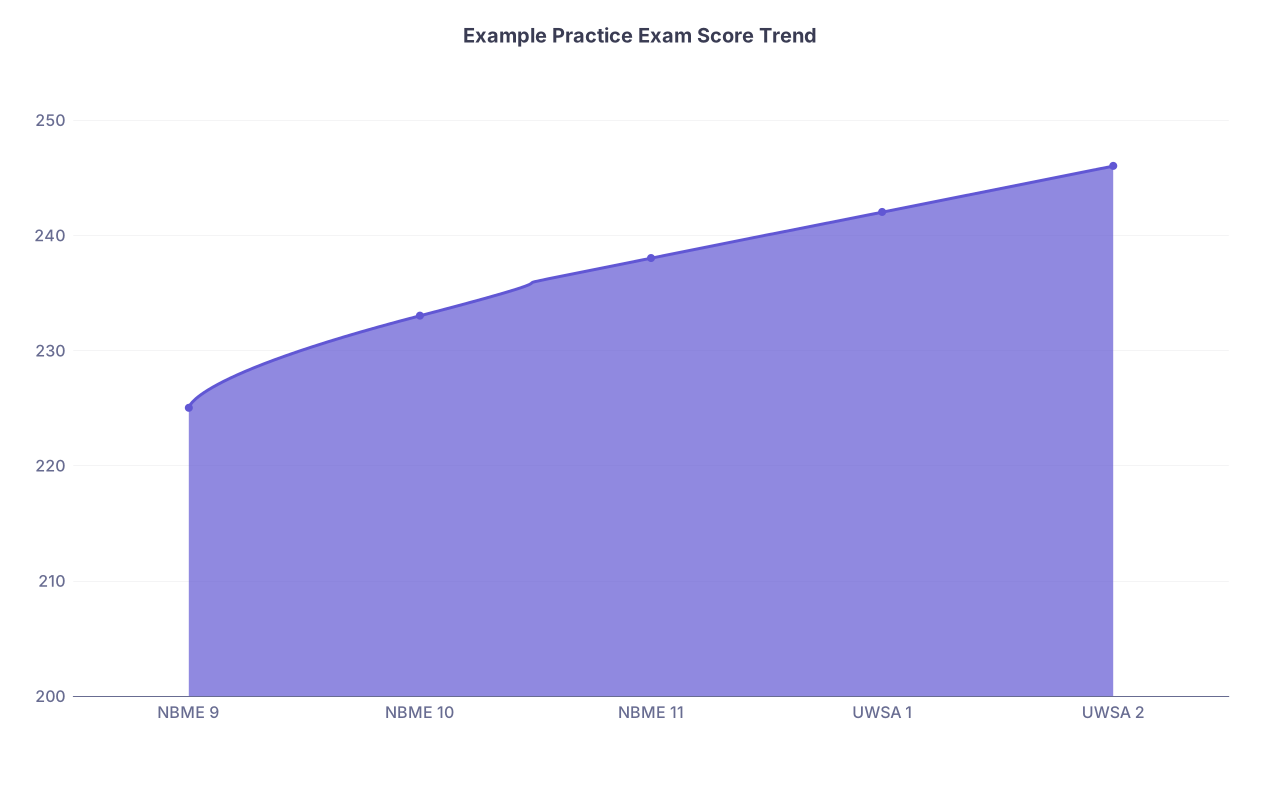
| Category | Value |
|---|---|
| NBME 9 | 225 |
| NBME 10 | 233 |
| NBME 11 | 238 |
| UWSA 1 | 242 |
| UWSA 2 | 246 |
That trend? Healthy.
Someone with that curve shouldn’t be burning their whole plan down after one mediocre block.
On the flip side, a flat or downward trend should scare you more than a single low score. But people ignore that.
If you’re making these mistakes:
- Taking practice exams too close together (e.g., weekly) without time to implement changes
- Using only UWorld % as your “readiness metric”
- Taking NBMEs so late there’s no time left to adjust
…you’re driving blind.
Practical fix:
- Do a full assessment (NBME/UWSA) every 2–3 weeks once you’re ~50–60% through your main QBank
- After each exam, identify 2–3 concrete changes (e.g., “Daily timed block,” “Dedicated hour for OB/Psych,” “Error log every evening”)
- Give those changes at least 10–14 days before judging if they’re working
Stop swinging wildly. Step 2 rewards steady correction, not panic.
9. Not Training Your Brain for Eight Hours of Decision Fatigue
Step 2 CK is long. People love to underestimate how ugly hour 6 and 7 feel.
I’ve seen this play out in testing center stories:
- “First four blocks felt okay, then my brain just… stopped. I started misreading questions I would normally nail.”
The trap:
You only ever do 40-question blocks. Maybe two in a day. You never simulate the full test environment.
So your brain thinks Step 2 is a marathon when you’ve only trained for 5Ks.
Even good knowledge collapses under fatigue if you never stress-tested it.
You’re in this trap if:
- You’ve never done more than 3 blocks in a day, timed, before test week
- You’ve never experimented with your caffeine, food, bathroom breaks under realistic timing
- You don’t know at what hour you start making dumb mistakes because you’ve never checked
Fix it like an adult instead of hoping “adrenaline will carry me”:
- 2–3 weeks before the exam, schedule at least one full-length simulation day:
- 7–8 blocks
- Real breaks
- No phone distractions
- Same wake-up time as exam day
- On that day, track:
- When your focus drops
- If certain snacks or caffeine timing help or hurt
- Whether your speed falls apart on later blocks
Then adjust now, not on the actual exam.
10. Pretending Your Mental Health and Sleep Don’t Matter
No, you’re not the exception. Sleep debt and burnout will flatten your Step 2 performance.
The self-sabotage version:
- Telling yourself “I’ll catch up on sleep after the exam”
- Studying 12–14 hour days where half of it is low-quality because you’re exhausted
- Taking no real days off for weeks, then wondering why you’re numb and unmotivated
I’ve watched multiple students drop 10–20 points between their last NBME and their real score because they destroyed themselves in the final 2 weeks:
- Sleep cut to 4–5 hours
- Panic-cramming new resources
- No exercise, terrible food, zero decompression
If your last 10–14 days look like a nervous breakdown, don’t be surprised when your performance reflects that.
Be very clear:
- 6–7 high-quality focused hours of study beats 12 unfocused, half-asleep ones
- Chronic sleep restriction wrecks executive function – exactly what Step 2 is testing
You should especially not:
- Do a full QBank block late at night when you’re fried (you’ll just learn to perform badly)
- Take a full-length exam on <6 hours of sleep “to fit it in”
Protect the machinery (your brain) or your content won’t matter.
11. Not Capturing Your Mistakes in an Error Log
This one’s quiet but lethal.
Most students make the same underlying 20–40 mistakes over and over:
- Misreading key vitals or age ranges
- Forgetting a single contra-indication
- Confusing similar presentations (e.g., schizoid vs avoidant vs ASD traits)
But they never track them. So they re-learn the same lesson 15 times and call it “bad luck.”
An error log is annoyingly simple. That’s why people skip it. They think it’s beneath them.
It’s not.
Basic structure:
- Date
- Question/source
- Topic
- What I did
- What I should have done
- Why I missed it (knowledge gap, misread, rushed, overthinking, etc.)

The trap version:
- You tell yourself, “I’ll remember this, it’s obvious now”
- You don’t consolidate similar mistakes (e.g., all the “stabilize before imaging” errors)
- You don’t review your log
You know who tends to beat their predicted scores?
The students who can say things like:
“I used to miss all the questions involving chronic liver disease + bleeding, but after logging those and reviewing the pattern, I started getting them right consistently.”
They didn’t magically get smarter. They just didn’t waste their failures.
Do this bare minimum:
- Start an error log today (paper, Notion, Word, doesn’t matter)
- Add 5–10 key mistakes per day only (not every single miss)
- Review your entire log 2–3 times a week
→ Look for patterns like “keep missing outpatient management step for X” and fix those in bulk
You can’t afford to pay the “tuition” of missing a concept five times and getting nothing permanent out of it.
Your Next Step: Catch One Trap Today, Don’t Wait
Don’t try to fix all 11 at once. That’s another trap.
Do this instead, right now:
- Grab a piece of paper or open a blank note.
- Write the numbers 1–11 down the side.
- Re-scan this article and circle 3 traps you’re clearly guilty of. Be brutally honest.
- For each of those 3, write one concrete action you’ll do in the next 48 hours. Example:
- #2 Questions: “Switch to 40 timed questions/day with 3–5 min explanation review for misses.”
- #6 Weaknesses: “Do one 40-question psych/OB block tomorrow sorted by weakest subject.”
- #11 Error log: “Create a 6-column error log and fill in 5 entries today.”
Then actually start with one today. Not tomorrow. Not “once my schedule calms down.”
Open your QBank, schedule a timed block, and right after it, begin your error log with the first 5 mistakes. If you build that habit now, your Step 2 CK score will thank you in a way panic-cramming never will.