
The Myth That Step 2 CS Is ‘Just Common Sense’ and Why People Fail
If Step 2 CS is “just common sense,” why did thousands of smart, clinically competent students fail it every year before it was finally killed off?
No, they weren’t all socially awkward disasters who forgot to wash their hands and say hello. Some were chief residents later. Some were gunning for derm and crushed every rotation. Yet they walked out with a big fat “Fail” on an exam everyone kept telling them was easy.
Let’s take a scalpel to this myth.
What the Data Actually Showed (Before CS Died)
Step 2 CS is gone now, but the mythology around it still lives on in how students think about OSCEs, clinical skills exams, and “doctoring” courses. And the same thinking that got people burned on CS is still causing failures on school OSCEs and clinical performance assessments.
First, the numbers.
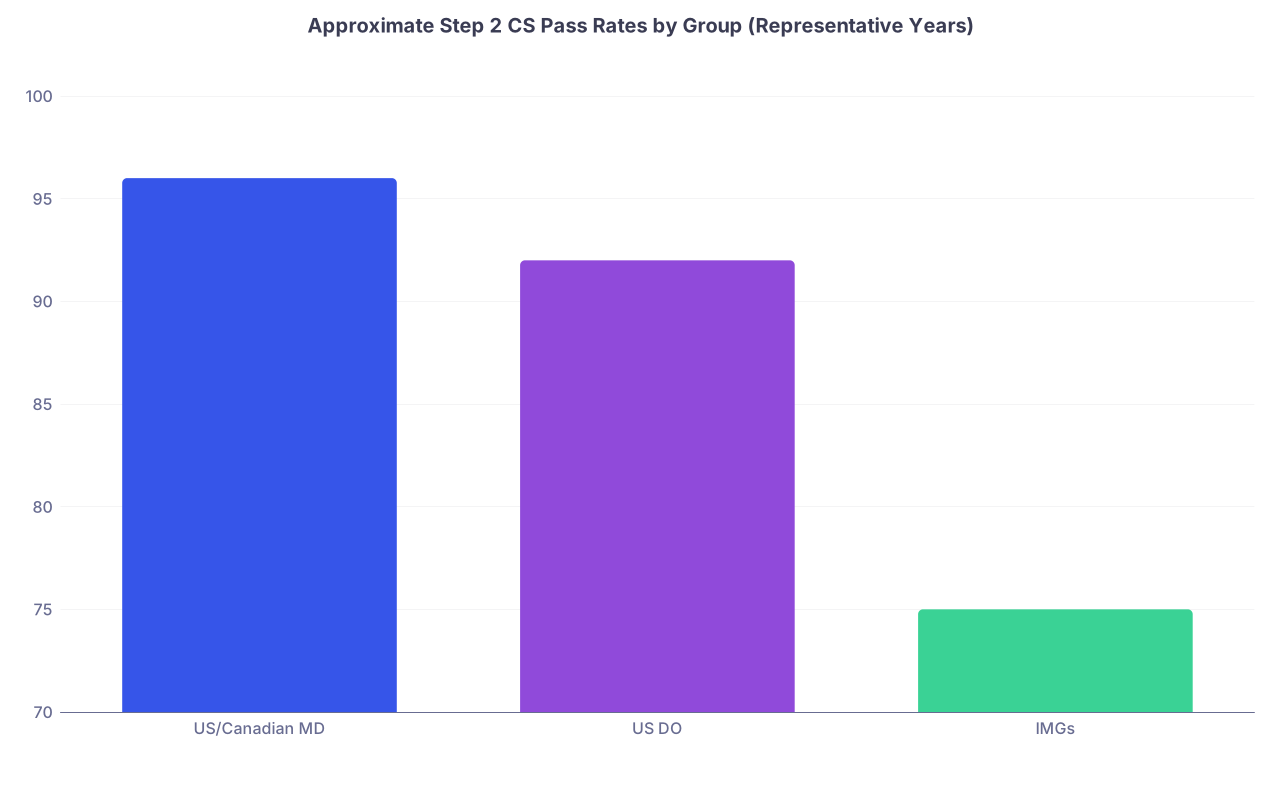
The NBME/USMLE used to publish pass rates:
| Category | Value |
|---|---|
| US/Canadian MD | 96 |
| US DO | 92 |
| IMGs | 75 |
So yes, U.S. MD students usually passed. But “usually” does not mean “automatically.” A 4% fail rate in a huge pool of high-performing students is not trivial. And among IMGs it was brutal.
Those failure rates didn’t come from people forgetting one physical maneuver. They came from patterns:
- Communication and interpersonal skills (CIS) failures
- Integrated clinical encounter (ICE) failures
- Spoken English proficiency (SEP) — mostly for non-native speakers, but not only
I saw plenty of students who were actually good with patients fail CIS. Why? Because they treated Step 2 CS as a “vibes” exam instead of a structured, graded performance with specific, unforgiving checklists.
The myth:
“If you’re decent with patients and have common sense, you’ll be fine.”
The reality:
Examiners were not scoring your “common sense.” They were scoring behaviors and documentation against a rigid rubric you never see.
Why “Common Sense” Completely Misreads What CS Was Testing
You’ve probably heard residents shrug: “Just be nice, wash your hands, and ask a few questions.” That’s how people set each other up to fail.
Step 2 CS (and your school’s OSCEs now) do not measure how good of a clinician you could be. They measure whether, within 15 minutes, under stress, you can:
- Perform a structured, efficient interview
- Hit key checklist items for that specific complaint
- Demonstrate specific communication behaviors (not general niceness)
- Document a focused but complete note in a very short time
Those are four different skills. Plenty of smart, empathetic people are only good at two.
Here’s what “common sense” people get wrong:
They think rapport = communication score.
It doesn’t. Saying “I’m sorry you’re going through this” is nice, but if you never explicitly ask “How is this affecting your daily life?” or “What are you most worried about?” you may be missing the actual CIS checklist items.They think a decent H&P = clinical encounter score.
Wrong again. ICE cared about:- Right positives/negatives documented
- Right differential list
- Right basic workup
Not just “you examined the abdomen.”
They think English fluency = SEP.
I’ve watched native speakers mumble, turn away, or use disorganized word salads that tanked perceptions of clarity.
“Common sense” is what you use in a 45-minute outpatient visit with a real patient who actually has time and context. CS was an artificial, compressed, gamified environment. Those are different skill sets.
The Real Reasons People Failed Step 2 CS
Let’s go through the main failure patterns I’ve actually seen, and why they’re not about intelligence.
1. Treating It Like an OSCE You Can Fake
I remember one student — strong Step 1, honors in medicine and surgery — who said, “I’ll just do what I do on the wards. I don’t need to rehearse fake patient lines.”
He failed CIS.
Why? Because on the wards:
- You have chart context.
- You already know the chief complaint.
- You can come back and ask more questions.
- Your attending often leads discussions of sensitive topics.
In CS:
- You walk in cold.
- You have one shot at getting EVERYTHING in 15 minutes.
- If you don’t explicitly say or do something, it does not exist on the checklist.
So students who “just wing it” do what they’re used to: unstructured, wandering interviews, incomplete counseling, and weak closure.
2. Sloppy, Incomplete, or Misprioritized Histories
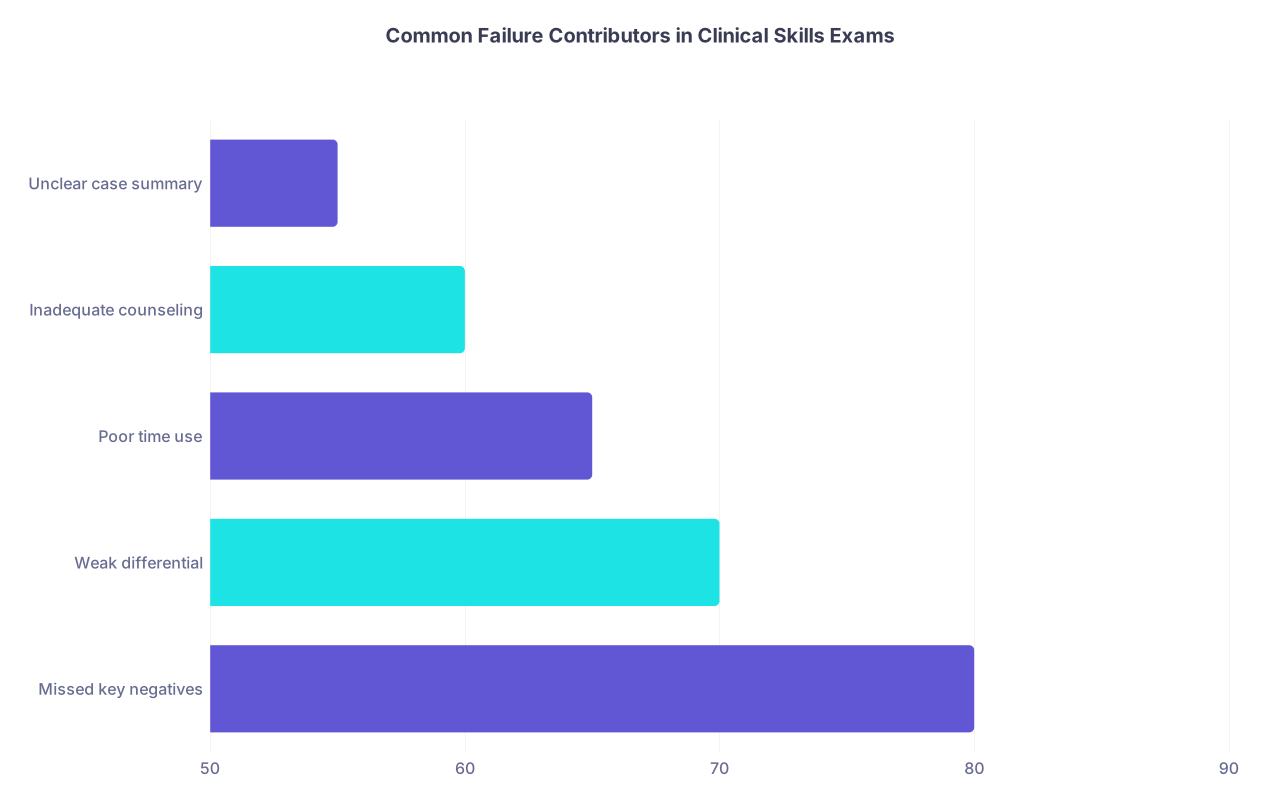
Common failure pattern: missing key negatives.
Example: 45-year-old with chest pain.
The “common sense” student asks:
- Location, quality, duration, radiation, associated symptoms
- Maybe risk factors
Sounds fine. But they never explicitly:
- Characterize exertional vs. non-exertional
- Ask about pleuritic nature
- Clarify relation to meals
- Screen for DVT/PE risk factors
- Ask “Have you noticed any leg swelling or pain?”
If they also miss reproductive or pregnancy questions in appropriate patients, or fail to ask about sexual history in GU complaints, the checklist hemorrhage becomes real.
Individually, each miss seems small. Collectively, it signals to the scoring system: “Incomplete data gathering.” ICE takes the hit.
3. Weak, Generic Differential Diagnoses
This is where high Step 1 scorers got exposed.
The exam didn’t care if you memorized every obscure vasculitis. It cared if your differential:
- Matched the presenting complaint
- Reflected probable and dangerous causes
- Was prioritized reasonably
I saw practice notes like this for a 60-year-old with classic angina symptoms:
- Dx 1: Panic attack
- Dx 2: GERD
- Dx 3: Costochondritis
No unstable angina. No MI. They “knew” those existed, but didn’t put them in the top three because “the vitals looked fine” or “she didn’t seem that sick.”
The scoring system does not reward you for vibes. It rewards you for naming the real threats. Students who tried to be too clever or too “pattern-recognition pure” often failed the ICE reasoning piece.
4. Time Management Meltdowns — Especially on the Note
This was massive and still haunts school OSCEs.
You have 15 minutes in the room. Then a very short chunk of time to write a note. Many students:
- Spend 13–14 minutes in the room
- Exit with a vague plan in their head
- Then panic-type a bloated, incoherent note that doesn’t hit key findings
The note is not a diary. It’s evidence that you:
- Collected the right data
- Interpreted it sensibly
- Can outline a basic initial workup
I’ve watched students write paragraphs of social history and then list a single, lazy differential: “Chest pain — ACS vs GERD.” No workup, no rationale. That’s how you turn a borderline performance into a fail.

The Checklist Reality: How CS Actually Scored You
You never saw the rubric, which is exactly why “common sense” led people into a trap.
Based on NBME documentation, faculty experience, and debriefs, here’s what they actually cared about — and what still shows up in current OSCE rubrics.
Communication (CIS) was NOT “Be Nice”
It was structured, observable behaviors. Things like:
- Introduces self with name and role
- Confirms patient name and how they prefer to be addressed
- Washes hands or uses sanitizer visibly
- Explores patient’s ideas, concerns, and expectations (ICE questions)
- Checks understanding
- Summarizes and signposts transitions (“Now I’m going to…”)
If you’re friendly but never ask the patient what they’re worried about? You missed a core item. If you jump into sexual history without warning or permission? CIS dings for boundaries and sensitivity.
Students failed not because they were rude human beings, but because they didn’t deliberately perform the behaviors being scored.
Clinical Encounter (ICE) was NOT “Real Life Medicine”
It was medicine under a stopwatch with a checklist.
You got scored on:
- Did you ask about red-flag symptoms specific to that complaint?
- Did you perform the expected focused physical exam elements?
- Did you include at least one must-not-miss diagnosis on your list?
- Did your workup include standard, bread-and-butter tests?
If a 22-year-old with unilateral weakness and slurred speech never gets “stroke” in the differential because they “seemed too young,” you’re punished. Correctly.
| Category | Value |
|---|---|
| Missed key negatives | 80 |
| Weak differential | 70 |
| Poor time use | 65 |
| Inadequate counseling | 60 |
| Unclear case summary | 55 |
US vs IMGs: The Harsh Reality
There’s another myth floating around: that IMGs failed mostly because of language, and U.S. grads only failed if they were truly terrible.
That’s not what the patterns show.
Yes, IMGs had much lower pass rates, due to:
- Language issues
- Different communication norms
- Less exposure to standardized patient formats
But I’ve watched U.S. grads with perfect English fail for different reasons:
- Entitlement: “I’m from a top-20 med school; this exam is beneath me.”
- Overconfidence: No structured practice, no timed notes.
- Overcomplication: Writing mini-Harrison’s in the differential instead of listing the obvious stuff clearly.
Different roots, same outcome: “Fail.”

What This Means for You Now (Even Though CS Is Gone)
Step 2 CS is dead. But its ghost is very much alive in:
- School OSCEs
- Clinical skills courses
- Residency “observed encounters”
- EPAs and milestone evaluations
The same myths still cause the same failures:
- “I’ll just be myself in there.”
- “I’m good with patients; I don’t need to rehearse.”
- “It’s just common sense.”
Here’s the uncomfortable truth: the students who did best on CS weren’t always the “naturally gifted” communicators. They were the ones who treated communication and encounter structure as skills to be drilled, not personality traits.
They:
- Used reproducible templates for HPI, social history, and closure.
- Practiced 10–15 minute encounters on a clock until it felt normal.
- Memorized the skeleton of a safe, basic workup for bread-and-butter complaints.
- Got specific feedback on “you never check understanding” or “you never verbalize your diagnosis list.”
They treated it like studying for a procedure. Not performing in a talent show.

| Step | Description |
|---|---|
| Step 1 | Knock/Enter |
| Step 2 | Intro & ID Check |
| Step 3 | Open-Ended Question |
| Step 4 | Focused HPI & ROS |
| Step 5 | Past/Social/FHx as relevant |
| Step 6 | Focused Physical Exam |
| Step 7 | Summarize Findings |
| Step 8 | Discuss Differential & Plan |
| Step 9 | Check Understanding & Questions |
| Step 10 | Closure & Exit |
Why Calling It “Just Common Sense” Is Actually Dangerous
Label something “common sense,” and three things happen:
People under-prepare.
No one wants to admit they’re working hard on something supposedly easy. So they don’t seek feedback or drill the boring parts.They personalize failure.
If it’s “just common sense,” then failing means “I must lack common sense” or “I’m bad with patients,” which is almost never true. So instead of targeting specific, fixable behaviors, they spiral.Programs and schools under-teach it.
Faculty assume, “They’ll pick it up on the wards.” They won’t. Real clinical environments rarely provide the explicit, structured feedback CS was scoring you on.
You are not failing “humanity” or “empathy” if you struggle on these exams. You’re failing a specific performance task in an artificial environment with an opaque rubric.
The fix is not to become a different person. The fix is to:
- Learn the structure
- Rehearse the structure
- Translate your actual empathy and intelligence into behaviors the exam can see
That’s it.
| Myth | Reality |
|---|---|
| It's just common sense | It's a structured, checklist-driven performance |
| Being nice is enough for CIS | Specific behaviors (ICE questions, summaries) are scored |
| Good English = good SEP | Clarity, volume, and organization matter |
| Strong H&P = strong ICE | Differential and workup choices are heavily weighted |
| Smart students don't fail | Overconfidence and no practice sink high-achievers |
The Bottom Line
Keep it simple:
- Step 2 CS was never “just common sense”; it was a scripted performance exam with rigid checklists that punished unstructured, wing-it behavior.
- People didn’t fail because they were bad doctors; they failed because they missed specific, observable behaviors under time pressure — incomplete histories, weak differentials, poor note structure, and superficial communication.
- The same trap still exists in OSCEs and clinical skills assessments today. If you stop treating them like “easy” and start treating them like skills you drill deliberately, you’ll outperform a lot of people who think they’re too smart to practice.