
What do you think hurts more on Step 2 PE: missing a rare zebra diagnosis—or losing points because your note looks like a rushed, sloppy mess with no plan?
I’ve watched too many otherwise solid students walk out of Step 2 CS/PE-type exams thinking, “The encounters went fine,” and then get blindsided by a fail because of the written note. The standardized patient smiled, the physical exam felt okay… but the note quietly sank them.
Let me walk you through the mistakes that bleed points—especially in a Step 2 PE-style exam—so you don’t repeat them.
1. Treating the Note Like an Afterthought
Most students over-focus on the in-room performance and under-respect the note. That’s mistake #1.
You get graded on three broad areas:
- Data gathering
- Communication/interpersonal skills
- Documentation (the note)
Everyone remembers the first two. The third? People assume they’ll “just write what they did.” That assumption is dangerous.
Here’s the trap:
You can do a solid history and exam, but if it never appears in the note—or appears in an incoherent, incomplete way—you basically didn’t do it as far as the grader is concerned.
Common “afterthought” behaviors:
- Starting the note 5+ minutes late because you’re still in the room chatting
- Spending 8 minutes on the history box and then speed-typing a nonsense plan in 60 seconds
- Skipping review because “I need every second just to type”
Do not do this.
You should be:
- Leaving the room with a mental outline of your note
- Allocating time on purpose (for example: 2–3 minutes for HPI, 2 for ROS/PMH, 2 for PE, 3–4 for assessment/plan)
- Accepting that a short, organized note beats a sprawling, chaotic one every single time
The exam isn’t testing how much you can type. It’s testing whether you can document what matters. Under pressure.
2. Sloppy, Vague, and Useless HPIs
If your HPI reads like this, you’re throwing away points:
“Pt is a 45 yo man here for chest pain that started a few days ago. Denies SOB, nausea, or vomiting. No other complaints.”
That’s barely useful clinically, and it’s pathetic in a graded patient note.
Big HPI mistakes:
- No structure: Random facts thrown in with no timeline, no clear onset, no context
- Missing critical qualifiers: Location, quality, severity, duration, modifying factors, associated symptoms
- Burying the lead: Tossing in, “Had 30-min substernal pain with radiation to left arm” at the end as an afterthought
- Copy-paste symptom lists with no relevance or prioritization
Your HPI needs to scream, “I know how to think like a clinician.”
Think SOAP, but actually logical:
- Start with one clean opening line (age, sex, main complaint, duration)
- Then a short, focused paragraph on:
- Onset & context
- Character & severity
- Course (better, worse, constant, intermittent)
- Associated red flags / key negatives (that matter)
- Relevant risk factors
What kills you is not leaving out some obscure symptom. It’s omitting the things that obviously steer the differential.
For example:
- New headache in a 50-year-old and you forget to document worst-ever, sudden vs gradual, neck stiffness, neuro deficits → that’s a red flag omission.
- Chest pain and you never say exertional vs pleuritic vs positional → that’s a core failure.
You may have asked. If you don’t document it, it does not exist.
3. Shotgun ROS and PMH That Look Lazy
You’re not graded on how many systems you list. You’re graded on whether what you list seems purposeful.
Pitfalls:
- Writing “ROS otherwise negative” for every single case, no specificity
- Listing 10+ ROS items that have nothing to do with the chief complaint
- Leaving out key system questions directly related to the main problem
- Forgetting basic PMH elements: meds, allergies, surgeries, chronic diseases, OB/GYN when relevant
You’re not in preclinical anymore. Clinical reasoning matters.
Tie your ROS and PMH to the complaint:
- Cough? You better have constitutional, ENT, respiratory, sometimes cardiac, sometimes GI (reflux).
- Syncope? Cardiac, neuro, constitutional, maybe psych/substances.
- Abdominal pain? GI, GU, GYN (for anyone with a uterus), constitutional.
What impresses graders:
- Focused ROS with clearly relevant positives and negatives
- PMH that includes at least: medical conditions, meds, allergies, surgeries, family history, social history, and smoking/alcohol/substance use when appropriate
And no, “No PMH” is not acceptable shorthand if you didn’t state meds/allergies/social. I’ve watched notes get hammered for that.
4. Half-Baked Physical Exam Documentation
One of the most frequent—and most avoidable—mistakes: your physical exam looks like you examined a cardboard cutout.
Common errors:
- Only documenting “VS stable. NAD. HEENT WNL. Heart RRR. Lungs CTAB. Abd soft NT/ND” for every single case
- No system-specific exam tailored to the complaint
- Writing clearly impossible exams (pelvic exam in an SP case that didn’t allow it, or detailed neuro exam you didn’t do)
- Forgetting basic vitals or describing obviously abnormal findings as “normal”
Here’s what graders expect:
- General appearance and vitals mentioned or clearly acknowledged
- A baseline: heart, lungs, general constitutional
- A focused system exam relevant to the complaint
For example, if the case is:
- Knee pain: You’d better have gait, inspection, palpation, ROM, special tests (as allowed), and maybe comparison to the other side.
- Shortness of breath: Lungs in detail, heart, JVD, edema, maybe extremity exam.
- Headache: Neuro exam, cranial nerves, fundoscopic (document that you would or did attempt it).
If your note looks like a generic template pasted into every encounter, it signals either:
- You don’t understand focused exam
- Or you didn’t actually examine the patient properly
Both cost you.
5. Garbage Differentials: Too Broad, Too Narrow, or Totally Implausible
You lose easy points by being cute or by being lazy.
I’ve seen this pattern:
- Diagnosis 1: The obvious one (okay)
- Diagnosis 2: A wild zebra (because “they might want me to consider it”)
- Diagnosis 3: Something completely unrelated to the HPI
And then no reasoning. Just a list.
Bad habits:
- Listing 3 diagnoses that don’t match the data you wrote
- Picking 3 variants of the same thing: “viral URI, post-viral cough, bronchitis”
- Putting the scary thing (like MI, ectopic, meningitis) nowhere in the top 3 when the HPI screams for it
- Giving no explanation for why each diagnosis is or isn’t likely
The exam wants to see whether your brain flags important possibilities and can prioritize.
Your differential should:
- Include at least one “must not miss” when appropriate
- Be plausible based on the HPI and exam
- Be ranked in reasonable order
- Include 1–2 concise points of justification each
Example for chest pain:
- #1 Unstable angina – exertional substernal chest pressure relieved by rest, multiple CAD risk factors
- #2 GERD – burning pain after large meals, worse lying down, partial relief with antacids
- #3 Costochondritis – reproducible chest wall tenderness, recent upper respiratory infection and coughing
You don’t need novels. You need rational thinking visible to the rater.
6. Plans That Are either Nonexistent or Unsafe
Too many notes treat the plan like an afterthought:
“Plan: Labs, imaging. Will follow.”
That’s a way to bleed points fast.
On a Step 2 PE-style note, the plan is where your clinical maturity is on display. Or not.
Major plan mistakes:
- Ordering a ridiculous shotgun panel of tests with no prioritization
- Completely ignoring the must-not-miss diagnosis you should be ruling out STAT
- Forgetting immediate stabilization steps when appropriate
- No mention of patient education, follow-up, or when to seek urgent care
- Writing “reassure patient” for things that are absolutely not benign
You need at least:
- Immediate management (if needed):
- ER transfer, admission vs outpatient
- Analgesia, oxygen, fluids if relevant
- Targeted diagnostics:
- A few key labs, key imaging, not a laundry list
- Basics of treatment:
- Symptomatic treatment, key meds, lifestyle
- Safety-netting / education:
- Red flags, follow-up timeline, basic counseling
Remember: they’re not grading you on cost-effectiveness. They are grading whether your plan is:
- Safe
- Focused
- Intern-level reasonable
If you’re thinking, “What would I write in my intern note for this?” you’re on the right track.
7. Disorganized Notes That Hide Good Thinking
Here’s an ugly truth: many students think clearly but present terribly.
Raters are human. They skim. They read fast. If your note feels like a wall of words with no structure, they’ll miss things—and you’ll get lower scores.
Disorganization mistakes:
- Jamming every detail of the history into the HPI with zero line breaks
- Repeating the same fact three times in different places
- Mixing exam findings into the HPI or ROS
- Writing your assessment as one giant block paragraph
You’re being tested on communication too. That includes written clarity.
Make your note:
- Structured: Clear sections for HPI, ROS, PMH/SH/FH, PE, Assessment, Plan
- Prioritized: Most important information first
- Legible: Short paragraphs, some spacing, logical flow
If you did something crucial (like checked for neck stiffness in a headache case), make sure it’s documented in the right spot, where the grader actually expects to see it.
8. Time Mismanagement: Running Out Before Writing the Plan
You can’t score well on a note that never gets finished.
The single most common time-management failure:
- Spending way too long describing the history in beautiful prose
- Leaving yourself 1 minute for the assessment and plan
- Typing half of a first diagnosis and zero for the rest
Let me be blunt: an unfinished plan is an easy way to fail.
The solution isn’t “type faster.” It’s simplify ruthlessly:
- HPI: Focused, bullet-like sentences, not essays
- ROS/PMH: Only the relevant positives/negatives, plus the core basics
- PE: Focused, not a full head-to-toe unless it truly fits
- Assessment/Plan: You must protect time for this
A simple internal rule that works:
- By halfway through your note time, you’re done with HPI/ROS/PMH/PE
- Last half is assessment and plan + quick review
You’re being tested on prioritization under time pressure. Prove you can prioritize.
9. Copy-Paste Templates and Robotic Language
Examiners see it all the time: the same phrases, same formatting, same “ROS otherwise negative” line in every case. It screams “template,” not “thinking clinician.”
Pitfalls:
- Writing the exact same generic PE every time
- Same closing statement every note, regardless of context
- Plans that look identical for totally different diagnoses
- Using weird, obviously memorized phrases that don’t match the case
You’re not going to impress anyone by sounding like a preloaded EMR macro.
Instead:
- Keep a mental skeleton, not a full script
- Let the chief complaint determine which systems get more detail
- Make your rationale and plan case-specific, even if the structure is similar
A grader can tell in 5 seconds whether you adapted to the patient or just jammed the case into your preset template.
10. Forgetting Patient-Centered Details and Safety Netting
You can lose points even when your medical facts are fine—because the note shows zero awareness of the patient as a person.
Common misses:
- No mention of smoking cessation in a smoker with COPD or cardiac issues
- No pregnancy test in a reproductive-age patient with abdominal pain or missed period
- No counseling about medication adherence, lifestyle, or return precautions
- Ignoring psychosocial context completely (stressors, lack of insurance, etc., when clearly relevant)
On a Step 2 PE, they want to see that you:
- Think prophylactically
- Care about risks and complications
- Keep the patient safe after they leave the room
Add one or two concrete education/counseling points into your plan:
- “Advise patient to stop smoking; offer nicotine replacement and counseling referral.”
- “Discuss need to return immediately for worsening pain, fever, vomiting, or fainting.”
- “Educate patient about importance of medication adherence and follow-up with PCP.”
These are cheap points. Don’t throw them away.
11. Documentation That Doesn’t Match What You Actually Did
This one is ugly—and yes, people fail for it.
Big mistake:
- Documenting things you did not do (fundoscopy, pelvic exam, specific neuro maneuvers)
- Claiming tests you never actually performed
- Writing “no JVD, no edema” when you never looked
On standardized exams, this looks like:
- Dishonesty
- Poor self-awareness
- Potentially unsafe practice
Even if you think “everyone does it,” don’t. Examiners know what’s realistically possible in the time given, and standardized patients often have checklists of what you actually did.
If you forgot an exam component:
- Accept the loss
- Don’t attempt to claw it back on the note by fabricating
You’d be amazed how many borderline passes get pushed toward fail because the note looks dishonest or delusional.
12. Ignoring Practice and Feedback on Notes
Last pitfall: treating practice notes as optional.
Students spend:
- 50+ hours on question banks
- 20+ hours doing practice cases
- Maybe 1–2 hours, total, seriously practicing notes under timed conditions
And then act shocked when the documentation domain sinks them.
If you’re smart, you’ll:
- Practice full encounters with timed notes (realistically, 8–10+ times minimum)
- Have someone harshly critique your notes (resident, attending, or a strong peer)
- Compare your differentials and plans to high-quality examples
- Learn what you can safely omit to save time without losing points
If nobody’s tearing your notes apart before test day, the examiners will do it for you. You won’t like their version.
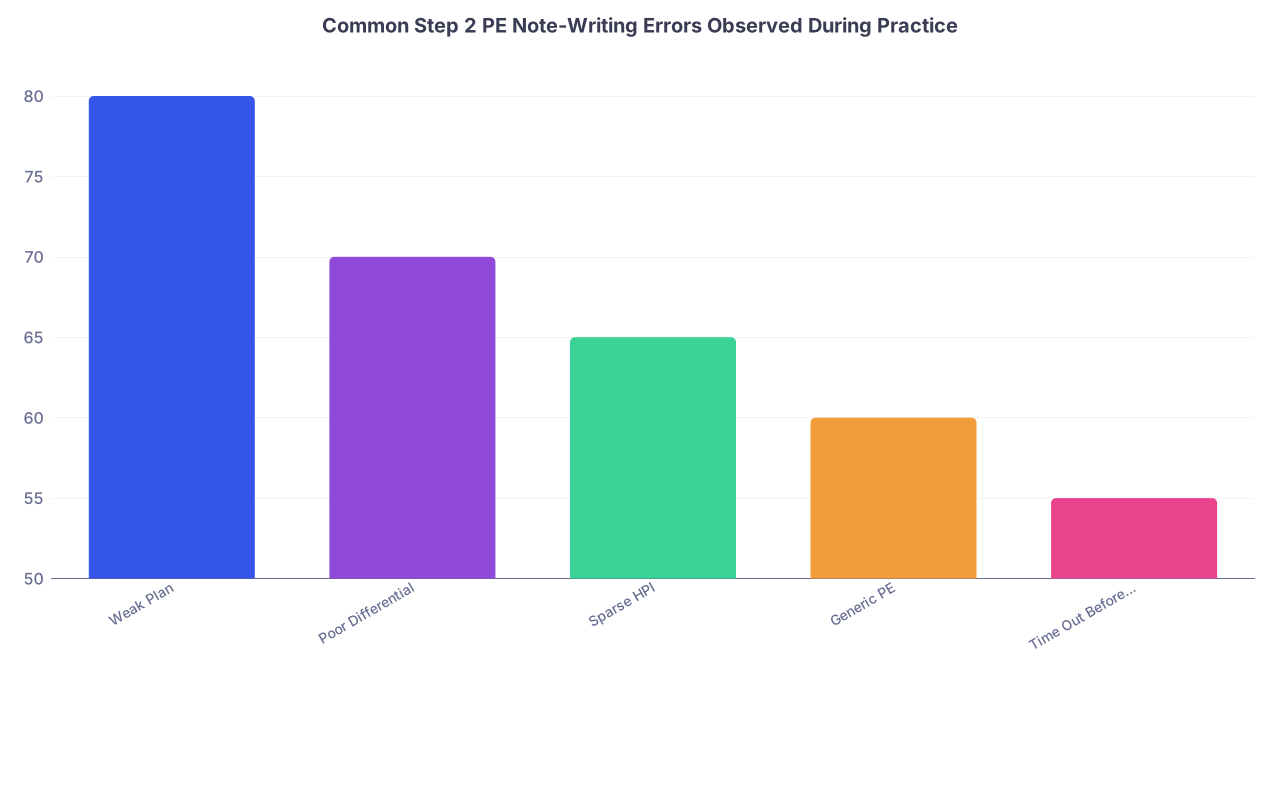
| Category | Value |
|---|---|
| Weak Plan | 80 |
| Poor Differential | 70 |
| Sparse HPI | 65 |
| Generic PE | 60 |
| Time Out Before Finish | 55 |

| Step | Description |
|---|---|
| Step 1 | Leave Room |
| Step 2 | 30-sec mental summary |
| Step 3 | HPI first: focused |
| Step 4 | ROS/PMH/SH/FH brief |
| Step 5 | Focused PE section |
| Step 6 | Top 3 Differential + reasoning |
| Step 7 | Plan: tests, treatment, education |
| Step 8 | 30-sec quick review & edit |

| Aspect | High-Risk Pattern | Strong Pattern |
|---|---|---|
| HPI | Vague, missing core details | Focused, timeline-based, key positives/negatives |
| ROS/PMH | Generic, irrelevant, or minimal | Targeted to CC plus core basics |
| Physical Exam | Copy-paste boilerplate | Tailored to complaint, realistic |
| Differential | Implausible, unprioritized | Ranked, justified, includes must-not-miss |
| Plan | Vague “labs/imaging”, no safety netting | Specific tests, treatment, education, follow-up |

Boil It Down: What You Cannot Afford to Screw Up
Keep these non-negotiables in your head:
If it’s not documented, it didn’t happen.
Solid history and exam are worthless if your note doesn’t clearly, concisely show them.Your differential and plan are where most easy points hide—and vanish.
Write plausible, prioritized diagnoses with a safe, specific, patient-centered plan every time.Time management beats perfection.
A complete, focused, slightly imperfect note will always outscore a beautiful half-finished one.
Avoid these note-writing pitfalls, and you stop bleeding avoidable points. Which, on an exam like Step 2 PE, is often the difference between walking away with a pass… or facing a very painful retake.