
Eight Weeks to Go: Weekly Milestones for a Structured Step 2 Study Sprint
It is eight weeks before your Step 2 CK date.
You have UWorld half-finished, a half-baked Anki habit, and a vague sense that you “should probably start taking this seriously.”
This is where you lock it in.
I am going to walk you week by week, then zoom into what an actual day should look like at each stage. The assumption: 6–8 solid weeks, mostly protected (light rotation, study elective, or post-rotation gap). If you are on a brutal inpatient month, you will need to scale volume but keep the structure.
Goalposts I am using:
- Target: 240–260+
- Baseline: you finished core clerkships, at least touched UWorld, and are not lost in basic path/phys.
If that is roughly you, here is what you should be doing at each point.
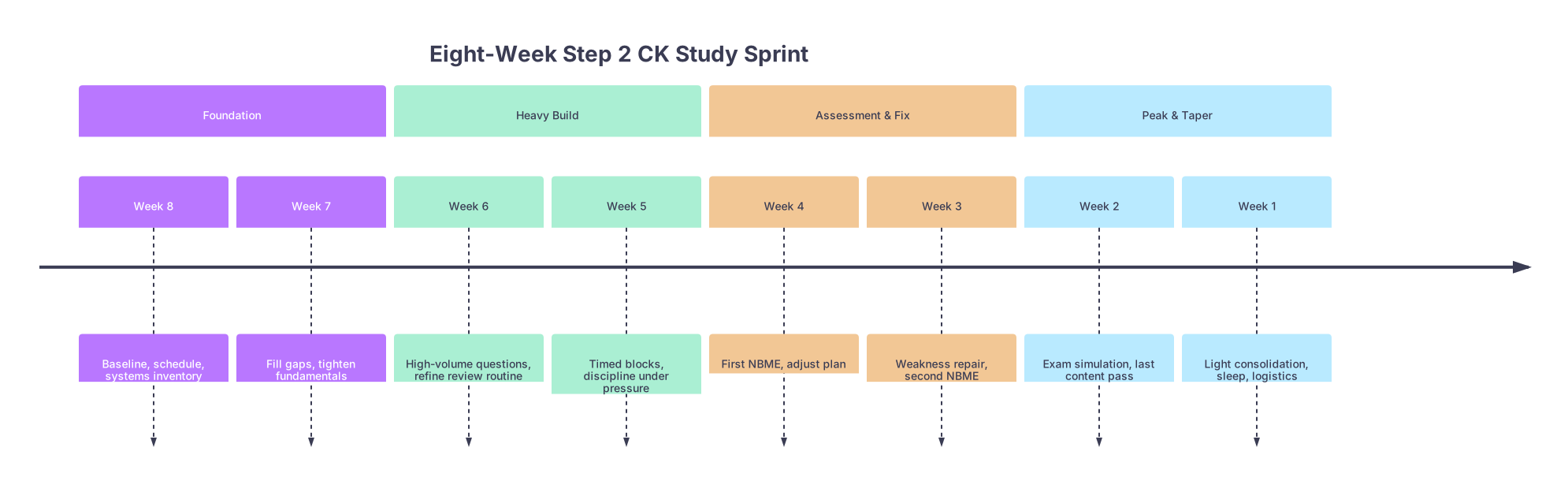
| Period | Event |
|---|---|
| Foundation - Week 8 | Baseline, schedule, systems inventory |
| Foundation - Week 7 | Fill gaps, tighten fundamentals |
| Heavy Build - Week 6 | High-volume questions, refine review routine |
| Heavy Build - Week 5 | Timed blocks, discipline under pressure |
| Assessment & Fix - Week 4 | First NBME, adjust plan |
| Assessment & Fix - Week 3 | Weakness repair, second NBME |
| Peak & Taper - Week 2 | Exam simulation, last content pass |
| Peak & Taper - Week 1 | Light consolidation, sleep, logistics |
Week 8: Baseline, Blueprint, and Honest Damage Report
At this point you should stop pretending this is “future you’s problem.”
Main objectives this week:
- Get your baseline.
- Build a realistic weekly schedule.
- Map your strengths and weaknesses by system.
Early Week 8 (Days 1–2): Measure Where You Are
You do not start with a random UWorld block. You start with a controlled assessment.
- Take either:
- NBME Comprehensive Clinical Science Self-Assessment (CCSSA) (e.g., Form 10, 11, or 12), OR
- UWorld Self-Assessment (UWSA 1) if you cannot access NBME immediately.
Timed. Single sitting. No pausing for “urgent” texts.
Then:
- Write down:
- Overall score and predicted Step 2.
- Score by system and discipline (medicine, surgery, OB, peds, psych).
- Circle the worst 2–3 systems and worst discipline.
You now have marching orders.
Mid–Late Week 8 (Days 3–7): Build the Framework
At this point you should create your 8-week calendar:
- Block off:
- Exam day.
- One full rest day every 1–2 weeks.
- Any unavoidable events (weddings, calls, interviews).
Then map your question and review quotas.
A reasonable 8-week UWorld target:
| Total Qs Needed | Weeks | Qs/Week | Qs/Day (6 days/wk) |
|---|---|---|---|
| 2400 (full reset) | 8 | 300 | 50 |
| 1600 (partial, targeted) | 8 | 200 | 35 |
| 1200 (cleanup + review) | 8 | 150 | 25 |
Pick your lane. Then commit.
Daily structure for Week 8 (foundation-focused):
- 40–50 UWorld questions (mixed or system-based, tutor mode allowed this week).
- 3–4 hours of detailed review (this is where the learning is).
- 1–2 hours of content (videos or notes) in your weakest area from your NBME.
At this point you should not:
- Obsess over your percent correct in UWorld.
- Hop between three different resources because a classmate swears by them.
Pick:
- Questions: UWorld (primary).
- Content: OnlineMedEd, Boards & Beyond Step 2, or similar.
- Rapid review: Anki / personal deck OR a concise review book (e.g., Master the Boards for targeted reading).
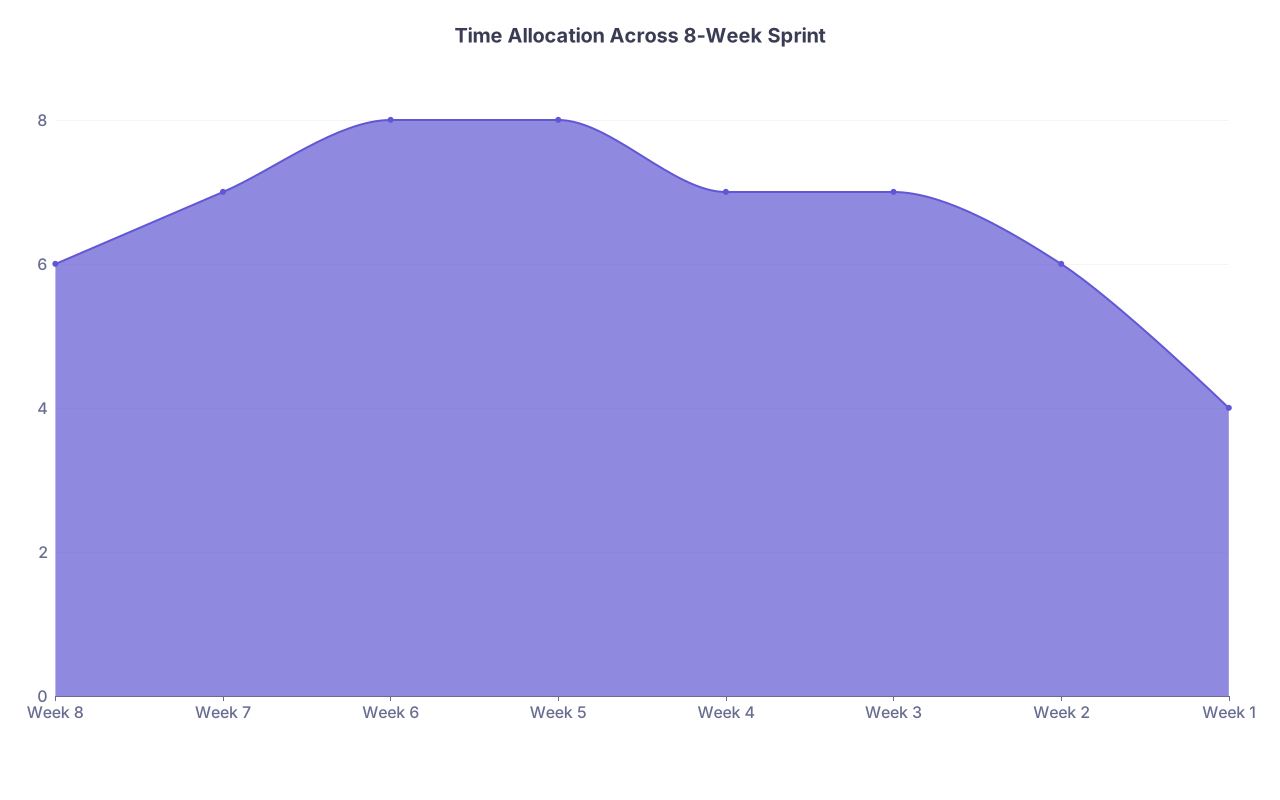
| Category | Value |
|---|---|
| Week 8 | 6 |
| Week 7 | 7 |
| Week 6 | 8 |
| Week 5 | 8 |
| Week 4 | 7 |
| Week 3 | 7 |
| Week 2 | 6 |
| Week 1 | 4 |
Week 7: Tighten Fundamentals, System by System
Now you have a baseline and a schedule. This week is about cleaning up the obvious holes before you go into full timed-block mode.
At this point you should be:
- Doing 1–2 question blocks per day.
- Pairing each with focused content review of that system.
Recommended structure:
- Morning: 40-question UWorld block (system-based in a weak area; e.g., OB/GYN). Timed or tutor, but leaning toward timed.
- Midday: Deep review of that block:
- For each question:
- Why was the right answer right?
- Why was your answer wrong?
- What is the key learning point? (1 sentence)
- For each question:
- Afternoon/Evening: 1–2 hours of videos or notes on that same system.
By end of Week 7 you should have:
- Completed 250–300 questions.
- Done at least one focused pass on your weakest system from Week 8’s NBME.
Do not chase perfection. You are building a base to transition into mixed timed blocks soon.
Week 6: Heavy Volume and Serious Review Discipline
Now you start treating this like the real thing.
At this point you should:
- Switch to mostly timed, random, mixed UWorld blocks.
- Increase volume:
- Target: 60–80 questions per day, 5–6 days per week.
Day structure for Week 6:
Morning
- 40-question timed, mixed block.
- 2 hours of review.
Afternoon
- 40-question timed, mixed or targeted block (if one system still lags badly).
- 2 hours of review.
Evening
- 30–60 minutes:
- Anki or flashcards for high-yield facts.
- Quick read of key charts/algorithms (e.g., HTN management, sepsis bundles).
By the end of Week 6 you should:
- Have knocked out another 300–400 questions.
- Feel more comfortable with:
- Time pressure (1 minute 15 seconds per question is your real-world rhythm).
- Switching rapidly across systems.
If your review is sloppy here, your score will stall. I have seen people do 3,000+ questions and barely move because they “checked answers” instead of actually understanding them.

Week 5: Pressure Testing and Pattern Recognition
Four weeks out from your first serious practice NBME. This week is where you lock in routines and start thinking like the test.
At this point you should:
- Be comfortable with 2 full 40-question blocks back-to-back.
- Start treating each block like a “mini-exam.”
Daily structure for Week 5:
Morning:
- 40-question timed, mixed block.
- Quick 10–15 minute break (as on the real exam).
- Optional: Another 40-question timed block back-to-back 2–3 days this week to simulate fatigue.
Midday/Afternoon:
- 3–4 hours review:
- Mark patterns:
- Are you consistently missing:
- Mild vs severe preeclampsia distinctions?
- Which antibiotics cover Pseudomonas?
- What to do with incidental pulmonary nodules?
- Are you consistently missing:
- Open your content resource only for clusters of misses, not every random obscure fact.
- Mark patterns:
Evening:
- 30–45 minutes of rapid review:
- Algorithms, tables, and must-know numbers (BP cutoffs, weeks gestation, lab thresholds).
By the end of Week 5:
- You should be around 50–70% of your total UWorld goal.
- You should have a “top 10” recurring error list written somewhere visible. Yes, written.
Week 4: First Real NBME and Course Correction
This is the halfway point. No more guessing how much you have “probably improved.” You check.
Early Week 4 (Day 1): NBME #1 of the Sprint
At this point you should:
- Take an NBME CCSSA (different form than baseline).
- Simulate test conditions as closely as possible:
- Start in the morning.
- Timed, no pausing.
- Use the same break pattern you think you might use on test day.
When you finish:
- Log:
- Score.
- Predicted Step 2.
- Subscores by system and discipline.
- Compare to your Week 8 baseline.
If your improvement is <10 points, something is off:
- Either you are not reviewing deeply enough.
- Or your content gaps are larger than you thought.
Mid–Late Week 4: Adjust the Plan
At this point you should pivot, not panic.
- Identify your now-confirmed bottom 2 systems.
- Carve out extra 60–90 minutes/day for targeted work on those:
- 1 focused UWorld block in that system every other day.
- Plus dedicated content: OB hemorrhage, peds rashes, psych meds—whatever keeps burning you.
Daily template for the rest of Week 4:
- 1 mixed block (40 Qs).
- 1 targeted block (40 Qs in worst system).
- 3–4 hours total review.
- 1 hour focused content on bottom systems.
By the end of Week 4:
- Total questions done should be ~1,200–1,600 in most reasonable plans.
- You should know, with painful clarity, where you bleed points.
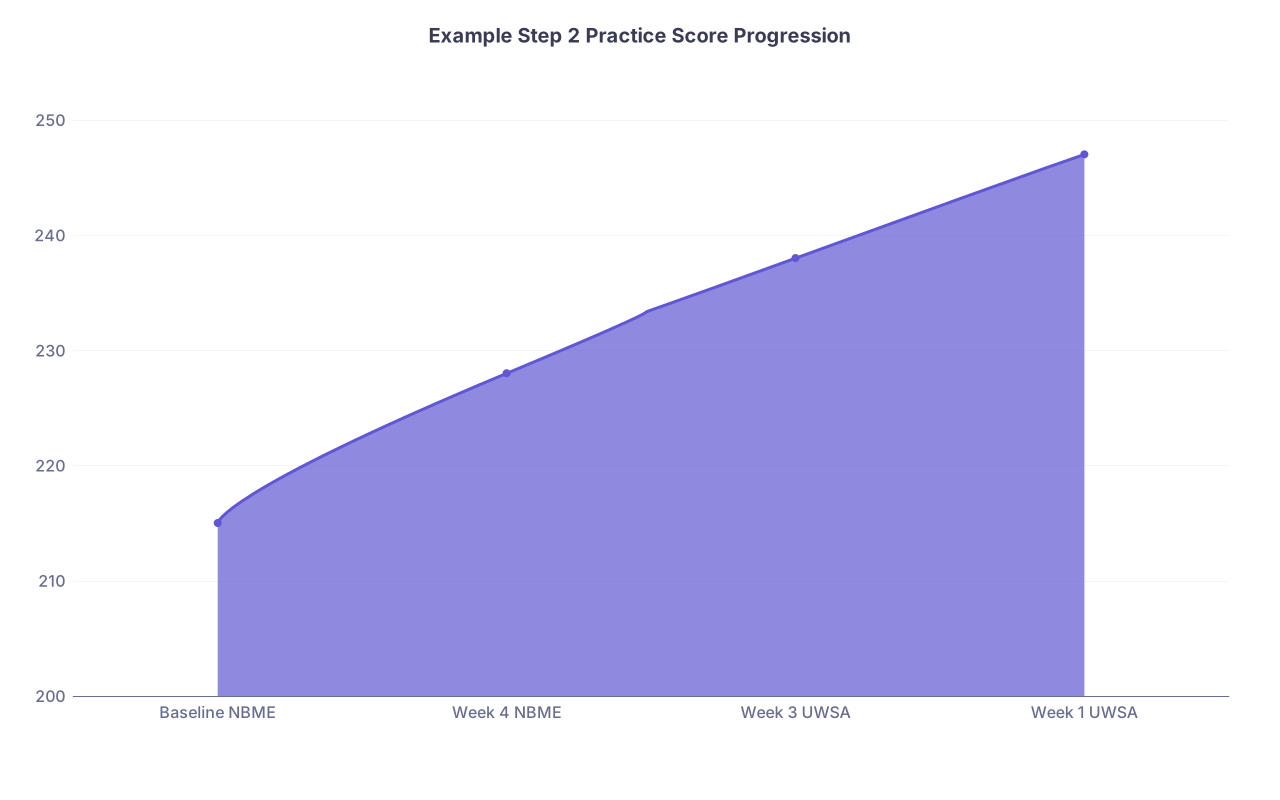
| Category | Value |
|---|---|
| Baseline NBME | 215 |
| Week 4 NBME | 228 |
| Week 3 UWSA | 238 |
| Week 1 UWSA | 247 |
Week 3: Targeted Repair and Second Assessment
This week is more surgical. Less “do everything,” more “fix the things that matter most.”
At this point you should:
- Still be doing 60–80 questions per day.
- Spend more time per missed question than before, especially in your weak areas.
Early–Mid Week 3: Aggressive Weakness Repair
Day structure:
- Block 1 (mixed, timed, 40 Qs)
- Non-negotiable.
- Block 2 (weak system or discipline, 40 Qs)
- At least 3 days this week.
- Review:
- For every weak-area miss, build:
- A 1–2 line summary.
- If helpful, a tiny sketch of an algorithm in your notebook (e.g., approach to syncope, chest pain, anemia).
- For every weak-area miss, build:
If you are still missing basic concepts (e.g., cannot distinguish prerenal vs ATN), spend a focused 30–60 minutes with a single video/lecture on that micro-topic. Do not just keep missing it over and over in questions.
Late Week 3: Second Major Checkpoint
Take either:
- Another NBME CCSSA, OR
- UWSA 1 or 2 (whichever you have not used yet).
Again, full simulation: morning, timed, limited breaks.
Afterward:
- Compare:
- Week 8 baseline → Week 4 NBME → Week 3 exam.
- Look at trajectory:
- Flat? Your review/content strategy is broken.
- Steady upward trend into your target range? Stay the course, tighten.
By the end of Week 3:
- You should be within ~10 points of your goal score.
- Your panic should be replaced by focused annoyance at specific topics, not generalized dread.

Week 2: Full Simulation and Strategic Taper
This is where overachievers wreck themselves. They try to cram everything, sleep 5 hours, and walk in fried.
You are not doing that.
At this point you should:
- Do 2 major simulations this week:
- One full-length practice exam early in the week.
- One long UWorld “mock” mid-week if you still have unused questions.
Early Week 2 (Day 1–2): Full-Length Simulation
Use:
- UWSA or a full NBME, or:
- 6–7 UWorld blocks back-to-back (40 Qs each) if you are out of formal exams.
Simulate:
- Test-day wake-up time.
- Break patterns.
- Snacks, hydration, caffeine.
Afterward (same day or next):
- Review only the most educational misses.
- Prioritize concepts that:
- Are high-yield.
- Have shown up repeatedly across multiple exams.
- Prioritize concepts that:
Do not deep-dive every trivial detail now. The goal is pattern refinement, not encyclopedic coverage.
Mid–Late Week 2: Question Volume with Slight Taper
At this point you should:
- Drop to ~50–60 questions per day.
- Emphasize:
- Mixed blocks.
- Review of “Marked” or “Incorrect” questions in UWorld (if you have this feature).
Your evenings:
- 1–2 hours max of:
- Rapid algorithm review.
- Checklists for:
- OB (pre-e, eclampsia, HELLP, postpartum hemorrhage).
- Emergencies (ACS, sepsis, anaphylaxis).
- Peds vaccines and milestones.
This is not the week to add a new resource. No one gets a 10-point bump from starting an entire book 10 days before the exam.
Week 1: Taper, Consolidate, and Set Up Test Day
Seven days left. At this point you should protect your brain, not punish it.
Day-by-Day Outline
Day 7–6 before exam
- 40–50 mixed questions per day, max 1–2 blocks.
- High-yield review only:
- Your own notes.
- Prior error patterns.
- Key tables (e.g., murmurs, shock types, acid–base patterns).
- No new topics. If you have never understood a niche topic (e.g., porphyrias), you probably will not rescue it this week. Accept it.
Day 5–4
- 30–40 questions per day.
- Short, focused review sessions:
- OB/peds half-day.
- Medicine/emergencies half-day.
- Build your test-day logistics plan:
- Route to the testing center.
- What time you will wake up.
- What you will eat.
- What snacks you bring.
If your last practice test is disastrous here (rare but happens), you do not cancel in a panic unless you are dramatically below passing. Instead, tighten review and prioritize sleep.
Day 3–2 At this point you should:
- Drop to ~20–30 questions per day or even stop questions completely on Day 2 if you feel mentally saturated.
- Focus on:
- Flashcards / high-yield lists.
- Quick scans of:
- EKG patterns.
- Imaging buzz patterns (pneumothorax, SBO, appendicitis, intracranial hemorrhages).
Limit screen time at night. Your brain consolidates while sleeping; you are buying points by respecting that.
Day 1 (Day Before Exam) No heroic studying.
Your checklist:
- No more than 0–20 very light review questions, if any.
- Pack:
- ID, permit, wallet.
- Snacks, water, caffeine.
- Comfortable clothing with layers.
- Confirm:
- Test center location and parking.
- Alarm(s) set.
- Evening:
- Light walk.
- Normal dinner.
- Bed at a time consistent with your planned wake-up.
Do not “just check one more thing in UWorld” at midnight. That last question will not fix anything. It can, however, wreck your sleep.

Putting It All Together: What a Strong Day Looks Like (Weeks 6–3)
To ground all of this, here is a sample peak-phase day (Weeks 6–3):
- 08:00–08:15 – Light breakfast, quick scan of yesterday’s top 5 mistakes.
- 08:15–09:30 – UWorld Block 1 (40 Qs, timed, mixed).
- 09:30–09:45 – Short break.
- 09:45–12:00 – Detailed review of Block 1.
- 12:00–13:00 – Lunch, short walk, screen-free.
- 13:00–14:15 – UWorld Block 2 (40 Qs, timed; mix or targeted weak system).
- 14:15–14:30 – Break.
- 14:30–17:00 – Detailed review of Block 2.
- 17:00–18:00 – Content reinforcement:
- Video or notes on 1–2 high-yield topics you consistently miss.
- 18:00 onward – Dinner, 30–45 min light Anki/flashcards, then shut it down.
Could you push more? Sure. But beyond 80 high-quality questions and tight review, most students shift into diminishing returns and sloppy thinking.
Three Things to Keep in Your Head
- Assessment drives the plan. Baseline at Week 8, then again at Week 4 and Week 3. If you are not measuring, you are guessing.
- Review is where the points come from. Not the number of blocks you grind through. Sloppy review equals flat scores.
- Taper with intention. The last 7–10 days are for consolidation and sleep, not panic and all-nighters. Protecting your brain is part of studying.
You have eight weeks. Structured correctly, that is plenty.