
You are here
It’s July 5th. Your first clerkship just started last week. You’re pre-charting for tomorrow, your senior just barked “Know this cold for rounds,” and somewhere in your bag there’s a half-opened shelf review book.
In the back of your head:
“Step 2 CK is coming. Everyone says clerkship year is Step 2 prep. But what does that actually look like day-to-day?”
Here’s the reality: if you don’t tie your shelf prep to a Step 2 plan from month one of clerkships, you’ll reach dedicated with 6–8 weeks left and way too many holes. I’ve watched people do that. They survive, but they suffer.
Let’s build a concrete, time-based plan. Month-by-month through clerkships. Then how that rolls into Step 2 CK.
Big Picture: Year-Long Structure
First, zoom out. Third year (typical 12 months) often looks like:
| Block | Length | Rotation |
|---|---|---|
| 1 | 8 wks | Internal Med |
| 2 | 6 wks | Surgery |
| 3 | 6 wks | Pediatrics |
| 4 | 6 wks | OB/Gyn |
| 5 | 4 wks | Psychiatry |
| 6 | 4 wks | Family Med |
| 7 | 4 wks | Elective |
You’ll adapt details to your schedule, but the integration pattern stays the same.
At this point you should understand the three overlapping goals for the year:
- Pass/Excel on rotations and shelves
- Build a knowledge base that stacks directly into Step 2 CK
- Create, not destroy, your future dedicated period
Your guiding rule for the year:
Every week of clerkships should contribute a little to shelves, and a little to Step 2 CK.
Not 50/50. The mix changes by month. But Step 2 is never “future you’s problem.”
Month 0: Pre-Clerkship Setup (The Week or Two Before You Start)
If you’re already in clerkships, skim this and retrofit what you can this weekend.
At this point you should:
Pick your core resources for the whole year
Do not switch every block unless something is clearly not working.- Question banks (QBs)
- Shelf-level: UWorld (subject sets), NBME subject exams, maybe AMBOSS if your school provides it
- Step 2 CK-level: UWorld Step 2 CK QBank (this is your backbone)
- Books:
- Internal Med: Step-Up to Medicine or equivalent concise text
- Surgery: Pestana notes or equivalent
- OB/Gyn, Peds, Psych, FM: a high-yield shelf-oriented review book each
- Rapid review:
- Anki (if you already use it) or high-yield flashcards
- Question banks (QBs)
Decide your baseline daily minimums
- 20–30 Step 2-style QBank questions per weekday (subject-mixed or subject-specific depending on block)
- 10–15 on weekend days
Anything extra is bonus. These minimums are sacred.
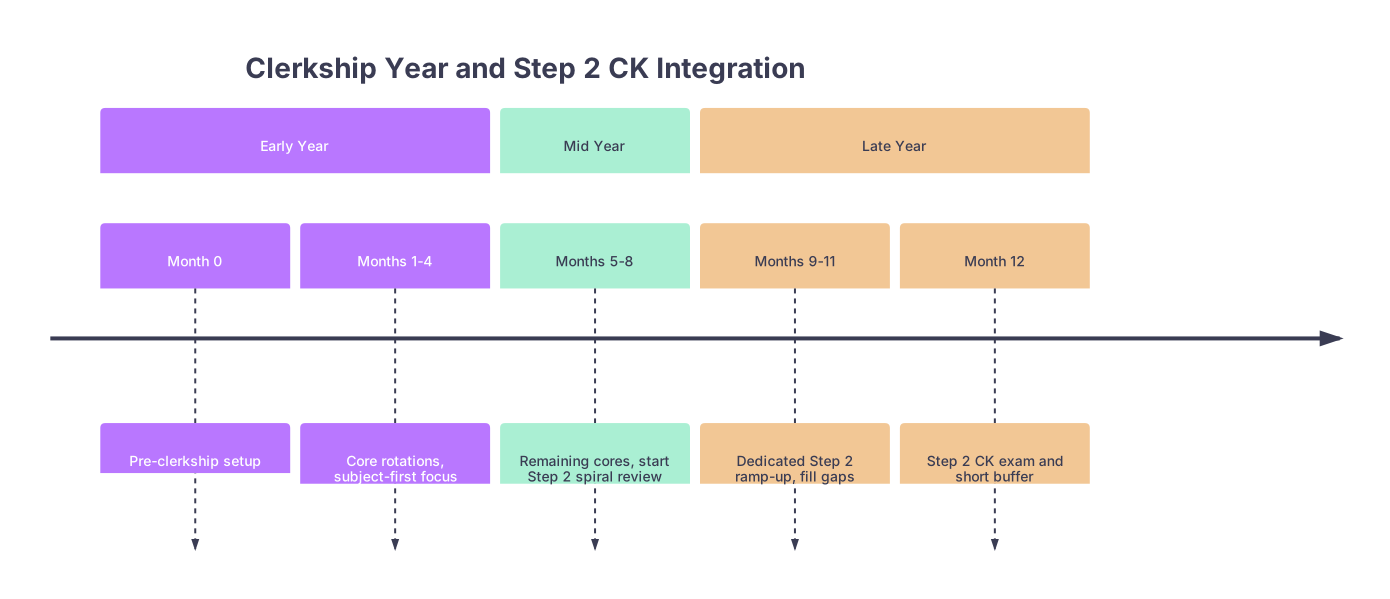
| Period | Event |
|---|---|
| Early Year - Month 0 | Pre-clerkship setup |
| Early Year - Months 1-4 | Core rotations, subject-first focus |
| Mid Year - Months 5-8 | Remaining cores, start Step 2 spiral review |
| Late Year - Months 9-11 | Dedicated Step 2 ramp-up, fill gaps |
| Late Year - Month 12 | Step 2 CK exam and short buffer |
You don’t need a perfect 365-day plan. You do need this skeleton.
Months 1–2: First Big Rotation (Usually Internal Medicine or Surgery)
You’re overwhelmed. Everyone is busy learning “how to be in the hospital.” Fine. Don’t fight that.
At this point you should focus on:
Weekly Targets
Clinical Skills Priority: Very high
Shelf Priority: High
Step 2 CK Priority: Low–moderate, but not zero
Concrete numbers (adjust if rotations are shorter/longer):
- Weekdays
- 15–20 rotation-specific Qs/day (IM or Surgery) from UWorld/AMBOSS
- 5–10 Step 2 Qs/day that are either:
- The same subject but in “CK mode”
- Or a mix of IM/Peds/OB if you’re on IM and have energy
- Weekend
- One dedicated “shelf half-day” (2–3 hours)
- 40–60 rotation-specific Qs
- Quick skim of weak topics from a review book (e.g., CHF, COPD, ACS for IM)
- One dedicated “shelf half-day” (2–3 hours)
Week-by-Week Rhythm (First Rotation)
Week 1–2: Survival + Foundation
At this point you should:
- Learn workflow: prerounding, notes, presenting
- Do at least:
- 15 Qs/day, 5 days/week – all in your current rotation’s subject
- Keep Step 2 mixed questions minimal (maybe 5/day tops). Your job now: understand the “style” of questions and start mental mapping.
Week 3–4: Shelf Structure + Light CK Layer
Now you’re not lost every morning. Turn up the knob.
At this point you should:
- Do:
- 20–25 rotation Qs/day, 5 days/week
- 5–10 CK-style mixed Qs/day or on 2–3 days/week
- Start an “error notebook” or digital doc:
- Key patterns you miss (e.g., when to give spironolactone, which imaging for SBO, handling postpartum hemorrhage)
- You will reuse this in CK dedicated
Week 5–Last Week of Rotation: Shelf Push
Here, shelf prep = Step 2 prep in disguise.
At this point you should:
- Focus heavy on:
- Rotation-specific Qs: 40–60/day on off days, 20+/day on busy days
- NBMEs or school-provided practice exams 1–2 weeks before shelf
- Optional but powerful:
- One weekly 40-question mixed CK-style block on your lighter day. Just to keep the Step 2 muscle alive.
Months 3–4: Second and Third Core Rotations
You’ve done one shelf. Now the game changes. You’re past pure survival mode.
At this point you should start thinking in systems, not just rotations.
You’ll likely be on Surgery → Peds or OB → Psych, something like that.
Shift Your Focus Slightly
- Clinical Skills: High
- Shelf: High
- Step 2 CK: Moderate
Now, every rotation should:
- Deepen one domain (e.g., OB for pregnancy, Peds for vaccine schedules)
- Reinforce overlapping IM content (management, risk stratification, guidelines)
A Typical 6-Week Block Structure Now
Week 1–2: New Specialty, Same Muscle
At this point you should:
- Rebuild your “survival” for the new service in 3–4 days, not 2 weeks
- Daily:
- 20 rotation-specific Qs
- 5–10 mixed CK Qs, ideally focused on topics that overlap prior rotations
- Example: On Surgery? Mixed block with pancreatitis, GI bleed, trauma, fluids/electrolytes
Week 3–4: Integrated Review Weeks
This is the most underused window. People just grind the current shelf and forget what they learned last block. That’s how knowledge leaks.
At this point you should:
- Keep:
- 20–25 rotation-specific Qs/day
- Add:
- One 40-question mixed CK block every 3–4 days
- Timed
- Mixed disciplines (IM-heavy usually)
- One 40-question mixed CK block every 3–4 days
- And:
- Briefly (10–15 min/day) review old error notes/Anki from prior rotations
Week 5–End: Shelf Push + Spiral Review
Two parallel tracks:
- Immediate: Crush current shelf
- 40–60 rotation Qs on weekend/freedays
- One NBME or practice exam 5–7 days before test
- Future: Do not let prior content die
- 20–40 mixed CK Qs/week (split across 2–3 days)
Months 5–8: Later Cores (Psych, Family Med, Remaining IM/OB/Peds)
By now, you’ve taken several shelves and you’re halfway through the year. This is where Step 2 prep truly becomes explicit, not background.
At this point you should shift your priority split:
- Clinical: Moderate–high (still matters for evals and letters)
- Shelves: High
- Step 2 CK: High and rising
Month 5–6: Start Calling It “Step 2 Season Lite”
Your question strategy should change from “rotation silo” to “Step 2 structure with rotation emphasis.”
New Weekly Pattern
- Rotation Qs
- 15–20/day on weekdays
- Step 2 Mixed Qs
- 10–15/day on weekdays OR
- 40–60 Qs on 2 separate days/week
- Dedicated Weekly Task
- Once/week: 40-question full mixed block (all subjects), timed, real-test conditions
- Immediately review, tag:
- “Know cold by CK”
- “Serious gap → schedule deep dive”
Use Psych and FM wisely. They’re lower cognitive load rotations on service compared to Surgery or IM at many schools. That extra mental bandwidth? That’s where I’ve seen students make their biggest Step 2 leaps.

Month 9: End of Core Year and Step 2 CK Date Lock-In
Around this point, most students:
- Have finished or nearly finished all core rotations
- Are thinking about:
- When to schedule Step 2 CK
- ERAS, letters, sub-Is, etc.
At this point you should:
Set your Step 2 CK test window
- Most people do best with 4–8 weeks of “quasi-dedicated” or true dedicated after last core
- Tight schedules? You might only get 3–4 weeks. Then your clerkship year integration matters even more
Assess where you actually are, not where you hope you are
- Take a baseline NBME or UWorld Self-Assessment near the end of last core
- That score tells you:
- How much gap-filling vs. polishing you’ll need
- Whether you can afford long research/elective blocks before CK or need to go earlier
Build a rough “to fix” map
- List by system:
- Cards
- Pulm
- GI
- Renal
- Endo
- Neuro
- Psych
- OB
- Peds
- ID
- Mark:
- Green: “I see these constantly in questions and on wards”
- Yellow: “Know something but shaky”
- Red: “Honestly, I’ve been faking it”
- List by system:
This becomes your dedicated roadmap.
Months 10–11: Quasi-Dedicated / Light Rotations Before Step 2 CK
Now the balance flips hard.
At this point you should:
- Treat Step 2 CK as your primary job
- Treat whatever rotation you’re on as:
- A patient-care responsibility you still meet
- But not your main academic heavy lift
Ideal scenario: you have electives, outpatient, consults, or lighter blocks here. If you’re stuck on a brutal ICU right before CK, you’ll need to protect evenings + post-call like your life depends on it.
Weekly Pattern Now
Aim for 250–350+ Step 2 Qs/week depending on time and endurance.
Breakdown:
- On lighter days
- 60–80 Qs/day (2–3 blocks)
- On busy clinical days
- 20–40 Qs/day
- At least 1 formal practice exam every 2 weeks
- NBME or UWSA
- Fully simulated (timed, minimal breaks, exam environment)
Content Strategy
At this point you should prioritize integration and high-yield patterns, not memorizing obscure facts.
- Repeated themes in CK:
- What’s the next best step in management?
- When do you image vs. observe vs. operate?
- Which initial test vs. confirmatory test?
- Outpatient vs. inpatient thresholds
- Emergency vs. routine management
You’ve seen these in every shelf. Now you polish them across all disciplines.
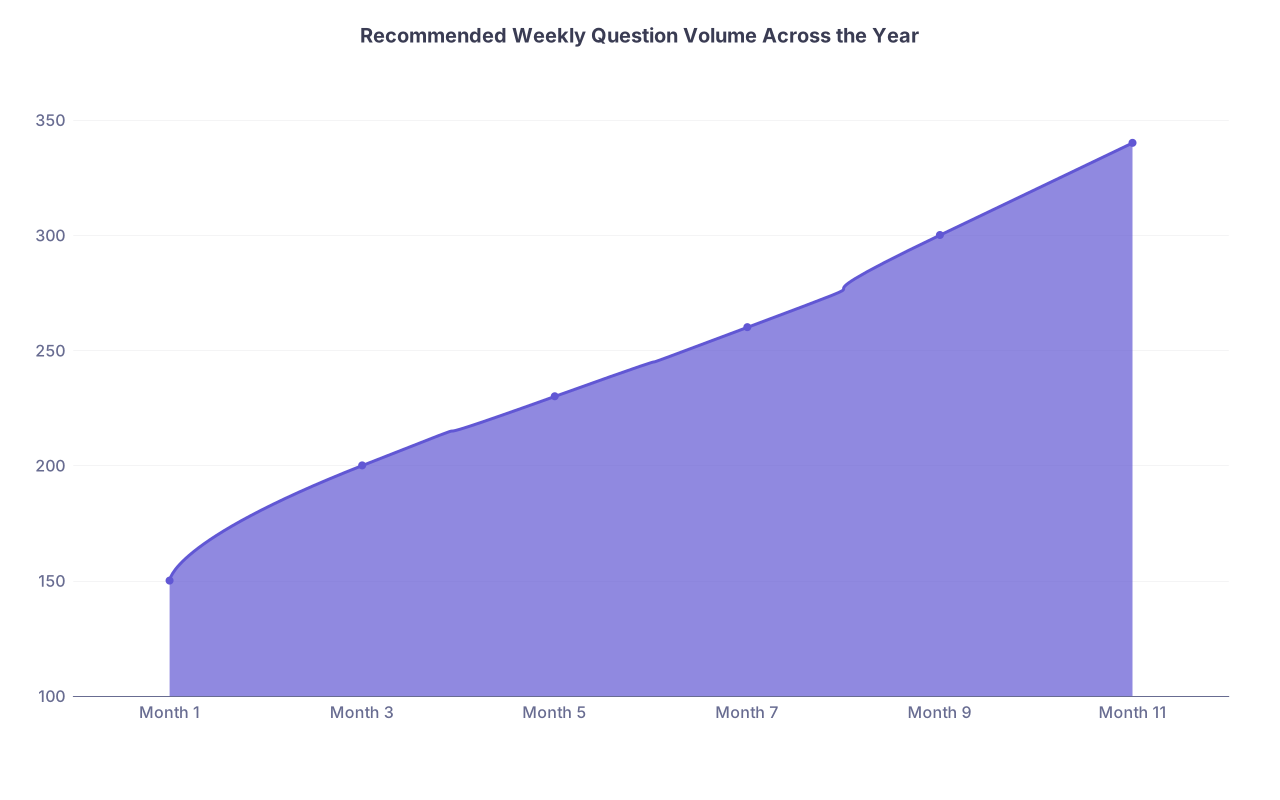
| Category | Value |
|---|---|
| Month 1 | 150 |
| Month 3 | 200 |
| Month 5 | 230 |
| Month 7 | 260 |
| Month 9 | 300 |
| Month 11 | 340 |
Day-to-Day: How to Actually Blend Shelf and Step 2 Prep
Concept is nice. Let’s get down to one normal weekday template.
Imagine a Surgery clerkship day, moderately busy.
Morning (Pre-rounding 6–7 AM)
At this point you should:
- Not be doing questions. Focus on notes and patients. People who do Qs at 5:30 AM burn out.
Midday Break (30–45 min between cases or during lunch)
- 1 short untimed block:
- 10–15 Surgery/UWorld Qs (or AMBOSS)
- Quickly review, flag anything to revisit at night
Evening (Post-call or normal day, 7–9 PM)
At this point you should:
- Do:
- 10–20 more surgery shelf questions
- 10–20 mixed CK questions (if you’re not absolutely fried)
- Rapid review:
- 15–20 min reading on your top 2–3 missed topics that day (e.g., postop fever, gallstone disease, thyroid nodules)
Total: 30–50 Qs/day, with at least some of them contributing to Step 2 CK.
On a weekend:
- Morning:
- 2 blocks (40–80 Qs)
- One rotation-specific
- One mixed CK if possible
- 2 blocks (40–80 Qs)
- Afternoon:
- Review those blocks
- Light read of central weak topics
- Night:
- Off. You’re still a human.
Common Mistakes by Season (And What You Should Do Instead)
Early Year Mistake: “Shelves Only, CK Later”
I’ve seen this too many times. Students grind 100% shelf resources, ignore CK integration, then hit dedicated and realize they’ve never done serious mixed blocks.
At this point in the early months you should:
- Still do mostly shelf work, yes
- But add at least 1–2 mixed 40-question CK blocks/week after your first rotation
Mid Year Mistake: Letting Old Rotations Decay Completely
If you leave IM behind for 4 months, it won’t be there for you at CK.
At this point in mid-year you should:
- Have a drip of:
- 20–40 IM-heavy questions weekly
- Use FM and Psych rotations as times to:
- Rebuild IM systems (cards, pulm, renal)
Late Year Mistake: Over-studying Rare Stuff, Ignoring Bread-and-Butter
Everyone gets fascinated by weird rheum, zebra infectious diseases, and rare genetic syndromes.
At this point late in the year you should:
- Spend at least 60–70% of time on:
- Diabetes
- Hypertension
- Heart failure
- Chest pain
- Dyspnea
- Abdominal pain
- Pregnancy complications
- Newborn issues
- Common psych disorders
- If you haven’t done that, you’re not ready, no matter how much vasculitis you’ve memorized.
Final 2–3 Weeks Before Step 2 CK
You’re basically off from clinical or on a very light elective, if you planned decently.
At this point you should:
Switch fully to exam simulation + targeted repair
- 2–3 blocks/day:
- 40 Qs each, timed, random, mixed
- Daily:
- Active review of misses and “guessed rights”
- Every week:
- 1 full-length simulation (or close)
- 2–3 blocks/day:
Use your shelf-year work product
- Error notebooks from each rotation
- Any topic summaries you wrote during IM/Surg/OB
- These are gold because they’re already in your words and from patient encounters you remember
Do brief passes of rotation-specific weak areas
- Example:
- 1 day = heavy OB/Peds focus
- 1 day = heavy Surgery/Trauma
- 1 day = heavy Psych/Neuro
- Example:
But still via mixed blocks. Not in isolation.
If You’re Already Halfway Through Clerkships and Behind
You’re in March. You’ve finished IM and Surgery, shelves went “okay,” but you never thought about Step 2 until now.
At this point you should:
- Start with:
- One NBME or self-assessment to see where you stand
- Then:
- Commit to:
- 30–40 mixed CK Qs per week on top of normal shelf studying
- Use weekends to:
- Revisit IM and Surgery topics via mixed questions, not reading alone
- Commit to:
You can salvage a lot in 4–6 months if you start now.
Core Takeaways
- Clerkship year is not “shelf now, Step 2 later.” From month 1, a small but consistent chunk of your effort should be Step 2–oriented, mainly via mixed questions.
- Every rotation should do double duty: prepare you for that shelf and reinforce at least one major Step 2 domain (IM especially).
- The last 2–3 months before Step 2 CK are where you convert a year of decent integration into a strong score—but only if you’ve built that foundation block by block during clerkships.