
The biggest mistake students make after Step 2 is wasting the gap between “Exam Complete” and “Score Released.”
You can’t afford that dead time. Not with ERAS breathing down your neck.
Below is a post-exam, score-release-to-ERAS timeline—week by week, then zoomed in to the critical days—so you know exactly what to do at each point. I’ll assume a typical setup:
- You’re taking Step 2 CK between late May and mid-August
- You’re applying through ERAS in September of the same year
- You care about how timing affects programs seeing your score and interview invites
If your dates shift a bit, the logic stays the same. You’ll just slide the timeline forward or back.
Big Picture: Step 2 to ERAS in One View
Here’s the high-level sequence you’re really dealing with, whether anyone has spelled it out for you or not.
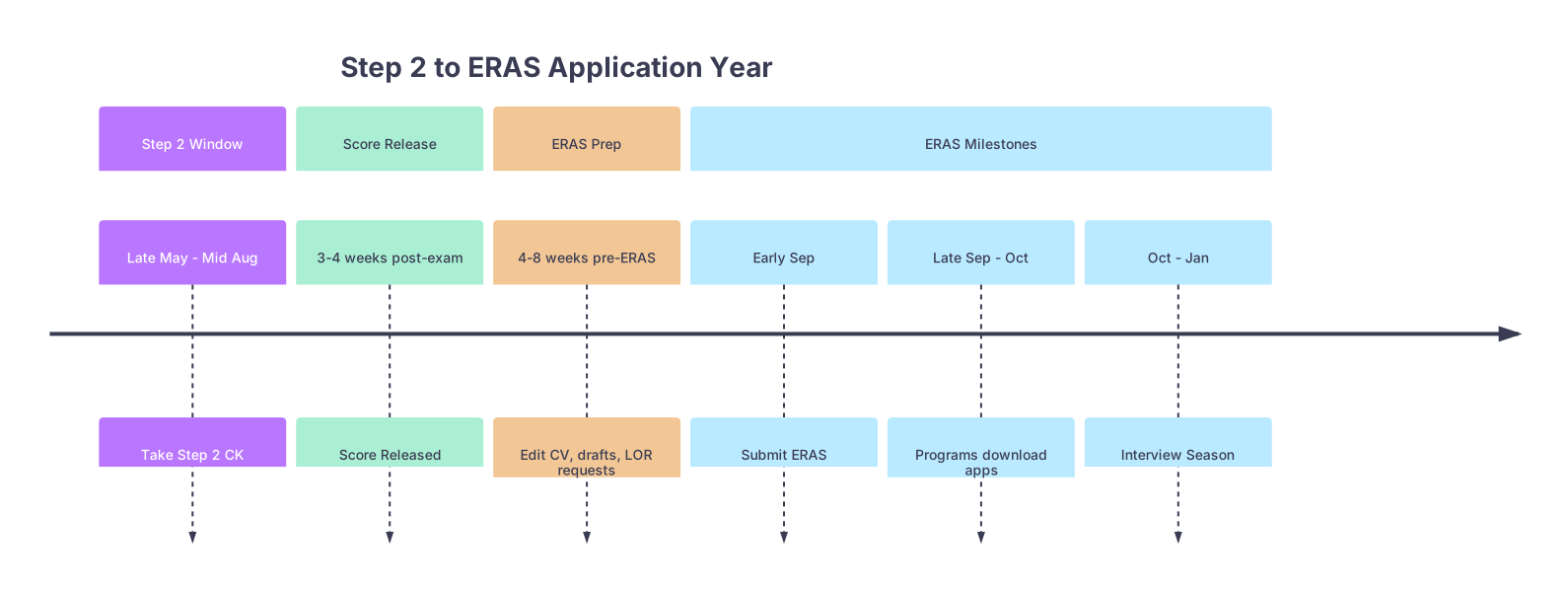
| Period | Event |
|---|---|
| Step 2 Window - Late May - Mid Aug | Take Step 2 CK |
| Score Release - 3-4 weeks post-exam | Score Released |
| ERAS Prep - 4-8 weeks pre-ERAS | Edit CV, drafts, LOR requests |
| ERAS Milestones - Early Sep | Submit ERAS |
| ERAS Milestones - Late Sep - Oct | Programs download apps |
| ERAS Milestones - Oct - Jan | Interview Season |
At this point you should understand the core problem:
- Your Step 2 date determines your score release
- Your score release determines whether programs see Step 2 on day 1 of ERAS download
Let’s get concrete with the usual 3–4 week score lag and how it lines up with ERAS.
Month-by-Month: Exam Date vs Score Release vs ERAS
Use this section to choose a target exam date or to understand the consequences if your date is already set.
Typical USMLE Step 2 CK Score Lag
Most Step 2 scores release 3–4 weeks after your test date, usually on a Wednesday. There are occasional “score delays” windows the NBME/USMLE announces (for big content changes, etc.), but I’m going to give you the standard expectations you can actually plan around.
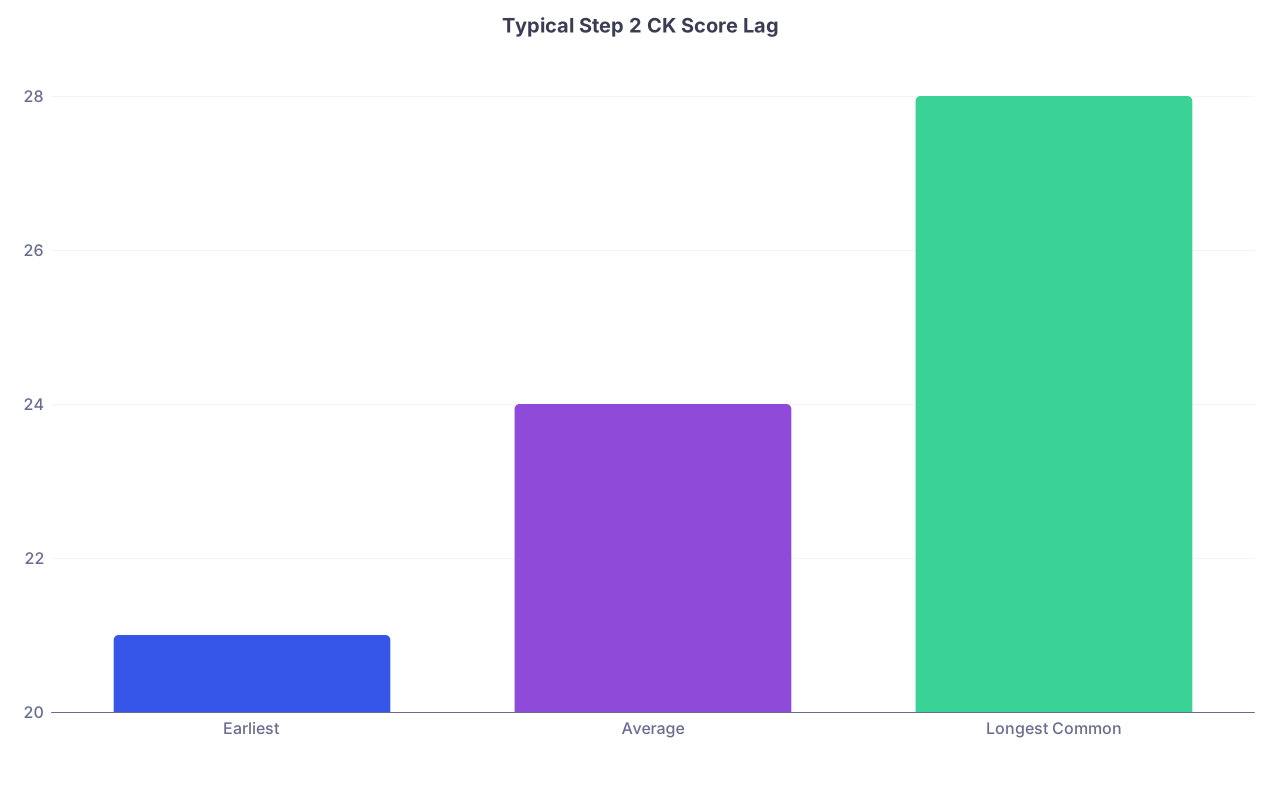
| Category | Value |
|---|---|
| Earliest | 21 |
| Average | 24 |
| Longest Common | 28 |
Those numbers are days from exam to score release in a normal cycle.
Now, how this interacts with ERAS:
- ERAS applications open for entry (you can start filling) usually in June
- You can submit in early September
- Programs can start downloading applications about 1–2 weeks after submission opens
If You Take Step 2 in May–June
Goal: Have Step 2 available at initial ERAS download.
- Exam in late May
- Score likely late June
- Step 2 will be on your transcript long before September → perfect
- Exam in June
- Score likely mid-to-late July
- Still comfortably ahead of ERAS submission and first download
At this point you should:
- Lock in a May–June test date if:
- You need Step 2 to “rescue” a mediocre Step 1
- You’re aiming for competitive specialties (derm, ortho, ENT, plastics, etc.)
- You want PDs to see a complete, strong picture on day one
If You Take Step 2 in July
This is the grey zone. Not good or bad by default—depends how late.
- Early July exam
- Score: late July / early August
- You’ll still have Step 2 back before ERAS opens for submission
- Mid-July exam
- Score: mid-to-late August
- Still usually in time to include it with your first ERAS submission
- Late July exam
- Score: early-to-mid September
- Risk: programs downloading on day 1 might not see the score right away if the transcript hasn’t updated yet
At this point you should:
- Be honest: if you’re late July and nervous, that’s valid
- Have a Plan A: submit ERAS early September with Step 1 + everything else ready
- And a Plan B: as soon as Step 2 posts, re-release USMLE transcript in ERAS (it auto-updates, but you need to authorize early)
If You Take Step 2 in August
Now you’re playing with fire, especially for competitive fields.
- Early August exam
- Score: late August / early September
- Might barely make it for the first transcript send; still stressful
- Mid-August exam
- Score: mid-September
- Many programs will start initial screens before it posts
- Late August exam
- Score: late September
- For early-application-heavy fields, that’s effectively a post-screen score
At this point you should:
- Accept this reality: some programs will rank you initially based on everything except Step 2
- Use Step 2 more as:
- damage control if Step 1 was weak (PDs may look later), or
- reassurance for programs that haven’t made decisions yet
- Prioritize:
- Strong letters,
- A sharp personal statement,
- A clean, coherent application story
You can’t fix timing now; you can only maximize everything else.
Week-by-Week: From Test Day to Score Release
Let’s say you’ve just walked out of Prometric. At this point you should not be refreshing the USMLE site 12 times a day. Here’s how to use those 3–4 weeks intelligently.
Week 0: Test Day + 2–3 Days
You’re useless for high-level work right now. That’s normal.
Days 0–2
- Sleep. Hydrate. Move.
- Write down:
- Rough content areas that felt weak (OB? Psych? Biostats?)
- Any test-day issues you want documented (testing center problems, etc.)
- Then stop replaying questions in your head. That way lies madness.
Day 3–4
At this point you should:
- Open ERAS once:
- Create/verify your account
- Skim every section so nothing surprises you later
- Make a post-exam checklist:
- CV updates
- Personal statement versions (by specialty)
- LOR requests
- Program list draft
- Transcript release tasks (USMLE, med school)
Week 1 After Exam
This is the planning and drafting week.
Focus on:
ERAS CV and Experiences
- Fill in:
- Work, volunteer, leadership, research, teaching
- Start writing 3–4 “most meaningful” style descriptions:
- 2–3 sentences max
- Concrete responsibilities + impact
- Do not wordsmith for hours. Get a solid first pass across everything.
- Fill in:
Personal Statement Skeletons
- If you’re dual applying (e.g., IM + neuro), decide:
- Primary specialty → PS A
- Backup specialty → PS B
- Write bullet-point outlines:
- 1 short story → why this field
- 1–2 experiences → show fit/skills
- 1 paragraph → what you want from training
- If you’re dual applying (e.g., IM + neuro), decide:
Letters of Recommendation
- At this point you should:
- Identify 3–4 core letter writers for your main specialty
- 1 “swing” letter you can use for prelim / backup
- Email them:
- Thank them for prior teaching/mentorship
- Ask if they can write a strong letter for [Specialty] residency
- Give them a deadline: 3–4 weeks before ERAS submission
- At this point you should:
Week 2 After Exam
Now build structure and polish. Still pre‑score, but heavy ERAS lift.
Focus on:
Programs Research (First Pass)
Create a simple program spreadsheet:
Sample ERAS Program Tracking Sheet Program City/State Type (Univ/Community) Reach/Target/Safety Priority (1–3) Example Univ A Big City, NY University Reach 1 Example Comm B Suburb, TX Community Target 2 Example Univ C Mid-size, OH University Target 1 Example Comm D Rural, IA Community Safety 3 Example Univ E City, CA University Reach 2 At this point you should:
- Filter by:
- Geographic preferences
- Step score “vibes” (use Step 1 + expected Step 2 range)
- Program size and reputation
- Aim for a provisional list:
- Competitive specialties: 60–80+
- Less competitive: 30–50 (varies, but you get the idea)
- Filter by:
Personal Statement Drafts
- Turn outlines into full drafts (ugly but complete)
- Send to 1–2 trusted people:
- A resident in your target field
- An advisor who actually reads these things
LOR Logistics
- Confirm writers in person if possible
- Upload ERAS letter requests
- Give each writer:
- CV
- Personal statement draft
- Summary of your work with them
- Any specific strengths you’d like highlighted
Week 3 After Exam
This is usually score-release-adjacent. Assume your score is coming any Wednesday now.
At this point you should:
Tighten ERAS Content
- Clean up:
- Typos
- Repetitive verbs (“I was responsible for…” x100 = painful)
- Standardize:
- Date formats
- Capitalization of positions and departments
- Clean up:
Prepare Two Plans Based on Score
Before you see the number:
- Write down:
- Plan if score is at/above expectations
- Plan if score is below expectations
- For each plan:
- How many programs you’ll apply to
- Whether you’ll adjust specialties (e.g., drop the ultra‑reach ones)
- Whether you’ll mention Step 2 in your personal statement or not
- Write down:
You make better decisions calmly before you’re emotional about the score.
Score Release Day: What To Do in the First 72 Hours
Score day is a pivot point. Handle it systematically.
Step 1: Check Your Score Once. Then Step Away.
Yes, really.
Open your NBME/USMLE portal. See the number. Screenshot or save the PDF.
Then step away from your computer for 20–30 minutes. Walk. Breathe. Let the adrenaline drop before you start rewriting your entire career plan.
Step 2: Interpret the Score Realistically
Use a simple framework:
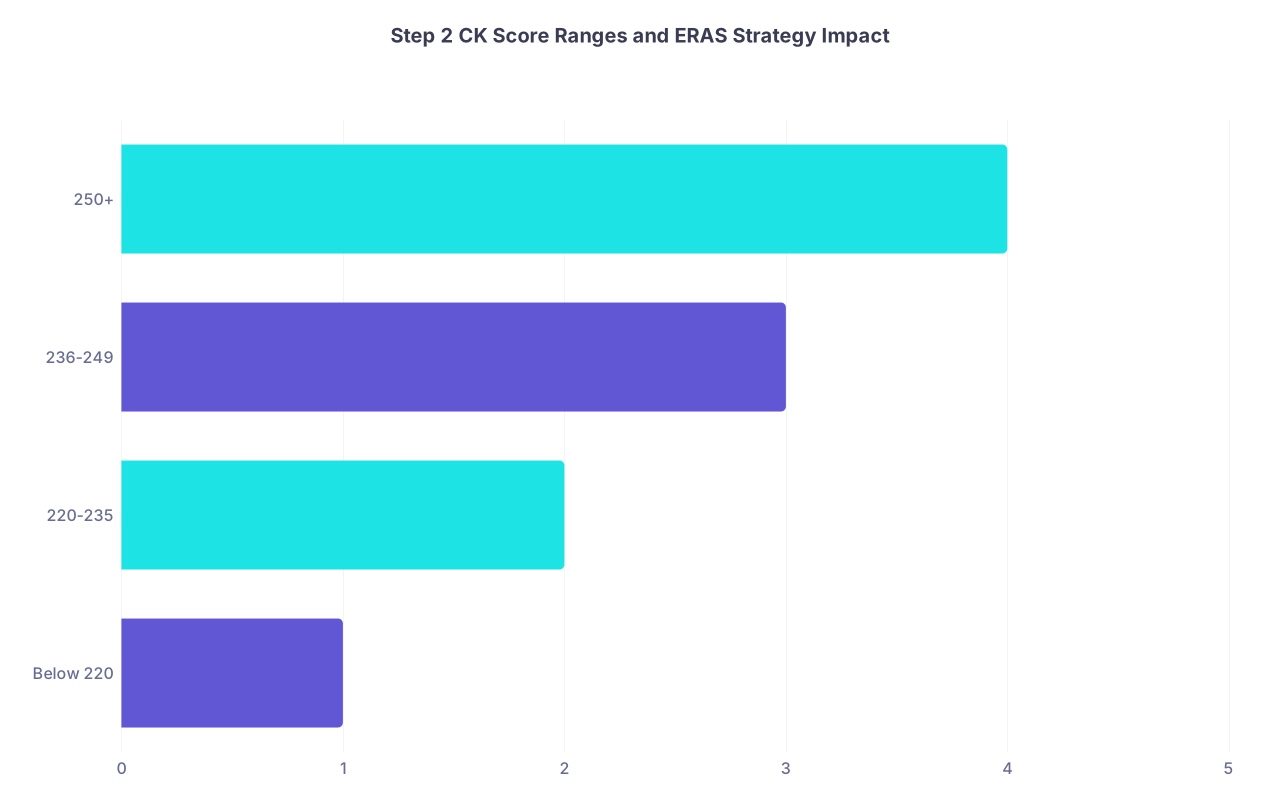
| Category | Value |
|---|---|
| Below 220 | 1 |
| 220-235 | 2 |
| 236-249 | 3 |
| 250+ | 4 |
Interpretation (rough, but practical):
- Below ~220
- For competitive specialties: tough road, need heavy backup strategy
- For most core fields (IM, FM, peds, psych) → still possible but:
- Increase program numbers
- Lean hard on letters, fit, and geography
- 220–235
- Solid for many primary care and some IM programs
- Borderline for super competitive specialties unless you have other major strengths
- 236–249
- Strong. You’re competitive for most non-ultra-competitive fields
- 250+
- You just bought yourself attention. Especially if Step 1 was lower.
At this point you should decide:
- → Keep original specialty plan or
- → Shift to more realistic mix (e.g., IM instead of cards-obsessed super-elite-only strategy)
Step 3: Update ERAS and Strategy
Now, concretely, what changes?
USMLE Transcript Release in ERAS
- Make sure you’ve authorized USMLE transcript release
- If you took Step 2 close to ERAS season:
- Re-check just before/after submission to ensure it’s queued to send
Program List Adjustments
Based on your score:
- Increase/decrease:
- Number of “reach” programs
- Number of “safety” programs
- Shuffle:
- Add more community, mid‑tier, or regionally less competitive sites if needed
- If your score is a major positive jump from Step 1:
- You can justify adding some more ambitious programs
- Increase/decrease:
Personal Statement + Narrative
- Big upward jump from Step 1 to Step 2 (e.g., 208 → 240+)?
- Consider a brief, calm explanation in interviews—not an essay in the PS
- Big drop? Don’t launch into excuses in writing.
- Focus on what you’ve done well clinically, in sub‑Is, and in letters
- Big upward jump from Step 1 to Step 2 (e.g., 208 → 240+)?
ERAS Submission Timing: The Critical Weeks
You’ve got your score. Now the only thing that matters is when and how you submit ERAS.
4–6 Weeks Before ERAS Submission Opens
At this point you should:
- Have:
- Final-ish CV
- Almost-final personal statements
- LOR requests all out
- Be doing:
- Final proofreading
- Double-checking program requirements (Step 2 required? Step 1 cutoffs?)
- Finalizing your program spreadsheet
This is where students waste time fussing with 3-word changes instead of checking basic details like program eligibility.
2–3 Weeks Before ERAS Submission Opens
Lockdown time.
- Freeze 90% of your ERAS entries:
- Experiences
- Publications
- Awards
- Confirm with your school:
- MSPE timeline
- Transcript handling
- Check:
- That your USMLE ID in ERAS is correct
- That you’ve authorized transcript release
At this point you should stop adding new “fluff” experiences unless they’re substantial (e.g., a real publication, not a preprint you’re hoping will get accepted).
Submission Week (Early September)
Your job is simple:
- Submit early in the opening window.
- Do not wait “to see if one more letter comes in.” Letters can be uploaded after submission and attached as they arrive. Programs know this.
Then:
- Verify:
- USMLE transcript sent/queued
- Letters are assigned correctly to each program
- Specialty‑specific PS is mapped to the right programs
You do not get bonus points for waiting. Being in the first wave is better, especially for competitive fields and popular regions.
After ERAS Submission: When Step 2 Timing Still Matters
Even after you submit, Step 2 timing keeps affecting you in the background.
At this point you should:
Monitor Programs That Require Step 2 Before Ranking
Some specialties/programs explicitly require Step 2 before they rank you or even before interview.
- Check program websites / FREIDA:
- “Step 2 required for consideration”
- “Step 2 required by rank list deadline”
- If your Step 2 is pending and they need it:
- Consider an email once it posts:
- Brief, factual: “My Step 2 CK score is now available and has been transmitted via ERAS.”
- Consider an email once it posts:
- Check program websites / FREIDA:
Use a Strong Step 2 as a Nudge
If you have:
- Strong Step 2
- Weak/mediocre Step 1
And a program you’d really fit at but haven’t heard from:
Consider a short, targeted interest email after interview season starts, especially if:
- You’re from that region
- You have a genuine tie to the program
Accept the Ceiling You Set by Timing
If you took Step 2 very late (August/September) and your score is great but some programs never saw it early:
- Stop replaying the timing decision
- Focus on:
- Crushing sub‑Is
- Being normal and prepared on interviews
- Ranking programs intelligently
The timing game is front-loaded. Once ERAS is out, obsessing over what you could have done in June is just self‑punishment.
Quick Timeline Recap: What You Should Be Doing When
Here’s the compressed “do this now” sequence:
-
- Choose Step 2 date with ERAS in mind (May–July is prime for most)
- Rough ERAS planning starts (especially if you’re in a competitive field)
Test Day → Week 1 Post-Exam
- Recover
- Build ERAS checklist
- First pass at CV and experience entries
- Draft LOR request emails
Week 2 Post-Exam
- Draft personal statements
- Build program spreadsheet
- Confirm letter writers and give them materials
Week 3–4 Post-Exam (Score Imminent)
- Clean up ERAS entries
- Pre-write two strategy plans (good score vs weaker score)
- Confirm school transcript and MSPE logistics
Score Release Week
- Read score once, reset
- Adjust specialty competitiveness and program list
- Confirm USMLE transcript release in ERAS
- Finalize PS strategy (no dramatic rewrites)
4–6 Weeks Before ERAS Submission
- Lock most ERAS content
- Final proofreading
- Verify program requirements, eligibility
Submission Week
- Submit in the earliest reasonable window
- Ensure transcript and letters are correctly set up
- Stop tinkering
Post-Submission
- Use strong Step 2 intelligently (not desperately)
- Provide updates only when they’re meaningful and requested/appropriate
- Focus on interview prep and clinical performance
Core Takeaways
- Your Step 2 date is an ERAS decision, not just an exam decision. Plan it backwards from when you want programs to see the score.
- The 3–4 weeks after your exam are prime ERAS-building time. If you waste them doom‑scrolling Reddit threads about score releases, you’re hurting yourself.
- Score day is a pivot, not a panic. Have two strategies ready, plug your number into the right one, and move on.