
The way most students schedule Step 2 is quietly sabotaging their residency chances.
Not their test-taking. Not their knowledge. Their timing.
I’ve watched students with the brains and work ethic to match into any program blow it because they treated Step 2 scheduling like booking a cheap flight. Flexible. Last minute. “I’ll figure it out.” And then it figured them out.
Let me walk you through the exact timing mistakes that hurt residency applications—and how to avoid stepping on those landmines.
The Five Deadliest Step 2 Timing Mistakes
Let’s start with the big ones. If you mess these up, you’re playing residency roulette.
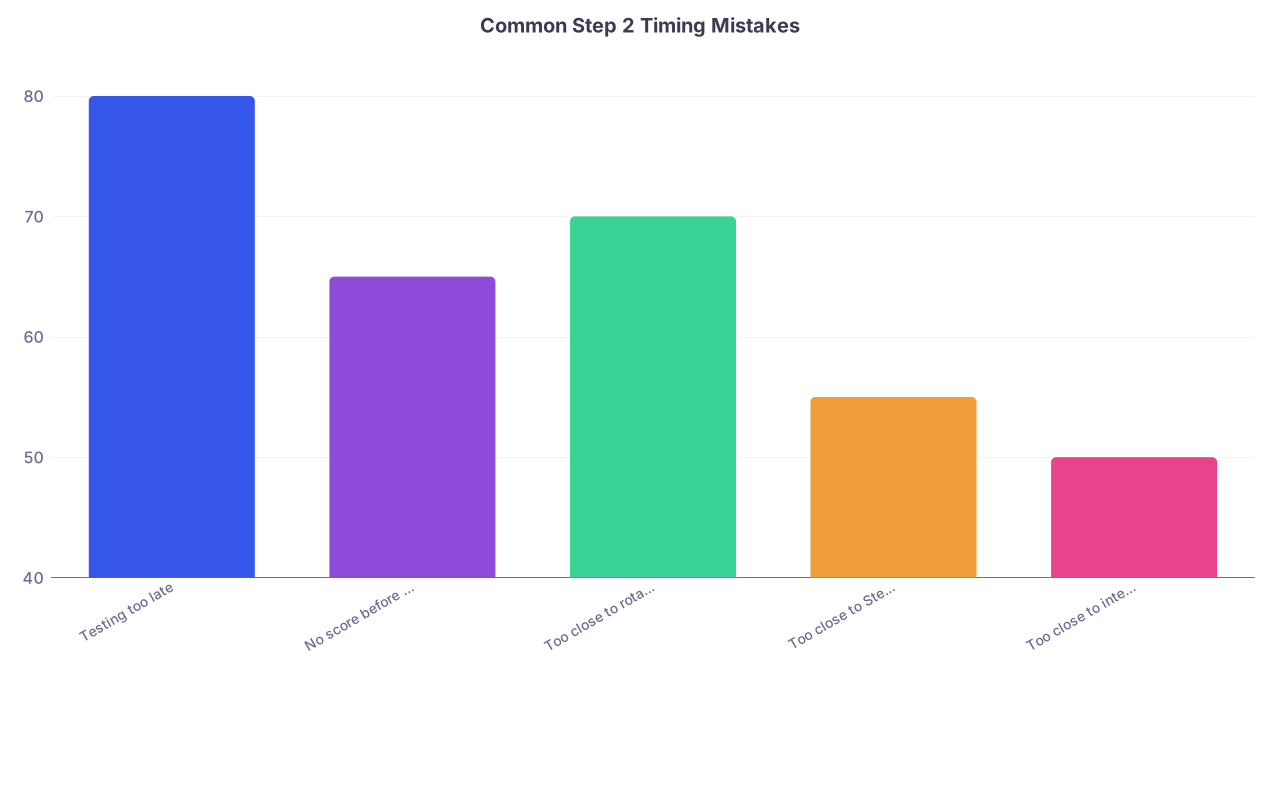
| Category | Value |
|---|---|
| Testing too late | 80 |
| No score before ERAS | 65 |
| Too close to rotations | 70 |
| Too close to Step 1 | 55 |
| Too close to interviews | 50 |
1. Taking Step 2 Too Late for Programs to See Your Score
The classic unforced error.
You schedule Step 2 for late September or October of your application year because:
- “ERAS opens in September, I’ll just mention I’m taking it.”
- “Programs know scores come later.”
- “I need more time.”
Here’s what actually happens:
- ERAS opens in June.
- Application submission starts mid-September.
- Programs start downloading apps immediately and sending interview invites within days to weeks.
- Many competitive programs and specialties expect a Step 2 score on file when they review you.
If your score isn’t in:
- You get screened out at the first pass.
- Or you get dropped into the “maybe later” pile… that rarely gets revisited.
I’ve seen this with IMGs especially. They booked Step 2 for November “to be safe.” Result: No interviews from the better programs in their list. Not because they were weak. Because they were invisible.
Avoid this mistake:
- If you’re applying in September of M4:
- Aim to take Step 2 no later than mid-July to early August.
- That gives you time for scoring (typically 2–3 weeks) so your result is in ERAS by the time programs start serious review in late September/early October.
Red flag thought pattern:
“I’ll just put ‘Step 2 scheduled’ on my application.”
Programs have seen that line 1,000 times. Most do not care unless they’re already strongly interested in you.
2. Taking Step 2 Too Close to Core Rotations
Another disaster: jamming Step 2 right after a brutal core rotation (surgery, OB/GYN, inpatient medicine) with no real buffer.
Typical scenario:
- You finish 6–8 weeks of a demanding rotation.
- You’ve been doing notes, call, shelf prep, trying not to look clueless.
- You tell yourself: “I’ll study for Step 2 at night during this rotation.”
Reality:
- You collapse at 10 p.m.
- You “review” UWorld questions half-asleep.
- You walk into Step 2 with a patchwork of half-retained knowledge and untreated exhaustion.
Your performance drops not because you’re unprepared conceptually, but because you:
- Didn’t consolidate material post-rotation.
- Didn’t drill high-yield Step 2-style questions in a focused way.
- Took the exam mentally fried.
Avoid this mistake:
- Build in at least 2–3 weeks of dedicated time after your heaviest rotations before Step 2.
- Do not schedule the exam within 3–5 days of finishing an intense inpatient month.
- Treat recovery as part of studying. Your brain isn’t a robot; it needs a reset.
What good timing looks like:
- Finish core rotations by April–May of M3.
- Take shelf exams.
- Start Step 2 prep with a short bridge period.
- Have 3–6 weeks of consolidated studying before exam day.
You don’t get extra points for “toughing it out” with no buffer. You just risk a worse score.
3. Overreacting to Step 1: Taking Step 2 Either Way Too Early or Way Too Late
Step 1 going pass/fail created a new kind of panic. I’ve watched schools give conflicting advice, and students get caught in the crossfire.
Two bad extremes:
Extreme A: “Take Step 2 ASAP to Prove Yourself”
You:
- Just finished your first few cores.
- Have incomplete exposure to OB, peds, psych, or surgery.
- Haven’t seen enough variation in question styles.
You schedule Step 2 in early M3 or right after only half your rotations because:
- “I want to show programs I can do well with numbers.”
- “My school strongly recommends early Step 2.”
The problem:
- Step 2 is a clinical exam built on patterns and volume of cases.
- You can’t cram experience.
- Missing major core content means there will be entire sections you only know from skimming, not from real clinical context.
Result:
A mediocre score that doesn’t match your true potential—and now it’s permanent.
Extreme B: “Wait Until I’m Perfectly Ready”
You:
- Push Step 2 repeatedly.
- Want to “get just a bit more UWorld done.”
- Want your practice scores to be “consistently over 250” (I’ve heard this exact phrase from more than one student).
Suddenly it’s:
- August.
- You’re applying in September.
- You still don’t have a test date locked or your practice scores are all over the place.
Now:
- You either rush into an exam before you’re ready.
- Or you delay Step 2 until after apps go in, risking no score when it matters most.
Avoid this mistake:
- Finish all core rotations before Step 2.
- Target a window:
- June–August of the application year for most people.
- Earlier (April–May) if you’re applying to ultra-competitive specialties or need to prove yourself after a weak academic record.

4. Ignoring Score Release Timelines
Too many students act like scores appear “sometime” after the exam and it doesn’t really matter when.
It matters.
NBME usually releases scores:
- On Wednesdays.
- Roughly 2–3 weeks after your exam.
- But holidays, technical issues, and certain audit flags can delay this.
If you take Step 2:
- Late August / early September and need that score in for ERAS opening, you’re cutting it painfully close.
- Programs don’t sit around waiting for you. They start sorting apps as soon as they download them.
Avoid this mistake:
- Work backward from:
- ERAS opening and first download dates.
- When your target programs historically send out interview invites.
- Then schedule Step 2 at least 4 weeks before you want the score visible in ERAS.
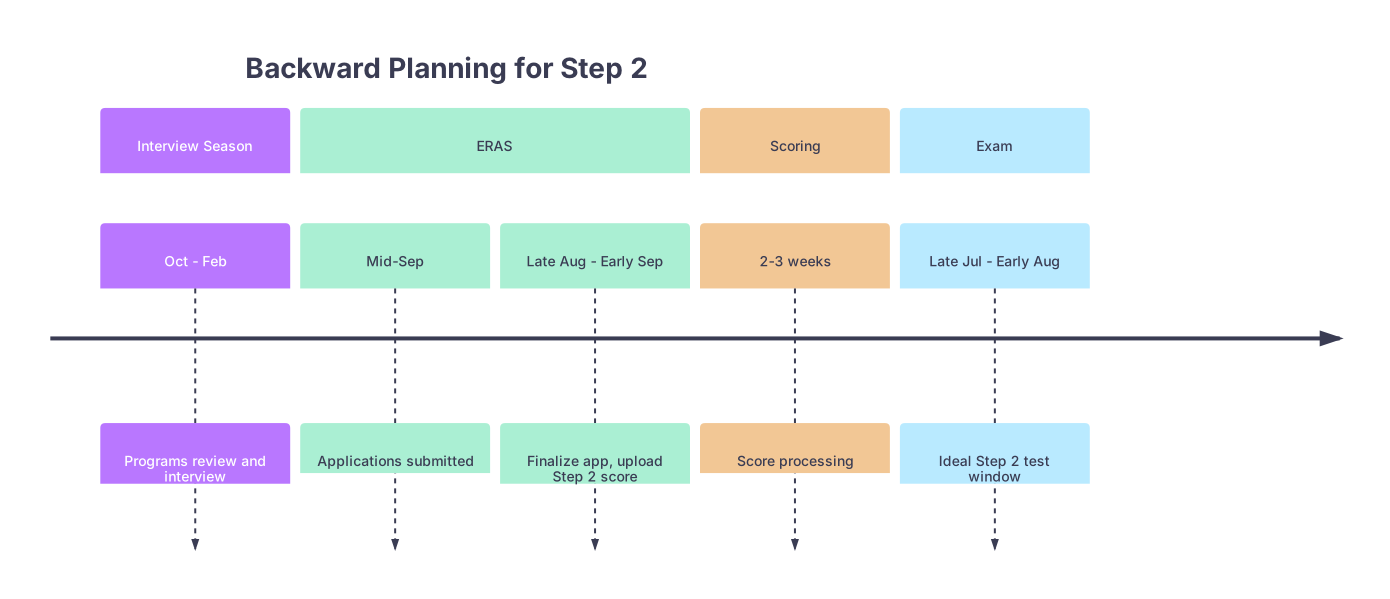
| Period | Event |
|---|---|
| Interview Season - Oct - Feb | Programs review and interview |
| ERAS - Mid-Sep | Applications submitted |
| ERAS - Late Aug - Early Sep | Finalize app, upload Step 2 score |
| Scoring - 2-3 weeks | Score processing |
| Exam - Late Jul - Early Aug | Ideal Step 2 test window |
5. Booking Step 2 During Audition Rotations or Early Interviews
This one’s brutal because it wrecks two high-stakes things at once.
Situation:
- You’ve landed an away rotation at a dream program in EM, surgery, ortho, whatever.
- You also have Step 2 scheduled in the middle or at the end of that rotation.
- Or even worse: during your first big interview month.
What actually happens:
- You try to study after 10–12 hour days.
- You’re exhausted, trying not to screw up basic tasks on the rotation.
- Your evals suffer because you’re distracted and stressed.
- Your Step 2 score suffers because you never hit proper study depth.
Or:
- You schedule Step 2 between interview trips.
- You’re flying, sleeping in hotels, breaking your routine.
- You convince yourself you’ll “review on flights.”
You will not. You’ll stare at your screen and retain nothing.
Avoid this mistake:
- Treat away rotations and interview months as protected from major exams.
- If you must take Step 2 near an away:
- Put it before the rotation with enough buffer to study.
- Or well after, once interviews quiet down.
Timing by Profile: Who Needs to Be Extra Careful
Not everyone should schedule Step 2 the same way. But certain groups get hurt much more when they time it wrong.
| Applicant Type | Timing Priority |
|---|---|
| Strong Step 1, Strong Clerkships | More flexible, but avoid very late dates |
| Weak/Pass Step 1, Strong Clerkships | Earlier Step 2 to show improvement |
| Step 1 Failure/Remediation | Step 2 early enough to be visible and strong |
| IMG/Non-US Grad | Step 2 before applying, no exceptions |
| Competitive Specialties | Earlier, high score needed before audition/interviews |
If Your Step 1 Was Weak or Barely Pass
You don’t have the luxury of late Step 2. Programs will be looking for:
- Evidence of upward trajectory.
- Proof that you can handle standardized exams.
Your mistake to avoid:
Scheduling Step 2 so late that:
- Programs see only a borderline Step 1.
- You’re “planning” to take Step 2 but don’t have a score yet.
For you:
- Aim for Step 2 toward the earlier side of the June–July window.
- Let programs see your growth early.
If You’re an IMG
You cannot afford vagueness with Step scores. Many programs quietly filter:
- No complete scores = auto-discard or auto-hold.
Your mistake to avoid:
- Testing close to or after ERAS opens.
- Expecting programs to wait.
You should:
- Have Step 2 done and scored before the application season starts.
- Ideally by June/July of the year you apply.
Overestimating Your Ability to “Study During Rotations”
Let me be blunt.
“Don’t worry, I’ll just study for Step 2 while on rotations” has killed more Step 2 scores than bad multiple-choice questions ever did.
What actually happens:
- You underestimate how drained you’ll be post-call or after clinic.
- You overestimate the quality of your studying at 11 p.m.
- You get behind on UWorld and NBMEs.
- You extend your test date. Again. And again.
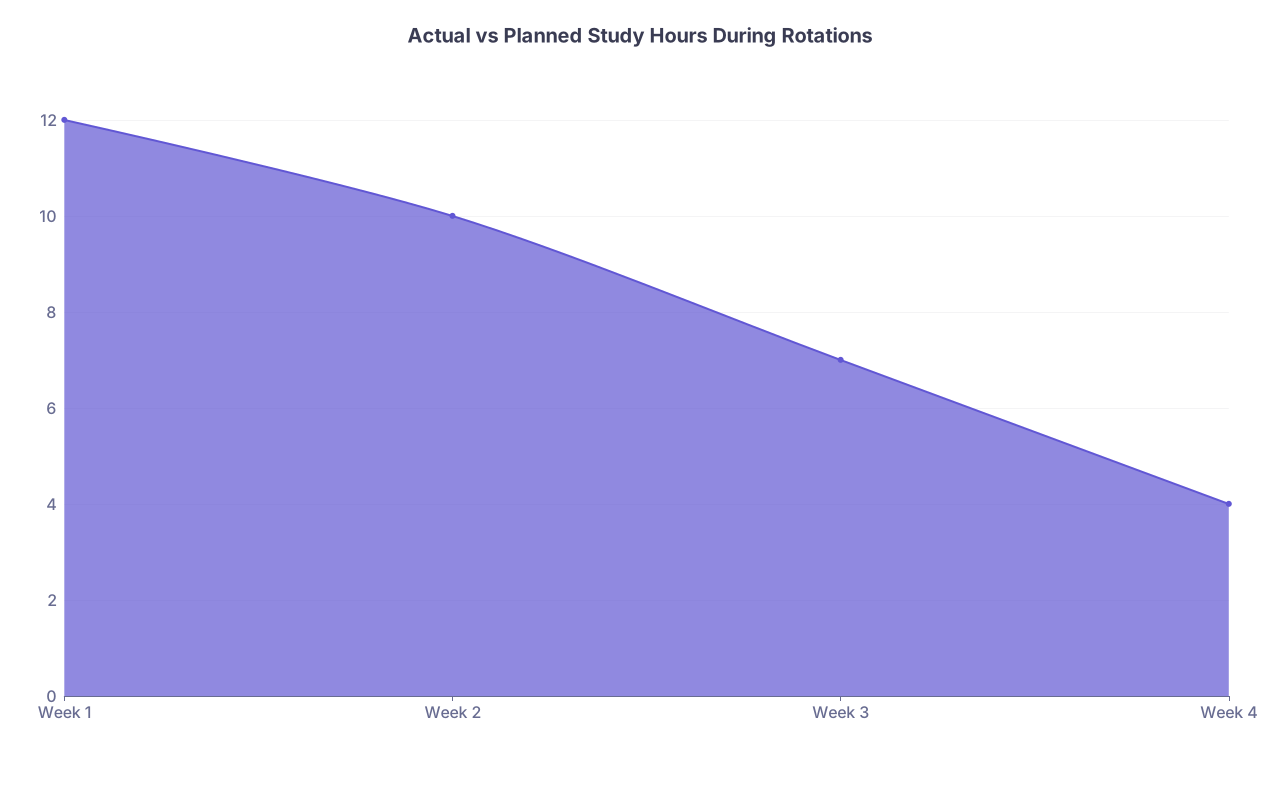
| Category | Value |
|---|---|
| Week 1 | 12 |
| Week 2 | 10 |
| Week 3 | 7 |
| Week 4 | 4 |
By the time you realize this, all the good test dates in your preferred centers are gone.
Avoid this mistake:
- Accept this truth: core rotations are not “dedicated study” time.
- Count rotation-time studying as bonus, not baseline.
- When planning, assume:
- 0–1 hrs/day of usable studying on heavy rotations.
- Maybe 2–3 hrs/day on lighter ones.
If your plan requires “I’ll do 5 solid hours every day after wards,” it’s a bad plan.
Underestimating Test Center Availability
Another sneaky problem: You pick an ideal week in your mind… then wait too long to schedule. By the time you log in:
- Your city has no seats.
- The only available dates are either way too early or stupidly late.
- You end up taking Step 2 where you don’t want, when you don’t want.
I’ve seen students drive 3–4 hours the night before their exam because they waited and lost every local seat. Then they wonder why their performance tanked.
Avoid this mistake:
- Once you have a target month, schedule the exam.
- You can:
- Shift it a bit within that month if absolutely necessary.
- But don’t wait for your studying to feel “perfect” before grabbing a slot.
Treat test center seats like housing in a college town. If you wait until the last minute, you’re sleeping on someone’s couch.
A Simple, Safe Step 2 Timeline (That Won’t Wreck Your Application)
This isn’t the only way. But it’s one that avoids the big landmines for most U.S. MD/DO students.
M3 Year
- Finish all core rotations by April–May.
- Shelf exams done.
- Start light Step 2 prep during the last few rotations (2–3 blocks/day of UWorld is enough).
Early Dedicated (Late M3 / Early M4)
- Block out 3–6 weeks of focused Step 2 study:
- Preferably May–July.
- No heavy rotations, no aways, no interviews.
Test Window
- Schedule Step 2:
- Late June–early August.
- So scores release before or around when ERAS opens and programs start serious review.
Then:
- Use August/September for:
- Finishing personal statement.
- Getting LORs finalized.
- Starting aways or sub-Is strong, not exhausted.

Less Obvious But Costly Micro-Mistakes
These are smaller, but they stack up.
1. Not Aligning Step 2 With Letters and MSPE
If your school uses:
- Core rotation performance.
- Shelf scores.
- Early Step 2 attempts.
…in your MSPE or summary evaluations, then a rushed or weak Step 2 taken during M3 can bleed into your written narrative.
2. Taking Step 2 While Emotionally Burned Out
Burnout isn’t just “feeling tired.” It:
- Blunts focus.
- Narrows recall.
- Shortens your attention span during a 9-hour exam.
If you just finished:
- A toxic rotation.
- A major personal crisis.
- Or remediation/remedial work.
Do not immediately throw yourself into Step 2. A 1–2 week decompression before you dive deep into prep isn’t laziness. It’s damage control.
3. Ignoring Specialty-Specific Expectations
Some specialties (derm, ortho, plastics, rad onc, ENT) often want:
- High Step 2 scores.
- Early completion so programs can use it as a screen.
If you’re applying to those and take Step 2:
- Late August/September.
- Barely have scores back by first wave of invites.
You’ve already missed the first cut at some programs.
What You Should Do Today
Open your calendar and:
- Mark your target application year.
- Block a 4–6 week window for Step 2 studying in late M3/early M4.
- Pick a 3-week span where you could realistically test (June–August if you’re applying that fall).
- Go to the registration site and check actual test center availability for those weeks.
If the dates you want aren’t available?
That’s your warning. You’re already behind on the logistics, even if you’re not behind on the content.
FAQ (Exactly 4 Questions)
1. Is it a mistake to delay Step 2 until after I see how my Step 1 (pass/fail) looks on my transcript?
Yes, usually. Programs won’t know “how close you were to failing,” they’ll just see Pass. Waiting does nothing for you and risks having no numeric score when applications open, especially in competitive specialties. For most students, getting Step 2 done before ERAS submission is the safer play.
2. I’m doing well on shelves—can I just take Step 2 with minimal dedicated time?
That’s the trap. Strong shelf performance helps, but Step 2 still demands system-level integration and stamina that shelf exams don’t fully test. Squeezing Step 2 in with <2 weeks of focused review, especially around busy rotations, is a common way strong students underperform relative to their potential.
3. What if my practice scores are inconsistent close to my scheduled date? Should I push the exam?
Pushing once for a clear, structured extra 2–3 weeks of study can make sense. Pushing multiple times because you’re chasing a fantasy “perfect preparation” is how students end up testing way too late. If your NBMEs and UWorld self-assessments cluster within a reasonable range and you’ve done a comprehensive pass, at some point you have to stop punting and take the exam.
4. How late is “too late” to take Step 2 if I’m applying this cycle?
If you test after mid-August, you’re rolling the dice. Your score might not post before programs begin serious review. After early September, you’re clearly late for that cycle unless you’re intentionally applying in a smaller, less competitive field or to programs that explicitly say they don’t require Step 2 for initial review (and even then, I wouldn’t risk it).
Open whatever you use as a calendar—Google, Outlook, a paper planner.
Find June, July, and August of your application year and block out a real Step 2 study window and testing week. If you can’t find that space, your issue isn’t content. It’s timing. Fix that now, before it quietly trashes your residency chances.