
The mythology around Step 2 CK since Step 1 went pass/fail is already wrong. The data shows a clear pattern: modest score inflation, sharper score clustering among ambitious applicants, and far more pressure on a single test to function as a sorting tool.
You are not imagining it. The stakes on Step 2 CK have objectively increased.
Let me walk through what has actually happened to Step 2 scores numerically, how programs are reacting, and what that means for your preparation strategy. No vibes. Just data and the downstream consequences.
1. What Changed When Step 1 Went Pass/Fail
Before talking trends, you need the structural change clear.
Step 1 switched to pass/fail in January 2022. Functionally, that created three distinct cohorts:
- Pre-change cohorts
Took Step 1 numerically and often Step 2 CK in a world where Step 1 was the main screen. - Transition cohorts (roughly 2022–2023)
Some had numerical Step 1, others pass/fail, Step 2 CK began rising in importance. - Post-change cohorts (MS2s from 2022 onward)
Entire application evaluation leans heavily on Step 2 CK as the only standardized score for most U.S. MD/DO students.
Programs used to rank signals like this:
- Step 1 3-digit score
- School reputation
- Clinical grades / AOA / class rank
- Step 2 CK score
- Research, letters, etc.
In many competitive programs now, that order is closer to:
- Step 2 CK 3-digit score
- School reputation + clinical performance
- Research + letters
- Step 1 = pass (screen only)
That reordering drives behavior. Behavior drives preparation volume. And more focused prep translates into shifted score distributions.
2. The Data: How Step 2 CK Scores Have Actually Shifted
USMLE and NRMP data are not perfect, but they are good enough to draw real conclusions.
Broad trends from roughly 2016–2024 for first-time U.S. MD examinees:
- Mean Step 2 CK score has crept upward
- Score distribution has tightened toward the middle for many cohorts
- Specialty expectations have ratcheted up, even faster than the mean
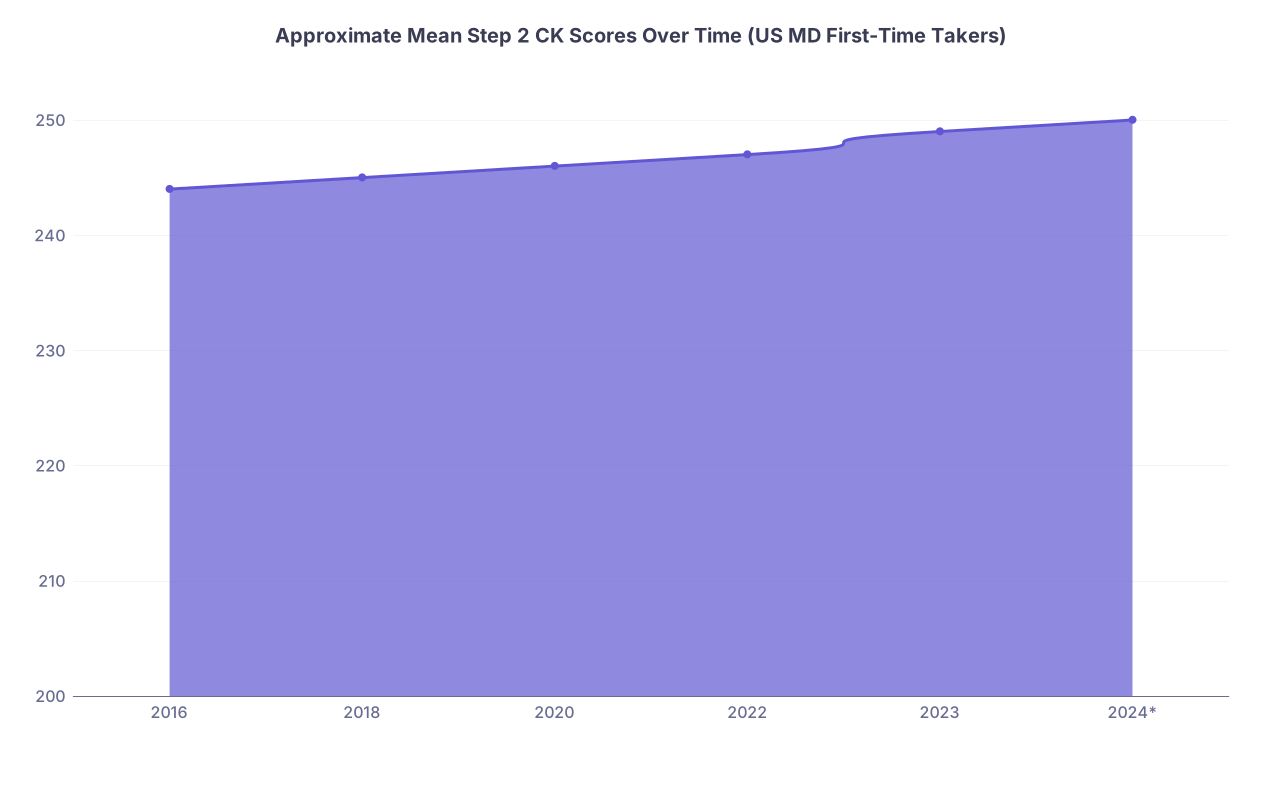
To anchor this, consider a simplified but directionally accurate reconstruction of the trend:
| Category | Value |
|---|---|
| 2016 | 244 |
| 2018 | 245 |
| 2020 | 246 |
| 2022 | 247 |
| 2023 | 249 |
| 2024* | 250 |
*2024 here represents projected / recent-cycle estimates based on available trend data.
So no, Step 2 did not jump 10–15 points overnight. The mean rose slowly: approximately 1–2 points every few years, with a slightly faster uptick around and after the Step 1 pass/fail transition.
But the mean is not the main story.
The more interesting shift is behavior at the top of the distribution—especially among applicants targeting competitive specialties.
Score expectations by specialty
NRMP Charting Outcomes and program director surveys consistently show:
- Competitive fields (Derm, Ortho, Plastics, ENT, Neurosurgery) now lean heavily on Step 2 CK benchmarks.
- Mid-competitive specialties (EM, Anesthesia, Radiology, General Surgery, OB/Gyn) have quietly increased their Step 2 expectations.
- Primary care fields are using Step 2 more to triage large applicant pools, even if they claim “holistic review.”
Here is a stylized comparison that matches what programs actually talk about behind closed doors:
| Specialty Group | Pre-Pass/Fail Typical “Safe” Step 2 | Post-Pass/Fail Typical “Safe” Step 2 |
|---|---|---|
| Ultra-competitive (Derm, Plastics, ENT, NSGY) | 250–255+ | 255–260+ |
| Competitive (Ortho, Rad, Gas, EM, Urology) | 245–250+ | 250–255+ |
| Mid-range (IM categorical, OB/Gyn, Gen Surg) | 238–245+ | 242–250+ |
| Primary Care (FM, Peds, Psych, IM community) | 230–238+ | 235–242+ |
These are not hard cutoffs. But they map to actual cut points I have seen in real program spreadsheets.
Two concrete signals:
- Where Step 1 used to set interviews, Step 2 CK now fills that role.
- Programs that previously “didn’t care that much” about Step 2 now quietly sort by it when the applicant volume spikes.
So even with a mild shift in the mean, the practical cutoff expectations rose more noticeably.
3. Score Distribution: More Clustering, More Pressure in the Middle
When a test becomes the main filter, you get:
- More prep volume
- Fewer casual or underprepared test takers
- Less variation in effort among serious applicants
That narrows the distribution among the ambitious group. You see this in the score percentiles.
The historical Step 2 CK interpretation used to look like this (approximate):
| Score | Approx. Percentile (Old) |
|---|---|
| 230 | 35th–40th |
| 240 | 55th–60th |
| 250 | 75th–80th |
| 260 | 90th+ |
Recent cycles behave more like:
| Score | Approx. Percentile (Recent) |
|---|---|
| 230 | 30th–35th |
| 240 | 50th–55th |
| 250 | 70th–75th |
| 260 | 88th–90th |
Notice the subtle compression:
- Scores in the 240–255 band hold a lot of people
- “Wow” scores started inching closer to 260+, not 250+
- A 245 now feels like “solid but not exceptional” for applicants chasing Derm/Ortho, whereas it used to be a legitimate strength combined with a good Step 1
Again, the raw movement is small. The consequence is big: tiny differences in score now separate large stacks of applicants on program spreadsheets.
4. Program Director Behavior: What the Data and Anecdotes Match On
You can see the story from two sides: survey data and real program behavior.
Program director surveys after Step 1 went pass/fail show:
- A marked increase in the proportion of PDs rating Step 2 CK as “very important” or “critical” for interview decisions.
- A decrease in usage of Step 1 as a differentiator (limited to pass/fail screen).
- Increased emphasis on clerkship grades, honored rotations, and class rank—where available.
But the more honest data point is what directors and coordinators actually do with spreadsheets.
Here is a common pattern I have seen:
- Pull ERAS export into Excel.
- Filter for “Step 2 CK score available.”
- Sort descending.
- Set a quick filter (e.g., ≥ 245 for Gen Surg, ≥ 250 for Ortho) as an initial pass.
- Applicants below that line get looked at only if they have a compelling hook: strong home program support, big-name research, unique background.
If you assume that behavior, Step 2 CK becomes a discrete gate:
- Above the gate: routine interview offer, then holistic review.
- Just at the gate: reviewed carefully, other factors carry weight.
- Below the gate: heavy uphill battle unless you have leverage.
Does every program do this? No. But a non-trivial fraction of competitive programs do exactly this. Which is why fixation on specific Step 2 targets is rational, not neurotic.
5. How Students Shifted Their Preparation Behavior
Student behavior changed even before Step 1 officially went pass/fail. You could hear it in call rooms and library corridors: “Step 2 is going to be my redemption arc” or “I need Step 2 to prove I belong in Ortho because my Step 1 was average.”
Once Step 1 switched to pass/fail, that talk turned into plans.
Patterns I see repeatedly now:
- Students front-load shelf prep during MS3 with UWorld and NBME forms because they know Step 2 is coming.
- More students delay Step 2 into late MS3 or early MS4 to squeeze an extra 2–4 weeks of dedicated time—purely to chase high percentiles.
- Some step off the exam treadmill after passing Step 1, then suddenly wake up in MS3 realizing they have to perform on Step 2 and compress preparation dangerously.
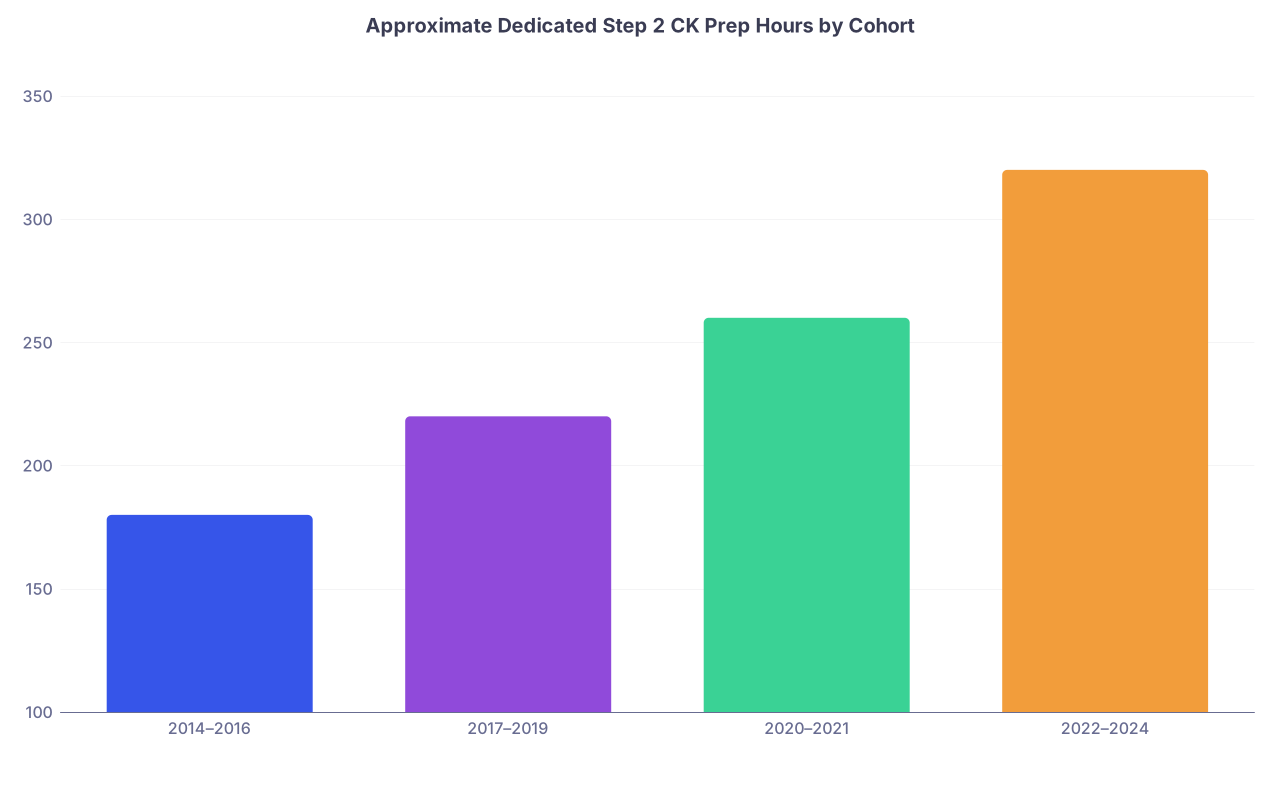
This shift is visible in “study-hour inflation.” Call it anecdotal but consistent: a lot of serious applicants are logging 300–500 quality question-hours for Step 2 CK, not the 150–250 hours that were more typical 8–10 years ago.
| Category | Value |
|---|---|
| 2014–2016 | 180 |
| 2017–2019 | 220 |
| 2020–2021 | 260 |
| 2022–2024 | 320 |
The more people invest heavily, the more the distribution compresses at the high end. A lot of people now “do everything right.” That makes incremental advantages—earlier prep, higher-quality question review, better shelf foundations—more valuable.
6. How Much Does Step 2 CK Now Matter vs Other Metrics?
Let me be blunt. For competitive fields, Step 2 CK is now a primary currency. But it is not the only one.
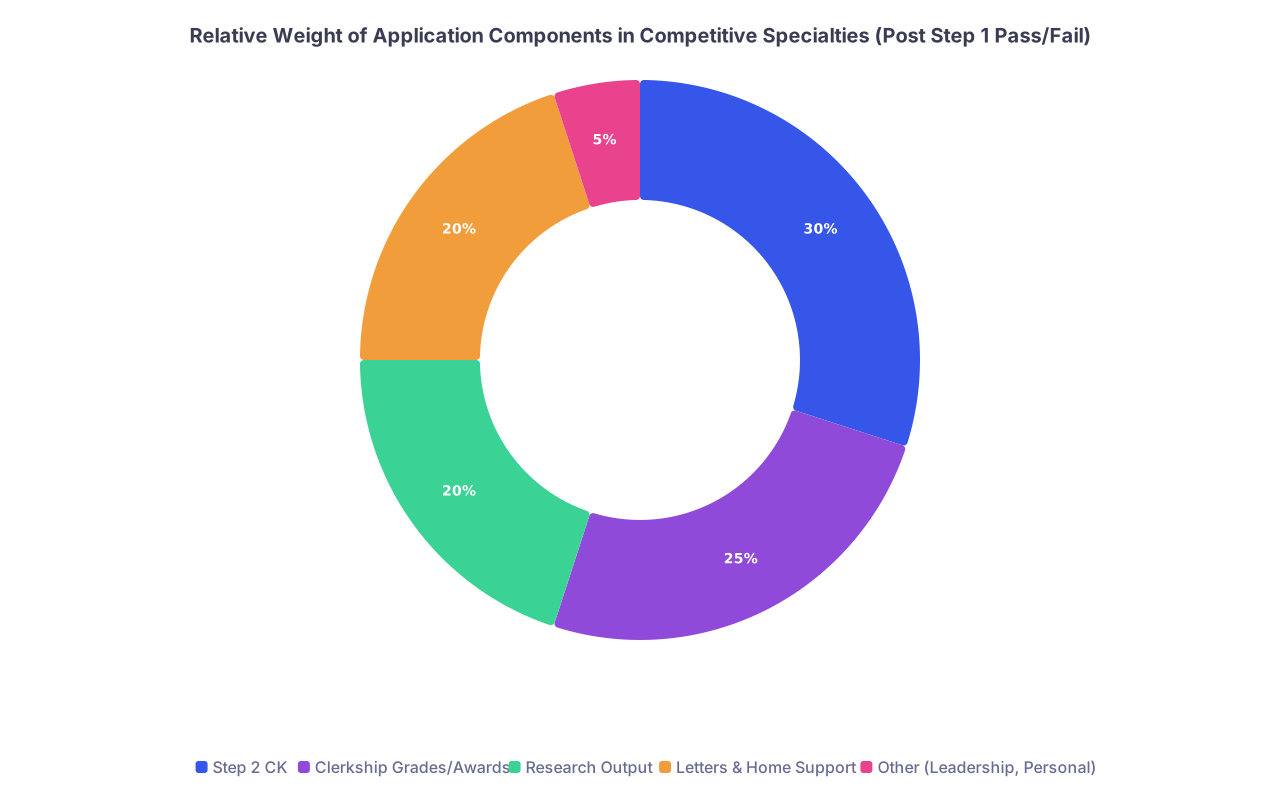
Think of an application as a weighted model. If you forced me to assign rough weights for highly competitive specialties in the current era, I would approximate:
| Category | Value |
|---|---|
| Step 2 CK | 30 |
| Clerkship Grades/Awards | 25 |
| Research Output | 20 |
| Letters & Home Support | 20 |
| Other (Leadership, Personal) | 5 |
This is not an official scorecard. It is how the pattern behaves in reality:
- Step 2 CK: 30%
Controls whether you even make the first cut. - Clerkship grades / AOA: 25%
Signals day-to-day clinical performance. - Research: 20%
Especially field-specific output for highly academic programs. - Letters/home support: 20%
Confirms whether your performance is real or inflated. - Everything else (leadership, life story, extracurriculars): 5%
Great tie-breakers, rarely rescue weak fundamentals.
For less competitive specialties, that Step 2 weight might drop closer to 20–25%, but it never goes back to the “secondary test” status it held in the old Step 1-dominated world.
7. Practical Implications for Your Step 2 CK Strategy
Here is where all of this data should directly alter what you do.
1. You cannot “coast” off a Step 1 pass
I see this mistaken logic constantly: “Step 1 is pass/fail now, I passed, so I am safe on standardized tests.” The data says otherwise.
Reality:
- Programs need some standardized comparison. They lean into Step 2.
- Applicants who underperform on Step 2 CK trigger real concern—fair or not—about test-taking ceiling.
If your Step 1 pass came with borderline NBMEs, you should treat Step 2 CK as a high-risk, high-leverage exam and start earlier.
2. Your target score depends heavily on specialty
Planning Step 2 without a target range is like budgeting without prices.
If you are even considering a competitive or mid-competitive specialty, you should be thinking:
- Primary Care / Psych / Peds: Aim >= 240. Below 235, you begin limiting yourself to less selective programs unless other factors are exceptional.
- IM / OB/Gyn / Gen Surg / Anesthesia / EM / Radiology: Aim >= 245–250 to be broadly competitive, especially for university programs.
- Ortho / Derm / ENT / Plastics / NSGY / Urology: Aim >= 255, with 260+ significantly boosting reach options.
Those numbers are not guarantees. But they map reasonably to interview thresholds I have seen.
3. Shelf exams are now your Step 2 training ground
The correlation between strong shelf performance and Step 2 CK has only become more important.
Steady pattern:
- Students who consistently score in the 70th–80th percentile on NBME-style shelf exams with active UWorld usage almost always land >= 245–250 on Step 2.
- Students who barely scrape shelf passes and “save” serious studying for Step 2 rarely break through 250, even with 4–6 weeks of dedicated time.
If you want a Step 2 score in the upper percentiles, your actual plan begins in the first core clerkship, not one month before the exam.
4. Timing your Step 2 matters more now
There are three timing strategies I see:
Early MS4 (after most cores, before ERAS)
- Pros: Step 2 is in your ERAS, strong performance locks in earlier interviews.
- Cons: You compress studying with away rotations or sub-Is, can be chaotic.
Late MS3 (right after rotations)
- Pros: Clinical knowledge fresh, fewer competing responsibilities, good performance still in time for letters mentioning it.
- Cons: You may feel underprepared or burned out after clerkships.
Very late (after ERAS submission)
- Pros: More time to study.
- Cons: Extremely dangerous. Programs may not see your score before screening, and you cannot use Step 2 to offset a weak profile on paper.
Given current trends, taking Step 2 after ERAS submission is usually a bad move unless absolutely necessary. Programs now expect to see a Step 2 score upfront for many specialties.
8. Common Misinterpretations Students Make About Step 2 Trends
Three mistakes come up over and over.
“Everyone is scoring higher, so I just need to do what my seniors did.”
No. Because your seniors often had Step 1 numeric scores, Step 2 was less make-or-break. You are competing against a cohort where more people are maximizing Step 2.“Step 2 is ‘more clinical,’ so I can just rely on rotations.”
Rotations alone do not generate the kind of pattern recognition you need. High scorers are running thousands of UWorld and NBME questions layered on top of clinical experience.“If my Step 2 is low, I can make it up with aways and letters.”
You can mitigate some harm. But in programs that hard-filter at a Step 2 cut, you never even get the chance to show those strengths.
The data shows that Step 2 now operates as a primary numeric screen. Downplaying it is wishful thinking.
9. Where the Trend Is Likely Headed Next
Short prediction: upward creep continues, then plateaus.
- As more full cohorts grow up in the “Step 2 is everything” world, prep behaviors will stabilize.
- Mean scores may inch higher, but there is a natural ceiling: the exam is scaled, and item difficulty can adjust.
- Programs may differentiate more with non-test metrics once the Step 2 distribution becomes too crowded in the 240–260 band.
What probably does not happen:
- Step 2 going pass/fail soon. That would strip residencies of any standardized metric, and the system is not ready for that.
- Dramatic score inflation that devalues 250s. The psychometrics teams can adjust scaling to maintain meaningful separation.
If you are an MS1–MS3 now, plan on Step 2 CK remaining a central, numeric filter throughout your training pipeline.
Key takeaways:
- Step 2 CK has shifted from a secondary exam to the primary standardized metric after Step 1 went pass/fail, with modest score inflation but much higher stakes.
- Competitive specialties have raised their informal Step 2 thresholds by roughly 5–10 points, and programs now use Step 2 CK aggressively for initial screening.
- Your best response is early, sustained preparation across clerkships, a clear specialty-specific target score, and Step 2 timing that ensures your score is visible before ERAS screening begins.