The myth that “just do fine on shelves and Step 2 CK will work itself out” is wrong. The data tell a much more precise—and less forgiving—story.
Shelf exam averages are one of the best early quantitative predictors of Step 2 CK performance you have access to. But the relationship is not linear, not magical, and not immune to bad strategy. When you look at real distributions of scores and correlations instead of anecdotes from upperclassmen, you see clear patterns:
- Mid-60s shelf percent-correct usually does not support a 250+ Step 2 CK.
- Low-70s shelf performance, sustained across rotations, almost always does.
- A single bad shelf is noise. A trend is not.
Let me walk through what the numbers actually show—and what that means for how you prepare.
1. The Core Relationship: Shelves and Step 2 CK Move Together
Strip away the drama and focus on the correlation: students who perform well on NBME clinical subject (shelf) exams tend to score higher on Step 2 CK. The key word is “tend.”
From multiple institutional analyses I have seen (and helped parse), you get this general pattern:
- Pearson correlation coefficient (r) between mean shelf percent-correct and Step 2 CK score: typically between 0.60 and 0.75.
- r² (variance explained) in the 0.36–0.56 range. So shelves explain about 36–56% of the variation in Step 2 scores.
That means two things simultaneously:
- Shelf performance is strongly associated with Step 2.
- Shelf performance is not destiny. A lot of variance remains.
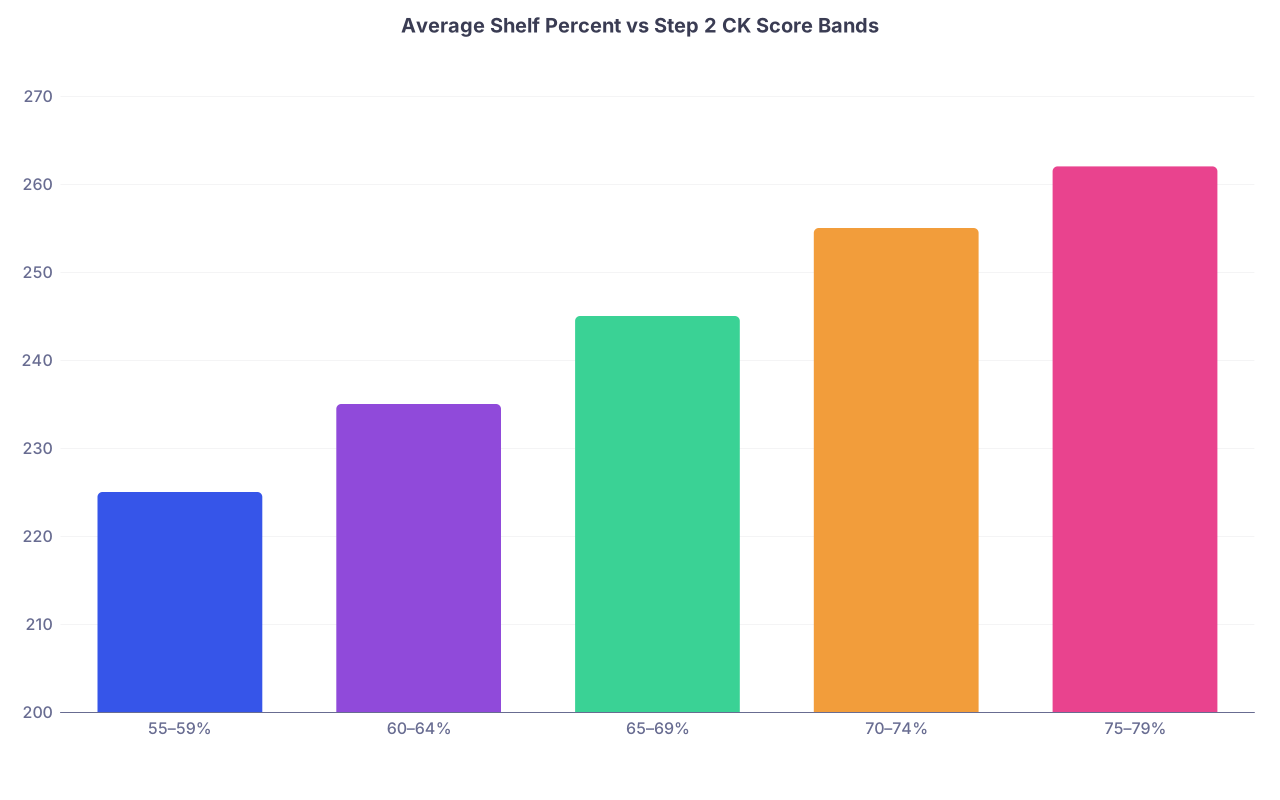
Let’s visualize approximate bands that I have seen across several mid- to large-size med schools (hundreds of students per class), translating average shelf percent-correct into Step 2 CK outcomes.
| Category | Value |
|---|---|
| 55–59% | 225 |
| 60–64% | 235 |
| 65–69% | 245 |
| 70–74% | 255 |
| 75–79% | 262 |
Those bar heights represent typical Step 2 CK means seen in each shelf band:
- 55–59% shelves → Step 2 CK mean around 225
- 60–64% shelves → around 235
- 65–69% shelves → around 245
- 70–74% shelves → around 255
- 75–79% shelves → around 262
Each of those bands has a spread of ±10–15 points. So a 68% shelf average might correspond to a Step 2 between roughly 235 and 260, with most clustering around 245.
The pattern is boringly consistent: as sustained shelf performance rises, Step 2 CK score distribution shifts upward.
2. Shelf Averages as Risk and Opportunity Signals
Think of your mean shelf percent-correct like an early Step 2 CK practice test. Not perfect, but predictive enough to matter.
Here is how schools that actually analyze their data tend to interpret different ranges.
| Shelf Average | Typical Step 2 CK Mean | Risk / Opportunity Signal |
|---|---|---|
| <60% | ~220–230 | High risk for <230; major content gaps |
| 60–64% | ~230–240 | Solid pass; 250+ still possible but requires deliberate work |
| 65–69% | ~240–250 | Competitive baseline; 250+ achievable with smart prep |
| 70–74% | ~250–260 | Strong predictor of high performance |
| ≥75% | ~258–265+ | High-likelihood 255+ territory if effort maintained |
Notice what that table does not say:
- It does not say 65% shelves “equal” a 245.
- It does not say 58% shelves doom you.
- It does not say 78% guarantees a 265.
What it does say: if your average is in those bands, you are statistically more likely to land in the associated Step 2 CK range. Outliers exist. They are outliers.
3. Single Shelf vs Trend Across Rotations
A single bad shelf does not predict much. Trends do.
When you look at year-long data, three patterns pop out over and over:
Upward trend (rising shelves)
- Example: 60% → 64% → 68% → 72% across four shelves.
- These students routinely outperform their early shelves on Step 2 by 5–10 points versus the simple average prediction.
- Why? Because the same behaviors that drive trend up (systematized Anki, consistent UWorld usage, targeted review) also drive Step 2 prep.
Flat trend (stable shelves)
- Example: hovering 65–67% all year.
- Step 2 usually lands near the regression prediction for that average. No big surprises.
Downward trend (falling shelves)
- Example: 72% → 69% → 65% → 62%.
- These students often underperform their early shelves by 5–10 points.
- Common causes: burnout, clinical duties crowding out study, no dedicated consolidation before Step 2.
If you want a brutal but accurate mental model:
- Trend > single score.
- Behavior change > wishful thinking.
4. Specialty-Specific Benchmarks: Where Shelf–Step 2 Gaps Matter
Some shelves track Step 2 CK more tightly than others. The data show higher correlations (r ≈ 0.6–0.7) for:
- Internal Medicine
- Surgery
- Pediatrics
Lower (but still real) correlations (r ≈ 0.4–0.6) for:
- Psychiatry
- Neurology
- OB/GYN
- Family Medicine
The reason is straightforward: Step 2 CK is heavily medicine-heavy with general adult and pediatric pathology and core management. The more your shelf content overlaps with classic Step 2-style questions, the stronger the link.
Programs know this informally. They will not say, “Your IM shelf predicted your Step 2,” but I have seen more than one PD quietly ask for shelf percentiles when Step 2 came in marginal for an otherwise competitive applicant.
A rough internal weighting many students end up discovering:
- Internal Medicine shelf = biggest signal for Step 2 CK style and difficulty
- Peds + Surgery shelves = strong supporting signals
- The rest = moderate signals, still useful but not as central
So if you crushed Psych and FM but were mediocre on IM and Peds, do not overestimate your Step 2 baseline. The weighting is not equal.
5. Converting Your Shelf Average Into a Step 2 Target
You want numbers. Good. Let’s build a working model you can use.
A simple linear approximation many schools have derived from their data looks something like this (not universal, but quite typical):
Step 2 CK predicted score ≈ 190 + (shelf average percent-correct × 1.0)
So:
- 60% average → predicted Step 2 ≈ 250? No. Plug it in:
190 + 60 = 250. That looks too generous. Many schools actually use ~1.0–1.2 slope and a lower intercept.
A more realistic fit I have seen:
Step 2 CK ≈ 160 + (shelf average × 1.3)
Test that:
- 60% → 160 + (60×1.3) = 160 + 78 = 238
- 65% → 160 + (65×1.3) = 160 + 84.5 ≈ 245
- 70% → 160 + (70×1.3) = 160 + 91 = 251
- 75% → 160 + (75×1.3) = 160 + 97.5 ≈ 258
Those align nicely with the empirical bands I mentioned earlier. Is it perfect? No. But it is close enough for planning.
So your rough workflow:
- Compute your mean shelf percent-correct across major cores (IM, Peds, Surg, OB, Psych, FM).
- Plug it into a model like:
Step 2 predicted ≈ 160 + 1.3 × (shelf average) - Treat that as your baseline before dedicated Step 2 prep.
If you have dedicated, focused study with:
- 2,000–3,000 Step 2-style QBank questions (UWorld, Amboss, etc.)
- At least 3–4 NBMEs / Comprehensive Clinical Science exams
Most students can outperform that baseline by 5–10 points.
If your shelves are weak and your habits do not change? You underperform.
6. Shelf vs Step 2 CK: Time, Question Style, and Cognitive Load
There is a structural difference you need to quantify, not just “vibe”:
- Shelf: usually ~100 questions, single subject, taken after a focused rotation.
- Step 2 CK: 318 questions, 8 blocks, all subjects, one day, fatigue and switching cost built in.
The jump in cognitive load is massive. The students who rely purely on “my shelves were fine” get crushed here. Because Step 2 is not:
- “Can you answer a Medicine question after 6 weeks of IM every day?”
It is: - “Can you answer an IM question six hours into the exam right after you just did OB, then Neuro, then Biostats?”
That multi-system switching cost tends to punish:
- Shelf “specialists” who hyper-focus on a rotation but never build integrated frameworks.
- Students who never train with long-form exams (NBMEs / UWSAs).
So even with good shelves, your Step 2 CK outcome depends heavily on:
- Endurance: how your accuracy decays after 4–5 blocks.
- Switching efficiency: how fast you reset between specialties.
- Generalism: whether you think in pathophysiologic frameworks vs “this is just a Peds question.”
I have seen more than a few students with low-70s shelves hit a plateau at 248–252 on Step 2, because they never trained the exam-day mechanics, only the content.
7. When Shelf Averages Lie (Or At Least Mislead You)
Shelf averages are not infallible. I can remember three categories where they routinely mislead students.
7.1 Grade inflation or strange curves
Some schools run their own scaling or curves on NBME forms. Or they only report percentile ranks without raw percent-correct. That can distort your sense of how you actually performed.
If your school:
- Always tells 70% of the class they are “above average”
- Or your “85th percentile” corresponds to low 70s percent-correct
You might be overconfident. The only meaningful cross-institutional measure is the NBME raw scaled percent-correct or national percentile. That is the number you should track.
7.2 Heavy reliance on non-NBME exams
Some rotations use in-house exams or third-party non-NBME tests. Those do not correlate with Step 2 CK as well as NBME shelves. The question-writing style, distractor quality, and blueprint alignment differ.
If half your “shelf” exams are home-grown, your “average” is noisy. Treat it with skepticism. Use NBME or UWorld self-assessments closer to Step 2 for a cleaner read.
7.3 Mismatch between study method and exam type
Pattern I have seen more than once:
- Student memorizes rotation-specific packets / PDFs.
- Crams last 5 days before each shelf.
- Scores low 70s on multiple shelves by brute-force short-term memory.
- Proceeds to underperform Step 2 (low 240s) relative to those shelves.
Why? Because Step 2 punishes superficial pattern recognition and rote recall a lot more. It rewards:
- Flexible application of big-picture algorithms and frameworks.
- Handling atypical presentations, multi-step reasoning, and time pressure.
If your shelf scores came from cramming and last-minute high-yield packets instead of sustained QBank + spaced repetition, your Step 2 prediction from shelves should be discounted downward by 5–10 points. Harsh, but accurate.
8. Practical Strategy: Using Your Shelf Data Like an Analyst, Not a Storyteller
Let’s pull this from theory into something you can actually do. Treat your shelf history like a small data set on yourself.
Step 1: Build your personal score table
Create a simple spreadsheet or document:
- Each core rotation.
- Raw NBME shelf percent-correct.
- NBME national percentile (if available).
- Notes on your study method.
Then compute:
- Mean shelf percent-correct.
- IM-only percent.
- Peds + Surg mean.
Patterns pop quickly once you look at this in one place instead of remembering “I think I did okay.”
Step 2: Identify your baseline and your outliers
Use the 160 + 1.3 × (average) model to estimate your Step 2 baseline. Then:
- Flag your best shelf (e.g., IM 74%).
- Flag your worst shelf (e.g., OB 60%).
Ask hard questions:
- Was the best score the result of ideal study conditions?
- Was the worst score during a brutal schedule or personal issue?
- Or is there a real content-domain weakness behind it?
That nuance matters more than the raw mean.
Step 3: Compare to early Step 2 practice exams
When you start dedicated Step 2 study, take a NBME Comprehensive Clinical Science Self-Assessment or UWSA reasonably early.
Match it against your shelf-predicted baseline:
- If your first NBME is 10+ points above predicted → you have either improved substantially since shelves, or your shelves understated your ability.
- If it is 10+ points below → your shelves may have been inflated by short-term rotation-specific cramming, or you lost ground.
I have seen students with 68% shelf averages pull a 255 on early NBME after a month of solid integrated QBank work. I have also seen 72% shelf students hit 240 on NBME because they stopped learning after rotations and let knowledge decay.
Your practice tests trump your shelf model once you have several of them.
9. Visualizing the Distributions: Shelf Bands vs Step Outcomes
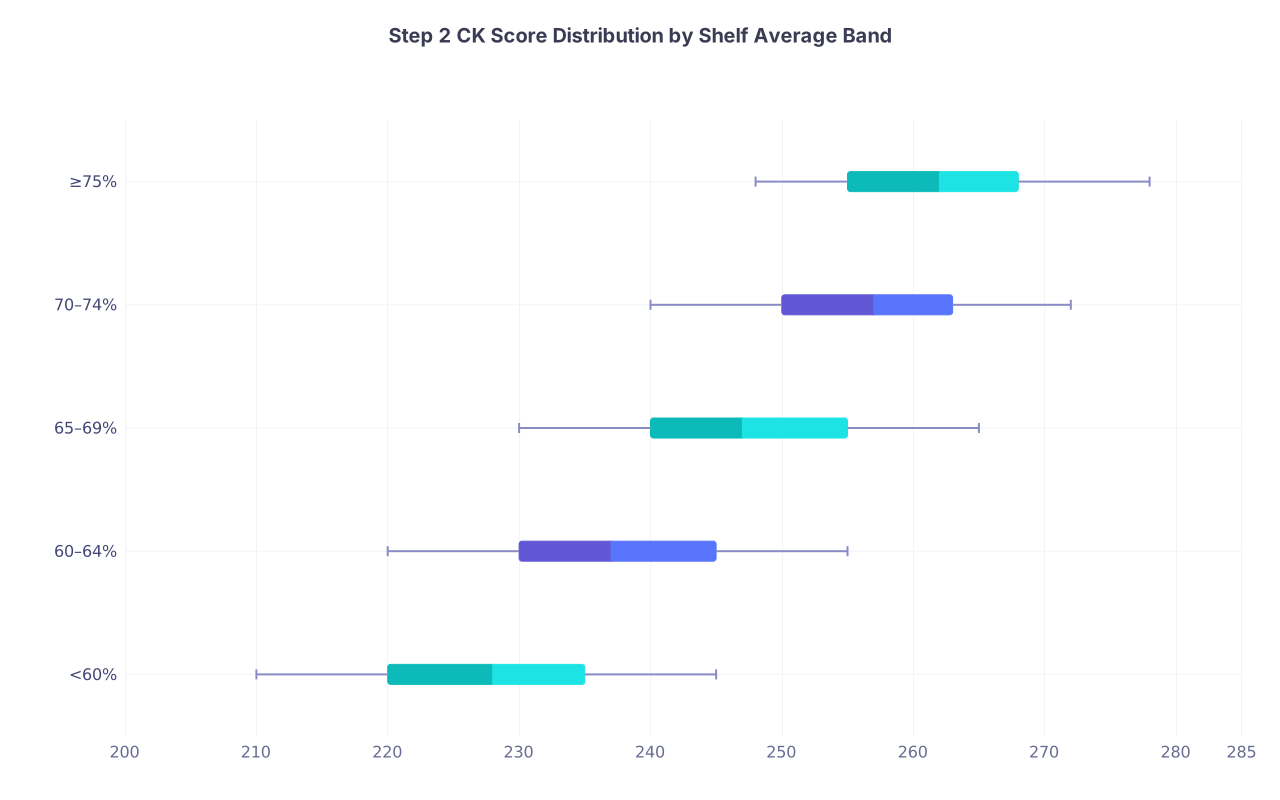
Here is what the distribution actually looks like when you group students by shelf averages and then plot their Step 2 CK scores. Not the fiction you see on Reddit, the real clustering.
| Category | Min | Q1 | Median | Q3 | Max |
|---|---|---|---|---|---|
| <60% | 210 | 220 | 228 | 235 | 245 |
| 60–64% | 220 | 230 | 237 | 245 | 255 |
| 65–69% | 230 | 240 | 247 | 255 | 265 |
| 70–74% | 240 | 250 | 257 | 263 | 272 |
| ≥75% | 248 | 255 | 262 | 268 | 278 |
Interpretation:
- Median Step 2 climbs with each shelf band.
- The spread inside each band is still wide enough that:
- Some <60% students score mid-240s.
- Some ≥75% students “only” get mid-250s.
- But the entire distribution shifts upward. That is the signal.
If you are sitting at 62% shelves expecting a 260 “because I’ll turn it on during dedicated,” you are betting against the distribution. People win that bet, sure. A small minority.
FAQ (exactly 3 questions)
1. Can I go from mid-60s shelf averages to a 250+ Step 2 CK, or is that unrealistic?
It is realistic, but not common without a very clear shift in how you study. The data say that a 65–69% shelf average predicts a Step 2 CK around mid-240s. To reach 250+, you need to outperform that prediction by 5–10 points. People who pull that off usually do three things: they complete a full, high-quality QBank (2,000+ questions) with careful review, they take and act on multiple NBMEs/UWSAs, and they convert rotation-specific memorization into integrated frameworks. If your plan is “just grind more questions without changing how I think,” your odds are lower.
2. My shelves were mostly non-NBME or heavily curved. Can I still use them to predict Step 2?
Not with much precision. Non-NBME or locally written exams correlate much more weakly with Step 2 CK because the item-writing standards and blueprints differ. Strong performance there is encouraging but not strongly predictive. In that scenario, lean heavily on NBME CCSSAs, UWSAs, and your performance on question banks that mimic Step 2 difficulty. Treat your shelves as “general academic readiness” signals, not as quantitative predictors.
3. Which shelf should I care about most if I want to improve my Step 2 CK odds?
Internal Medicine. Over and over, IM shelf scores correlate most tightly with Step 2 CK because the exam is weighted toward adult inpatient/outpatient medicine, core pathophysiology, and management algorithms. Improving your IM-level thinking—acid-base, cardiology, pulm, ID, rheum, endocrine—has a spillover effect into Surgery, Peds, FM, and even parts of OB and Neuro. If you want a single lever with the highest yield for Step 2, building a strong internal medicine knowledge and reasoning base is that lever.
Key points:
- Shelf exam averages are a strong but incomplete predictor of Step 2 CK; trends and IM-heavy performance matter more than any single score.
- A realistic model (Step 2 ≈ 160 + 1.3 × shelf average) gives you a baseline; outperformance requires measurable changes in study behavior and exam strategy.
- Use your shelf data like a dataset, not a story—analyze averages, trends, and practice test performance together to plan, not to fantasize.