
The myth that “a good Step 2 CK score is anything above 240” is lazy, misleading, and statistically wrong.
Where you stand depends entirely on two things: the national percentile distribution and the specialty you care about. A 240 in Family Medicine is not the same asset as a 240 in Dermatology. The data makes that painfully clear.
Let me walk you through it like an analyst, not a cheerleader.
1. Understanding Step 2 CK Percentiles: The Baseline
Step 2 CK is scaled with a mean around 245 and a standard deviation around 15 for first-time U.S. MD examinees. The exact numbers creep over time, but the pattern is stable enough for practical decisions.
Think in distributions, not scores. A single score is almost meaningless without its percentile context.
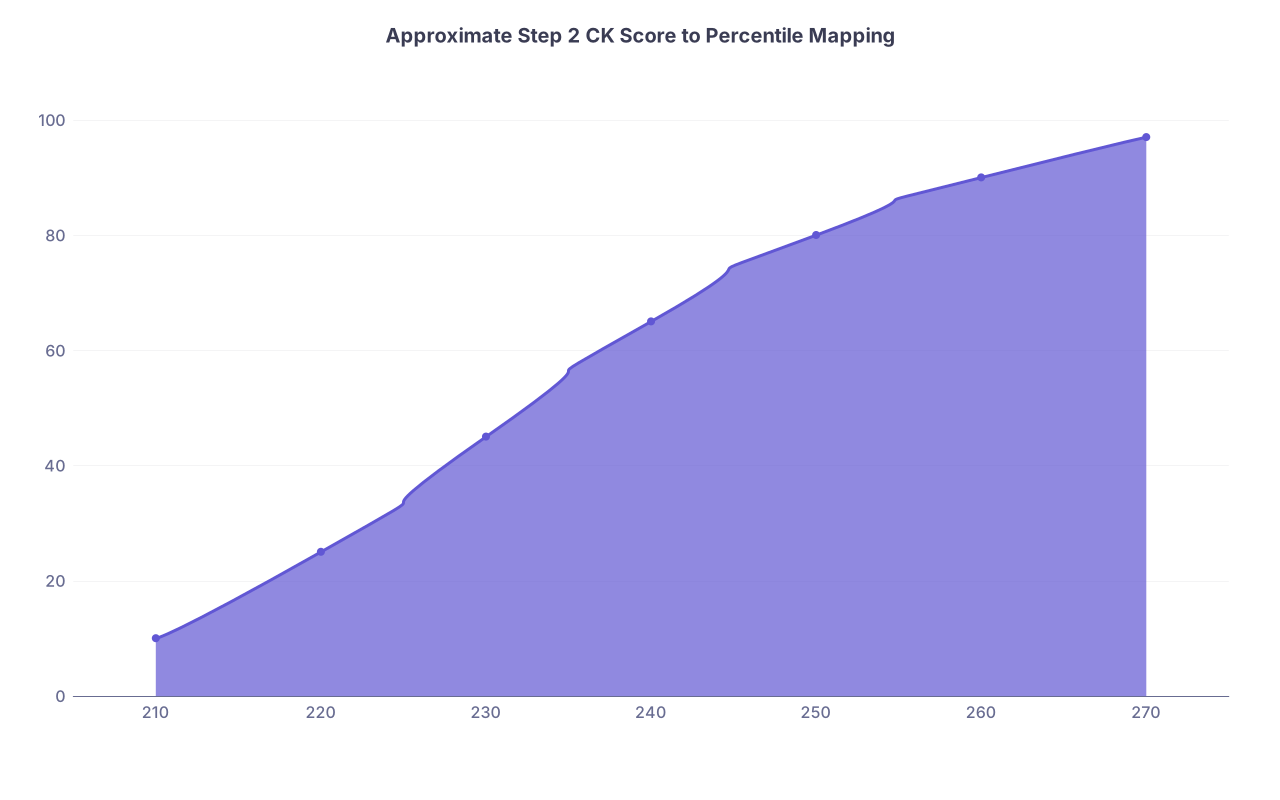
Approximate Step 2 CK percentile curve for recent cohorts:
| Category | Value |
|---|---|
| 210 | 10 |
| 220 | 25 |
| 230 | 45 |
| 240 | 65 |
| 250 | 80 |
| 260 | 90 |
| 270 | 97 |
You can read that as:
- 210 ≈ 10th percentile
- 220 ≈ 25th percentile
- 230 ≈ 45th percentile
- 240 ≈ 65th percentile
- 250 ≈ 80th percentile
- 260 ≈ 90th percentile
- 270 ≈ 97th+ percentile
These are rounded, but directionally right. So when someone says, “I got a 245, is that good?” what they are really asking is, “Am I above the median? Am I competitive in my specialty?”
Answer: 245 is slightly above mean, around the 70th-ish percentile. That is “good” in general. It is not “elite” in competitive specialties.
Now let’s layer specialties on top of this.
2. Big Picture: Step 2 CK by Specialty Competitiveness
Program directors do not read your score in a vacuum. They compare you to the pool applying to their specialty. That pool is not uniform.
Here is a simplified comparison of Step 2 CK score ranges that tend to be competitive for different specialty tiers, based on NRMP data, program director surveys, and real-world match outcomes I have seen:
| Specialty Tier | Example Specialties | Often Competitive Score Range |
|---|---|---|
| Ultra-competitive | Dermatology, Plastic Surgery, Neurosurgery | 255–270+ |
| Competitive | Orthopedic Surgery, ENT, Urology, Ophthalmology, Radiology, Anesthesia | 245–260+ |
| Mid-competitive | Internal Medicine, EM, OB/Gyn, General Surgery, Peds | 235–250+ |
| Less competitive | Family Med, Psych, PM&R, Neurology, Pathology | 225–240+ |
Read that table correctly:
- “Often competitive” is not a cutoff. It is the ballpark where successful applicants cluster.
- You can match below those ranges if you have strong research, AOA, home program, or niche advantages.
- You can still fail to match with scores in or above those ranges if other parts of the file are weak.
But mathematically, if you are below the average matched applicant in a competitive field, your odds drop. That is how distributions work.
3. Where You Stand: Score Bands vs Specialty
Let’s group Step 2 CK scores into bands and map them to realistic expectations. Not fantasies. The actual data picture.
Score band: 270+
You are in roughly the top 2–3% of test takers.
- Percentile: ≈ 97th–99th
- Signal: You are a statistical outlier. Programs notice.
For specialties:
Dermatology / Plastics / Neurosurgery / Ortho:
- Your score will never be your limiting factor.
- It gives you permission to be mediocre in other domains and still get looks.
- If you also have strong research and letters, you sit in the “top of the pile” bin.
Radiology / Anesthesia / Ophtho / ENT / Urology:
- You will exceed the mean for nearly all programs.
- You can aim broadly and include multiple top-tier academic centers.
IM / EM / OB/Gyn / Surgery / Peds:
- You are overshooting the typical requirement.
- Opens doors to fast-track fellowships / research-heavy academic tracks.
Primary care (FM, Psych, etc.):
- You are far above what is necessary.
- Programs may assume you are “using them as a backup.” I have heard PDs say this out loud.
Step 2 prep decision: If you are projected to reach this band based on NBMEs, the marginal benefit of grinding from a projected 267 to 273 is low. Focus on clerkships and letters.
Score band: 260–269
Strong, top 10% territory.
- Percentile: ≈ 90th–96th
- Signal: Elite performance; programs recognize this as “excellent.”
Specialty implications:
Ultra-competitive (Derm, Plastics, Neurosurg):
- You are at or above the Step 2 mean for these applicants.
- You will not be screened out for scores at almost any program.
- Now your fate hinges on research output, home program, away rotations, letters.
Competitive (Ortho, ENT, Urology, Ophtho, Rads, Anesthesia):
- You are clearly competitive scores-wise.
- Some hyper-elite programs will still prefer home students and heavy research portfolios.
Mid-competitive and below:
- Scores in this band can compensate for weaker parts of the application (lack of AOA, average school).
- For IM, this range is typical for people landing top academic places (Mayo, UCSF, BWH, MGH, Hopkins) when combined with solid research.
Step 2 prep: This range is where grinding question banks and timed mixed sets translates directly into meaningful signal. Going from 250 to 262 matters more than from 262 to 270 for most people.
Score band: 250–259
Above average to high, top 20%–25%.
- Percentile: ≈ 80th–90th
- Signal: Very solid, “strong applicant” territory.
Specialty outlook:
Ultra-competitive:
- You are slightly below the top cluster but still viable.
- Here the rest of the file must carry weight: high-tier school, serious publications, strong mentors, audition rotations.
- You will be competitive at many but not all programs. The very top ones will skew higher.
Competitive:
- Near or above mean for matched applicants in many Ortho, ENT, Urology, Ophtho, Rads, Anesthesia programs.
- Realistic to aim broadly, including several strong academic centers.
IM / EM / Surgery / OB/Gyn / Peds:
- Generally very competitive.
- Enough for almost any program if paired with good evaluations and letters.
Primary care:
- Strong but well above needed.
- Use it to target academic-focused FM or psych programs if that matters to you.
This is the band where a lot of “strong but not insane” applicants land. The data shows high match rates across most specialties with these scores, assuming no other red flags.
Score band: 240–249
Above mean but not elite.
- Percentile: ≈ 65th–80th
- Signal: Good, clearly above average.
Reality by specialty:
Ultra-competitive:
- Now you are swimming against the current.
- You will be below the mean for successful matches at many top Derm/Plastics/Neurosurg programs.
- You can match with this score, but you need serious non-test strengths: strong home program, outstanding letters, publications, connections.
- You cannot assume that a “good” score will float you in a field where many applicants have 255–265.
Competitive (Ortho, ENT, Urology, Ophtho, Rads, Anesthesia):
- Borderline to reasonable.
- You will match somewhere if the rest of your application is strong and your school/support network is solid.
- You may need to apply more broadly and include community or lower-tier academic programs.
IM / EM / OB/Gyn / Gen Surg / Peds:
- Very workable; strongly competitive for most programs.
- Gets you in the door for interviews at high-quality residencies.
Primary care:
- More than enough.
- Focus should shift almost entirely to fit, location, and career development, not just score flexing.
This is the band where you must be specialty-specific in your planning. A 242 in IM is comfortable. A 242 in Derm means your strategy needs to be flawless.
Score band: 230–239
Around the median to slightly above.
- Percentile: ≈ 45th–65th
- Signal: Solid, not spectacular.
Here the divergence by specialty is stark.
Ultra-competitive:
- You are significantly below the mean matched applicant.
- Matching is still possible but now firmly in “exception, not rule” territory.
- Expect to work harder on every other dimension: research, home rotation performance, networking, backup plans.
Competitive:
- Some programs will screen you out on raw score. Many will not.
- Realistically, your best chances are at less competitive, community, or mid-tier academic programs.
- You should absolutely have a backup specialty you would be genuinely okay with.
IM / EM / OB/Gyn / Gen Surg / Peds:
- You remain decently competitive, especially at mid-tier and community programs.
- Top programs may see you as slightly below their internal average but will still consider you if the rest of your file is strong.
Primary care, Psych, Neurology, PM&R, Path:
- Entirely adequate for most programs.
- Emphasis moves to clinical performance, personality, and fit.
If you are in this band and aiming at a highly competitive field, the data says you need a Plan B. Not because you cannot match, but because the probability distribution is skewed against you.
Score band: 220–229
Slightly below mean.
- Percentile: ≈ 25th–45th
- Signal: Acceptable but not a strength.
Specialty impact:
Ultra-competitive and most surgical subspecialties:
- Realistically, this is a severe handicap.
- Outliers match with this kind of score only with unusually strong support (legacy, extreme research, home program with a small, loyal residency).
- From a data standpoint, your probability of matching is low.
IM / EM / OB/Gyn / Gen Surg / Peds:
- You are below what many academic programs want but still viable for a broad range of community and some mid-tier academic sites.
- You will need strong clerkship grades and letters to offset the test metric.
FM / Psych / Neurology / PM&R / Path:
- This band remains compatible with matching successfully, including some academic programs.
- Psych is creeping more competitive in some regions, so context (geography, program saturation) matters.
I have watched students in this score band match very happily into IM, FM, Psych, and PM&R at good programs. They just picked battles wisely and did not chase fantasy targets.
Score band: <220
Below average.
- Percentile: ≈ <25th
- Signal: This will be interpreted as a weakness.
Not a career death sentence, but the data is not kind if you ignore reality.
Ultra-competitive & competitive surgical subspecialties:
- You are almost entirely an outlier if you match.
- At this point, sinking more time and ego into those fields is usually a bad expected value decision.
IM / EM / OB/Gyn / Gen Surg / Peds:
- Matching is still possible, more so in community programs and less saturated regions.
- You should expect more rejections and fewer interview invitations compared to classmates with higher scores.
FM / Psych / Neurology / PM&R / Path:
- These fields remain accessible, particularly FM and many psych/PM&R programs.
- A strong Step 2 recovery from a borderline Step 1 (if applicable) can still help your narrative, but not erase concerns.
At this level, the key move is not denial. It is recalibrating your specialty list and aggressively optimizing everything else: rotations, letters, personal statement, and networking.
4. Specialty-by-Specialty: Rough “Where You Stand” Matrix
Let us compress this into a quick reference. This is what most students actually want: “For my score and my target, where am I?”
| Step 2 Band | Ultra-Competitive (Derm/Plastics/Neurosurg) | Competitive Surgical (Ortho/ENT/Uro/Ophtho) | IM / EM / OB/Gyn / Gen Surg / Peds | FM / Psych / Neuro / PM&R / Path |
|---|---|---|---|---|
| 270+ | Excellent shot | Excellent shot | Overkill / top-tier eligible | Massive overshoot |
| 260–269 | Strong, highly competitive | Strong | Very competitive | More than enough |
| 250–259 | Viable with strong extras | Competitive at many | Competitive most places | Very strong |
| 240–249 | Borderline / selective | Borderline to reasonable | Competitive | Comfortable |
| 230–239 | Unfavorable odds | Risky, needs backup | Still viable, esp. mid/community | Usually fine |
| 220–229 | Very low odds | Very low odds | Limited but possible | Generally viable |
| <220 | Nearly impossible | Nearly impossible | Challenging, but possible | Still realistic, especially FM |
Is this table perfect? No. But it matches what program director surveys, NRMP data, and real-world match outcomes show year after year.
5. Strategy: Using Percentiles to Guide Your Decisions
Percentiles and score bands are not just vanity metrics. They tell you how to allocate effort.
A. Before Step 2 CK: Setting Score Targets
Use your specialty interest to set rational floor and stretch targets.
Example:
If you want Dermatology:
- Floor target: 245
- Realistic competitive target: 255+
- Dream: 260+
If you want Internal Medicine, aiming for academic programs:
- Floor: 235
- Competitive target: 245+
- Dream: 255+ (for top 10 programs, plus research)
If you want Family Medicine:
- Floor: 220
- Target: 230–240 (mainly to keep doors open geographically and academically)
Translate that into practice exam performance. Your NBME/CCSSA scores roughly correspond to real step performance with a ±5–7 point band. If all your practice tests are clustering at 230 and you want Ortho, the data is screaming at you that something has to change—either your prep strategy or your specialty plans.
B. After You Have a Score: Rational Specialty Planning
The worst move is to ignore the distribution and just “hope.” The second-worst is to prematurely abandon a specialty you actually love because of one data point.
Use this approach:

| Step | Description |
|---|---|
| Step 1 | Get Official Step 2 Score |
| Step 2 | Proceed with Primary Specialty Focus |
| Step 3 | Apply with Primary + Strong Backup |
| Step 4 | Shift to More Realistic Specialty Options |
| Step 5 | Boost Other Metrics: Research, Letters, Rotations |
| Step 6 | Score >= Competitive Target for Specialty? |
| Step 7 | Score within Borderline Range? |
If you are within a 5–10 point margin of where most successful applicants sit for your specialty, you are in the gray zone. That is the zone where non-numerical strengths and strategic planning really matter.
You do not need to abandon ship automatically. But you do need a backup.
C. Program List Construction by Percentile
Once you commit to a specialty, the number of interviews you secure will depend partly on where your score sits relative to that field.
Rough guidance for how to build your list:
If you are ≥90th percentile for your specialty:
- You can load more “reach” programs (top academics, desirable locations).
- Still include some mid-tier and safety programs because arrogance is not a strategy.
If you are ~60th–80th percentile for your specialty:
- Balanced mix: 1/3 reach, 1/3 mid, 1/3 safer programs.
If you are ~30th–50th percentile for your specialty:
- Heavier emphasis on mid-tier and safety.
- Use your home institution and any strong rotations to anchor your list.
Percentile here is not national percentile alone. It is “estimated percentile within that specialty’s applicant pool.” A 250 in Family Medicine is probably 90th+ within the FM applicant crowd. A 250 in Derm might only be around median to slightly above for that niche pool.
D. Step 2 CK vs Everything Else
One last dose of perspective. Program directors repeatedly rank Step 2 CK as a top screening metric. But once you are above a program’s internal screen, marginal increases matter less.
Think of it this way:
, Research & Activities](https://cdn.residencyadvisor.com/images/articles_svg/chart-relative-impact-of-step-2-ck-vs-other-factors-once-2649.svg "Relative Impact of Step 2 CK vs Other Factors Once Above Cutoff")
| Category | Value |
|---|---|
| Step 2 CK | 25 |
| Clerkship Grades & MSPE | 30 |
| [Letters & Reputation](https://residencyadvisor.com/resources/usmle-step2-prep/what-attending-letters-secretly-signal-about-your-step-2-readiness) | 25 |
| Research & Activities | 20 |
If your score gets you into the pile, the next 10–15 points do not rescue terrible clinical evaluations or weak letters. I have seen plenty of 260+ applicants get fewer interviews than expected because their narratives and letters signaled “difficult to work with” or “lukewarm performance.”
Use the data, but do not worship the number.
6. Final Thoughts: Where You Stand, Really
Three key points, stripped of fluff:
A “good” Step 2 CK score is specialty-dependent. A 240 is strong for many fields and underwhelming for Derm or Plastics. Think in percentiles within your target specialty, not national averages alone.
Score bands predict risk, not destiny. 250+ generally puts you in a strong position everywhere. 230–239 is fine for many core specialties but weak for ultra-competitive ones. Below 220, you need realistic specialty choices and a strong narrative to match well.
Once you clear program cutoffs, marginal score differences matter less than clinical performance, letters, and fit. Use your Step 2 CK percentile to set expectations and build a rational strategy, then move on and optimize the rest of your application.