
It’s mid-July. You just opened your Step 2 CK score.
You see the three bars: Systems, Physician Tasks, and the Overall band. No exact subscores, just those vague blue bars with a confidence range.
And you’re thinking: “Does any of this actually matter to program directors… or is it just NBME window dressing?”
Let me tell you what really happens.
Behind closed doors, PDs and selection committees don’t stare at your PDF dissecting every millimeter of those bands. But they absolutely use what those bands represent—signal vs noise, consistency vs spikiness, pattern vs fluke.
They are not statisticians. They are clinicians making quick pattern-based judgments. And your Step 2 band profile either reassures them… or makes them nervous.
I’ll walk you through how they actually think about it, what different band patterns imply, and how this plays out when your file is on a screen with 300 others.
First Reality Check: What PDs Actually Look At
Here’s the unfiltered version.
During first-pass screening, almost every PD or selection committee member is looking at three things:
- Step 2 CK numeric score
- Pass/fail history (any fails? retakes?)
- Timing (took it late? borderline score right before rank list?)
Those blue bands? That’s second-pass material. Nuance. And nuance only matters once you’re already in the “maybe” pile.
But that doesn’t mean the bands are irrelevant. They’re used in two key situations:
- When your final score doesn’t quite match your narrative (strong clerkship comments but mediocre score… or vice versa)
- When PDs want to predict whether you’re going to be a problem for in-training exams or boards
Most programs don’t have time to parse bands for everyone. But I’ve watched multiple PDs do this:
“Pull up their Step 2 report. Is this a lopsided score or are they solid across the board?”
That’s band analysis, in PD language.
How Programs Conceptually Use Score “Bands”
Let’s translate those NBME bars into the mental buckets PDs actually use.
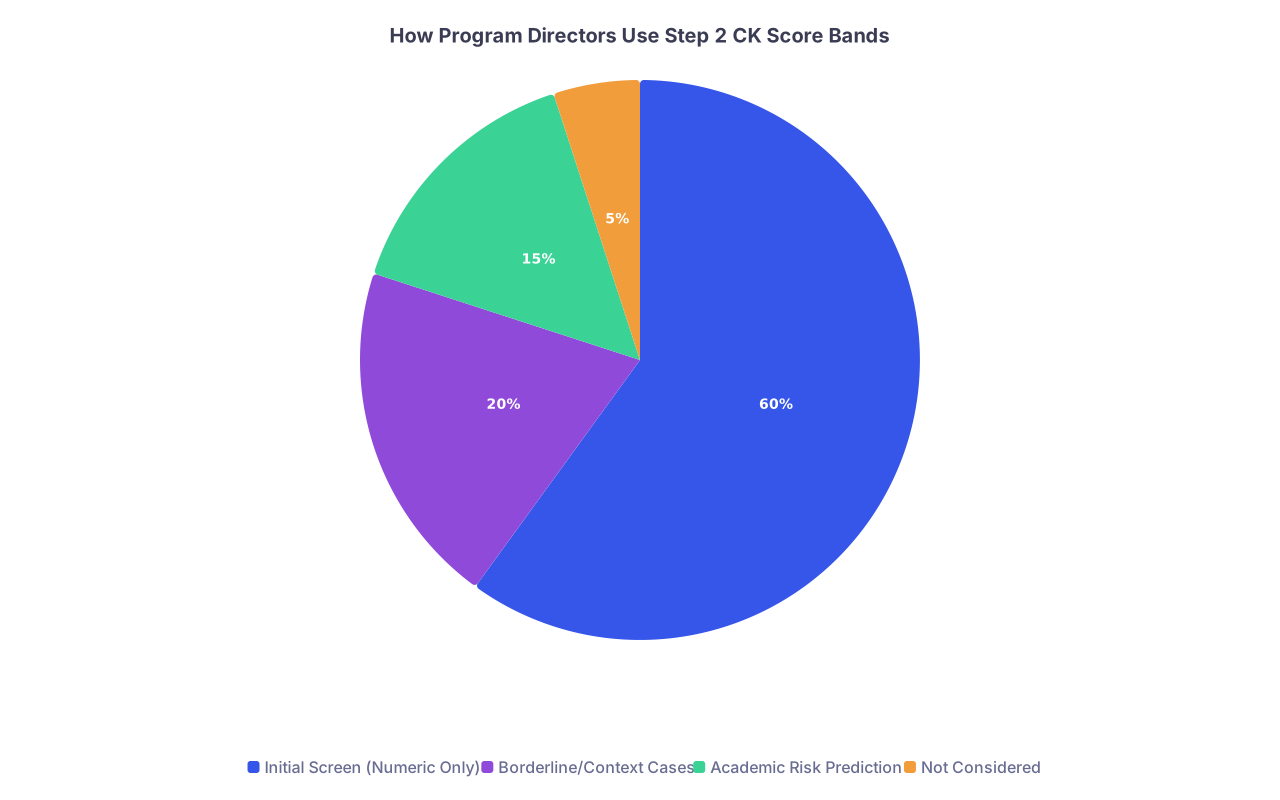
| Category | Value |
|---|---|
| Initial Screen (Numeric Only) | 60 |
| Borderline/Context Cases | 20 |
| Academic Risk Prediction | 15 |
| Not Considered | 5 |
You’re up against three main questions:
Are you safe?
Meaning: will you pass in-training exams and your specialty boards without giving the program a headache?Are you consistent?
Do your bands align with your clerkship grades, letters, transcript, and the story in your application?Are you hiding a weakness?
Did you compensate for a big hole in knowledge or reasoning with brute-force memorization or a lucky test day?
Step 2 bands are a crude but useful map of that.
PDs silently translate your report into one of a few archetypes. Let’s go through those.
Archetype 1: The “Clean” High Scorer
You: Step 2 CK ≥ 250
Bands: All solidly to the right, narrow ranges, nothing hanging on the border of “average”
This is the candidate PDs barely scrutinize. They take one look and think: “This person will not be our test-score problem.”
Here’s what they infer, even if they don’t say it out loud:
- You have broad, stable knowledge, not just memorized question banks
- You likely test well under pressure
- You’re very unlikely to fail the specialty boards on the first try
- They don’t need to waste meeting time debating your academic risk
If your Systems band and Physician Tasks band are both right-shifted, PDs see you as globally strong. No hidden weak organ system. No screaming “I can’t apply knowledge to clinical scenarios.”
Where it really matters:
If you’re aiming for a competitive specialty (derm, ortho, plastics, ENT, rads), a clean high-band Step 2 is essentially permission for them to move on and scrutinize your letters, research, and “fit.” Your test score is out of the way. That sounds minor. It’s not. You’ve removed a huge barrier.
Behind the scenes in some meetings, I’ve heard variations of:
“Step 2 255, all bands high. We’re not failing this person on in-training. Keep them in the pile.”
That’s the whole discussion. Then they move on.
Archetype 2: The Lopsided Scorer
This is where bands suddenly become interesting.
Case A: Strong Systems, Weak Physician Tasks
Profile:
Overall score decent (say 235–245). Systems band right of center. Physician tasks band more central or even dipping toward the average line.
Interpretation from PDs:
- You probably know content but may struggle with problem solving, multi-step reasoning, or test endurance
- Some PDs will worry about clinical judgment – especially for high-responsibility fields (EM, surgery, anesthesia, critical care–bound internal medicine)
- For more cognitive, less procedure-heavy fields (pathology, maybe psych), they might be less bothered
Example of the thought process:
“They’ve got the organ systems down, but if the physician task band is mediocre, our in-training exams—heavily case-based—might expose that.”
If you pair this with mediocre clerkship comments like “Needs to improve clinical reasoning” or “Sometimes misses the big picture,” you’ve just given the red flag two data points.
Case B: Weak Systems, Strong Physician Tasks
Opposite pattern: Systems band hovering at or just above average, Physician Tasks band clearly higher.
This profile is more reassuring than students think.
Many PDs read this as:
- You’re good at thinking through clinical scenarios, maybe better than your rote knowledge suggests
- You can compensate with reasoning and pattern recognition
- With some focused reading and repetition, you’re more likely to pass boards than your raw “knowledge” band suggests
I’ve seen PDs say something like:
“Okay, not a massive fund of knowledge, but they can process a case. I can work with that.”
If your letters emphasize “excellent clinical reasoning,” this asymmetry becomes a coherent story, not a risk.
Archetype 3: The Borderline Band with a “Lucky” Score
This one worries PDs more than you think.
Profile:
Score around the low 220s with wide bands that barely edge over the “pass” region, or a higher score (235–240) but with one band grazing that low-performance region.
Remember: bands include measurement error. PDs aren’t dissecting that deeply, but they do think in simple terms:
“Is this score stable, or could they easily have been 10 points lower on a different day?”
If your band is wide and just above average, PDs interpret:
- You’re at risk of underperforming on a bad test day
- Your knowledge may be spotty and fragile, not deeply integrated
- They worry about Marginal In-Training Exam Performance – and that matters because programs get judged (and sometimes penalized) for poor board pass rates
Some PDs have internal rules, even if they don’t write them down:
“If the Step 2 is below X and bands look borderline, you need something else compelling—like stellar letters—to get past the academic committee.”
This is exactly where bands come off the shelf and enter the conversation.
Archetype 4: The Discrepancy Candidate (Score vs Story)
Bands are most powerful when something about your file doesn’t match the narrative.
Scenario 1: Stellar Clerkships, Mediocre Step 2
You have honors in IM, surgery, peds. Glowing comments. Step 2 is 225–230.
Committee room conversation:
If bands are narrow and middle-of-the-road:
They might say, “Test ceiling. Good clinician, just not a standardized test killer. Probably okay.”If bands are wide and sagging toward low in one region: Now they start to ask, “Is this an outlier or is there a hidden deficiency? Did they get grade inflation or easy teams on clerkships?”
This is where I’ve seen PDs literally pull up the score report mid-meeting because something “doesn’t add up.”
Scenario 2: Average Clerkships, High Step 2 with Clean Bands
Opposite situation: Mostly passes or high passes, but Step 2 is 245+ with bands solidly right-shifted.
What they infer:
- You probably grew late, figured out how you study, or had weaker early clinical mentorship
- You might actually be under-graded or had tougher evaluators
- The test suggests an upper ceiling they aren’t seeing in your clerkship summary
This often works in your favor. I’ve seen PDs say:
“The paper record is lukewarm, but Step 2 and bands suggest this person will do fine on in-training. Let’s bring them in and see who they really are.”
High, consistent bands can rehabilitate a messy MS3 year more than anyone publicly admits.
Differences by Specialty: Who Cares About What
Not all PDs interpret bands the same way.

Here’s the unspoken breakdown:
| Specialty Type | Attention to Bands | Primary Concern |
|---|---|---|
| Competitive surgical | Moderate | Overall score & consistency |
| Competitive non-surgical | High | Long-term board pass safety |
| Core fields (IM, Peds) | Moderate | Risk of failure, red flags |
| Lifestyle specialties | Low–Moderate | Gross outliers only |
| Path/Psych/FM | Variable | Pattern + narrative fit |
Competitive Surgical Specialties (Ortho, ENT, Plastics, Neurosurg)
They care first about the number. If it clears their internal cutoff (and trust me, they have one), they might glance at bands to confirm you’re not bizarrely weak in clinical reasoning.
But they’re not dissecting subcategories. They’re thinking:
“If the score is 250 with nothing obviously low, great. Move on.”
An oddly low Physician Tasks band might make them pause more than a systems band, because they’re imagining you handling intra-op decision making, not trivia.
Internal Medicine, Pediatrics, Neurology
These fields talk about “board pass rates” a lot in meetings.
This is where bands get weaponized in discussion about borderline applicants.
A PD will say:
“We’ve had trouble with ABIM pass rates the last few years. This Step 2 is 222 with borderline bands. Do we really want to take that risk unless the rest of the file is incredible?”
They’re not doing math. They’re doing pattern-based risk avoidance. Your bands are part of that pattern.
Psych, Family Med, Pathology
These programs are more likely to use bands as confirmation rather than as a gate.
- Strong bands can counterbalance weaker grades or a light research background
- Weak bands might be set aside if your letters and rotation performance clearly show growth, maturity, and teachability
Psych in particular watches for major clinical reasoning red flags; a very weak Physician Tasks band in someone going into psych will spark conversation.
How Timing Interacts with Bands
Step 2 timing is underappreciated.
If you take Step 2 late (after ERAS release, close to rank list deadlines), committees get twitchy. When a late score finally arrives, they look harder at everything—including bands—because now you’ve compressed their risk assessment window.
Here’s how the thought process goes:
- Late + borderline number + borderline bands = “Possible academic liability. Only rank if we’re desperate or if there’s something exceptional elsewhere.”
- Late + solid number + clean bands = “Fine. They were just scheduling around rotations. No worries.”
You don’t want your academic risk conversation happening in January. You want it over in October.
If you already have a low-ish Step 1 (or a fail) and your Step 2 is delayed, PDs will absolutely pull your report and read into the bands to see if you actually recovered or just scraped by.
Red Flag Patterns That Get Talked About
Let me spell out the specific band patterns that actually get mentioned out loud in meetings.
One band clearly below average while others are okay
Example: Systems okay, Tasks clearly low.
Interpretation: “Is their clinical reasoning going to struggle when cases get complex?”All bands hugging the average line with a wide range
Interpretation: “They passed, but this is a fragile pass. Are we okay betting our board stats on this?”Decent final score with one unexpectedly weak domain
Interpretation: “This looks like cramming or gaming the test without robust underlying understanding.”Band pattern inconsistent with letters
Example: Letters say “fantastic clinical reasoning,” but Physician Tasks band is weak.
Interpretation: “Are these letters inflated or from someone who writes the same thing for everyone?”
Whenever there’s a discrepancy, your bands become a credibility check. On your narrative. On your school. Sometimes, on your letter writers.
How You Can Use This While Still in Med School
You cannot change your bands once the score drops. But you can predict, shape, and contextualize them.
Here’s how you actually use this information:
1. During Prep: Aim for Balance, Not Just a Single Number
If all you’re doing is hammering question banks without ever reviewing why you miss things across systems or task types, you’re setting yourself up for lopsided bands.
Simple but underused moves:
- Track your weaknesses by system (cardio, renal, neuro) and by task (diagnosis vs management vs ethics vs communication) and deliberately fix the worst 2–3
- Treat “I keep missing management steps” as a red flag, not just a random miss
You’re trying to avoid being the “good knowledge, poor clinical reasoning” candidate. That pattern absolutely shows up in the bands.
2. If You Already Have the Score: Shape the Story
If your band profile isn’t pretty, you don’t broadcast it. But you can make sure your application doesn’t contradict it.
Weak Physician Tasks band?
Then your personal statement and letters better not be full of “exceptional clinical reasoning” without evidence. That invites skepticism. Instead, emphasize work ethic, growth, humility, teachability—qualities that reassure them you’ll improve.Weak Systems band, good Physician Tasks band?
Ask letter writers to highlight your ability to integrate information and work through complex cases. That tells PDs you’re likely to keep improving academically with time and structure.
You’re aligning the narrative with the numbers, so there’s no jarring mismatch for committees to argue about.
3. Choosing Where to Apply and How Broadly
If your bands suggest academic fragility—even if you passed—don’t apply as if you’re an unambiguous 250.
Use your bands as a sober assessment tool:
- Are you at real risk of struggling with in-training exams?
Then you target programs where teaching and structure are stronger, not the sink-or-swim places that brag about how “independent” their residents are on day one.
Drag yourself out of denial early. Your future self will thank you.
A Quick Visual: Score vs Band “Risk”
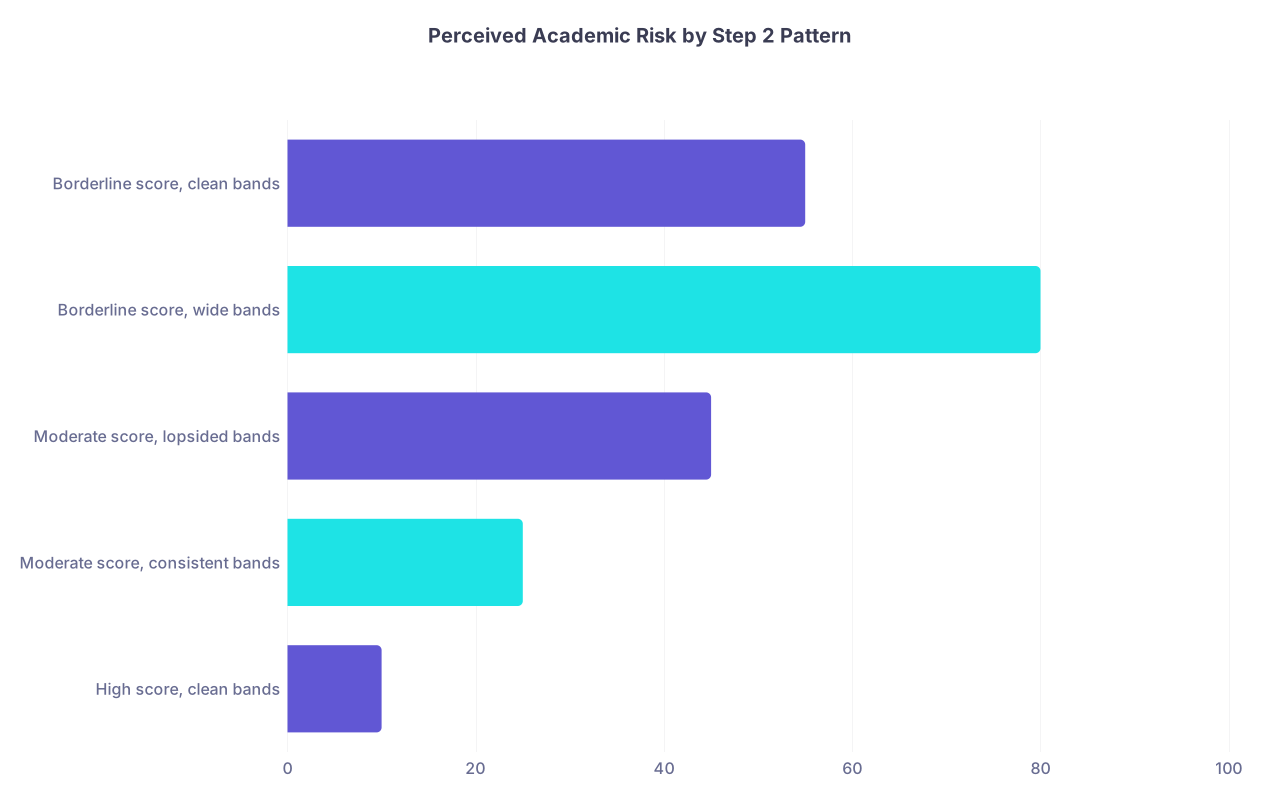
| Category | Value |
|---|---|
| High score, clean bands | 10 |
| Moderate score, consistent bands | 25 |
| Moderate score, lopsided bands | 45 |
| Borderline score, wide bands | 80 |
| Borderline score, clean bands | 55 |
The numbers are illustrative, but this is how the conversation feels in a committee room. Your absolute score is not the whole story. Stability and pattern matter.
The Bottom Line
Program directors don’t have a secret Step 2 CK decoding manual. They don’t calculate z-scores on your bands. They eyeball patterns and make fast, clinically flavored judgments:
- Stable vs fragile
- Broad vs lopsided
- Credible vs inconsistent with the rest of your file
Your numeric score gets you through the door or keeps you out. Your bands help decide whether they’re nervous about you after you’re already in the maybe pile.
Years from now, you won’t remember the width of your Systems band. You’ll remember whether you were honest with yourself about your weaknesses—and whether you used that knowledge to choose the kind of training environment where you’d actually thrive, not just barely survive.