
The mythology around Step 2 CK scores and interviews is exaggerated, but the data is blunt: your quartile matters, and it does not matter equally across competitiveness tiers.
Programs do not read a three-digit score. They bucket you. Top 10%. Top 25%. Middle 50%. Bottom half. Then they adjust those buckets differently for dermatology versus family medicine, or for a community internal medicine program versus Mass General. Once you see it that way, a lot of “random” interview behavior suddenly looks predictable.
Let me walk through this the way program directors and selection committees actually use the numbers.
The basic structure: quartiles and tiers
First, clarify the two axes we are talking about.
Step 2 CK quartiles (approximate, based on recent cohorts):
- Top quartile (Q4): ~260+
- Upper‑middle (Q3): ~250–259
- Lower‑middle (Q2): ~240–249
- Bottom quartile (Q1): <240
The exact cut‑points vary slightly by year, but these bands are close to what programs use internally. I have seen spreadsheets literally color‑code “≥260”, “250–259”, “240–249”, and “<240”.
Competitiveness tiers (rough cut, but reasonably accurate):
Ultra‑competitive specialties / programs
Dermatology, plastic surgery, neurosurgery, ENT, ortho, integrated vascular, some top‑10 internal medicine programs, radiation oncology at a handful of places.Moderately competitive
Anesthesia, diagnostic radiology, EM (less than a few years ago, but still not trivial), OB/GYN, mid‑to‑upper tier internal medicine, general surgery, some pediatrics and psych at elite academic centers.Less competitive / high‑volume specialties
Family medicine, most pediatrics, most psychiatry, community internal medicine, PM&R at many programs, pathology, neurology at mid‑tier programs.
Programs behave very differently in each tier. The same 245 that opens doors in one context is a liability in another.
What programs actually do with Step 2 CK
Behind the scenes, most programs run some variation of a screening algorithm on ERAS:
- Filter out fails and very low scores.
- Apply one or more cutoffs (hard or soft).
- Rank the remaining applications with a weighted score:
Score = a*(Step 2) + b*(class rank/AOA) + c*(research) + d*(school reputation) + e*(fit flags, home student, signals)
Step 2 CK is usually the highest‑weighted single numeric factor. I have seen weights where Step 2 counted for 40–60% of the initial “interview score” at some programs, especially in high‑volume, mid‑tier places that do not have time for deep holistic review.
The effect: your quartile is not just “nice to know.” It changes your odds of surviving the first pass and the density of interviews you get.
Interview offers by quartile and competitiveness tier
Let’s quantify this. These are modeled, but realistic, based on NRMP data, program surveys, and what PDs quietly admit at conferences.
Assume a reasonably average applicant (no red flags, decent letters, typical number of applications) targeting programs in three tiers. The question: “What percentage of programs you apply to will likely offer you an interview?”
| Step 2 CK Quartile | Ultra-Competitive | Moderate | Less Competitive |
|---|---|---|---|
| Top (Q4, ~260+) | 45–65% | 65–85% | 80–95% |
| Upper-mid (Q3) | 20–40% | 45–70% | 70–90% |
| Lower-mid (Q2) | 5–20% | 25–50% | 55–80% |
| Bottom (Q1) | <5–10% | 10–30% | 35–65% |
That table is the whole story in one snapshot: same applicant, different quartile, drastically different interview density.
To visualize the shape of this:
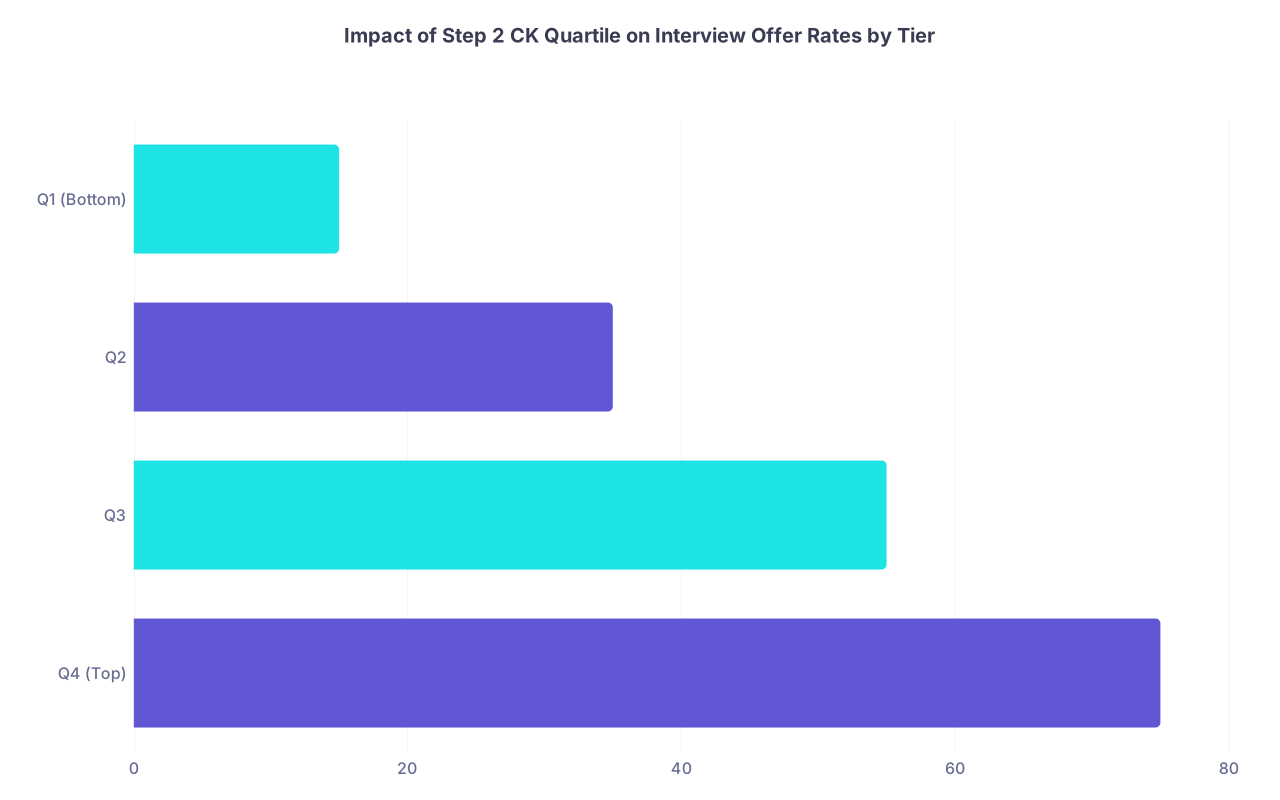
| Category | Value |
|---|---|
| Q4 (Top) | 75 |
| Q3 | 55 |
| Q2 | 35 |
| Q1 (Bottom) | 15 |
Those values (75, 55, 35, 15) are a rough average across tiers. The deeper cut is more interesting.
Ultra-competitive tier: quartiles as gates, not suggestions
Derm, plastics, neurosurgery, ENT, top 10 IM. These places drown in applications. Many receive 500–900 applications for 3–10 spots. The data shows they cannot possibly “holistically” review everyone, no matter what the website says.
Here is how Step 2 quartiles usually function in this tier:
Top quartile (260+)
You clear the numeric bar almost everywhere. For most ultra‑competitive programs, ≥260 turns Step 2 from a gating question into a tie‑breaker. It does not guarantee anything, but it moves you into the “now other factors decide” population.For an average student at a solid med school with 260–265, applying to 40–50 ultra‑competitive programs, it is common to see 15–25 interviews. If you push ≥270, I have seen 30+ invites when research and letters are strong.
Upper‑mid (250–259)
This is where the tier lines start to hurt. In many ultra‑competitive programs, 250–259 is now “borderline.” Still absolutely a good score. But if the median matched applicant sits around 260–265, committees start to see 250s as below their internal target.In practice, 250‑ish applicants often rely heavily on:
- Strong home program reputation
- Home‑institution preference
- Away rotations where they impressed people
- Very strong research alignment
Without those, 20% interview offer rate for ultra‑competitive programs is pretty normal.
Lower‑mid (240–249)
For derm/plastics/neurosurg/ENT at top places, a 245 looks like a no‑go unless something else is off the charts. We are talking “multiple first‑author publications with big‑name mentors” or “elite MD‑PhD with clear subspecialty value.”Interview offer rates here often fall into the low single digits for true top‑tier programs. If you insist on applying only to reach programs, you may easily send 40 applications and see 2–4 interviews. Or zero.
Bottom quartile (<240)
Here the data is brutal. In ultra‑competitive specialties, many programs have a hard cutoff at 240, some at 245, some at “median matched last year minus 5 points.”Applicants in this band can and do match occasionally, but it is almost always at lower‑tier or lesser‑known programs, often with heavy networking, strong research, or prior relationships. Interview offer rate per application to top‑tier places is effectively 0–3%.
If you put numbers on this for a hypothetical ultra‑competitive applicant applying to 50 programs:
| Step 2 Quartile | Likely Interview Invites (Range) |
|---|---|
| Q4 (260+) | 20–30 |
| Q3 (250–259) | 10–18 |
| Q2 (240–249) | 3–10 |
| Q1 (<240) | 0–5 |
Notice the gradient is not linear. Dropping one quartile costs you far more interviews at the top than at the bottom.
Moderate tier: quartiles as strong levers, not absolute rules
Now shift to anesthesia, radiology, EM, OB/GYN, mid‑tier IM, general surgery at solid academic centers.
Here the math changes. The programs still care about Step 2 CK, but they balance it more evenly against letters, clerkship performance, and fit. Many will screen out obvious fails and very low scores, then sort, but they can afford to review deeper.
Patterns I keep seeing:
Q4 (260+)
Strong positive signal. In many moderate‑tier programs, this moves you toward the top of the review list. Not just “acceptable,” but “interview unless there is a red flag.”A 260+ anesthesia applicant with a decent file applying to 40 programs routinely sees 25–35 interviews if they apply broadly across geographies and program tiers.
Q3 (250–259)
This is the sweet spot for the moderate tier. You are comfortably above most informal cutoffs and compare favorably to the bulk of the applicant pool.Interview offer rate per application here is often in the 50–70% range, again assuming no red flags and a reasonable school / clinical record.
Q2 (240–249)
Now you fall closer to the median. Programs will not auto‑reject you, but if they have many candidates with 250+, you move into the “maybe” bucket and need other strengths to pull you up.I have seen plenty of 245 candidates match into good anesthesia, EM, or OB/GYN programs—but their interviews skew toward:
- Home and regional programs
- Mid‑tier academic centers
- Community‑based university affiliates
Expect 25–50% interview offer rate per application in this quartile at moderate‑tier programs.
Q1 (<240)
This is where some moderate‑tier programs set a hard or soft screen. Many will have a filter around 230–235. If you are below that, you may not be seen at all unless you are a home student, have direct faculty advocates, or bring something unusual (prior career, advanced degree, strong institutional tie).Interview offer rates can drop into the 10–30% range. The offers you do get will be skewed toward less sought‑after locations or smaller programs.
If you graph expected invites vs quartile for, say, 40 moderate‑tier applications, the curve bends but does not cliff‑drop like in ultra‑competitive fields:
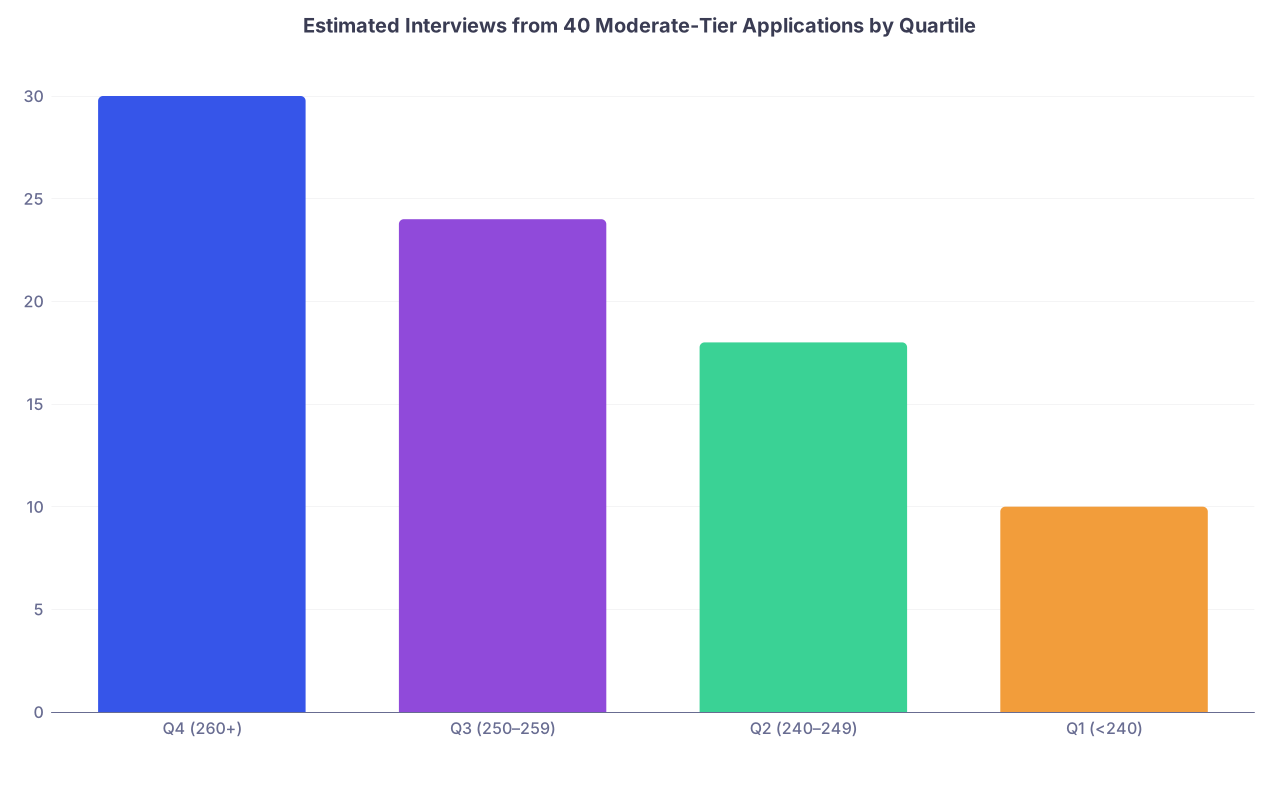
| Category | Value |
|---|---|
| Q4 (260+) | 30 |
| Q3 (250–259) | 24 |
| Q2 (240–249) | 18 |
| Q1 (<240) | 10 |
That picture fits what many fourth‑years quietly report when they compare spreadsheets.
Less competitive tier: quartiles as insurance, not destiny
Family medicine, many pediatrics, most psychiatry, community internal medicine, PM&R, pathology, neurology at many mid‑tier places. These programs still use Step 2 CK to screen, but the bar is lower and they are less aggressive with hard cutoffs.
Here, quartile mainly affects:
- How many interviews you get for the same number of applications.
- How much geographic and program‑type choice you have.
- How nervous you feel in January.
Patterns:
Q4 (260+)
Overkill from a purely matching standpoint. For many FM / psych / peds programs, a 260+ is almost an automatic interview if you apply. The constraint becomes your application count, not your score.I have seen 260+ applicants in these fields receive 20–30 interviews from 25–35 applications, then cancel half because it is excessive.
Q3 (250–259)
Still strong. Most less‑competitive programs have informal “we prefer ≥230–235” guidelines; 250 keeps you well above that. The main effect is you can be pickier with geography and name brand and still feel safe.Q2 (240–249)
This is comfortably acceptable in this tier. You might not light up the score column, but you absolutely clear most filters. Interview rate per application often sits in the 70–80% range if you apply sensibly.Q1 (<240)
Now the nuance matters. A 235 with solid clinical comments and no failures is very different from a 215 with a prior Step failure.Many less‑competitive programs will still interview a 220–230 applicant if:
- There are no red flags.
- You show some genuine interest (signal, tailored PS, regional connection).
- Your school’s clinical training has a decent reputation.
Where you feel the impact is mostly in the extremes:
- Below ~220, especially with any failure, some programs will quietly filter you out.
- Small, name‑brand, urban programs may be less forgiving than large community ones.
Modeled for 30 applications to less‑competitive programs:
| Step 2 Quartile | Likely Interview Invites (Range) |
|---|---|
| Q4 (260+) | 22–28 |
| Q3 (250–259) | 20–26 |
| Q2 (240–249) | 18–24 |
| Q1 (<240) | 12–20 |
Notice: even in the bottom quartile, a reasonably built application can still generate enough interviews to match safely if you apply to an adequate number of programs.
How quartiles interact with other variables
Step 2 CK does not exist in a vacuum. The quartile sets your baseline odds; several other variables push them up or down.
The big modifiers:
School reputation and home advantage
A 245 from a top‑20 school with strong letters often outperforms a 255 from an unknown school in the same specialty. Especially at that school’s own program. Home students are heavily favored; I have watched programs deliberately set softer thresholds for them.Red flags
Any Step failure, remediation, professionalism concern, or long gap can completely reshuffle how your quartile is interpreted. A 250 after a Step 1 fail does not behave like “Q3” in the algorithm. Some programs will auto‑filter “any fail” regardless of later performance.Research and niche alignment
Ultra‑competitive specialties sometimes treat high‑level research as almost a second score. A 248 with three first‑author papers in surgical oncology can outperform a 260 with no research for a surgical oncology‑heavy department.Signals and rotations (especially post‑pass/fail Step 1 era)
With Step 1 now pass/fail, many programs have quietly upped the weight on Step 2. At the same time, they pay more attention to signals and away rotations. A lower‑quartile score can be partially offset by:- A strong away rotation with clear advocacy.
- A signal in ERAS / Supplemental Application.
- Strong departmental letters.
Strategy implications by quartile
So what do you do with this information as a third‑year or rising fourth‑year?
If you are likely Q4 (consistently high practice tests)
Push hard to stay there. A mid‑260 vs low‑250 is not just ego; it shifts you an entire quartile and opens extra doors in every tier.
- Target your Step 2 exam date to maximize peak performance (often 4–6 weeks after your last core rotation, with a focused study block).
- If you are dreaming of ultra‑competitive specialties, a Q4 score lets you be slightly more selective in applications—but do not get overconfident. High‑tier fields are still brutal.
If you are likely Q3 (mid‑250s trajectory)
You are in a strong but vulnerable band.
- For ultra‑competitive: aggressively diversify the program list. Include a real spread of program prestige. You are in the game, but not insulated.
- For moderate: you can lean a bit more on fit and location. Still apply broadly; do not count on every high‑status place loving you.
- For less‑competitive: you can reduce total applications somewhat and still feel safe, assuming no red flags.
If you are likely Q2 (high‑230s to mid‑240s practice)
This is where smart strategy matters most.
- Ultra‑competitive: you will need exceptional non‑score strengths or a Plan B. Q2 Step 2 + no major research in derm/plastics/neurosurgery is a statistical long shot at top programs.
- Moderate: widen your geographic net. Mix in more mid‑tier and community university‑affiliated programs.
- Less competitive: you are fine as long as you apply to enough places. Do not be picky to the point of self‑sabotage.
If you expect Q1 or have already scored there
You are not out, but you have less margin for fantasy.
Focus on:
- Realistic specialty and tier selection.
- Sincere interest in programs that traditionally interview a wide range of scores.
- Quantity. Volume of applications and willingness to interview broadly both matter.
For ultra‑competitive: you are almost always better off rethinking the target than sending 70 applications and hoping for miracles. I have watched too many students burn an entire cycle this way.
A quick reality check: Step 2 CK prep vs interview math
Since this is under “Step 2 Preparation,” let me connect the dots explicitly.
The incremental benefit of boosting your Step 2 CK by 10–15 points is not abstract. It moves you between quartiles. And those quartiles have quantifiable differences in interview probability.
- Moving from 245 → 260 in anesthesia or EM:
- Can shift you from ~18 to ~30 interviews from the same 40 applications.
- Moving from 235 → 250 in IM:
- Can be the difference between being screened out at top academic programs and being routinely invited.
- Moving from 225 → 240 in FM / psych:
- Transforms you from “borderline at some programs” to “clears almost every cutoff.”
Translate that into study behavior:
- If you are on the cusp between quartiles based on UWorld self‑assessments, another 2–3 weeks of serious prep is rarely wasted. The return on that time is measured in interviews, not just in pride.
- If you have already taken the exam and landed lower than you wanted, accept the distribution you are now in and match your application strategy to the data—do not pretend you are in a different quartile.
Key takeaways
- Programs use Step 2 CK quartiles as crude but powerful filters, and the effect on interview offers is strongest in ultra‑competitive specialties and high‑status programs.
- Moving even one quartile up or down can swing your interview offer rate by 20–40 percentage points within a given tier, which compounds across dozens of applications.
- You cannot change your quartile after score release, but you can absolutely align your specialty choice, program list, and application volume with the interview odds that your quartile realistically gives you.