
Most students waste their shelf exam feedback. Then wonder why Step 2 CK feels like a blind ambush.
You are sitting on a goldmine of personalized data, and if you are not ruthlessly mining it, you are studying half-blind.
Let me show you how to turn that mess of score reports, vague comments, and rotation memories into a precise, targeted Step 2 CK plan that actually fixes your weaknesses instead of soothing your anxiety.
Step 1: Collect and Standardize All Your Shelf Data
You cannot fix what you have not measured. “I’m bad at surgery” is not a plan. “I consistently miss questions on post-op complications and trauma resuscitation” is.
Start by pulling every piece of objective data you have:
- NBME shelf score reports (raw percent correct or scaled)
- Clerkship grading breakdowns (shelf weight vs clinical)
- Any “content area performance” charts from NBME / school portals
- Question bank stats from:
- UWorld Step 2 CK
- AMBOSS
- OnlineMedEd QBank
- Rosh (for EM), TrueLearn, etc.
- Any written faculty feedback that mentions knowledge gaps
Now put it in one place.
Create a simple spreadsheet or table with:
- Rotation
- Date of shelf
- School grade (Pass / High Pass / Honors)
- NBME percentile or scaled score
- Relative strengths and weaknesses by content area
Example structure:
| Rotation | Date | Shelf Percentile | Grade | Weak Topics (Top 3) | Strong Topics (Top 2) |
|---|---|---|---|---|---|
| IM | 08/2024 | 45th | Pass | Renal, Rheum, Endocrine | Cardiology, Pulm |
| Surgery | 10/2024 | 30th | Pass | Trauma, Post-op Complications | Pre-op Eval, Hernias |
| Psych | 12/2024 | 80th | Honors | Substance, Emergency Psych | Mood, Psychosis |
You do not need perfection. You need patterns.
If your school gives you bar graphs (e.g., “cardiology: lower performance; GI: average”), take 5 minutes per clerkship and convert those into three bullet “weak areas” and two “strong areas.”
Step 2: Translate Rotation Feedback into Step 2 CK Domains
Step 2 CK is not “the IM shelf plus the surgery shelf plus everything else.” It is cross-specialty clinical problem solving, and the exam is organized by systems and task types.
So your next move is to convert rotation-specific feedback into Step 2–relevant categories.
Use this lens:
- System-based: Cardio, Pulm, GI, Renal, Endo, Rheum, Neuro, Heme/Onc, ID, OB, Gyn, Peds, Psych, MSK, Derm.
- Task-based (what the question is actually testing):
- Diagnosis
- Initial management
- Next best step
- Interpretation of tests/labs/imaging
- Prevention / screening / counseling
- Ethics / patient safety / systems-based practice
Make a second table where you move from “rotation → system and task.”
Example:
Surgery shelf weakness: “post-op complications” →
- Systems: Cardio (MI, PE), Pulm (atelectasis, pneumonia), GI (ileus, SBO), Heme (DVT/PE)
- Tasks: Diagnosis + acute management
IM shelf weakness: “renal” →
- System: Renal
- Tasks: Diagnosis (AKI types, GN vs ATN), management (fluids, dialysis thresholds), interpretation (FENa, UA)
You want something like this:
| System | Task Type | Evidence of Weakness |
|---|---|---|
| Renal | Diagnosis | IM shelf renal questions below average |
| Renal | Management | Missed AKI/CKD management on UWorld |
| Trauma | Acute Management | Surgery shelf trauma block lowest domain |
| OB | Diagnosis/Plan | OB shelf: preeclampsia, labor patterns |
This translation step matters. Step 2 CK does not care if your OB shelf was “fine.” It cares whether you can:
(See also: Distracted at Home? Building a Distraction-Proof Step 2 Study Workflow for strategies to maintain focus while studying part-time.)
(See also: Step 2 CK Timing Crunch: Condensing Prep into a 5-Week Schedule for advice if you're short on time.)
- Diagnose preeclampsia vs chronic HTN
- Decide when to deliver
- Choose magnesium vs antihypertensives vs expectant management
You are building that bridge now.
Step 3: Add Question Bank and Practice Test Data to Sharpen the Picture
Shelf exams give you a past snapshot. You now need a current snapshot.
If you are early in Step 2 prep:
- Start UWorld Step 2 CK in tutor mode by subject and do:
- 10–20 IM questions
- 10–20 mixed surgery/OB/peds
- Then look at:
- Percent correct by system
- Percent correct by question mode (diagnosis vs management)
If you are midway through a QBank:
- Pull your UWorld/AMBOSS performance report
- Sort by:
- System performance (IM, surgery, OB, peds, neuro, psych, etc.)
- Task / question type performance if available
Now integrate this with your shelf info:
- Renal low on IM shelf + Renal still low on UWorld → true persistent weakness
- Trauma weak on surgery shelf but now solid on QBank → probably improved
- Psych weak on shelf but strong on UWorld now → you fixed it; maintain, do not obsess
You can absolutely quantify how much each system is dragging you down.
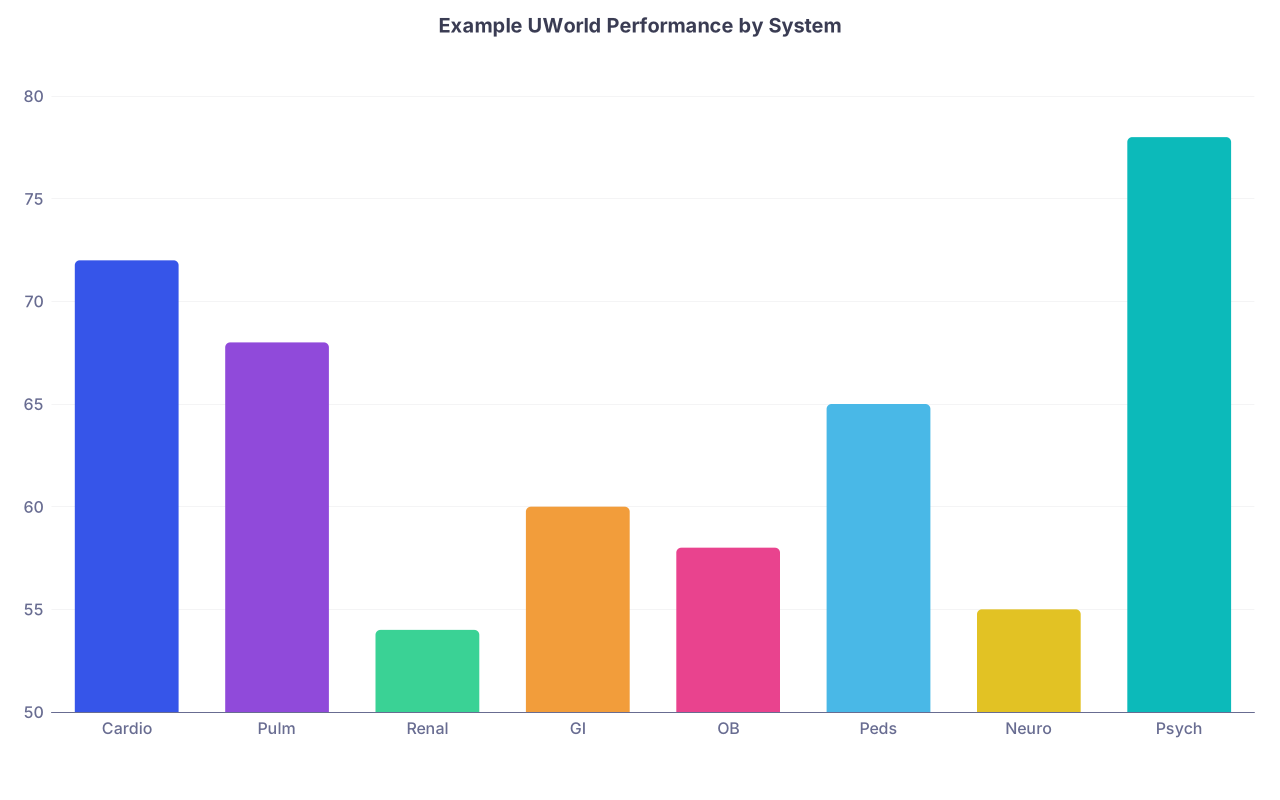
| Category | Value |
|---|---|
| Cardio | 72 |
| Pulm | 68 |
| Renal | 54 |
| GI | 60 |
| OB | 58 |
| Peds | 65 |
| Neuro | 55 |
| Psych | 78 |
If your scores look anything like that:
- Renal, Neuro, OB = red flags
- Psych, Cardio = relative strengths
- That should dictate where your study hours go, not your anxiety.
Step 4: Classify Weaknesses into Three Tiers
You cannot fix everything at once. If you try, you will skim everything and master nothing.
You will be ruthless here. Take your integrated data (shelves + QBank + practice NBMEs if you have them) and classify each system into:
- Critical weaknesses (Tier 1)
- Moderate weaknesses (Tier 2)
- Relative strengths (Tier 3)
Use simple criteria:
- Tier 1 (Critical)
- Shelf performance clearly below class average or at/below 25–30th percentile
- QBank performance <55–60%
- You feel uncertain on most questions in that domain
- Tier 2 (Moderate)
- Shelf OK (40–60th percentile) but QBank 55–65% and shaky confidence
- Tier 3 (Strengths)
- Shelf ≥70th percentile and QBank ≥65–70%
- When you miss questions, you understand why quickly
Example classification:
- Tier 1: Renal, OB, Neuro
- Tier 2: GI, Peds, ID
- Tier 3: Psych, Cardio, Pulm
Now allocate study time and intensity based on this, not guilt.
As a rule of thumb for a 6–8 week dedicated Step 2 CK block:
| Tier | Systems in Tier | Approx Study Time Share |
|---|---|---|
| Tier 1 | 2–3 systems | 45–50% |
| Tier 2 | 3–4 systems | 30–35% |
| Tier 3 | 2–3 systems | 15–25% |
This is how you stop spending 50% of your time on psych because you “like it” and then getting crushed by renal and OB on exam day.
Step 5: Build a Weekly Structure That Directly Targets Those Gaps
Now we get concrete.
Decide Your Total Prep Timeline
Common situations:
- You have 4 weeks between last clerkship and Step 2
Very tight but doable if third year was solid. - You have 6–8 weeks
Ideal for most students. - You are studying part-time during advanced rotations
Needs more discipline; you will rely heavily on daily QBank.
Let us assume a 6-week plan to illustrate. You can compress or stretch this framework.
Core Structure: Daily and Weekly
You need three pillars:
- Daily questions
- Targeted content review
- Regular mixed timed blocks + spaced practice
A solid baseline structure:
- 40–80 UWorld questions per day
- First 2–3 weeks: mostly system-focused on Tier 1 and Tier 2 systems
- Last 3 weeks: mostly mixed blocks
- 2–3 hours per day of targeted content review
- Focused on:
- Tier 1 weaknesses
- Repeatedly missed topics on QBank
- NBME practice misses
- Focused on:
- Practice test every 1–2 weeks
- NBME Comprehensive Clinical Science (CCSAs)
- UWSA 1 and 2
Now plug your Tier 1–2–3 into an actual week.
Example for someone with Tier 1 = Renal, OB, Neuro:
Weekday template:
8:30–10:30
40-question UWorld block (timed, random but filtered to 1–2 systems)
Review thoroughly.10:45–12:15
Content review on one Tier 1 system (e.g., Renal) using:- UWorld explanations
- OnlineMedEd / Boards & Beyond videos
- A concise book (like Step-Up to Medicine sections, Divine Intervention notes)
13:30–15:00
40-question UWorld block (can be mixed or another Tier 1/2 system)
Review.15:15–17:00
Content review / flashcards (Anki) focused on:- Missed concepts from that day
- Ongoing reinforcement of Tier 2 systems
Once or twice per week:
- Last block of the day = strictly mixed with all systems. This trains you for the real exam.
Step 6: Turn Specific Shelf Feedback into Micro-Goals
“Be better at OB” is not a goal. “Get 80% correct on UWorld questions about hypertensive disorders of pregnancy” is.
Take the rotation-level comments and NBME content rows and break them down to specific micro-goals.
Example: Surgery shelf feedback: “Weakness: Trauma and Shock Management”
Turn into:
Micro-goals for Trauma:
- Know the primary and secondary survey steps cold.
- Be able to choose next best imaging (FAST vs CT vs X-ray vs DPL).
- Distinguish hemorrhagic vs septic vs cardiogenic shock based on vitals and clinical picture.
- Recognize when to intubate, give fluids, give blood.
Micro-goals for OB (from OB shelf / QBank):
- Correctly diagnose every hypertensive disorder of pregnancy from vignettes.
- Know delivery timing for:
- Severe preeclampsia at different gestational ages
- Fetal growth restriction
- Placenta previa vs abruption
- Interpret fetal heart rate patterns and know when to:
- Continue
- Change maternal position
- Give oxygen/fluids
- Proceed to C-section
Each micro-goal gets:
- 10–20 targeted QBank questions
- A 20–40 minute focused review with:
- One high-yield video or section
- 1–2 pages of notes max
- A few Anki cards for the rules/thresholds
This is how you make feedback actionable.
Step 7: Use Practice NBMEs as Feedback Loops, Not Emotional Landmines
You are not taking practice NBMEs “to see if you pass.” You are using them as high-resolution feedback devices.
Plan roughly:
- NBME 1: Start of dedicated (or 4–6 weeks out)
- NBME 2 / 3: 2–3 weeks out
- UWSA 1 and 2: 1–3 weeks out (they tend to overpredict but are useful)
After each exam, you do not just look at the three-digit score and panic. You dissect.
Create a simple post-NBME protocol:
Categorize every missed question by:
- System
- Task (diagnosis vs management vs interpretation vs ethics)
- Error type:
- Did not know content
- Knew content but was misled by distractor
- Misread / rushed
- Overcomplicated / changed answer
Tally up where the losses cluster:
- Example:
- 8 misses in renal (mostly management)
- 6 misses in OB (delivery timing)
- 5 misses in ethics (consent, capacity, minors)
- Example:
Create a 48–72 hour micro-plan that directly attacks those clusters:
- Day 1: 40–60 renal questions + review + 1 renal video session
- Day 2: 40–60 OB questions + fetal monitoring + delivery timing cheat sheet
- Day 3: 30–40 ethics questions + read a concise ethics guide
Here is what that feedback cycle looks like in practice:

| Step | Description |
|---|---|
| Step 1 | Shelf and QBank Data |
| Step 2 | Identify Tier 1 and Tier 2 Systems |
| Step 3 | Build Weekly Study Plan |
| Step 4 | Take NBME/UWSA Practice Test |
| Step 5 | Analyze Missed Questions by System and Task |
| Step 6 | Create 2-3 Day Micro-Plan |
You do not change the whole plan every time you take a practice test. You just add 2–3 targeted “pressure fixes” based on where you are still leaking points.
Step 8: Correct the Common Shelf → Step 2 CK Mistakes
I have watched students repeat the same self-sabotage patterns for years. Here are the big ones and how to fix them.
Mistake 1: Ignoring Old Weaknesses Because “That Rotation Is Over”
“If I survived surgery, it cannot be that bad.” Wrong. Step 2 CK will happily test:
- Trauma resuscitation
- Post-op fever workup
- Acute abdomen triage
On the same exam where it expects you to manage DKA, preeclampsia, and neonatal sepsis.
Fix:
- Any rotation where your shelf was <50th percentile automatically promotes that system (or relevant parts of it) to at least Tier 2, if not Tier 1.
- Put those systems in your first 2–3 weeks of focused review.
Mistake 2: Treating QBank Percent Correct as the Only Truth
You know the student who proudly says: “I am at 67% on UWorld, I am fine.” Then fails Step 2 CK because their weak areas are exactly where the real exam leans heavy.
Fix:
- Treat overall QBank % as background noise.
- Focus on:
- System breakdown
- Trajectory (Were you 40% in renal and now 60%? Is OB stuck at 50%?)
- How similar your QBank mix is to Step 2 (if you do only IM questions, your % will be inflated and misleading)
Mistake 3: Overfocusing on Content, Undertraining Question Skills
If every feedback comment you have ever gotten is “knows a lot but overcomplicates,” you do not need more videos. You need to fix how you answer questions.
Look at your missed shelf/Step-style questions:
- Did you switch from correct to incorrect at the last minute?
- Did you pick rare zebras instead of common horses?
- Did you misread age/gestational age/vital sign clues?
Fix:
- For at least one QBank block per day:
- Force yourself to write a 1-sentence summary of the vignette and what the question is asking before looking at options.
- Commit to an answer mentally, then see if it exists.
- After reviewing:
- For every missed question, write a 1-line “rule” to prevent that error again.
- Example: “Kid with painless rectal bleeding and low vitals → think Meckel, not hemorrhoids.”
- For every missed question, write a 1-line “rule” to prevent that error again.
These “rules” become the core of your rapid review.
Step 9: Build a Realistic Final 2-Week Schedule
The last 2 weeks are not for starting huge new resources. They are for:
- Solidifying patterns
- Fixing the last big leaks
- Training your brain for 8-hour test-day endurance
Two weeks out:
- Take an NBME or UWSA.
- Analyze by system and task.
- Identify 2–3 remaining high-yield weak domains.
- Schedule:
- 2 days heavily weighted to Domain A
- 2 days heavily weighted to Domain B
- 1–2 days as mixed review + ethics/biostats
One week out:
- One final full-length (UWSA 2 is popular).
- Lighten the load slightly:
- 40–60 QBank questions/day, all mixed.
- 2–3 hours of review, focusing on your personal “rule list” and weak domains.
- 1–2 days before the exam:
- 20–40 easy to moderate questions, just to keep the gears oiled.
- No new topics. Just consolidation.
You should be able to look at your plan and say:
- “I was bad at renal based on IM shelf; now I have done 200–300 renal questions and a structured review.”
- “My OB shelf flagged hypertensive disorders; I have now explicitly drilled them with QBank sets and checklists.”
- “My last NBME showed ethics and biostats as a leak; I dedicated 1–2 full days to fixing that.”
If you cannot say that, your plan is not truly feedback-driven. It is just generic grinding.
Step 10: A Simple Weekly Review to Stay on Track
Every 7 days, you do a 15–20 minute review of your own performance:
- Look at QBank stats:
- Which systems improved?
- Which are still bad?
- Look at your log of missed concepts:
- What keeps recurring?
- Adjust the next week’s emphasis:
- Move a system from Tier 1 → Tier 2 if stats improved and you feel genuinely more fluent.
- Promote a neglected system from Tier 3 → Tier 2 if your accuracy drops.
This is not complex. But almost nobody does it formally. They “kind of notice” they are bad at neuro and then keep doing random mixed blocks.
Your rule: No week without a clear target.
“Work hard” is banned.
“Raise OB performance from 54% → 65% with 80 questions + structured review” is allowed.
Final Thoughts: What Actually Moves the Needle
You do not need more resources. You need discipline in how you use the feedback you already have.
If you remember nothing else, keep these three points:
Shelf exams are diagnostic tools, not just grades.
Translate every low shelf area into specific Step 2 CK systems and tasks, then make them Tier 1 priorities.Your plan must be weakness-driven, not comfort-driven.
Allocate ~50% of your time to true weaknesses, 30–35% to moderate areas, and only the remainder to strengths.Use practice NBMEs as feedback loops, not verdicts.
After each one, build a 2–3 day micro-plan that directly attacks the systems and question types that cost you the most points.
Do this consistently, and Step 2 CK stops being a mysterious monster and becomes what it really is: a long, predictable exam that rewards targeted, feedback-based work.