
You do not have “no time” for Step 2 CK. You have five weeks. That is enough—if you stop pretending you are on a 3‑month schedule.
This is the situation a lot of students land in: clinicals ran long, shelf exams stacked up, life happened, and now you have about a month and change before your exam. Your advisor says, “If you can, push the date.” You cannot. Or you should not. You need a plan that assumes the clock will not save you.
So here is the plan. A concrete, ruthless, 5‑week Step 2 CK schedule that:
- Uses only high‑yield resources
- Tells you exactly how many questions per day
- Builds in NBME and UWSA checkpoints
- Has a built‑in panic protocol if scores are bad
You will not “feel ready.” That is not the goal. The goal is to walk in with enough reps and enough pattern recognition to score safely in your target range.
1. Know What a 5‑Week Step 2 CK Plan Requires
Let me be blunt: a 5‑week plan is not gentle. If you are looking for balanced wellness, this is not that season. It is a sprint.
You need three things:
- Baseline reality check (where you are now)
- Question volume and discipline (daily execution)
- Performance checkpoints that you act on, not just stare at
The Non‑Negotiable Components
Here is the minimum viable framework for a compressed Step 2 CK prep:
- 4–6 full practice tests (mix NBME and UWorld self‑assessments)
- ~2,000–2,400 high‑quality questions (mostly UWorld, timed, random, mixed)
- Targeted review of weak systems using notes / videos / Anki, not textbooks
- One dedicated review day the week of the exam
You do not have time to “finish everything.” You have time to finish the right things.
2. Set Your Constraints: Time, Baseline, Target
Before I hand you a day‑by‑day schedule, you need to answer three questions. Quickly. No drama.
- How many true study hours per day can you do?
- Clinicals? Count on 3–4 hours on weekdays, 8–10 on weekends.
- Dedicated? Count on 8–10 hours most days, 6–7 on worst days.
- What is your starting level? Use something objective from the last 2–3 months:
- Recent shelf scores (Medicine >70%, Surgery >65%, etc.)
- A prior NBME or UWorld Self Assessment
- What is your real target?
- Passing with cushion (aim ~230+)
- Solid general score (aim 240–250)
- Competitive specialties (you already know you want 250+)
If you have not taken any practice test recently, you are going to fix that on Day 1.
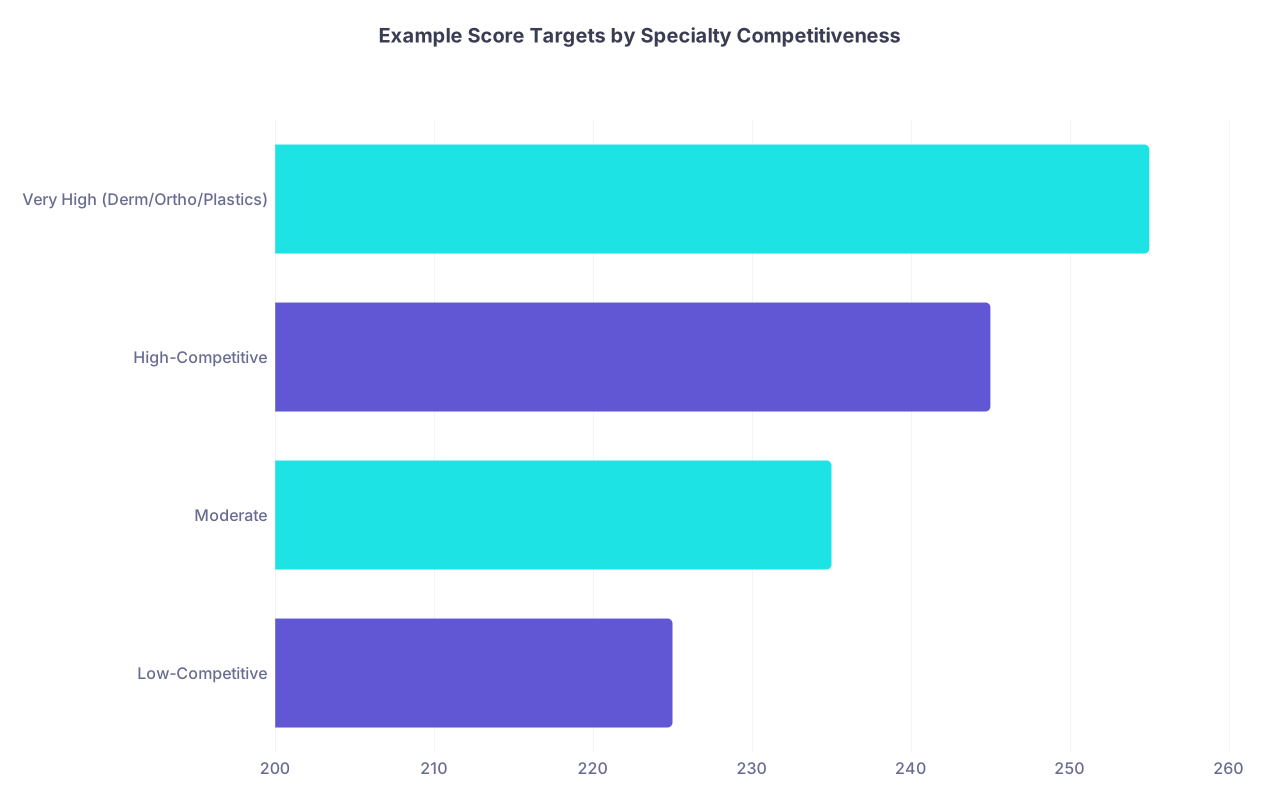
| Category | Value |
|---|---|
| Low-Competitive | 225 |
| Moderate | 235 |
| High-Competitive | 245 |
| Very High (Derm/Ortho/Plastics) | 255 |
These are not official cutoffs. They are the mental ranges students actually whisper about on rotations.
3. The Only Resources You Should Use in 5 Weeks
A compressed timeline kills resource bloat. You cannot dabble in five question banks and three video series. That is how people spin in place and fail.
Here is the tight core set.
Primary Question Bank
- UWorld Step 2 CK
- Mode: Timed, random, mixed from Day 1
- Goal: ~2,000+ questions in 5 weeks
- Do blocks of 40 to simulate test stamina
If you started UWorld months ago and are halfway done, fine. You are still treating these 5 weeks as a fresh intensive run—redo blocks you have not seen recently. Spaced repetition of high‑quality questions beats chasing “new” low‑yield questions elsewhere.
Self‑Assessments
Use these, not as ego tests, but as course corrections.
- NBMEs (pick 2–3 forms)
- UWorld Self Assessments (UWSA1 and UWSA2)
- Optionally: Free 120 from NBME / USMLE website in the last 7–10 days
Content Review (Secondary)
Priority list:
- Your own shelf notes + rotation notes
- OnlineMedEd (OME) or similar concise review for truly weak systems (e.g., OB, Peds)
- Anki decks (light touch, 30–60 minutes / day, only high‑yield)
What you do not do in 5 weeks:
- Read all of Step‑Up or Master the Boards cover to cover
- Start a giant new Anki deck from scratch
- Re‑watch every OME video “just because”
Use content only to patch holes identified by questions and NBMEs.
4. The 5‑Week Step 2 CK Schedule: Overview
You want structure. So here is the skeleton of your 5 weeks.
| Week | Main Focus | QBank Volume (approx) | Full-Length Exams |
|---|---|---|---|
| 1 | Baseline + Systems Triage | 300–400 | 1 NBME |
| 2 | Heavy QBank + Early NBME | 400–450 | 1 NBME or UWSA |
| 3 | QBank Grind + Targeted Review | 450–500 | 1 NBME |
| 4 | Peak Volume + UWSA | 450–500 | 1 UWSA |
| 5 | Taper, Fine-Tune, Confidence | 200–300 | 1 UWSA + (Free 120 optional) |
Let us break this into actionable daily work.
5. Week 1: Baseline + Systems Triage
Goal: Find out how bad (or good) it is and triage weak systems fast.
Day 1: Reality Check
- Morning
- Take an NBME (full length, timed). Pick a commonly used form (e.g., NBME 10/11/12 depending on what is current and recommended by recent students).
- Afternoon / Evening
- Carefully review the exam. Do not just look at wrong answers. Ask:
- Which systems are worst? (OB, Peds, Psych, Neuro, etc.)
- Which question types repeatedly hurt? (ethics, management vs diagnosis, biostats)
- Carefully review the exam. Do not just look at wrong answers. Ask:
You are building a war map, not punishing yourself.
Create a simple list:
- Strong: IM, ID, Cardio
- Medium: Neuro, Psych
- Weak: OB, Peds, Surgery, Biostats
That list will drive your next 4 weeks.
Days 2–7: Start the Grind (But Smart)
Daily structure (dedicated):
Morning: 2 UWorld blocks (40 questions each) – 80 total
- Timed, random, mixed.
- Review each block right away (1–1.5 hours per block).
Midday: Targeted Content (1.5–2 hours)
- Pick your worst system from the NBME.
- Example: OB is terrible
- Watch 2–3 focused OME OB videos (labor, prenatal care, high‑yield complications).
- Skim your own OB notes.
- Add 10–20 key cards to Anki or a short note doc.
Afternoon/Evening: 1–2 more UWorld blocks (40–80 questions)
- If you are short on time or mentally dead: 1 high‑quality block is better than 2 trash blocks.
You are aiming for ~60–80 questions per day and detailed review. If on rotations, cut to 40–60 per day but do them consistently.
By the end of Week 1, you want:
- ~300–400 questions done
- One NBME baseline
- A clear map of weak vs strong systems
6. Week 2: Heavy QBank + Early NBME Recheck
Goal: Ramp volume, start closing the biggest leaks, and see if you move the needle.
Question Volume Target
- Dedicated: 80–100 questions / day
- Rotations: 40–60 questions / day (plus some weekend catch‑up)
Same structure:
- Morning: 2 blocks
- Afternoon: review
- Evening: 1–2 blocks or content review if brain is fried
Mid‑Week: Second Assessment
Around Day 10–12:
- Take a second NBME or UWSA1
- If you started with NBME, consider UWSA1 now.
- If you started with UWSA1, choose an NBME now.
Compare scores:
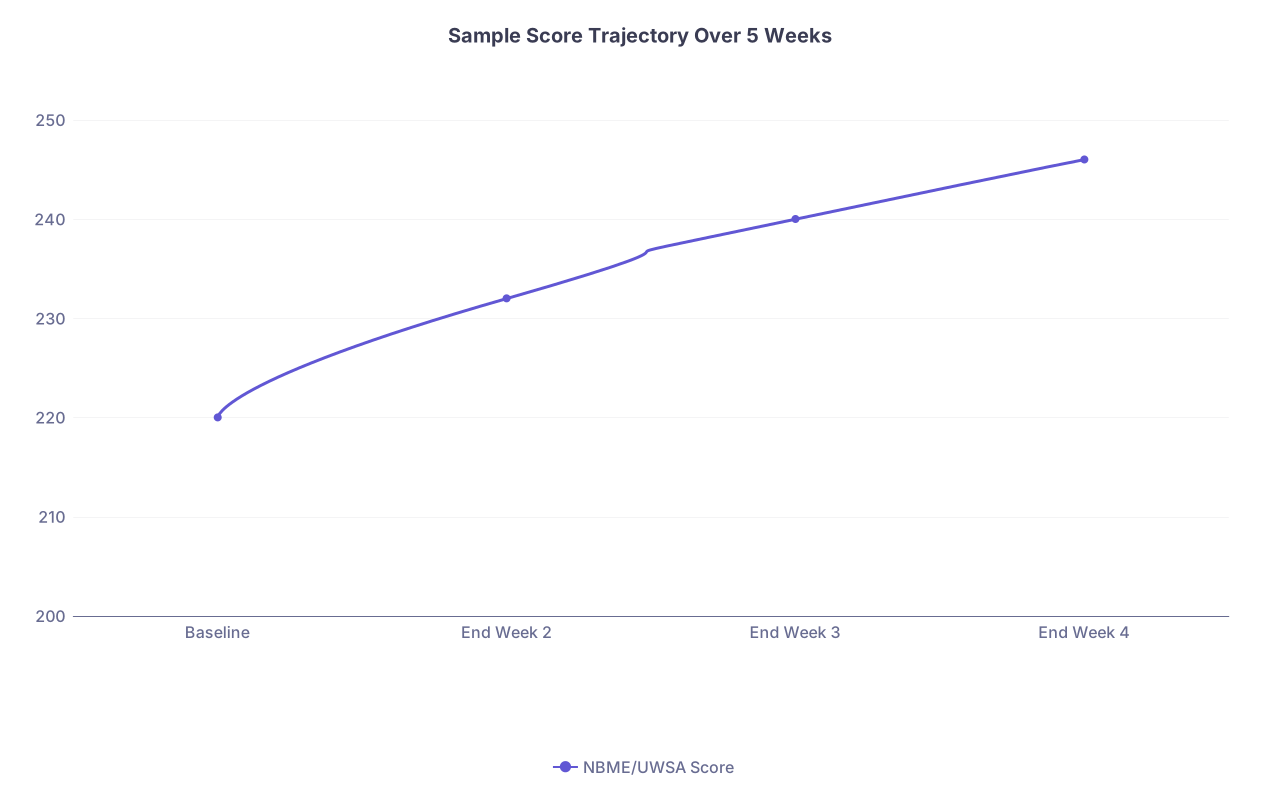
| Category | NBME/UWSA Score |
|---|---|
| Baseline | 220 |
| End Week 2 | 232 |
| End Week 3 | 240 |
| End Week 4 | 246 |
If your second score:
- Goes up ≥10 points: Good. You are responding. Stay the course.
- Flat / +/- 5 points: You are learning but not efficiently. You need to tighten review.
- Drops: Either random exam variance or you are doing mindless questions. Fix your review process.
Tightening Your Review
Ask yourself:
- Am I writing down patterns, or just reading explanations?
- Do I actually verbalize why each wrong answer choice is wrong?
- Am I guessing on topics I have never actually reviewed (e.g., OB protocols)?
If not, change this now. For each block:
- For top 5–10 missed questions, write a 1–2 line takeaway:
- “For preeclampsia with severe features >34 weeks: deliver.”
- “Acute pancreatitis with gallstones: early cholecystectomy during admission.”
You read those short notes daily. Not optional.
7. Week 3: Grind + Targeted System Attacks
This is the ugly week. You are tired, the novelty is gone, and the exam is still far enough away to feel endless. Most people drift here. You cannot.
Goal: High volume + precise targeting of the 2–3 weakest systems.
Daily Plan
- Questions: 80–100 per day
- Review: 4–5 hours per day
- Weak Systems Block:
- 1 block per day focused on your worst system (e.g., OB) in mixed but filtered mode in UWorld.
- Then switch back to mixed random for the rest.
Third Assessment (End of Week 3)
Take another NBME near the end of Week 3.
Now you should have at least:
- Baseline NBME / UWSA
- One mid‑week (Week 2) NBME or UWSA
- End of Week 3 NBME
Decision point:
- If you are consistently >235–240 and rising: keep the exam date.
- If you are <220 on multiple tests: you might need to have a serious talk with your advisor about postponing, especially if your school or specialty expectations are high.
Do not delude yourself. If your score trajectory is flat and low despite doing 1,200+ questions by now, something is very wrong in how you are studying, and 2 extra weeks may or may not fix it.
8. Week 4: Peak Volume + UWSA
Goal: Simulate real exam difficulty and push endurance.
This week, UWorld and the UWorld Self Assessments become central.
Early Week 4
- Keep doing 80–100 questions per day.
- Try to finish or nearly finish your main UWorld run this week.
Mid‑Week 4: UWSA2
Take UWSA2 around Day 24–26.
UWSA2 is often the closest predictor many students have for their real Step 2 CK score. Not perfect, but I trust it more than people’s “gut feelings” any day.
Interpretation:
- If UWSA2 is higher than your NBMEs: Good. UWorld questions are clicking.
- If UWSA2 is much lower: You may be gaming UWorld QBank but not truly understanding management steps.
Use the results to refine:
- Last‑minute focus on weak question types (biostats, ethics, OB triage, emergent vs outpatient management).
- Identify any system scoring below 60–65% in cumulative UWorld performance and schedule targeted half‑days for it.
9. Week 5: Taper, Solidify, Control Panic
This is not the week to suddenly double your hours because you “do not feel ready.” That is how people arrive burnt out and glassy‑eyed on test day.
Goal: Maintain sharpness, avoid burnout, patch final holes.
Early Week 5 (Days 29–32)
- 40–80 questions per day, depending on your fatigue.
- Shorter blocks (20–30) are acceptable now, but stay timed and random.
- Daily review of:
- Your high‑yield notes / error log
- Core OB, Peds, and Emergency / ICU management algorithms
- Biostatistics formulas and interpretation
Final Self‑Assessment
- Option 1: Free 120 (official practice questions) 7–10 days before exam.
- Option 2: A final NBME or UWSA if you have one left and you can handle seeing the score.
If the last two exams (e.g., UWSA2 + Free 120) cluster around a consistent range, take that as your rough expected performance. Do not start new resources now.
Last 2–3 Days
- No full‑length tests.
- 20–40 light questions per day max.
- Review laminated sheets / notes for:
- Vaccination schedules
- Prenatal screening algorithms
- Chest pain workup
- Stroke management
- Trauma ABCs and primary survey
- Psych first‑line meds and acute stabilization
The day before: half‑day max. Light questions (if any), review some flash notes, then stop.
Sleep is not optional.
10. Daily Time Blocking: What It Actually Looks Like
Let me spell out a sample dedicated day (aiming for ~80 questions):
- 08:00–10:00 – UWorld block #1 (40 Q, timed, random)
- 10:00–11:30 – Review block #1 in detail
- 11:30–12:30 – Break / food / short walk
- 12:30–14:30 – UWorld block #2 (40 Q, timed, random)
- 14:30–16:00 – Review block #2
- 16:00–17:30 – Targeted content review (weak system)
- 19:00–20:00 – Light Anki / review notes / key algorithms
On a rotation day, you compress:
- Evening – 1 full timed block (40 Q) + 1–1.5 hours of review
- Early morning / late night – 20–40 more questions or content review
Not ideal, but this is the reality for plenty of students. The key is not skipping days. One missed day is fine, three in a row and your “5‑week” schedule just became a 3‑week schedule.
11. Fixing Common Problems During a 5‑Week Crunch
Here is what I see over and over. And how to fix it.
Problem 1: “I am doing 120 questions a day but my score is flat.”
You are doing busy work, not learning work.
Fix:
- Drop to 80 questions / day.
- Double the effort on review. For every missed question, ask:
- What concept did I miss?
- Where in the algorithm did I go wrong?
- What pattern should I recognize next time?
If you cannot explain the “why” behind the right answer out loud, you have not learned it.
Problem 2: “My shelves were weak in OB/Peds and they are still killing me.”
You cannot brute‑force that with random questions only.
Fix (3‑day OB/Peds mini‑bootcamp):
- Each day:
- 1 hour OME or equivalent for high‑yield topics (prenatal care, labor, pediatric milestones, rashes, respiratory distress in neonates).
- 1–2 UWorld blocks filtered to OB/Peds.
- 30 minutes to make a single page of “non‑negotiable” facts.
Then go back to mixed blocks. You are not trying to be an OB attending. You are trying to be competent enough that OB questions stop being total guesswork.
Problem 3: “Biostats and ethics crush me.”
They crush everyone who treats them as optional.
Fix (1–2 focused sessions):
- Take one evening:
- Read a short high‑yield biostats summary (sensitivity, specificity, PPV, NPV, type I/II error, power, confidence intervals, NNT, NNH).
- Do 15–20 biostats / ethics questions in a row and review them.
Then add 3–5 biostats / ethics questions to your daily practice for the rest of the schedule.
12. Interpreting Your Score Trajectory Rationally
Stop reading anecdotes from anonymous forums that say, “I scored 40 points above my UWSA.”
Focus on your own data:
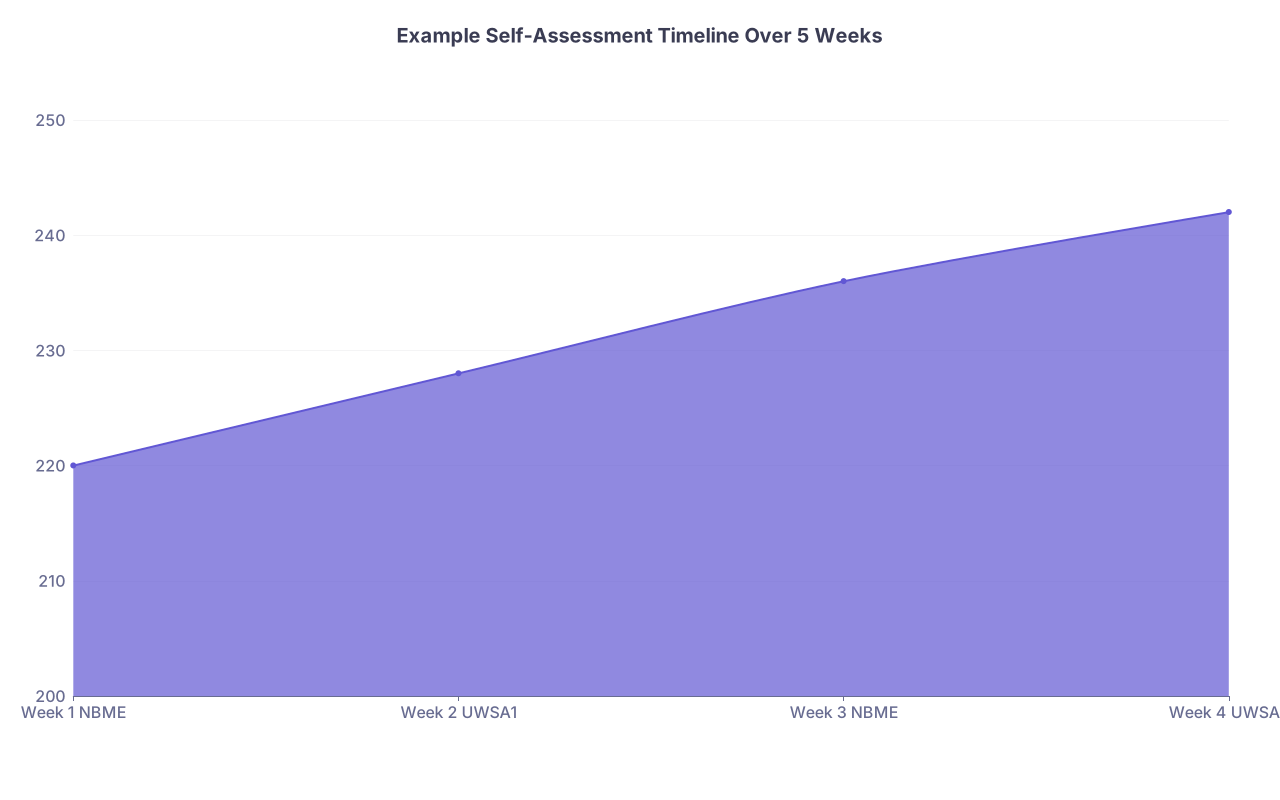
| Category | Value |
|---|---|
| Week 1 NBME | 220 |
| Week 2 UWSA1 | 228 |
| Week 3 NBME | 236 |
| Week 4 UWSA2 | 242 |
What matters:
- Trend: generally upward? Good.
- Consistency: last 2–3 scores within ~5–8 points of each other? That is your realistic band.
- Context: are your worst subjects at least moving out of the danger zone?
If your last two scores (e.g., NBME + UWSA2) are both:
- Above your minimum safe target → keep the date.
- Below by more than 10 points → you seriously consider a delay, if allowed.
- Right at your baseline goal → you can probably test and do fine, but adjust expectations.
13. Mental Game and Test‑Day Execution
The 5‑week crunch is not only a knowledge problem. It is an anxiety management problem.
During Prep
- Use one time of day as a hard “stop.” Midnight, 11 pm, whatever. Past that, you are trading sleep for sloppy memory.
- One non‑study activity daily that actually lowers your cortisol: 20‑minute walk, gym session, short call with someone who is not asking about scores.
Week of the Exam
- Standardize:
- Wake time
- Caffeine routine
- Breakfast
- Short warm‑up: 5–10 easy questions or quick review of “gimme” topics, then stop.
You want your brain to feel, “Oh, this is a normal day,” not, “This is the most important day of my life.”
14. Final 48‑Hour Checklist
Quick and blunt:
- Sleep: 7–8 hours each of the last two nights. Non‑negotiable.
- Logistics:
- Test center location, ID, confirmation email printout
- Snacks and fluids that you know do not upset your stomach
- Content:
- Review your 1–2 pages of key notes: OB, Peds, chest pain, stroke, sepsis, trauma, psych emergencies, biostats.
- Light questions only if they calm you, not if they spiral you.
Walk in expecting:
- To not know every question
- To guess intelligently often
- To feel uncertain afterward
Everyone does. The people who score well are those who did the work in the 5 weeks, not those who “felt ready.”
Key Takeaways
- Five weeks is tight but absolutely workable if you commit to UWorld, 4–6 self‑assessments, and ruthless focused review of your worst systems.
- Your schedule must be question‑heavy, review‑obsessed, and data‑driven; you adjust your plan based on NBME and UWSA trends, not vibes.
- Do not waste time on resource tourism. In a timing crunch, depth beats breadth. Execute the plan, protect your sleep in the final week, and let the score reflect the consistency of those 35 days, not the panic of the last 3.