
The biggest mistake MS3s make about Step 2 CK is thinking, “I’ll start once rotations calm down.” They never do.
You don’t need a perfect schedule. You need a ruthless, time-stamped plan that fits around the chaos of clerkships. That’s what this is.
I’m going to walk you from early spring of MS3 to test week—month by month, then down to the final weeks and days. At each point: what you should be doing, how much, and what to cut.
Big Picture: The Timeline From MS3 Spring to Test Day
First, zoom out. Here’s the rough shape of a sane Step 2 CK prep year if you’re taking it between late June and early August of MS4 (common for many schools):
| Timeframe | Primary Focus | QBank Target |
|---|---|---|
| MS3 March–April | Light foundation build | 200–400 total |
| MS3 May–June | Serious ramp-up | 800–1200 total |
| Dedicated Month 1 | Full-time studying | 1400–1800 total |
| Dedicated Month 2 | Refinement + NBMEs | 800–1200 + reviews |
| Final 7–10 Days | High-yield only | Light new, heavy review |
You’ll adjust the months slightly if your test date is earlier or later, but the sequence stays the same.
MS3 March: Quiet Setup While Rotations Are Still Busy
At this point you should be:
- Accepting that you cannot wait until “after clerkships”
- Laying infrastructure: resources, accounts, schedule
- Sneaking in small but consistent daily reps
Week 1–2: Choose Resources and Lock Your System
This is non-negotiable. Indecision here kills scores later.
By the end of March Week 2 you should have:
- One primary Qbank chosen:
- UWorld Step 2 CK (non-debatable; this is your core)
- One main text/reference:
- OnlineMedEd notes/videos or
- Step-Up to Medicine (IM heavy but strong foundation)
- One rapid review book (optional but helpful):
- Deja Review, Step 2 Secrets, or Boards & Beyond notes if your school uses them
- One way to track performance:
- Spreadsheet or Anki tags for “Incorrect/Urgent/Later”
Decide:
- Timed vs tutor mode?
- During March: tutor, random-by-subject is fine
- Where will you take notes from missed questions?
- Dedicated “Wrong Questions” notebook or Anki
Stop browsing Reddit for “best resource.” Commit.
Week 3–4: Start a Durable Daily Micro-Habit
You’re still in full clinical mode. So you’re not “studying for Step 2 full-time.” You’re building a streak.
Target for late March:
- 10–20 Step 2 questions/day on weekdays
- 20–40/day on one weekend day
- Quick review of your weakest clerkship topic (often OB or Peds if you’ve had less exposure)
At this point you should:
- Use blocks related to your current rotation to double-dip (e.g., on IM → do IM questions)
- Focus on learning from explanations, not your percent correct
- Start noticing patterns: “I keep missing anemia,” “I forget the order of shock management”
Do not stress about scores yet. March is about frictionless consistency.
MS3 April: Structured Build While You Finish Core Rotations
By April, you’ve got a bit of momentum. Now you layer structure.
Early April (Weeks 1–2): Move to Daily Blocks
At this point you should:
- Ramp to:
- 20–30 UWorld questions/day on weekdays (timed, random within 1–2 subjects)
- 40–60 on one weekend day
- Start one small content project:
- Example: “I’m going to systematically cover all endocrine over two weeks”
- Use OME videos or one chapter every 2–3 days from Step-Up to Medicine
End of Week 2 checklist:
- You’ve done at least 200–250 total UWorld questions
- You’ve identified 3 recurrent weak systems (e.g., renal, OB, psych)
- You’ve started capturing “rules” from explanations (e.g., BP thresholds, age cutoffs)
Late April (Weeks 3–4): First Reality Check
No, not an NBME yet if your baseline is shaky. But:
At this point you should:
- Do your first 40-question fully random timed block without pausing
- Sit through it like a real test:
- No phone
- No checking answers mid-block
- Review the entire block in one sitting
If your raw correct is regularly:
- ≥65–70% on random blocks: you’re in a good trajectory
- 55–65%: solid but need more foundation
- <55%: you need more content review mixed in, not just questions
Don’t freak out. April is still early. This is reconnaissance.
MS3 May: Ramp-Up and First Formal Assessments
This month separates the serious from the “I’ll figure it out later” crowd.
You’re probably finishing your last core or starting electives. Either way, there’s more control over your schedule than peak MS3.
Early May (Weeks 1–2): Increase Volume, Introduce Mixed Blocks
By now your brain should tolerate longer sessions.
At this point you should:
- Move to:
- 30–40 questions/day on weekdays
- 60–80 questions on one weekend day
- Switch most blocks to fully random, all-systems (still timed, 40 Q if possible)
- Add 30–45 minutes of focused content review 4–5 days/week:
- Example:
- Monday: Cardiology
- Tuesday: Pulm
- Wednesday: Renal
- Thursday: GI
- Friday: ID
- Example:
This is also when you should look at your test window seriously:
- Talk with your dean’s office / scheduling people
- Block 5–6 weeks of dedicated time between MS3 end and residency application crunch if possible
Mid–Late May (Weeks 3–4): First NBME / Assessment
You cannot afford to enter June blind.
By the end of May you should:
- Take your first NBME or UWSA (self-assessment):
- NBME 10/11/12, or UWSA1 if you prefer UWorld style
- Treat it like test day:
- Quiet environment, no pausing, timed strictly
- Review the whole thing over 1–2 days
Use that score:
- 215–225: You’re okay but need structured dedicated
- 230–245: You’re in striking distance for mid-to-strong scores
- 250+: You’re aiming for top tier with smart polish
Notice your weak domains (e.g., “Systems: OB, derm; Skills: ethics, stats”).
MS3 June: Final Clerkship Push + Pre-Dedicated Ramp
This month is awkward. You’re tired, rotations are wrapping up, everyone’s talking about vacations. You don’t get that luxury if you want a clean Step 2 run.
First Half of June: Finish Rotations, Maintain Momentum
At this point you should:
- Hold:
- 40 questions/day on weekdays
- One 80-question “mini-exam” each weekend
- Aim to cross ~800–1000 UWorld questions total by mid-June
- Spend 30 minutes after each block:
- For every missed question: write one line “if X, do Y” rule
- Tag truly confusing ones for revisiting later
During your final OSCEs/clinicals:
- Tie your daily patients to Step 2:
- See COPD? That night, do 10–15 pulm questions
- See preeclampsia? Review hypertensive disorders in pregnancy
Second Half of June: Transition Into Dedicated Mode
By late June you’re either done with rotations or within a week of being done.
At this point you should:
- Schedule your exact Step 2 CK date if you haven’t already
- Ideally 4–6 weeks from the start of full dedicated
- Draft a dedicated calendar:
- Which NBMEs/UWSAs on which days
- When you’ll finish UWorld
- Built-in light days every 7–9 days to avoid burnout
Here’s a simple view of assessment spacing for a 5-week dedicated:
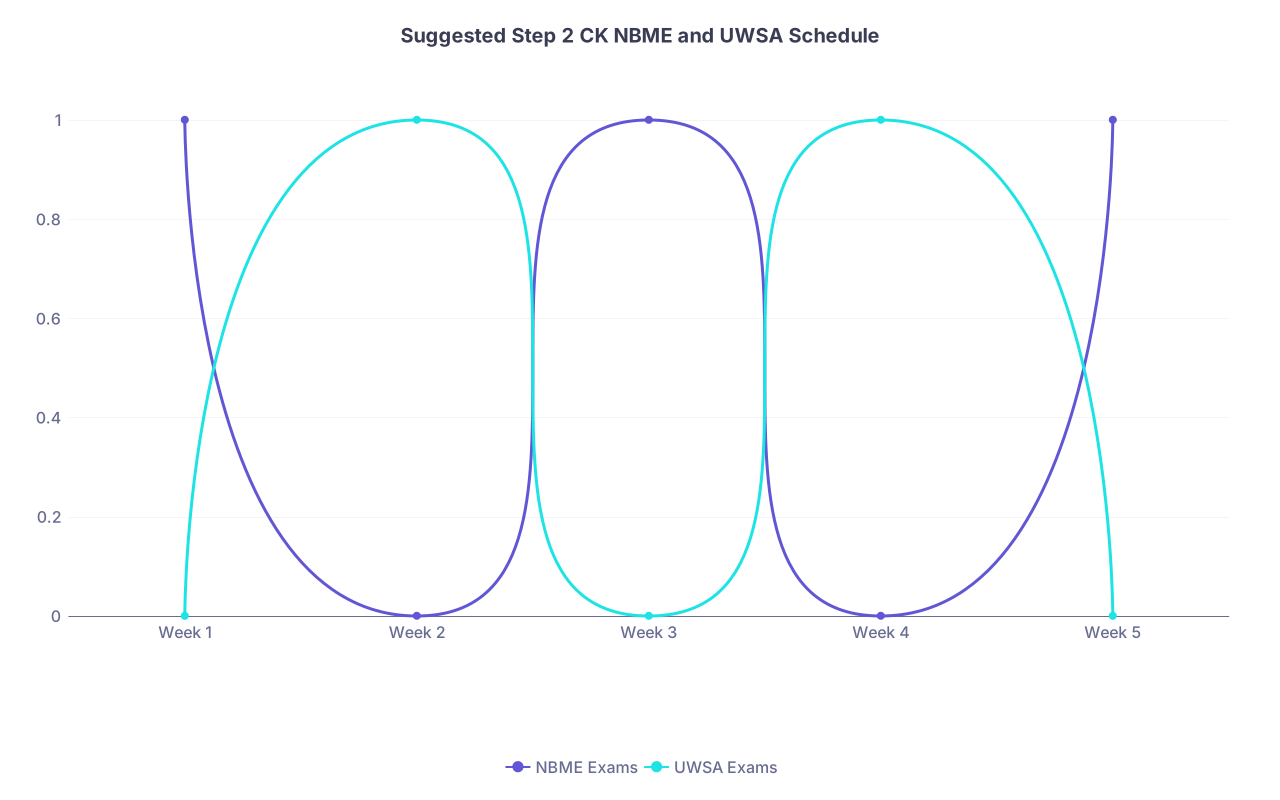
| Category | NBME Exams | UWSA Exams |
|---|---|---|
| Week 1 | 1 | 0 |
| Week 2 | 0 | 1 |
| Week 3 | 1 | 0 |
| Week 4 | 0 | 1 |
| Week 5 | 1 | 0 |
You want about 4–5 total full-length assessments before test day.
Dedicated Month 1: High-Volume, High-Structure (Weeks -5 to -3)
Assume you have 5–6 weeks. If you only have 4, compress but keep the order.
Week -5: Baseline + Content-Heavy Week
At this point you should:
- Take NBME or UWSA on Day 1 or Day 2 to set the baseline for dedicated
- Start a standard daily structure:
- Morning:
- 2 blocks of 40 Q each (timed, random)
- Afternoon:
- Full review of those 80 questions (2–3 hours)
- Late afternoon/evening:
- 1–2 hours content review (weak areas only)
- Morning:
Total: ~80 questions/day, 5–6 days/week.
Focus of Week -5:
- Aggressive content patching on:
- OB/GYN algorithms (bleeding in pregnancy, fetal monitoring, hypertensive disorders)
- Pediatrics growth and vaccine schedules
- Emergency management (ACLS basics, shock, trauma)
- Build one rapid “must-know tables” doc or deck:
- Murmurs
- Rashes by age
- Antibiotics of choice by bug/site
Week -4: Volume + First UWSA
At this point you should:
- Continue:
- 80–120 Q/day (depending on stamina)
- Schedule UWSA1 mid- or end-of-week:
- Treat it like the real test (breaks included)
- Compare results to baseline:
- Focus on pattern of misses, not just score jump
If your score is still far from target (e.g., aiming 245+ and scoring 225–230):
- Add 1 focused subject block/day (e.g., 40 Q only OB)
- Dedicate 1–1.5 hours nightly to that subject’s content for 3–4 days straight

Dedicated Month 2: Refinement, NBMEs, and Targeted Repair (Weeks -3 to -1)
This phase is where people either plateau or finally break into their goal range.
Week -3: Second NBME + Surgical/IM Depth
At this point you should:
- Take NBME 11/12 early in the week
- Drop slightly to:
- 60–80 new Q/day
- More time on review and “clustering” mistakes
Use this week to:
- Deepen your understanding of:
- Complex IM: rheum, heme/onc, nephro, endocrine
- Surgical management: pre-op risk assessment, post-op fevers, acute abdomen
Concrete daily rhythm:
- AM: 40 Q random
- Midday: 20–40 Q focused on one weak system
- PM: 2–3 hours of:
- Reviewing wrong questions
- Speed-running relevant content (not reading whole chapters)
Week -2: UWSA2 + Exam Stamina
UWSA2 tends to correlate very well for many students. You want this 10–14 days before test.
At this point you should:
- Take UWSA2 as a full simulation with timed breaks
- If this score is:
- Within ~5–7 points of your goal: you’re on track
- 10–15+ points below your goal: you need a tightly focused last two weeks, not more random flailing
Shift this week’s focus:
- Less new Q volume, more:
- Re-doing missed/flagged UWorld questions
- Reviewing your “core rules” notes
- 40–60 new questions/day is plenty if quality review is high
Week -1 (Days -7 to -4): Final NBME + Light Taper
You don’t want a full NBME 1–2 days before the exam. Too much fatigue, not enough time to fix anything. Aim for 4–7 days out.
At this point you should:
- Take your last NBME around Day -6 or -5
- Confirm your range is stable; do not obsess over a few points up or down
- Taper question volume:
- 40–60 Q/day, mostly mixed, mostly review
- Spend 1–2 hours/day on:
- Ethics and biostats (these are fast points if you’re comfortable)
- Rapid-fire review of tables, algorithms, and classic presentations
You should also:
- Walk through a “test day rehearsal”:
- What time you’ll wake
- What you’ll eat
- What you’ll pack
- How you’ll use your breaks between blocks
Final 3 Days: What You Should and Should Not Be Doing
This is where people sabotage themselves. Don’t.
Day -3: Last Real Study Day
At this point you should:
- Do:
- 40–60 light, mixed questions (preferably re-dos of old tricky ones)
- 2–3 hours of focused review:
- OB/Peds key algorithms
- Emergent management pathways
- Biostats formulas and examples
- Final pass of your own notes, not new resources
Don’t:
- Start any new big resource (no “oh maybe I should skim all of Case Files now”)
- Take another full-length NBME
Day -2: Consolidation and Confidence
At this point you should:
- Study 4–6 hours max:
- 20–40 easy/medium questions just to stay warm
- Review high-yield lists:
- Vaccines
- Milestones
- Psychiatric first-line treatments
- Screening guidelines
- Pack your test bag:
- ID, confirmation email, snack plan, drinks, glasses/contacts supplies, layers of clothing
Stop:
- Looking at other people’s score posts and “what I wish I knew” threads
Day -1: Mental Rehearsal, Not Cramming
At this point you should:
- Do:
- Maybe 10–20 very easy review questions in the morning if it calms you
- A brief skim of your shortest, most high-yield notes (1–2 hours max)
- Drive or check route to the testing center if you haven’t been before
- Wind down:
- Light exercise
- Early, predictable bedtime routine (don’t suddenly change it)
Do not:
- Do new full blocks
- Check your prior NBME scores repeatedly
- Load your brain with unfamiliar topics
Test Day: Block-by-Block Strategy
At this point you should focus on execution, not knowledge.
Before you start:
- Confirm:
- Noise-cancelling headphones/earplugs available
- You know how to use the highlight/strikeout tools
- Pre-decide your break schedule:
- Example:
- After Block 2: 10 mins
- After Block 4: 15 mins + snack
- After Block 6: 10 mins
- Small flex break if needed later
- Example:
During each block:
- First pass:
- Answer everything you can confidently
- Mark ~10–15 max for review (if you mark 30+, your standards are unrealistic)
- Second pass (if time):
- Tackle marked questions with elimination strategy
- If stuck:
- Pick the reasonable answer and move on
- There’s always an easier question coming; do not sacrifice it for a 50/50 guess
Between blocks:
- Do not discuss specific questions with anyone
- Eat and drink by schedule, not hunger (your brain lies under stress)

| Step | Description |
|---|---|
| Step 1 | Arrive at Center |
| Step 2 | Check In |
| Step 3 | Block 1 |
| Step 4 | Short Break |
| Step 5 | Blocks 2-3 |
| Step 6 | Longer Break + Snack |
| Step 7 | Blocks 4-5 |
| Step 8 | Short Break |
| Step 9 | Blocks 6-7 |
| Step 10 | Optional Final Break |
| Step 11 | Last Block |
| Step 12 | Exit and Decompress |
Quick Reality Check: Where Your Time Actually Goes
If you’re wondering whether you’re allocating your time sanely during dedicated, here’s a ballpark breakdown that works well:
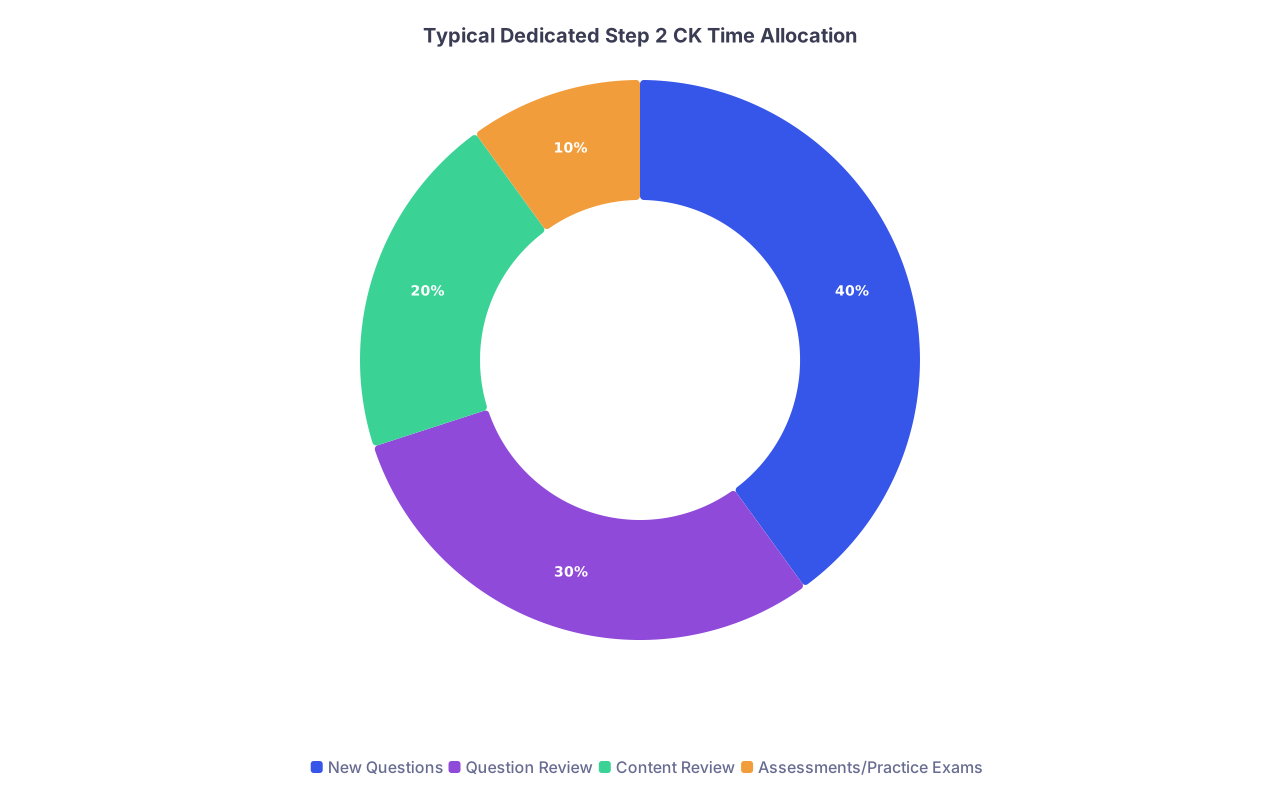
| Category | Value |
|---|---|
| New Questions | 40 |
| Question Review | 30 |
| Content Review | 20 |
| Assessments/Practice Exams | 10 |
If you’re flipping that—80% content, 20% questions—you’re studying for a class, not for Step 2 CK.
Three Takeaways To Actually Remember
- Start small in MS3 spring, but start. A 10–20 question daily habit from March beats a panicked 4-week cram in June, every time.
- Treat assessments like anchors. Use NBMEs and UWSAs every 1–2 weeks in dedicated to steer your plan, not to torture yourself.
- The last week is for sharpening and rest, not reinvention. Protect your brain, trust your process, and execute the plan you’ve rehearsed for months.