
The worst Step 2 plans are the ones that pretend the calendar does not exist. You are not just “studying for an exam”; you are trying to thread a needle between away rotations, ERAS, and interview season. If you do not plan this a full year out, the year will plan you instead.
Here is the one-year outlook, broken down month-by-month. I will assume you are a typical rising M4 in the U.S., finishing core clerkships around March–April and starting M4 in May–June.
12–10 Months Before Step 2: Big-Picture Mapping (Early M3 Spring)
At this point you should stop thinking “I’ll just take Step 2 sometime fourth year” and actually map the year.
Your main tasks (12–10 months out):
Pick your target Step 2 window.
- Ideal timing for most:
- Test between late June and mid-August.
- Score reported before:
- ERAS submission (mid–late September), or
- at least before programs start heavily reviewing files (early October).
- If you are applying to competitive specialties or had a weak Step 1:
- You want your score in ERAS on Day 1 or very close.
- That means:
- Test no later than early–mid August.
- Remember NBME score reporting lag: ~2–3 weeks.
- Ideal timing for most:
Sketch your M4 structure on a year calendar. Grab an actual year-at-a-glance layout (or print one) and mark:
- Core clerkship end dates.
- School deadlines for:
- Required acting internships / sub-Is.
- Required electives.
- ERAS milestones:
- ERAS opens for entry: early June.
- Letters uploading: starts around June.
- ERAS submission: mid–late September.
- Interview season:
- Heaviest volume: late October–January.
- Away rotation windows (VSLO/VSAS):
- Common months: July–October.
Decide your away rotation strategy first. Your away “audition” rotations are more important than Step 2 for many specialties. Harsh, but true. You need to place those intelligently, then fit Step 2 around them.
General principles:
- For very competitive fields (ortho, derm, ENT, neurosurgery, plastics, etc.):
- Prime away months: July–September.
- Many program directors want to see you on service before rank lists.
- For less competitive or less away-driven specialties:
- You can be more flexible and even skip aways.
Key rule: Do not put Step 2 smack in the middle of your highest-stakes away month. You will either neglect the away or tank the exam.
- For very competitive fields (ortho, derm, ENT, neurosurgery, plastics, etc.):
9–8 Months Before Step 2: Locking in Rotations and Test Window (Late M3 / Early M4)
At this point you should finalize the high-level order of:
- Sub-I at home
- Away rotations
- Dedicated Step 2 study period
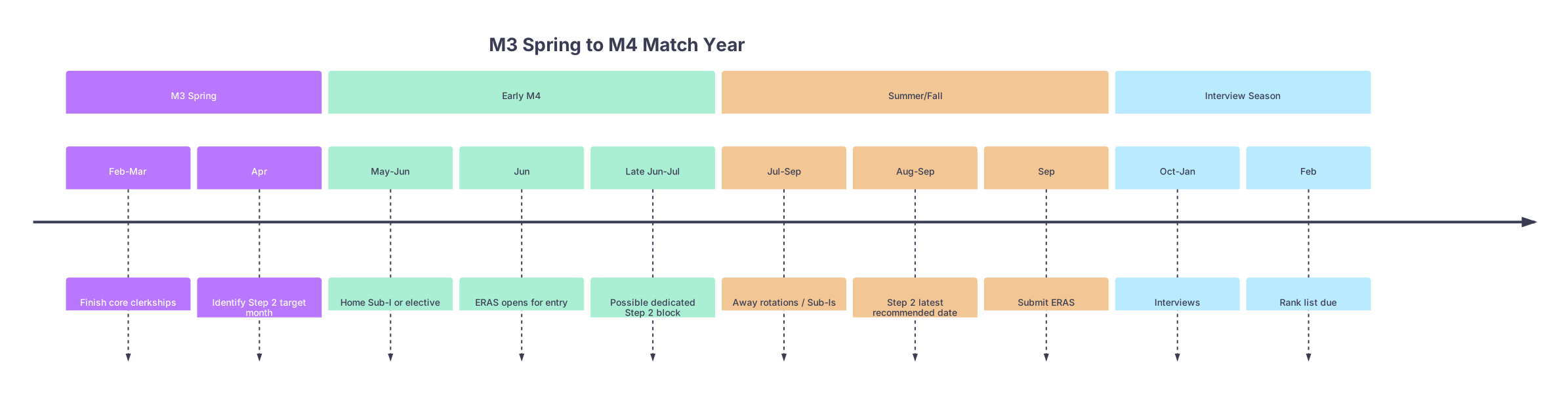
| Period | Event |
|---|---|
| M3 Spring - Feb-Mar | Finish core clerkships |
| M3 Spring - Apr | Identify Step 2 target month |
| Early M4 - May-Jun | Home Sub-I or elective |
| Early M4 - Jun | ERAS opens for entry |
| Early M4 - Late Jun-Jul | Possible dedicated Step 2 block |
| Summer/Fall - Jul-Sep | Away rotations / Sub-Is |
| Summer/Fall - Aug-Sep | Step 2 latest recommended date |
| Summer/Fall - Sep | Submit ERAS |
| Interview Season - Oct-Jan | Interviews |
| Interview Season - Feb | Rank list due |
Decide between three main Step 2 timing models
You are choosing between three realistic patterns. Do not invent some fourth “maybe I’ll just wing it during an away” option.
| Model | Test Window | Pros | Cons |
|---|---|---|---|
| A: Early Dedicated | Late Jun–early Jul | Score back before ERAS; clean study time | Less clinical context, tight after M3 |
| B: Mid-Summer Hybrid | Late Jul–early Aug | Fresh from cores, some time after an easier block | Risk of score posting after ERAS opens |
| C: Late Summer/Fall | Late Aug–Oct | More rotations completed | Score may not be in ERAS early; overlaps with aways/interviews |
Model A: Early Dedicated (test late June–early July)
Best if:
- You had a shaky Step 1 and need Step 2 to rescue your application.
- You want a clear 3–4 week dedicated block after M3 finishes.
- You are planning aways mainly in July–September and cannot be splitting focus.
Model B: Mid-Summer Hybrid (test late July–early August)
Best if:
- Your M3 year ends late.
- You can squeeze a light elective or research month in June, begin studying, and ramp up to a 2–3 week heavier period in July.
- You do not absolutely need your score in ERAS on Day 1, but earlier is still better.
Model C: Late Summer/Fall (test late August–October)
I generally advise against this if you are applying in a competitive field or have any academic red flags.
Acceptable if:
- Step 1 was strong.
- Specialty is more forgiving and not obsessed with early Step 2.
- You have unavoidable scheduling issues (e.g., only away slots in June–July, late core completion).
7–6 Months Before Step 2: Build the Weekly Structure (Early–Mid M4)
At this point you should move from vague “test in July” to a concrete weekly plan.
Step 1: Place non-negotiable rotations on the calendar
On a monthly calendar from May to January, block off:
- Home sub-I(s) (usually 4 weeks each).
- Away rotations (4 weeks each).
- Required electives (e.g., ICU, EM, etc.)
- “Light” blocks (research, outpatient electives, vacation).
You want to see clearly:
- Which months are intense (sub-I, away).
- Which months have more controllable hours.
Red flag pattern: Step 2 during:
- ICU month
- Surgery sub-I
- Two away rotations back-to-back
That is how scores drop 20+ points below your practice NBMEs.
Step 2: Assign your Step 2 prep “phases”
Think in three phases:
Maintenance phase (3–4 months before exam)
- 1–2 hours per day on most rotation days.
- Goals:
- Finish a first pass of UWorld Step 2 CK (or at least 70%).
- Complete NBME self-assessments spaced out.
- Keep Step 2 content connected to your daily clinical cases.
Ramp-up phase (4–6 weeks before exam)
- 2–4 hours per day on lighter rotations.
- 1–2 hours on heavier days, but protected half-days on weekends.
Dedicated phase (2–3 weeks pre-exam)
- 6–8 hours on most days.
- One rest day per week.
- This block should not overlap with an away or sub-I, unless you want to feel like you are failing both.
5–4 Months Before Step 2: Rotation-by-Rotation Plan
Now we go rotation by rotation. Assume a test date in late July for concreteness; you can shift by a month either direction.
Example Structure (Test Date: July 25)
- March–April: Finish cores.
- May: Home sub-I.
- June: Light elective or research.
- July 1–20: Dedicated Step 2 (+ lighter elective or research if school forces).
- July 25: Test.
- August–October: Away rotations and additional sub-Is.
- September: ERAS submission with Step 2 score in hand.
May (Home Sub-I) – Maintenance Phase
At this point you should:
- Study on weekdays: 60–90 minutes max.
- Study weekends: 3–4 hours each day.
Focus:
- 10–15 UWorld questions per weekday.
- 20–40 questions per weekend day.
- Start one NBME every 3–4 weeks to calibrate.
You are not trying to hit peak here. You are trying not to lose ground.
June (Light Elective or Research) – Ramp-Up Starts
This should be the month where Step 2 starts to dominate.
Weekly rhythm:
- 4 days per week: 40–60 UWorld questions + review.
- 1–2 days per week: NBME or practice exam / long mixed blocks.
- 1 day mostly off, light Anki or brief review only.
Take:
- 1 NBME around the first half of June.
- 1 NBME or UWSA near the end of June.
You want your scores moving upward and within striking distance of your target (±10 points).
Early–Mid July (Dedicated) – Peak Focus
At this point you should be treating Step 2 like a full-time job.
Typical day:
- Morning: 40–60 mixed UWorld, timed.
- Afternoon: 40–60 mixed UWorld or review of weak systems.
- Early evening: Rapid review (missed questions, high-yield notes).
Include:
- 1 full-length simulation (NBME or UWSA) each week.
- A lighter review evening afterward.
You do not take a vacation right before this exam.
3 Months Before: If You Must Take Step 2 During an Away
Sometimes the schedule is brutal. Step 2 has to land during an away rotation or right before interviews start.
Let me be blunt: that is a damage control scenario, not a performance-maximizing one. But it is survivable if you plan it carefully.
Scenario: Test Mid-September During an Away
Schedule might look like:
- May: Core wrap-up.
- June: Home sub-I.
- July–August: Away rotation 1 & 2.
- September 15: Step 2.
- October–January: Interviews.
Problems:
- You are wiped by the time September arrives.
- You are working long days at an away, trying to impress faculty.
- You only get small, fragmented study windows.
At this point you should:
Front-load your UWorld and core studying.
- Heavy UWorld volume before the aways.
- By August 1, aim for:
- 80–100% of UWorld completed.
- 2–3 NBMEs completed with stable scores.
Shift away months into “maintenance” mode. Realistic away-day plan:
- 10–15 questions each weekday (during lunch or after sign-out).
- 40–60 questions each weekend day + 1–2 hours of review.
- One NBME/assessment on a Sunday every 2–3 weeks.
Protect 4–5 days pre-exam, even in an away. This means:
- Arrange with the away coordinator to:
- End 2–3 days early, or
- Use vacation days from your home institution adjacent to the exam, or
- Take the exam immediately after the away with 2–3 days off in between.
- If you show up clinically useless and exhausted the last week because you are cramming, you will undermine the very thing the away was meant to build: strong letters and reputation.
- Arrange with the away coordinator to:
2 Months Before: Aligning Step 2 With ERAS and Letters
At this point you should be watching three clocks:
- Step 2 study
- ERAS application prep
- Letter of recommendation timelines
ERAS vs Step 2 Timing
General rule:
- If your Step 1 is average or weak:
- Best: Step 2 score already reported by ERAS opening.
- Next best: Clearly scheduled test with confidence your score will post before programs seriously screen (early–mid October).
- If Step 1 is strong:
- You can submit ERAS without Step 2 and let the score arrive later.
- But do not push Step 2 into deep interview season unless absolutely necessary.
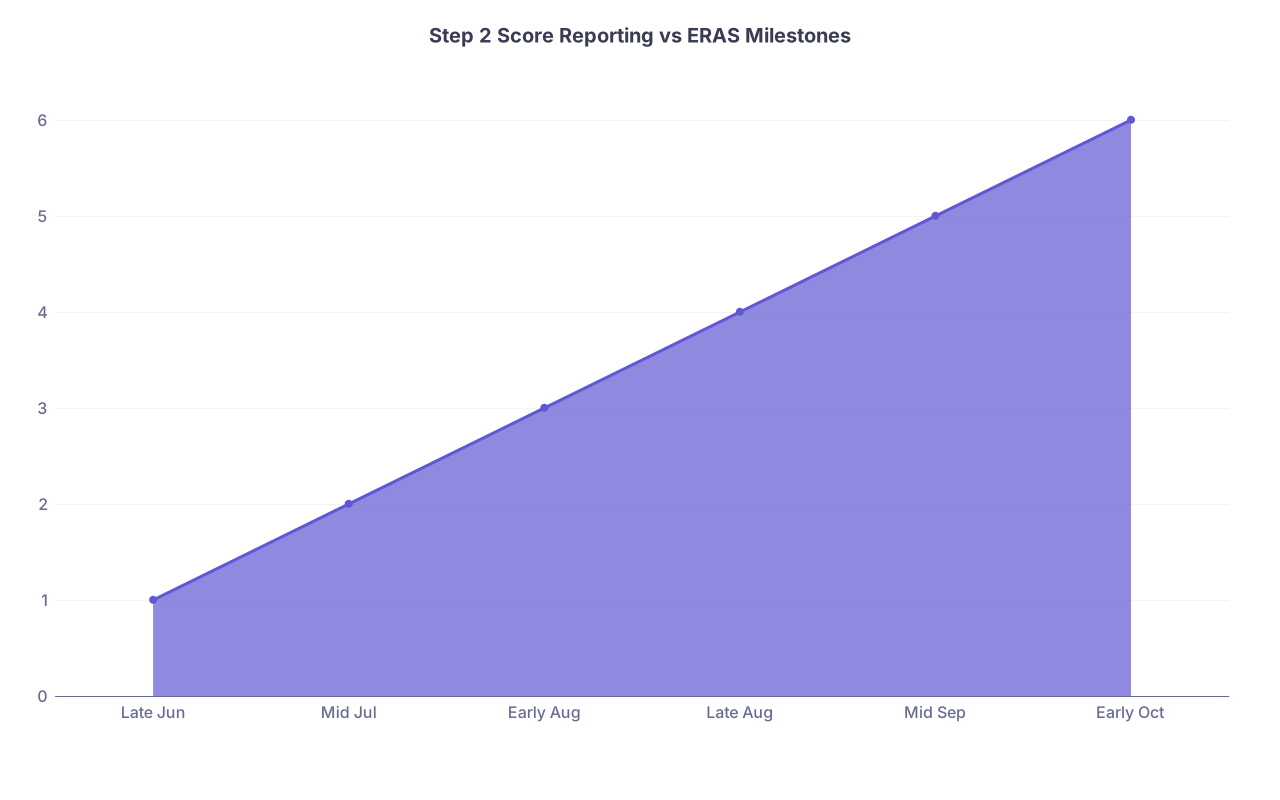
| Category | Value |
|---|---|
| Late Jun | 1 |
| Mid Jul | 2 |
| Early Aug | 3 |
| Late Aug | 4 |
| Mid Sep | 5 |
| Early Oct | 6 |
(Think of 1–6 as “risk level” for missing early review; early June = lowest risk, early October = highest.)
Practical checklist (6–8 weeks out)
At this point you should:
- Confirm:
- Exact test date.
- Location and travel plan.
- Finalize:
- ERAS personal statement drafts.
- CV and experiences section (at least in near-final form).
- Coordinate:
- Letters requested.
- Away supervisors reminded about LOR deadlines.
You do not want to be writing a personal statement from scratch the same week you take an NBME.
1 Month Before: Week-by-Week Plan
Let us assume a mid-July exam for concreteness. Adjust dates if yours is earlier/later.
Week -4
- Finish last 20–30% of UWorld.
- NBME or UWSA #1:
- Target: within 10–15 points of your goal.
- Clean up:
- Big weak spots (e.g., OB emergencies, renal, statistics).
Time allocation (if on a light elective):
- 3–4 hours per weekday.
- 5–6 hours per weekend day.
Week -3
At this point you should:
- Start second pass or re-do incorrect UWorlds in weak systems.
- NBME or UWSA #2:
- Evaluate endurance and pacing.
- If timing is a problem, focus entire week on block simulations.
Try to:
- Standardize your daily schedule:
- Morning long timed blocks.
- Afternoon detailed reviewing.
Week -2
Heaviest study week.
- Full-length practice exam early in the week.
- Target:
- Scores stable across exams.
- No new glaring weak system.
Adjust:
- If scores are flat but acceptable:
- Maintain current approach.
- If scores are dropping:
- You are likely burned out; cut volume slightly and prioritize sleep + targeted review.
Week -1
At this point you should be tapering slightly.
Plan:
- 40–60 questions per day.
- Focus on:
- Statistics, ethics.
- High-yield OB/peds/EM algorithms.
- Review of your personal “hall of shame” question list.
Two days before exam:
- No full-length tests.
- Only light review of flashcards or notes.
- Half day of very light review, then stop.
- Lock in:
- Route to test center.
- Food, ID, earplugs, clothing.
During Interview Season: If Step 2 Is Still Pending or You Barely Squeezed It In
Sometimes Step 2 ends up just before or even during interviews. Not ideal, but it happens.
At this point (October–January) you should:
If Step 2 score is pending:
- Be prepared to answer:
- “Have you taken Step 2 yet?”
- Answer: “Yes, I took it on [date]; I expect the score to be available around [approx date].”
- If Step 1 was weak, emphasize:
- Ongoing clinical performance.
- Shelf scores if strong.
- “Have you taken Step 2 yet?”
- Be prepared to answer:
If you took Step 2 during early interview season and feel unsure:
- Do not insist on discussing your score anxiety in every interview.
- Focus on:
- Clinical strengths.
- Fit for the program.
- Growth from M3 to M4.
Protect your remaining bandwidth.
- Light maintenance:
- 30–60 minutes per week of clinical reading.
- No massive new commitments if you are still recovering from Step 2 and traveling for interviews.
- Light maintenance:
Sample One-Year Outlook Templates
To make this concrete, here are two realistic templates: one for a competitive specialty with aways, one for a less competitive field.
Template 1: Competitive Specialty (e.g., Ortho, ENT) – Early Step 2
Feb–Apr (M3):
- Finish cores.
- Start light Step 2 maintenance (10–15 UWorld/day).
May:
- Home sub-I.
- Continue 10–20 UWorld/day, heavier on weekends.
June:
- Research or lighter elective.
- Ramp up:
- 40–60 UWorld/day.
- 1–2 NBMEs.
Early July:
- 2–3 week dedicated period.
- 80–100 questions/day, weekly assessments.
Mid–Late July:
- Take Step 2.
- Brief 3–4 day recovery.
Aug–Oct:
- Away rotations and additional sub-Is.
- ERAS submitted with strong Step 2 already posted.
Oct–Jan:
- Interviews with exam in the rearview mirror.
Template 2: Less Competitive Specialty – Mid-Summer Step 2
Mar–Apr:
- Finish cores.
May–Jun:
- One required sub-I + one elective.
- 20–40 UWorld/day.
- 1–2 NBMEs.
Jul:
- Light elective / vacation + Step 2 ramp/dedicated.
- Test late July / early August.
Aug–Sep:
- Optional away or home electives.
- ERAS submitted with score likely in by early October.
Oct–Jan:
- Interviews, minimal test stress.
Final Thoughts: What Actually Matters
Three points to walk away with:
Place Step 2 around, not inside, your highest-stakes months.
Sub-Is and aways are auditions. You cannot afford to be half-present because you stuck Step 2 in the middle.Pick a model and commit.
Early dedicated, mid-summer hybrid, or late summer/fall. Each can work if you plan the rotations and weekly study volume accordingly. Waffling is what kills people.Front-load the work before life gets chaotic.
Get through most of UWorld and at least a couple of NBMEs before aways and ERAS open. Then Step 2 becomes a peak, not a rescue mission in the middle of chaos.