
Faculty do not score Step 2 PE–style encounters the way you think they do. They are not sitting there with a mental checklist of NBME buzzwords. They are watching you and asking one blunt question: “Would I trust this person with my patients next month?”
That’s the part students never get told directly.
You’ve been fed this sanitized script: be empathetic, ask OPQRST, summarize, close with “Do you have any questions?” and you’ll be fine. That’s not how it actually plays out in grading rooms, CCC meetings, or residency selection committees reading your “borderline” narratives from OSCEs and clinical skills exams.
Let me walk you through what really happens behind the glass.
First: Understand What “Borderline” Really Signals to Faculty
“Borderline” is not a neutral word to faculty. It’s a red flag that triggers a very specific mental sorting process.
On paper, Step 2 CS/PE (back when it was official) and school OSCEs talk about domains: data gathering, communication, professionalism, clinical reasoning, documentation. In private, attendings translate borderline performance into three buckets:
- Is this a safety risk?
- Is this a teachable quirk?
- Or is this a pattern that will haunt us on the wards?
In faculty rooms, it sounds more like:
- “They’re awkward but safe.”
- “They’re missing stuff a third-year should not miss.”
- “This is someone who’ll miss a STEMI at 2 a.m.”
Borderline performance doesn’t automatically mean you’re bad; it often means you’re unreliable. And unreliability is what terrifies faculty far more than ignorance. Ignorance they can fix with five minutes of teaching. Unreliability is a personality pattern.
So when they see a borderline encounter—either in a mock Step 2 PE, school OSCE, or any structured clinical skills check—they’re not arguing about one missed question. They’re asking: “Is this a one-off, or is this who this student is?”
Let’s break down how they actually interpret the common “borderline” scenarios.
How Faculty Deconstruct a Borderline Encounter
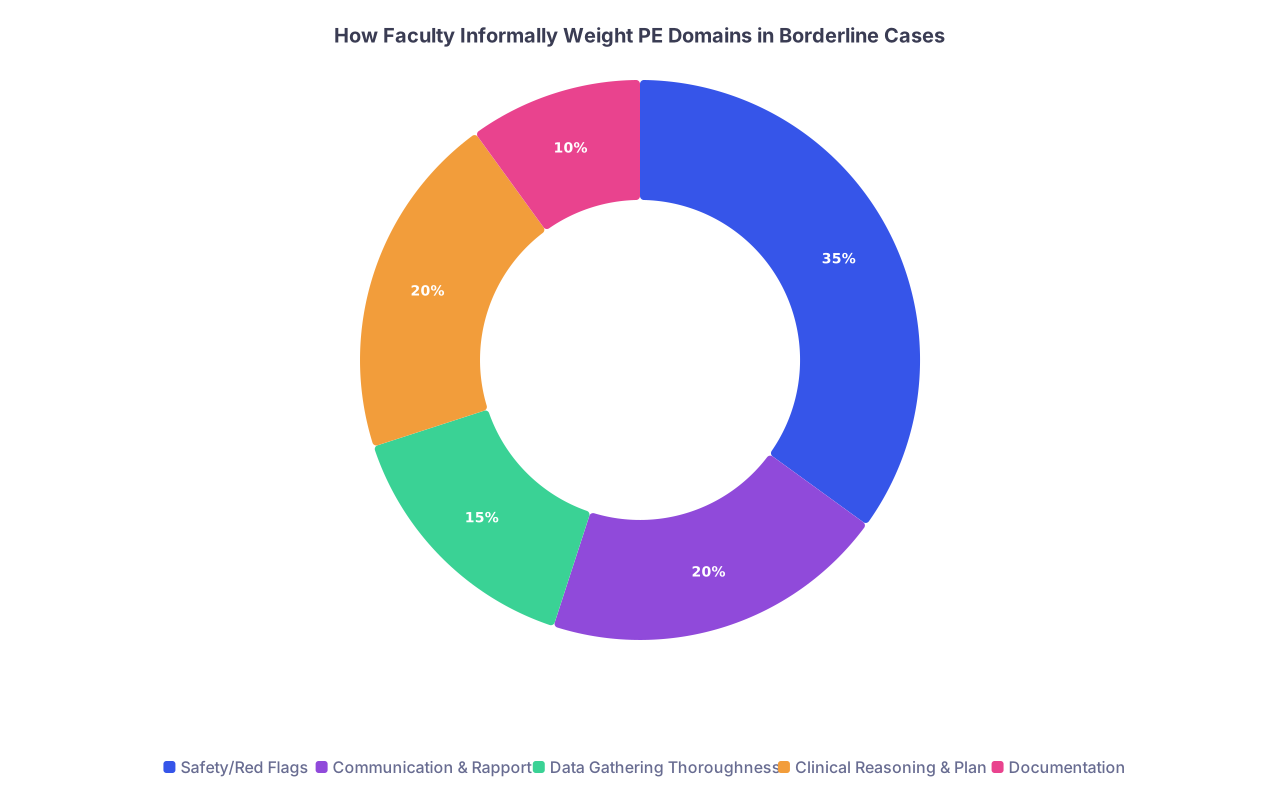
| Category | Value |
|---|---|
| Safety/Red Flags | 35 |
| Communication & Rapport | 20 |
| Data Gathering Thoroughness | 15 |
| Clinical Reasoning & Plan | 20 |
| Documentation | 10 |
Those official rubrics you see? They’re partially real, but decision-making is more lopsided than anyone admits. In borderline cases, safety and trust dominate.
1. “Technically competent, but something feels off”
This is incredibly common. The student:
- Hits most of the history.
- Does a mechanically correct exam.
- Speaks politely, uses the right “empathy” phrases.
- Still leaves faculty uneasy.
How do attendings interpret this?
They look for authenticity vs. scripting.
I’ve sat in debrief rooms where faculty say things like:
- “They’re saying the right words, but I don’t think they’re actually listening.”
- “If something unexpected happened, I don’t trust they’d adapt.”
The big behind-the-scenes truth: a borderline encounter with good technical performance but robotic interaction usually gets coded as:
“This student will probably pass standardized tests but might struggle badly with real, messy patients.”
So on a Step 2 PE–style rubric, they’ll pass you on communication. But in comments, they’ll write: “Needs to work on genuine rapport and flexibility,” which in committee translation means: “Borderline—keep an eye on them.”
Practically: You do not get failed for being awkward. You get watched. If later there’s a real professionalism complaint or patient complaint, that borderline skills exam becomes supporting evidence.
2. Incomplete history or physical: what they actually care about
Here’s where student and faculty priorities usually don’t line up.
Students obsess over whether they remembered every part of the ROS or did a perfect neuro exam. Faculty care about something else:
Did you miss anything that could kill or permanently harm the patient?
I watched a case grading discussion that went like this:
- Student A missed 3-4 minor ROS items but asked about chest pain red flags and did a decent cardio exam.
- Student B did a gorgeous, comprehensive ROS, then forgot to ask about exertional symptoms and didn’t check lower extremities for DVT signs in a concerning case.
Which one was borderline? Student B.
Faculty logic is blunt:
- Systematic but shallow on danger = borderline unsafe.
- Imperfect but clearly thinking about safety = acceptable, needs polishing.
When your encounter gets called “borderline” in this domain, faculty are often reading it as:
“Does this student have a danger-sense? Do they recognize when something might be more than a routine ‘clinic complaint’?”
If the answer is no—if you treat everyone like they have benign musculoskeletal pain—that's what scares them.
3. Clinical reasoning: the part that’s almost never explained to you
Most schools pretend clinical reasoning is this vague, holistic thing. Behind closed doors, what faculty really ask when they see your assessment/plan from a borderline encounter is:
- “Does this differential make sense for this level of training?”
- “Did they show they know what can’t be missed?”
- “Are they overconfident in a wrong answer, or just incomplete?”
Two specific patterns faculty hate:
Very confident, very wrong
- Student says: “This is 100% GERD, no need for further workup” in a red-flag chest pain scenario.
- Faculty translation: “This person will hurt someone.”
- Even if everything else was okay, this can push an encounter into “borderline concerning” or worse.
List of 10 diagnoses, no prioritization
- Student writes an impressive shotgun differential but doesn’t identify the probable or dangerous one.
- Faculty reaction: “They studied, but they don’t think like a clinician yet.”
A borderline reasoning performance with appropriately cautious language (“I’m concerned about X; I also want to consider Y and Z, and I’d rule out serious causes by doing…”) is interpreted far more generously than a flashy, overconfident but misguided assessment.
If you sound teachable and aware of uncertainty, borderline gets labeled as “developing.” If you sound arrogant and wrong, borderline becomes “liability.”
The Three Types of Borderline Encounters That Worry Faculty
Not all borderline performances are equal. There are three recurring types that trigger real anxiety in attendings and clerkship directors.

Type 1: The “Nice but Lost” Student
Every faculty member has a soft spot for this one. The encounter looks like:
- You’re kind, you sit, you listen.
- The patient feels heard.
- But your differential is thin and your plan is vague.
In meetings, this sounds like:
- “Lovely with patients, but clinically behind.”
- “They’re going to need hand-holding intern year.”
Interpretation: remediable, not dangerous—as long as you’re not also missing obvious red flags. This type of borderline will usually be met with extra feedback, more supervision, maybe mandatory coaching. People want you to succeed.
But here’s the secret: if two or three evaluations mention this pattern, residency committees absolutely notice. You’ll get boxed as “pleasant, average, not a standout,” which matters if you’re aiming at competitive specialties.
Type 2: The “Smart but Prickly” Student
You know this person. Maybe you are this person.
- Strong fund of knowledge.
- Finds the right diagnosis.
- But interrupts the patient, brushes off concerns, or has an edge of impatience.
On paper, the rubric might show “meets expectations” or “borderline” on communication. In reality, faculty are saying:
- “This student will clash with nurses.”
- “I wouldn’t send them to see a difficult family.”
This type of borderline is taken much more seriously than you think, because faculty have been burned before. They’ve watched a technically strong but abrasive resident get multiple complaints and drag down team morale.
Between a “nice but lost” borderline and a “smart but prickly” borderline, most program directors will choose the former 9 times out of 10. Nobody tells students that.
Type 3: The “Pattern of Sloppiness”
This is the one that actually sinks people.
On a single PE-style encounter, it looks like:
- Forgot to wash or sanitize hands.
- Missed introducing self or confirming patient name.
- Disorganized questioning that jumps around with no structure.
- Key elements of the exam completely omitted without explanation.
- Unclear plan that doesn’t address the main concern.
One sloppy encounter on a bad day? You’ll get nudged, maybe remediated. But when this same style shows up in multiple OSCEs, SP comments, and real patient feedback, faculty mentally move you from “borderline” to “liability in progress.”
And when they interpret a borderline encounter through that lens, they’re not analyzing checklists. They’re thinking: “We’ve told this student three times. Why is this still happening? Is this laziness? Is this insight problem?”
That’s when borderline becomes dangerous for promotions, MSPE language, and letters.
What Borderline Actually Does to Your Record and Reputation
Let me demystify something that haunts students: what actually ends up in the file.
Most schools will not stamp “failed” or “borderline” directly onto your transcript for one iffy PE-like station. But there are three places it can leak into your long-term record.
| Where It Appears | How Explicit It Is |
|---|---|
| OSCE narrative comments | Often very explicit |
| Clerkship evaluation comments | Subtle but visible |
| MSPE (Dean's letter) language | Indirect, coded phrases |
| Internal promotions file | Very explicit, not public |
OSCE and skills exam comments
These are usually detailed. Standardized patients will write things like:
- “Student did not ask about my concerns.”
- “Student seemed rushed and didn’t explain tests.”
Faculty see every word of those narratives. When they see “borderline” in the numeric score and those kinds of comments, the interpretation is:
“This is not just test anxiety. This is how you actually behave with people you think are ‘low-stakes’.”
And yes, that matters.
Clerkship comments and the “coded” language
By fourth year, almost nobody writes “borderline” directly in official comments. But the language gets coded:
- “With continued growth, will become a strong clinician.”
- “At times needed prompting to fully develop differential.”
- “Benefited from supervision in managing complex interactions.”
Those phrases often grow out of a pattern that includes borderline PE/OSCE performance plus borderline on the wards. Residency PDs can read that code fluently.
MSPE (Dean's letter)
No dean is going to write: “This student had a borderline Step 2 PE mock exam.”
But if your school has a major clinical skills remediation or a repeated OSCE, that often gets folded into generic phrasing like:
- “The student required additional development in clinical skills early in the third year, which improved with targeted coaching.”
Faculty on selection committees absolutely ask: “What does that mean?” Especially if you’re applying to a field where communication and safety are critical.
How To Turn a Borderline Encounter Into an Asset (Yes, Really)
Here’s the part nobody tells you: faculty don’t expect perfection. They expect trajectory. A borderline encounter, handled well, can actually improve how they see you.

| Step | Description |
|---|---|
| Step 1 | Borderline PE Encounter |
| Step 2 | Negative pattern reinforced |
| Step 3 | Targeted feedback |
| Step 4 | Deliberate practice on weak areas |
| Step 5 | Visible improvement on later rotations |
| Step 6 | Positive narrative in MSPE and letters |
| Step 7 | Student reaction |
What faculty love to see is this sequence:
- You get difficult feedback from a borderline encounter.
- You ask for specifics without arguing.
- Next OSCE or rotation, they see concrete change.
When that happens, the story in their heads changes from:
“Borderline student.”
to
“Student who takes feedback seriously and improves fast.”
Which, frankly, is more attractive to residency programs than the naturally gifted student who coasts and plateaus.
Concrete ways faculty judge your response
When they’ve flagged an encounter as borderline and you come for feedback, faculty are silently scoring your reaction:
- Do you blame the SP, the case, the time pressure? (Huge red flag)
- Do you show you’ve reflected accurately on what happened?
- Are you asking for strategy, or just venting?
If you walk in saying, “I think I lost the thread when the patient started crying; I wasn’t sure how to get back to the history,” that tells them you’ve already done half the work. They’ll invest in you.
If you say, “The SP was just difficult, and the time limit was unrealistic,” you’re confirming their worst fears about your insight and professionalism.
And yes, I’ve watched more than one student go from “maybe needs remediation” to “strong letter candidate” based almost entirely on how they handled a borderline performance and the work they put in over the next 2–3 months.
How to Prepare So You Don’t End Up in the Borderline Bucket
This is the part you actually care about: what to do differently before these encounters.
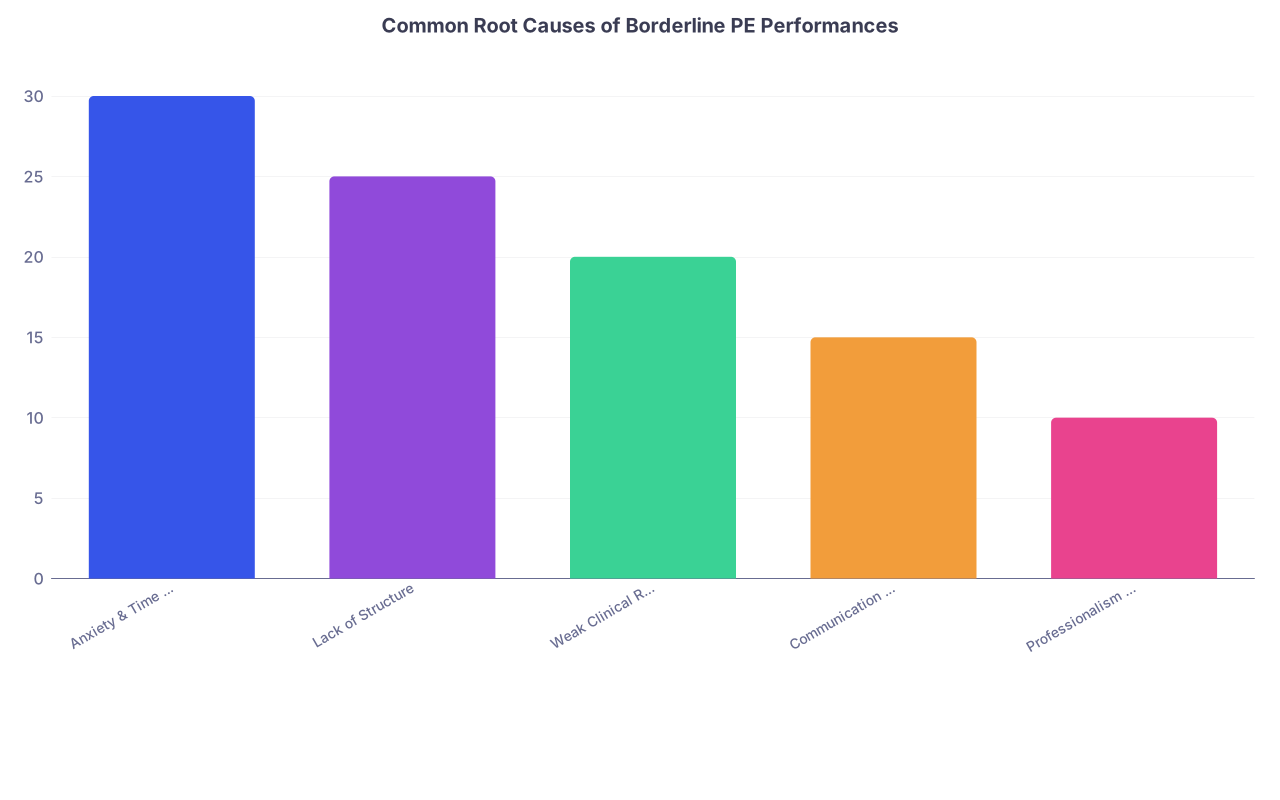
| Category | Value |
|---|---|
| Anxiety & Time Pressure | 30 |
| Lack of Structure | 25 |
| Weak Clinical Reasoning | 20 |
| Communication Blind Spots | 15 |
| Professionalism Slips | 10 |
Stop trying to be “perfect”; be reliably safe
Faculty are not scoring artistry. They’re scoring safety and reproducibility.
That means your prep should focus on:
- Having a simple, rigid structure for every encounter: open, agenda, focused HPI with red flags, targeted exam, summary, plan, close.
- Always, always scanning for “could this be something dangerous?” and asking the few critical questions that show you thought of it.
You don’t need 25 checklist items. You need a handful of non-negotiables that never slip, no matter how anxious you feel.
Practice handling weird moments, not just canned cases
Most students rehearse ideal scenarios. Faculty and SPs are trained to break your script.
Common things that push people into borderline territory:
- Patient starts crying or gets angry.
- You run out of time halfway through your exam.
- You forget a piece, realize it late, and panic.
In faculty talk, the evaluation here is:
“Do they adapt or implode?”
So your preparation has to include role-plays where things go sideways and you practice simple recovery lines like:
- “I know we’re short on time, but there are a few important safety questions I want to make sure to ask before we finish.”
- “I can see this is really upsetting; let me pause for a moment and make sure I’m understanding what’s worrying you most.”
That’s the kind of behavior that turns a technically borderline encounter into a narrative of “handled adversity well.”
The Uncomfortable Truth: Faculty Are Watching for Patterns, Not Episodes
Let me end with something blunt.
No one’s career is made or broken by a single borderline Step 2 PE–style encounter. Faculty know these are artificial, clunky, test environments. Everyone has an off day.
What faculty are hunting for is consistency:
- Does this borderline OSCE match what nurses say on the floor?
- Does it match what real patients write in comments?
- Does it match how you behave when you think nobody important is watching?
When all those line up, that’s when borderline becomes “we need to intervene,” and possibly “we need to warn residency programs diplomatically.”
So your job is not to fear the one bad case. Your job is to:
- Learn exactly how they’re reading it.
- Take that feedback seriously but not personally.
- Make sure the next 5–10 patient interactions tell a completely different story.
Faculty remember the storyline more than they remember a single simulated patient.