
You cannot “wing” the physical exam for Step 2-style encounters and get away with it. The fantasy that your “natural clinical skills” will cover the gaps is exactly how otherwise smart students fail OSCEs, remediation exams, and high-stakes clinical skills assessments.
Let me be blunt: the students who tell you, “Don’t stress, the physical is easy, they just want basics,” are often the same ones who quietly end up in remediation or barely pass.
This myth survives for three reasons:
- Most schools do a terrible job giving you hard feedback on your exam technique.
- Your real patients are too polite to tell you that your exam was incomplete or sloppy.
- The grading system for OSCE/Step 2 PE–style encounters is checklist-based, not vibes-based.
You’re being judged on what you do, not on how confident you look doing it.
Let’s tear this apart properly.
The Myth: “If You Know the Medicine, the Physical Exam Will Take Care of Itself”
I’ve heard this exact line in student workrooms:
“If you can reason through the case and talk confidently, the physical exam doesn’t really matter. They only want you to check a few boxes.”
Wrong. Technically half-true, which makes it more dangerous.
In a standardized encounter (OSCE, school SP exam, or any Step 2 PE–style test), there are three separate but linked skill sets being graded:
- History and communication
- Physical exam
- Organization / reasoning / documentation
Most students intuitively respect the first and third. They know they have to sound coherent, structure their questions, present a differential. But they treat the physical exam like a formality.
Here’s what the data from school OSCE rubrics and old Step 2 CS/PE scoring models actually showed (and current institutional exams still use similar logic):
- Physical exam checklists routinely carry 20–40% of the total station score.
- Missed critical maneuvers can drop you below passing despite a good history.
- Overly broad/unfocused exams are specifically penalized as “inefficient” or “unfocused.”
In other words, the physical exam is neither optional nor something you can improvise on the fly. It’s a scoring domain with structure, triggers, and predictable failure modes.
What These Exams Actually Reward (and Punish)
These encounters are not judging you like a seasoned attending would. They’re using standardized checklists, often built by committee. That means you’re not being graded on “clinical intuition.” You’re being graded on whether you reliably produce a minimum standard of care in a predictable way.
Here’s how it usually breaks down behind the curtain:
| Domain | Approx. Weight | Examples of Items Scored |
|---|---|---|
| Data Gathering (Hx) | 30–40% | OPQRST, ROS, risk factors |
| Physical Exam | 20–40% | Focused maneuvers by complaint |
| Communication/PEP | 20–30% | Empathy, organization, clarity |
| Documentation/Reasoning | 10–20% | Note structure, differential |
Old Step 2 CS data (before it was discontinued) plus internal med school assessments consistently showed the same pattern:
- Students rarely failed on “knowledge alone.”
- They failed on systems: missing core maneuvers, disorganized approach, poor closure, or no documentation logic.
The physical exam sits right in the middle of that mess. It’s where “I’ll just wing it” collides with a checklist that doesn’t care how smart you are.
The Real Problem: Your Clinical Rotations Are Lying to You
Rotations train you for the attending’s eye, not the examiner’s checklist.
On wards and in clinic:
- You cut corners because you’re busy.
- Attendings accept “pertinent findings only” on presentations.
- Nobody watches your actual hand placement or sequence for most exams.
- The team is impressed if you can interpret, not just collect data.
So you internalize: “As long as I sound smart, the rest will follow.”
On exams, the equation flips.
Standardized patients and examiners are literally trained to look for:
- Did you expose appropriately?
- Did you compare bilaterally?
- Did you auscultate the correct locations?
- Did you test the right neuro components for this complaint?
- Did you wash or gel your hands every time?
Your fellow students might shrug at missing tactile fremitus or not checking for costovertebral angle tenderness. But in a checklist world, each of those is not “style.” It’s a lost point.
And enough lost points becomes: “Borderline pass” or “unsatisfactory encounter.”
What “Winging It” Looks Like in Reality
Let me show you the common “I’ll wing it” patterns I’ve seen in real OSCE review sessions.
1. The Kitchen-Sink Exam
Student panics and thinks: “I don’t know exactly what to do, so I’ll just do everything.”
So they:
- Listen to heart in three positions
- Auscultate lungs front and back
- Palpate abdomen superficially and deeply
- Check peripheral pulses
- Do a quick neuro screen
- Maybe even check for edema or JVD “just in case”
Result:
- They run out of time.
- They never test the range of motion for the painful shoulder.
- They don’t inspect the rash up close.
- They miss the one critical maneuver the case writer wanted.
They feel thorough. They score poorly.
2. The Charismatic Talker
Student is personable and talks well, but the exam is theater: stethoscope taps, one-second auscultation, random palpation with no structure.
The SP checklist, unfortunately, doesn’t give “style points” for looking confident. It’s marking:
- Did you check for rebound?
- Did you test cranial nerves relevant to the complaint?
- Did you perform special tests (e.g., straight leg raise, Homan’s, Phalen’s) when appropriate?
If you skip or half-do maneuvers, you might as well not have done them at all from a scoring standpoint.
3. The Memory Fog
Student knows the correct maneuvers… in theory. But under time pressure, the sequencing falls apart.
Classic example: neurologic exam for unilateral weakness.
What should happen (at minimum):
- Inspect, tone, bulk
- Strength testing proximal and distal, both sides
- Reflexes (at least 2+ levels)
- Sensation (light touch ± pinprick)
- Coordination (finger-nose, heel-shin)
- Gait, if safe and feasible
What “winging it” looks like:
- Quick strength on one side only
- Reflexes in one limb
- No sensory testing
- “Follow my finger” lumped in with “neuro exam” and called a day
The student walks out thinking: “I did a neuro exam.” The checklist thinks: “You did 30–40% of one.”
How These Exams Were Actually Passed (Back When Step 2 CS Existed)
When Step 2 CS was active, the pass rate for U.S. MD students hovered around 95–97%, which people love to quote as proof you can coast. That number is misleading.
Several important truths were hiding under that glossy pass rate:
- IMGs and DOs had significantly lower pass rates. Why? Less standardized exam training early on, more variability in bedside teaching, less rehearsed checklists.
- Failures clustered in specific domains: communication and physical exam. Not “raw knowledge.”
- Students who failed once were at much higher risk of failing again unless they systematically retrained their exam habits.
Training centers that specialized in CS prep didn’t sell content. They sold structure:
- Structured checklists by chief complaint
- Standardized phrasing and flows
- Timing drills for complete H&P in 15 minutes
Students who used them often jumped from borderline to comfortably passing. Not because they suddenly got smarter. Because they stopped winging the physical exam and turned it into a reproducible algorithm.
Your school’s OSCEs and Step 2–style practicals work on the same logic, even if the branding changed.
What a “Non-Winged” Physical Exam Actually Looks Like
If you want to stop kidding yourself, your physical exam for Step 2/OSCE needs three things:
- Complaint-based templates
- Hard-wired sequences
- Practiced timing
Let’s be concrete.
Say the chief complaint is chest pain. Your physical exam template should basically be plug-and-play:
- General: appearance, distress, vitals (verbal if not available)
- Heart:
- Inspect chest
- Palpate (heaves, thrills, PMI if time)
- Auscultate all four standard areas, diaphragm ± bell
- Lungs:
- Inspect
- Auscultate posterior and anterior fields
- Vascular:
- Peripheral pulses (radial ± pedal)
- Edema check
- Jugular venous distention if indicated
- Focused extras:
- Reproducibility of chest wall tenderness (MSK cause)
- Carotid auscultation if thinking vascular disease
You should not be figuring this out in the room. You should have rehearsed the sequence so many times that your body does it while your brain thinks.
Same for:
- Abdominal pain
- Shortness of breath
- Weakness / numbness
- Joint pain
- Headache
- Back pain
Each of those should have a short, memorized exam script. Not “I sort of know what to do.” Script. Sequence. Muscle memory.
The Time Trap: Why “I Know the Exam, I Just Ran Out of Time” Is Still Your Fault
Physical exams on these encounters are designed to be just barely doable in the time allotment if you’re organized.
Most SP encounters give you something like 10–15 minutes for complete H&P. That’s not an accident. It forces prioritization.
Let’s talk numbers.
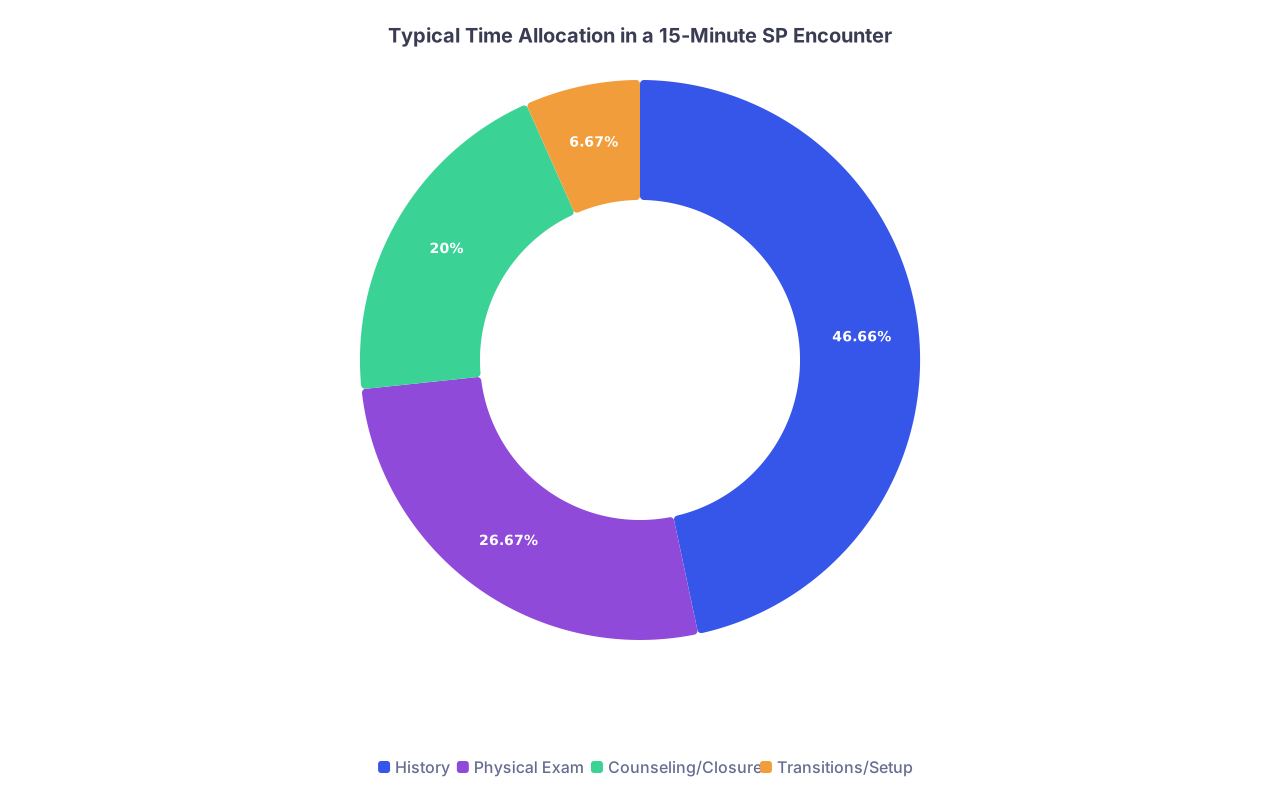
| Category | Value |
|---|---|
| History | 7 |
| Physical Exam | 4 |
| Counseling/Closure | 3 |
| Transitions/Setup | 1 |
If you:
- Spend 11 minutes on a wandering history
- And 1 minute on a half-hearted exam
- And 3 minutes trying to jam in counseling
You did not “just run out of time.” You mismanaged the encounter.
The solution is not to become faster in some vague way. It’s to:
- Limit history once you have a working differential (and you must decide).
- Commit to a focused, pre-planned exam template for that complaint.
- Stop adding tests “just in case” because you’re anxious.
That only happens if you’ve drilled this ahead of time.
What You Actually Need to Practice (Not Just Read)
Reading Bates or watching YouTube exam videos is not practice. It’s theory.
For a Step 2 PE–style physical exam, you need deliberate, repetitive, slightly uncomfortable practice:
-
- Trade roles as “SP” and “student.”
- Use real cases or school practice stems.
- Force yourself into full speed: full intro, focused history, focused exam, closure, in 15 minutes or less.
- Then ruthlessly critique each other on missed maneuvers and awkward flow.
Mirror/Wall Rehearsal
- Yes, it’s awkward. Do it anyway.
- Talk through your exam out loud: “I’m going to start by listening to your heart in these four areas…” while moving your hands as you would.
- You’re training sequence, wording, and hand placement.
Checklist to No-Checklist Transition
- Start with printed exam templates by complaint.
- Run them slowly, line by line.
- Gradually hide the checklist and see what you remember.
- Add speed after accuracy.
You’re not building “memorization.” You’re building automaticity. There’s a difference.
When Is It Enough? How to Know You’re Not Winging It Anymore
You’re no longer winging the physical exam when:
- You can walk into a chest pain case and, without thinking, perform a consistent cardio-pulm-vascular exam in under 4–5 minutes.
- You have a distinct mental template for neuro versus MSK versus abdominal versus respiratory complaints.
- Your SP or partner can follow a checklist and you consistently hit 80–90% of the items without them saying anything.
If you’re still “deciding” what to examine after you enter the room, you’re not there yet.
You need to be thinking:
“Chest pain → Template A.”
“Right leg weakness → Template B.”
“RUQ abdominal pain → Template C.”
Then you adapt at the margins, not rebuild from scratch.
Quick Reality Check: Isn’t Step 2 CS Gone?
Yes, Step 2 CS is gone. But the skills are not.
Schools replaced it with:
- Internal OSCEs that you can fail.
- Graduation OSCEs.
- Clinical competency evaluations.
- Some schools even have external standardized exams that feel suspiciously CS-like.
And even beyond exams: residency programs absolutely notice if you can’t do a coherent, focused physical on day one. It shows up on your evaluations quickly.
“Can I wing it?” sure, for one or two friendly patients on a slow afternoon.
“For a standardized, watched, timed, checklist-based exam?” No. That’s self-sabotage.
Key Takeaways
- Physical exams in Step 2-style encounters are graded by checklists and structure, not by how confident or “clinical” you look.
- Winging it usually means: unfocused, incomplete, or mistimed exams that quietly bleed points and turn into borderline or failing performances.
- You need complaint-based exam templates, drilled to the point of muscle memory, with real-time practice under time pressure—not just watching videos or trusting your rotation habits.
FAQ (Exactly 5 Questions)
1. If my school OSCEs have been fine so far, do I really need to change anything?
Maybe, maybe not. If you’ve consistently scored well and you can describe clear, complaint-based exam templates you actually use, you’re probably ok. If your “strategy” is mostly, “I go in and see what feels right,” then your passing so far says more about lenient grading than solid skills. Treat upcoming high-stakes exams as stricter versions of what you’ve already seen.
2. How many different physical exam templates do I realistically need?
You do not need 50. For Step 2-style encounters, having solid, automatic templates for about 8–10 chief complaints covers most cases: chest pain, shortness of breath, abdominal pain, headache, weakness/numbness, back pain, joint pain, fever/infection, psych complaint, and pediatric visit. Each template is just a slightly customized version of core systems you already know.
3. Is doing a super-comprehensive exam ever safer than a focused one?
No. Overly broad exams burn time, signal disorganization, and often cause you to miss the critical maneuver the case was built around. Examiners don’t reward “volume.” They reward relevance. A tight, targeted exam that nails the key findings will always score better than a scattered kitchen-sink production.
4. How do I practice if I do not have access to standardized patients?
Use what you have. Classmates, partners, friends, even a pillow for hand placement and sequence. The key is not realism; it’s repetition under time pressure with feedback. Use online OSCE cases, set a timer, talk out loud, and record yourself if possible. Then nitpick: look for missed steps, awkward transitions, and wasted motion.
5. Do residency programs really care how polished my physical exam is if I know the medicine?
Yes. Maybe not in the romantic “old-school diagnostician” way, but in a very practical one. Poor exam skills correlate with disorganized thinking, weak data gathering, and over-reliance on imaging and labs. Attendings notice. Evaluation language like “needs to work on focused physical exam” is code for “I don’t fully trust their clinical judgment yet.” Fixing that before residency is a gift to your future self.