
The hype around Step 2 group study is massively overblown. Most group sessions help your social anxiety more than your score.
Let me be blunt: for a lot of students, “group study for Step 2” is structured procrastination with friends. It feels productive. It rarely is. But there are very specific ways group work can give you an edge—if you’re ruthless about how you use it.
Let’s slice through the mythology and talk about what actually helps your score, not your vibes.
What Step 2 Actually Tests (And Why That Matters for Groups)
Step 1 used to be the boogeyman. Now that it’s pass/fail, Step 2 CK is the number that can make or break applications—especially for competitive specialties. So you’d think people would be smarter about how they prep.
They aren’t.
Step 2 is not testing:
- Your ability to recall Anki cards in front of classmates
- How many hours you can sit in a library with other people
- How well you “review” together
It is testing:
- Clinical pattern recognition under time pressure
- Prioritization: what do you do first, what do you not do
- Management decisions consistent with guidelines
- Interpretation of labs, imaging, vignettes
- Stamina over 8+ hours of reading dense text
None of that inherently requires a group. Step 2 is an individual, timed, decision-making exam. So any group work you do has to map to that reality.
Here’s the uncomfortable truth: most group study formats do not resemble test-day thinking at all.
What the Data (Actually) Says About Group Learning
There’s a lot of sloppy extrapolation from “group learning is good” to “group Step 2 review will help me.” Those aren’t the same claim.
What the evidence supports:
- Team-based learning (TBL), problem-based learning (PBL), and small-group case discussion can improve understanding, retention, and engagement in preclinical or didactic contexts.
- Peer teaching can solidify knowledge for the person doing the teaching.
- Social accountability can increase time-on-task for some students.
What the evidence does not clearly show:
- That generic, student-organized “study groups” raise standardized exam scores more than well-designed individual practice using high-quality questions and explanations.
- That being in a group magically fixes low question volume, poor review habits, or lack of spaced repetition.
Most Step 2 score gains in the literature and in real life come from:
- High-yield question banks (UWorld, NBME forms)
- Deliberate error review
- Sufficient question volume (thousands, not hundreds)
- Time management practice in timed blocks
Groups can support some of this. They can also destroy it.
The Common Group Study Myths (And Why They’re Wrong)
Myth 1: “Explaining things to others always helps you learn”
Partially true, heavily abused.
Teaching does improve retention—for the teacher. The ones actively explaining, troubleshooting, and synthesizing gain the most. The others half-listening and nodding along? Not as much.
I’ve watched groups where:
- One strong student basically tutors three classmates for two hours
- The three others feel good because “we went over hemodialysis indications”
- The tutor is exhausted and gets behind on their own UWorld blocks
Who won there? Maybe the tutor (if they weren’t already solid). The others mostly outsourced their thinking.
If your version of “group study” is:
- One person explaining, others “learning”
- Slides and mini-lectures
- Passive listening
…it’s not Step 2 prep. It’s unpaid tutoring plus passive consumption.
Myth 2: “Group review makes me more efficient”
Often the opposite.
In a 2-hour “review session,” I’ve seen groups cover:
- 8–10 UWorld questions
- Long tangents about residents, attendings, rotations
- Arguments about super-rare zebras with no exam relevance
Compare that to a solo, focused student doing:
- 40 timed questions in 1 hour
- 1–1.5 hours of targeted review with notes
That’s 4–5x the question volume and far more exposure to patterns. Step 2 is a pattern-recognition game. Volume matters.
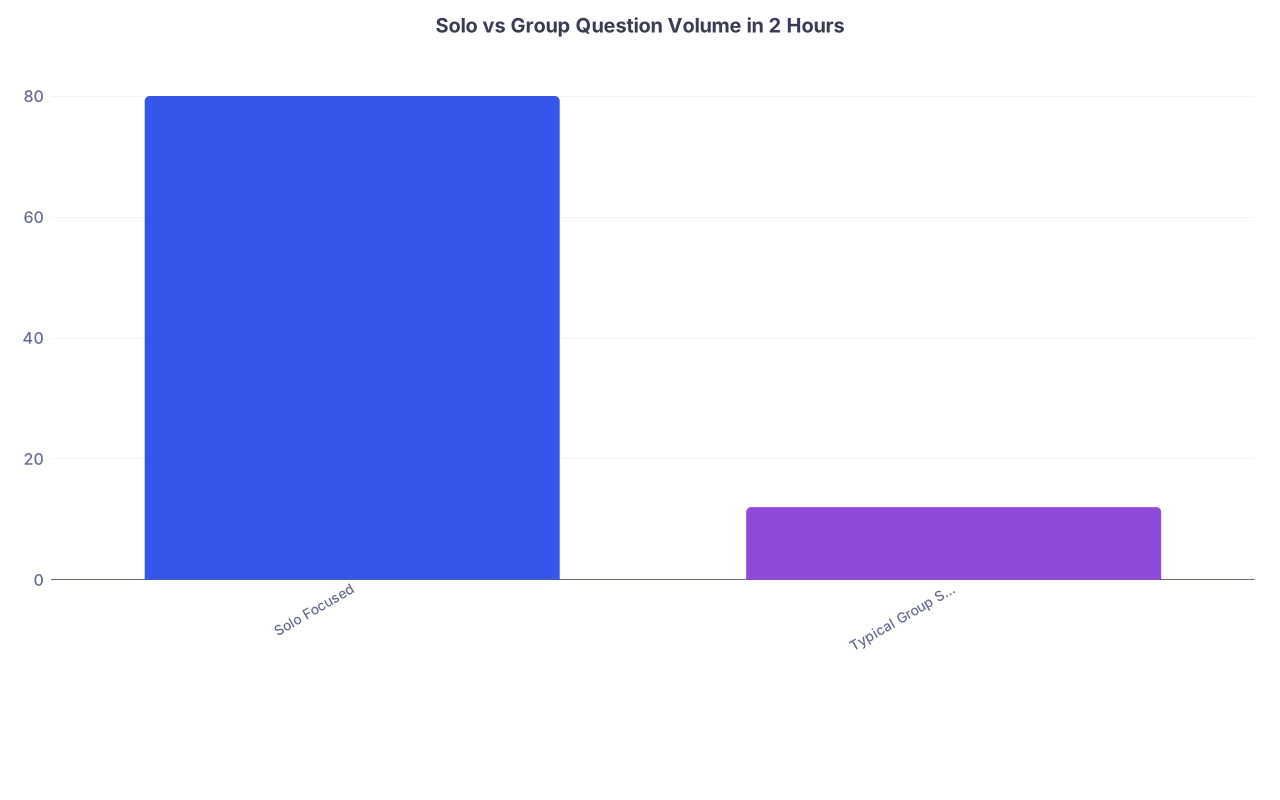
| Category | Value |
|---|---|
| Solo Focused | 80 |
| Typical Group Session | 12 |
Group efficiency is a myth unless the group is brutally structured.
Myth 3: “Study groups keep me accountable”
Sometimes. Sometimes they enable denial.
I’ve heard all of these:
- “We’re meeting every night, so I must be doing enough.”
- “I don’t have time for full blocks because we have our group from 6-9.”
- “We’ll go over the stuff I missed in UWorld later with the group.”
That is not accountability. That’s hiding in a crowd.
Real accountability looks like:
- You did your own timed blocks before the group
- You track your personal weaknesses and attack them
- You use the group to fix your gaps, not to pretend you don’t have them
If you’re using the group as your primary study method, your score ceiling just dropped.
When Group Study Actually Helps Step 2 (And When It Hurts)
Group work isn’t useless. But it’s narrow. It shines in a few specific scenarios.
Helpful: Clarifying management frameworks
Step 2 loves “what’s the next best step” questions. These often follow predictable algorithms:
- Chest pain: EKG → troponin → risk stratification
- Trauma: ABCs, imaging, surgical consults
- Prenatal care: timeline of labs, imaging, vaccines
Working through these decision trees out loud with peers can solidify mental flowcharts. A good session might be:
- One person presents a UWorld or NBME-style vignette from memory
- Group identifies key data: unstable vs stable, red flags, what’s missing
- Together, you construct: what’s the first thing, what’s contraindicated, what can wait
That’s productive. Because it’s modeling test-day thinking.
Helpful: Short, targeted concept repair
If you’re repeatedly missing:
- Acid-base interpretation
- Vent settings
- Types of shock
- Murmurs and maneuvers
A 30–45 minute focused mini-session with one or two peers to hammer just that topic using questions and quick whiteboard diagrams? That can be high yield.
Key word: focused. Not 3 hours of “IM review.”
Helpful: Final weeks, high-yield blitz
- Rapid-fire questions: “What’s the next step in…”
- Key drug side effects
- Don’t-miss diagnoses and red flags
You’re not learning from scratch here. You’re reinforcing and speed-testing. A group can be great for that—as long as everyone is already near exam-ready.
Now the flip side.
Harmful: Using group time to substitute for question volume
If you’re behind on:
- UWorld completion
- NBME forms
- Timed blocks
And your plan is “I’ll just go over questions with my group instead,” you’re throwing away score points. Secondhand questions don’t hit the same.
You need:
- Your own time pressure
- Your own guesses and mistakes
- Your own emotional response to “I have no idea”
Being told the answer or talking it out slowly is not the same neural load.
Harmful: Large, unfocused “review sessions”
Anything that looks like:
- 5–8 people crammed in a room
- No clear agenda
- “Let’s just go through some stuff”
- Laptops open, phones buzzing, side conversations
You’ll leave tired and falsely reassured. I’ve seen plenty of students in those groups bomb NBME practice tests. They thought hours spent together equaled preparation. It did not.
How to Design a Group Session That Actually Improves Your Score
If you’re going to do group work, treat it like a scalpel, not a security blanket.
Here’s a simple structure that works.

| Step | Description |
|---|---|
| Step 1 | Before Session |
| Step 2 | Timed Solo Questions |
| Step 3 | Identify Top Weak Areas |
| Step 4 | Start Group Session |
| Step 5 | 10 min: Set Agenda |
| Step 6 | 60-90 min: Targeted Questions & Discussion |
| Step 7 | 10 min: Summarize Key Takeaways |
| Step 8 | After Session: Solo Review & Anki |
Before the session (non-negotiable)
You do, alone:
- A timed block (20–40 questions, UWorld or NBME-style)
- Brief performance check: What topics/concepts are repeatedly weak?
- Bring 2–3 specific problem types you want to dissect
If you’re showing up without this, you’re expecting the group to do your thinking.
During the session
Max group size: 3–4. Past that, quality nosedives.
Rough format (60–90 minutes works well):
- 5–10 minutes:
- Each person names 1–2 specific targets (“I keep missing hyponatremia management,” “I screw up pregnancy imaging questions”).
- 45–60 minutes:
- Rotate through people’s flagged questions or topics.
- Use question stems (preferably unseen by most of the group) to frame discussion.
- For each: one person commits to an answer before discussion. Then dissect why.
- 10–15 minutes:
- Rapid “what did you learn today that you didn’t know before?”
- Each person writes down 3–5 micro-takeaways to review later.
Rules that keep it effective:
- No phones, no side browsing mid-question
- No slideshows—this isn’t a lecture
- No spending 20 minutes arguing on fringe stuff that’s unlikely to be tested
- If someone is consistently unprepared, you either coach them once or stop inviting them
You’re there to raise your Step 2 score, not run a free board review course.
After the session
You, alone:
- Convert takeaways into:
- 2–3 flashcards
- Short notes
- Or annotated UWorld explanations
- Get back to timed questions
The group is a supplement. The exam is still individual.
Who Should Avoid Group Study Entirely?
Some of you are better off never touching a group until maybe a 2–3 hour blitz the week before the exam.
You probably fall into that camp if:
- You’re easily derailed and hate confrontation. You won’t push the group back on track.
- Your baseline test-taking speed is slow; you’re already struggling to complete blocks on time.
- You’re introverted enough that social energy cost > any learning benefit.
- You’ve got significant home or rotation obligations—your study time is fragmented and sacred.
If you’re below your target NBME range with less than 4–6 weeks to go, your priority is simple:
Timed blocks. Review. Sleep. Repeat. Group work is optional at best, harmful at worst.
The One Table You Probably Need
Use this to be honest with yourself about what you’re actually doing.
| Aspect | High-Yield Solo Study | Typical Group Session |
|---|---|---|
| Question Volume (2h) | 40–80 questions | 8–15 questions |
| Time Pressure | Full, timed blocks | Rarely timed, lots of pausing |
| Focus on Weaknesses | Directly targeted by you | Diluted across group needs |
| Accountability | Self-tracked scores, schedules | “We met, so I studied” feeling |
| Cognitive Load | High, similar to test conditions | Lower, shared problem-solving |
| Social Energy Cost | Low | Medium–high |
If your “group study” looks like the right column and your NBME scores are stagnant, you know why.
So, Are Group Study Sessions Actually Helpful for Step 2?
The honest answer: usually no, occasionally very.
They help when:
- You’re already doing high-volume, high-quality solo work
- The group is small, focused, and agenda-driven
- You use it to sharpen decision-making and repair specific weaknesses
They hurt when:
- They replace your own timed question blocks
- They make you feel productive without moving your score
- They become social therapy disguised as prep
If you remember nothing else:
- Step 2 is an individual, timed, decision-heavy exam. Your prep should look like that.
- Group study is a tool, not a requirement. Use it surgically or skip it entirely.
- Judge any group session by a simple metric: did this increase my question volume, clarify my algorithms, or fix a real weakness? If not, it’s entertainment, not preparation.