
Grinding more hours for Step 2 CK is one of the most overrated strategies in medical school.
The hero story you hear on the wards goes like this: “I studied 10–12 hours a day for 8 weeks and my score jumped 40 points.” You almost never hear the other half: the people who did the same thing, torched their sleep, burned through UWorld twice, and barely moved their score. Or even dropped.
Let me be blunt: beyond a certain point, adding more hours is a very inefficient way to raise your Step 2 CK score. And in a lot of cases, it quietly makes things worse.
You are not graded on suffering. You are graded on performance under time pressure in a specific cognitive domain. The data – from cognitive science, from board prep studies, and from what we repeatedly see in students – is brutally clear: how you use your hours matters far more than how many you log.
Let’s dismantle the “more is always better” myth.
The Data: Time Spent vs Performance Is Not Linear
Everyone thinks Step studying is like a paycheck: more hours in, more points out. Reality is more like weightlifting: add smart training, you grow; add too much, you get injured and stagnate.
Cognitive psychology has been beating this drum for decades: practice has diminishing returns and becomes actively harmful when done in a fatigued, low-quality state.
On Step 2 CK, that plays out in a few ways.
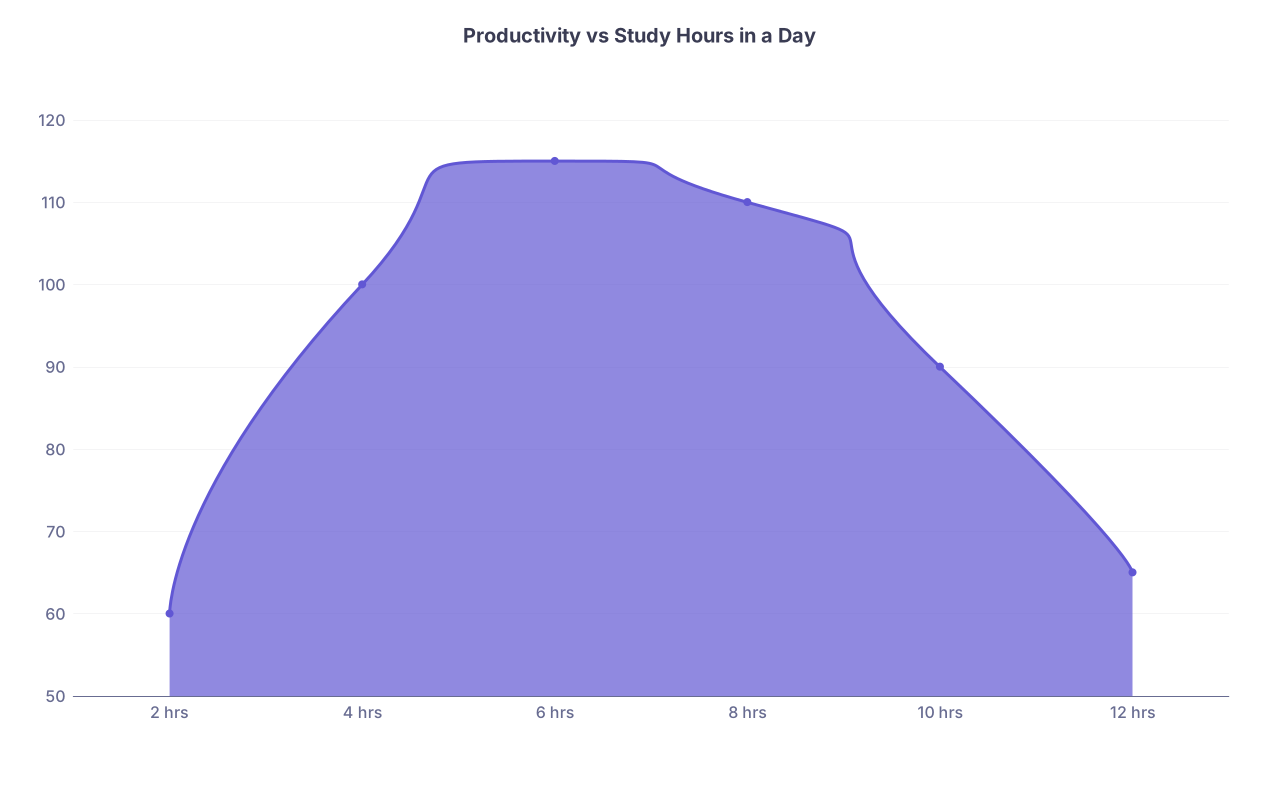
| Category | Value |
|---|---|
| 2 hrs | 60 |
| 4 hrs | 100 |
| 6 hrs | 115 |
| 8 hrs | 110 |
| 10 hrs | 90 |
| 12 hrs | 65 |
This is a stylized curve, but it matches what I’ve seen repeatedly:
- Most students’ best net learning sits around 4–7 focused hours of real work per day.
- Above that, total hours go up, but useful retention and problem-solving ability start to flatten or fall.
- Past 9–10 hours of “studying,” a lot of what you’re doing is rereading, zoning out, and panic-reviewing – not building durable knowledge.
The USMLE doesn’t care what your Google Calendar says. It only cares what’s available in your brain at question 267 on test day.
Myth: “If My Practice Scores Are Stagnant, I Just Need More Hours”
No. If your practice scores are stagnating, you need different hours.
I’ve watched students do 80–100 questions a day, 7 days a week, for a month. Then their NBME is identical to the prior one. They respond by… adding another 20 questions a day.
That is not strategy. That is superstition.
The question you should be asking isn’t “How many hours?” but “What actually moves my score?” The data from learning science is boringly consistent:
- Active retrieval beats passive review.
- Spaced repetition beats cramming.
- Mixed practice (interleaving topics) beats blocks of single-topic drilling after you have basic understanding.
- Sleep and recovery amplify consolidation; chronic sleep debt wrecks it.
Notice what’s not on that list: “Staring at UWorld explanations for 6 extra hours.”
Where “More Hours” Starts Hurting You
There are three big ways excessive hours tank Step 2 CK performance.
1. Sleep Debt: The Silent Score Killer
People love to flaunt their “I studied until 2 a.m.” stories like war medals. Neurocognitive data says otherwise.
Sleep loss reliably impairs:
- Working memory
- Processing speed
- Attention and vigilance
- Complex decision-making
Exactly the skills Step 2 CK is testing.
There are controlled studies showing that being awake for 20–24 hours impairs performance comparable to a blood alcohol level in the 0.08% range. You would not show up drunk to your exam, but many students show up functionally similar because “I just had to get in one more pass of OB.”
Let’s be concrete. If you’re chronically getting 5–6 hours of sleep trying to hit 10–12 study hours daily, your “extra” hours are often trading away score-critical brain function.
I’ve seen this in real time: A student running 6 hours of sleep nightly improved their NBME by ~3 points over 3 weeks. Then they cleaned up their schedule, locked in 7.5–8 hours, dropped total study to ~6 solid hours/day. Their next NBME? +11 points in two weeks. Content didn’t magically change. Their brain did.
2. Cognitive Overload and Fake Learning
The brain doesn’t store infinite high-yield pearls per day just because you want it to. There is a saturation point.
What overloaded studying looks like:
- You review the same explanation 3 times and still can’t recall it 2 days later.
- Every endocrine question blurs together because you “reviewed” 60 diabetes questions in one sitting.
- You do 40 questions after dinner and cannot remember more than 2 of them the next morning.
That is not “hard work.” It is evidence you’ve crossed into cognitive overload. New information is being processed superficially and dumped.

Deep learning on Step 2 CK needs:
- Time to connect a new fact to what you already know.
- Repeated retrieval spaced out over days.
- Enough mental freshness to actually think through pathophysiology, not just memorize “buzzwords.”
Endless hours of half-foggy question review actively block that process. You feel busy, but you are not building a test-day-ready brain.
3. Burnout and Motivation Collapse
There’s a reason even professional athletes do not train at 100% intensity, 7 days a week, for months. Humans break.
With Step 2 prep, the cycle is predictable:
- Panic: “Step 1 was pass/fail, Step 2 is my shot. I’ll just outwork everyone.”
- Overshoot: 10–12 hours/day, minimal days off, lots of guilt, lots of caffeine.
- Plateau: practice scores stall, despite big effort.
- Despair: “Maybe I’m just not smart enough.”
- Collapse: 3–5 days of barely studying or total shutdown.
- Resume with more panic and less time left.
I’ve watched very capable students sabotage themselves this way. They did not lack knowledge. They lacked a sustainable plan.
You’re not a machine. If your schedule only “works” for 5 days and then you break, it does not work.
What Actually Predicts Step 2 CK Performance (It’s Not Raw Hours)
Let’s zoom out. When you look at who performs well on Step 2 CK, a few patterns show up again and again. None of them are “logged the most hours.”
The usual heavy hitters:
- Strong Step 1 or shelf exam foundation
- Consistent question-bank use during clerkships
- Good test-taking discipline (reading carefully, managing time, not panicking at weird questions)
- Targeted practice on weak systems or skills (e.g., ambulatory, biostats)
- Reasonable sleep and steady habits
To make this less abstract, here’s a rough comparison of two fictional-but-typical students.
| Factor | Student A (Hours Maximalist) | Student B (Quality-Focused) |
|---|---|---|
| Daily study hours (avg) | 10–11 | 6–7 |
| Sleep | 5–6 hours | 7.5–8 hours |
| Qbank use | 80–100 Q/day, rushed review | 40–60 Q/day, deep review |
| Days fully off | 0–1 over 6 weeks | 1 per week |
| Practice exams | 3 NBME + UWSA | 5 NBME + UWSA |
| Score trajectory | Stagnant, small last-minute bump | Steady, predictable improvement |
Student B often outperforms Student A by 10–20 points. With fewer hours.
The Three Levers That Matter More Than Hours
If you want higher Step 2 CK scores, focus here first. Then talk about how many hours you need to make these happen.
1. Question Quality > Question Quantity
UWorld and NBME practice are not Pokémon. You do not get bonus points for “catching them all” twice.
Here’s what actually helps:
- Doing questions in exam-like conditions: 40-question timed blocks, minimal distractions.
- For each missed question, asking:
- Did I lack knowledge?
- Did I misread?
- Did I get tricked by similar answer choices?
- Did I run out of time and rush?
- Writing short takeaways that connect mechanisms, not paragraphs of copied explanations.
- Revisiting high-yield patterns of mistakes 2–3 times over weeks, not redoing the entire block blindly.
Students who do 40–60 questions with this kind of review regularly beat those doing 80–100 questions with “skim the explanations, next block.”
2. Spaced Repetition and Targeted Review
You forget most of what you cram in a day or two. That’s not a character flaw; it’s human memory.
So if you’re using your extra hours to reread the same chapter or re-watch the same video rather than embedding facts over time, you’re losing efficiency.
Good use of your time looks like:
- A daily small Anki or flashcard routine (even 200–300 good cards) targeted at:
- Core differentials (chest pain, SOB, altered mental status)
- Must-know management steps
- Common “gotchas” you’ve missed in questions.
- A running list of recurring weaknesses (e.g., hyponatremia, rheum, pediatrics rashes) that you hit 2–3 times per week.
- Brief, structured re-reads of weak topics after you’ve missed questions, not as a comfort activity when you’re anxious.
That doesn’t require 10–12 hours. It requires planning and discipline.
3. Test-Day Brain, Not Just Test-Day Knowledge
You’re not just preparing content; you’re preparing a brain that can perform for 8 hours under pressure. That includes:
- Practicing full-length or near-full-length exams to build stamina.
- Learning your energy curve: when you start to fade in blocks, how many questions you can answer before mentally checking out.
- Experimenting with break strategies during practice exams and locking in what works.

| Step | Description |
|---|---|
| Step 1 | Focused Study Block |
| Step 2 | Short Break |
| Step 3 | Question Review |
| Step 4 | Spaced Repetition |
| Step 5 | Sleep |
| Step 6 | Practice Exam / Qbank Block |
| Step 7 | Adjust Plan Based on Performance |
Your “extra” hours are worthless if they push you into chronic fatigue that flattens your ability to sustain attention across those last two exam blocks.
How Many Hours Do You Actually Need?
Now the question everyone wants answered.
No universal number will be correct for everyone, but there are ranges where most successful students land – and they’re lower than the horror stories.
Assuming you’ve engaged reasonably with clerkship shelves and not completely ignored clinical content:
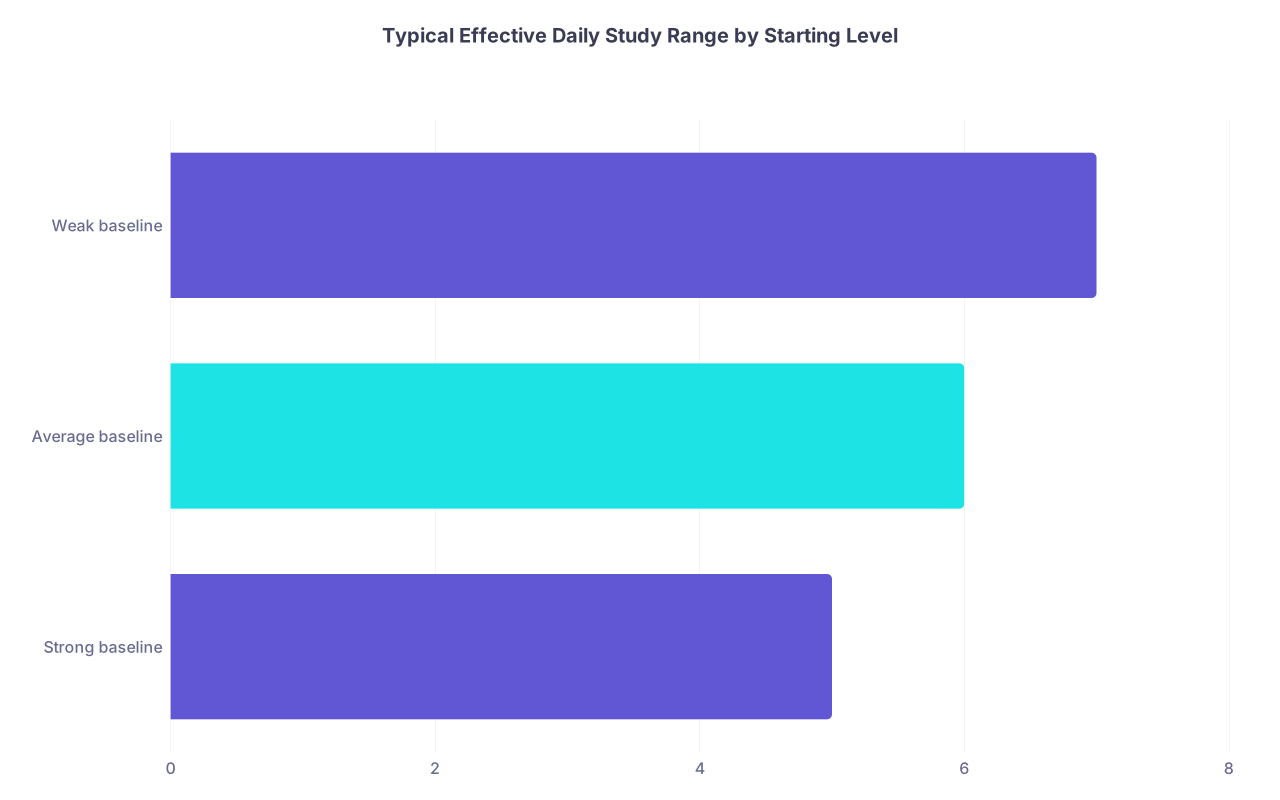
| Category | Value |
|---|---|
| Strong baseline | 5 |
| Average baseline | 6 |
| Weak baseline | 7 |
Interpretation, not dogma:
- Strong baseline (solid shelf scores, comfortable clinically):
4–6 hours of focused work on off-days, fewer on hard clinical days. - Average baseline:
5–7 hours of good studying on lighter days, 2–4 on tougher clinical days. - Weak baseline or big score jump needed (e.g., Step 1 was shaky):
6–8 hours on study days can be reasonable – but only if sleep stays ≥7 hours and you’re not in full-time heavy rotations.
Those are averages, not a daily quota to hit no matter what. Some days you’ll do 3 excellent hours and be done. Some days you’ll do 8 because you feel sharp and you’re off service. That’s fine.
If you’re routinely above 9–10 hours of “studying,” ask yourself how much of that is:
- Rereading notes you never test yourself on
- Doom-watching video series passively
- Re-answering questions you’ve memorized rather than understood
That’s anxiety, not strategy.
A Smarter Way to Use “Extra” Time
Let’s say you genuinely have more time than the averages. Maybe you took 4 weeks off for dedicated. Good. Here’s where to put the surplus so it actually helps:
- Add more practice exams spaced out (NBMEs, UWSA) rather than stuffing every open hour with more Qbank.
- Add second-order review: going back through your logged errors and patterns, not just raw q’s.
- Add exercise, 20–40 minutes most days. That’s not “nice to have.” Physical activity has robust evidence for improving cognitive performance and mood.
- Add actual breaks and one real day off weekly to prevent the burnout spiral.

If your “extra time” is not going to those, but instead into watching the same lecture twice at 1x speed because “I don’t feel ready,” you’re not buying points. You’re burning fuel.
When More Hours Can Make Sense
Let me not swing the pendulum too far. There are times when increasing hours is rational:
- You’ve been under-studying (e.g., 1–2 hours a day, constantly interrupted, minimal practice questions).
- You’re clearly under-prepared and your exam date is not moving.
- You’ve fixed the quality issues (sleep, method of review, practice tests) and still need more total reps.
If that’s you, increasing to 6–8 focused hours can absolutely move your score. But again, that’s not 8 hours of useless grind. That’s 8 hours of high-yield structure.
The key: hours are a tool, not the main strategy. If your plan is “just add more,” you don’t have a plan.
The Real Flex Is Not “I Studied 12 Hours” – It’s “My Practice Scores Predict My Real One”

Here’s what you actually want in the final 2–3 weeks before your exam:
- 2–4 recent practice test scores (NBME/UWSA) that cluster within a 5–8 point range.
- A log of your recurring weak areas with a clear plan you’ve already been executing.
- A daily routine that you’re not white-knuckling through.
- Sleep, mood, and focus that are trending better, not worse.
That does not come from “more hours at any cost.” It comes from weeks of sane, repeatable, evidence-based studying.
Years from now, you won’t brag about how little you slept or how many hours you were chained to a desk. You’ll remember whether you treated Step 2 CK like a fear-driven endurance contest or like a complex performance you trained for intelligently.