
You miss one question in a Qbank block and suddenly you're spiraling, scrolling Reddit threads about people scoring 270+ who “barely missed any” practice questions. Your heart rate spikes every time you hit “End Block,” terrified the percentage will be a few points lower than yesterday’s.
If that’s you right now, I’m going to say the sentence you probably don’t believe: you can stop panicking over every single missed Step 2 question. Not because it doesn’t matter at all. But because the way you’re reacting is actually making things worse, not better.
The Lie Your Brain Tells You About Missed Questions
Here’s what your brain is probably doing after every block:
You miss a question.
Your brain: “If I don’t know this now, I’ll never know it.”
You miss three in a row.
Your brain: “Clearly I’m not ready. I’m going to fail. My NBME was a fluke. My shelf scores were a fluke. Everything was a lie.”
I’ve seen people with 240+ Step 1 and solid clinical evaluations almost postpone Step 2 because they had a “bad” UWorld session at 54%. One rough block and they were convinced their entire residency future was imploding.
The problem isn’t the missed question. It’s the story you tell yourself about what the missed question means.
Your brain likes extremes:
- “I missed that CHF management question → I have no idea how to manage heart failure → I’m a danger to patients → I shouldn’t be a doctor.”
- “I keep missing OB triage questions → I will 100% fail → Program directors will know I’m an idiot.”
None of that is reality. It just feels true when you’re exhausted and staring at red X’s.
What Missed Qbank Questions Actually Mean (Statistically, Not Emotionally)
Let me rip off the Band-Aid: you will miss a lot of Qbank questions and still do completely fine on Step 2.
Not “fine” as in barely pass. Fine as in solid, competitive score.
Here’s what people forget: Qbanks are not designed to make you feel good. They’re designed to:
- Stretch you past your comfort zone
- Expose you to patterns, not just facts
- Over-represent weird/“high-yield-adjacent” scenarios
And your raw percentage in a Qbank does not equal your future Step 2 score. At all. I’ve watched this play out way too many times to keep quiet.
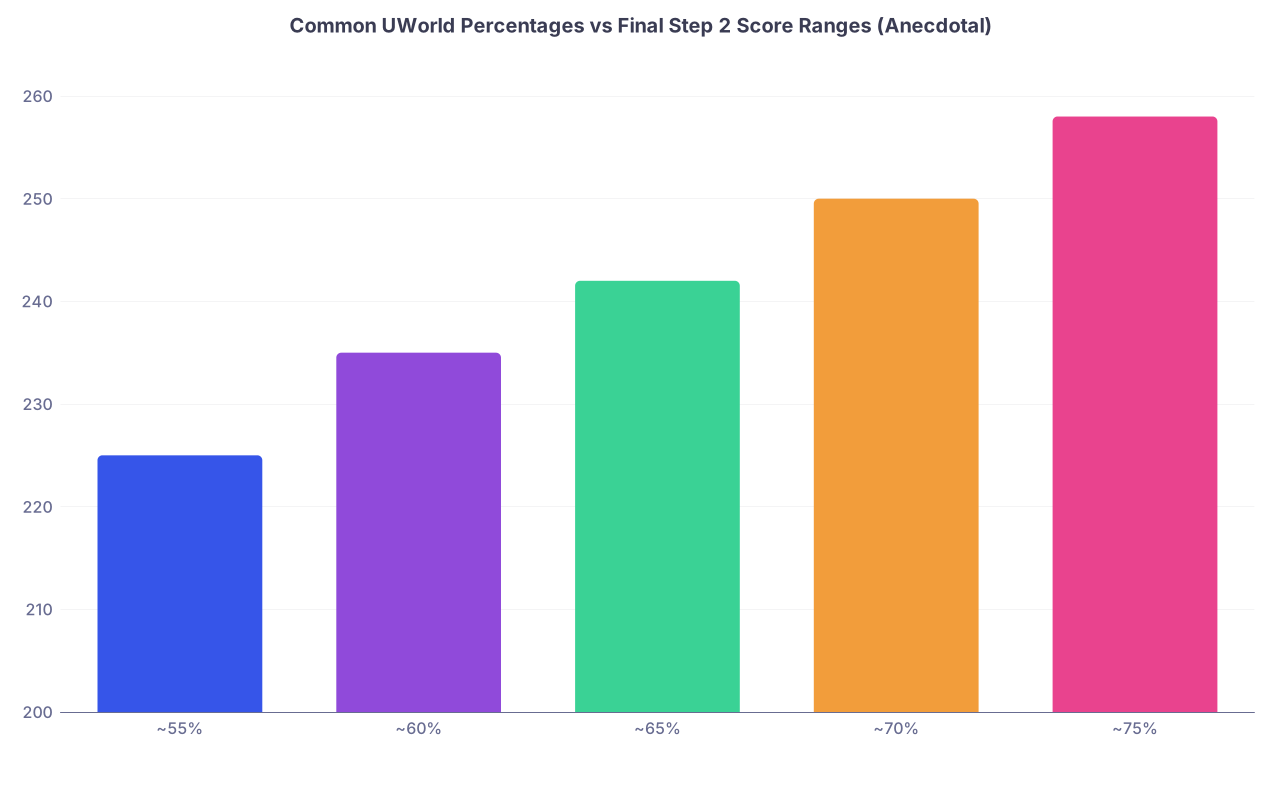
| Category | Value |
|---|---|
| ~55% | 225 |
| ~60% | 235 |
| ~65% | 242 |
| ~70% | 250 |
| ~75% | 258 |
That chart isn’t an official promise from NBME. It’s just what I’ve seen over and over: people freaking out over “low” 60s who end up with 240–250+.
The question isn’t: “Did you miss questions?”
The question is: “Are you learning anything from the ones you missed?”
If the answer to that second question is “not really, I just feel awful and move on,” that’s the problem. Not the red X itself.
When Panicking Over Missed Questions Becomes Harmful
Here’s where your anxiety actually starts sabotaging you.
You know you’ve crossed the line from “concerned and motivated” to “self-destructive” if:
- You’re checking your percentage after every single block and letting it dictate your mood.
- You can’t finish reviewing explanations because you’re too busy mentally calculating “what this means” for your score.
- You keep restarting Qbanks to “fix” your percentage instead of progressing.
- You’re changing your test date purely because of feelings after one or two bad days, not because of trends across NBMEs.
I’ve watched stronger test-takers tank their preparation because they were so obsessed with their Qbank stats they forgot the whole point: turning weaknesses into strengths.
They’d:
- Redo blocks they already knew to inflate percentages
- Avoid harder subjects because “they drag my average down”
- Compare their “correct” rates to strangers who may not be using Qbanks the same way at all
That’s like avoiding leg day because you’re bad at squats and only doing biceps so you feel “stronger.” It might make you feel good short term. It does nothing for your actual performance.
A Saner Way to Look at Qbank Performance
Let’s be blunt: you’re not going to stop caring about missed questions. You’re not a robot. You’ve basically tied your self-worth to a three-digit number for the last few years.
But you can set rules so your anxiety doesn’t completely own you.
Think about your performance in 3 buckets:
Block-Level Noise
One 40-question block at 52%? Noise. You were tired. It was heavy on a weak system. You misread two questions. Whatever. Single blocks say almost nothing about your final score.Short-Term Trend (3–5 days)
Are you consistently around the same percentage for a week? That’s a better reflection of your current level. But still not destiny.Long-Term Trend (2–4 weeks + NBMEs)
This is what matters. Are your practice NBMEs/clerkship shelf-style exams and cumulative Qbank performance nudging upward or at least staying stable as you fill in gaps?
If you zoom out to this level, you’ll realize the daily panic over each missed question is like checking your weight every 20 minutes while trying to get in shape. Useless and stressful.
How to Review Missed Questions Without Spiraling
This is where I see people fall apart. They either:
- Skim the explanation, think “okay I’ll remember that on test day,” then promptly forget.
- Or read every explanation like a courtroom cross-examination and burn 3–4 hours per block, then feel behind, then panic more.
Here’s a calm middle ground that actually works.

| Step | Description |
|---|---|
| Step 1 | Finish Block |
| Step 2 | Glance at Score Once |
| Step 3 | Sort Questions by Incorrect |
| Step 4 | Add to Notes/Anki |
| Step 5 | Mark as Test-Taking Error |
| Step 6 | Clarify Key Distinction |
| Step 7 | Move On |
| Step 8 | Why did I miss it? |
You don’t need to read every single explanation line-by-line. You do need to figure out why you missed it in under a minute:
Pure knowledge gap?
Fine. That’s fixable. Add 1–2 concise lines to your notes/Anki and move on.Misread the stem / rushed?
That’s test-taking. Circle it mentally: “I read too fast when I’m anxious.” Different problem, different solution.Narrowed to 2, picked wrong?
That’s a pattern issue. You need to identify what subtle phrase in the stem or answer choices should’ve pushed you the other way. This is gold for Step-style thinking.
The most dangerous thing you can do is take a missed question and translate it into: “I’m stupid.” Once you label yourself, you stop being curious. And curiosity is the only thing that makes Qbanks worth your time.
When Your Qbank Scores Actually Should Worry You
Not every panic is irrational. Sometimes your anxiety is picking up on a real pattern you do need to address.
Here are red flags that aren’t just “all in your head”:
- You’re consistently scoring under ~50–55% across multiple weeks of mixed, timed blocks, and your practice NBMEs are well below where you want to be.
- Your incorrects cluster heavily in core, high-yield areas like basic internal medicine, OB emergencies, or peds infections—not just weird zebras.
- You’re never improving. Same mistakes, same topics, no retention of prior questions you’ve already seen.
That’s not a “you missed some questions and should be perfect” situation. That’s a “your foundation isn’t strong enough yet” situation.
But even here, obsessing over each little red X still doesn’t help. What helps is turning this into a plan.
| Situation | What It Probably Means |
|---|---|
| One bad block (e.g., 50%) on a rough day | Noise – ignore emotionally, review logically |
| Up-and-down scores but 60–70% overall | Normal learning curve – keep going |
| Slowly improving trend over weeks | You’re on track, even if it feels ugly day-to-day |
| Weeks stuck <55% with poor NBMEs | Foundation issue – change strategy, maybe delay |
| Strong Qbank but bad test-day habits | You need test-taking practice, not more content |
If you’re in that “foundation issue” category, your next move isn’t “do 200 more questions in a panic.” It’s:
- Short, focused content review on your worst systems
- Fewer, more thoughtful blocks
- Probably talking to a mentor/tutor to reality-check your situation and maybe your test date
But again: that’s strategy. Not emotion.
The Ugly Truth About Comparing Qbank Percentages
You already know this, but I’ll say it because you’re still checking Reddit and SDN and convincing yourself you’re doomed.
Everyone lies about, cherry-picks, or misinterprets their Qbank percentages.
They’ll say:
- “I was at 75% on UWorld and got a 260.”
And forget to mention they did most of it untimed, by system, after heavy content review.
Or:
- “I was stuck in the low 60s and still got 250+.”
And they “forgot” to say that was cumulative, random, timed blocks after a full first pass.
You’re comparing:
- Your raw, current, stressed-out self
To: - Their curated, partially remembered, self-serving summary of their prep
That’s like comparing your lowest moment of clerkship to someone’s filtered Instagram photo in a white coat.
Your Qbank percentage needs exactly one comparison point: your own trend over time. Not your friend’s, not a stranger’s, not some post with 800 upvotes that conveniently leaves out details.
Concrete Rules for When to Stop Panicking
Let me give you actual lines in the sand. Because the vague “don’t worry too much” nonsense is useless when you’re already spiraling.
Stop panicking over a missed Qbank question if:
- You’re doing mixed, timed blocks and your overall average is somewhere in the mid-50s to 60s or higher, and…
- Your practice NBMEs or CCSSAs are anywhere even near your goal range (or trending upward), and…
- You can look at your incorrects and say, “I understand why I got this wrong and what I’d do differently next time.”
Start genuinely reconsidering your strategy (not just catastrophizing) if:
- After 2–3 weeks of consistent effort, both your Qbank performance and practice tests are flat or dropping
- You repeatedly miss basic management steps, not just esoteric details
- You review questions and still feel totally lost on the concept afterward
That’s when you pause, not panic. Talk to someone. Shift the balance more toward high-yield content review. Maybe slow down Qbank volume and increase depth of review.
But in both cases, obsessing over each individual wrong question like it’s a prophecy? That needs to stop.
What You Can Actually Do Today
Here’s the part where I ask you to do something painfully specific.
Next time you finish a block, do this:
- Look at the percentage once.
- Say out loud (yes, out loud): “This number doesn’t define my score. The value is in the review.”
- Pick five missed questions that:
- Represent repeated topics you struggle with
- Or were “between two answers” decisions
- Review those five questions in depth.
- For everything else you got wrong, spend less than 60 seconds just identifying why you missed it and, if needed, adding a short note.
Then close the Qbank. Walk away. Don’t reread your percentage. Don’t calculate your “projected” Step 2 score based on a single block. Don’t open Reddit to compare.
Just start with that. Because if you don’t retrain how you react to each missed question now, you’ll carry that panic all the way to test day.
FAQ
1. My UWorld percentage is around 55–60%. Am I doomed for Step 2?
No. Absolutely not. I’ve seen tons of people in that range end up with 230–245+ scores, sometimes higher. Context matters: are you doing mixed, timed blocks? First pass? Learning as you go? A 55–60% while you’re still building foundations is not a death sentence. It’s normal. What matters is whether you’re improving over time and learning from your mistakes—not whether every single block looks pretty.
2. Should I redo Qbank questions I got wrong until I’m scoring super high?
Not obsessively. Redoing some questions can help reinforce patterns, but redoing huge chunks just to see a higher percentage is basically self-soothing with fake data. You already know the answers. Better: flag concepts you keep missing, review them, then test similar questions in new contexts (another Qbank, NBMEs, or mixed review blocks).
3. How many missed questions per block is “too many”?
There isn’t a magic number. On a 40-question block, missing 15 (62.5%) can still be part of a completely normal upward trend. Even 20 wrong (50%) on a rough topic-heavy block isn’t catastrophic by itself. The only time “too many” matters is if this is happening over and over across weeks and your practice tests say the same thing. Single-block disasters happen to everyone.
4. My friend is scoring 70%+ on Qbanks and I’m in the low 60s. Does that mean I’ll score way lower on Step 2?
Not necessarily. Different people use Qbanks differently and start from different baselines. Your friend might have stronger test-taking skills, finished a dedicated review earlier, or started with more solid clerkship knowledge. You might still close the gap—or even outperform them—by test day if your learning curve is steeper. Again: your own trend matters way more than side-by-side comparisons.
5. How do I know if I should delay my Step 2 exam?
Look at multiple data points, not just Qbank percentages. If your recent NBMEs/CCSSAs are well below where you need to be for your goals, and your Qbank performance has been flat or worsening over 2–3 weeks despite serious effort, that’s when a delay is reasonable to consider. If your practice scores are slowly improving, even if they’re not perfect, you’re missing questions but understanding them on review, and your anxiety—not the data—is screaming the loudest, you’re probably more ready than you feel.
Open your Qbank history and look at the last 10 blocks as a group—ignore individual scores. Ask yourself: “Is there even a slight upward or stable trend?” If the answer is yes, your job isn’t to panic over each miss. It’s to keep showing up and learning from them.