
You can be working hard and still be failing Step 2 CK practice tests. That’s the part nobody says out loud.
Let’s talk about that.
Because right now I’m guessing it feels like this: you open another NBME or UWorld self-assessment, click “End Test,” and your stomach drops. Again. 196. 201. 205. Or even worse, like 185. Nowhere near the 214 passing mark. And instead of feeling “motivated,” you’re thinking:
“What if I’m just not someone who can pass this?” “What if I fail and my school delays my graduation?” “What if this ruins residency, ruins everything?”
You’re not irrational for thinking that. Step 2 can wreck things if it goes badly. But being stuck below passing on practice doesn’t automatically mean that’s your fate. It means something in your process is broken. And broken processes can be fixed.
Let me walk through this like we’re sitting in the library at 11:30 pm, you’re half-crying over a UWSA score, and I’m the slightly older med student who’s seen this before.
First: How Bad Is “Below Passing,” Actually?
Not all “below passing” is the same kind of emergency.
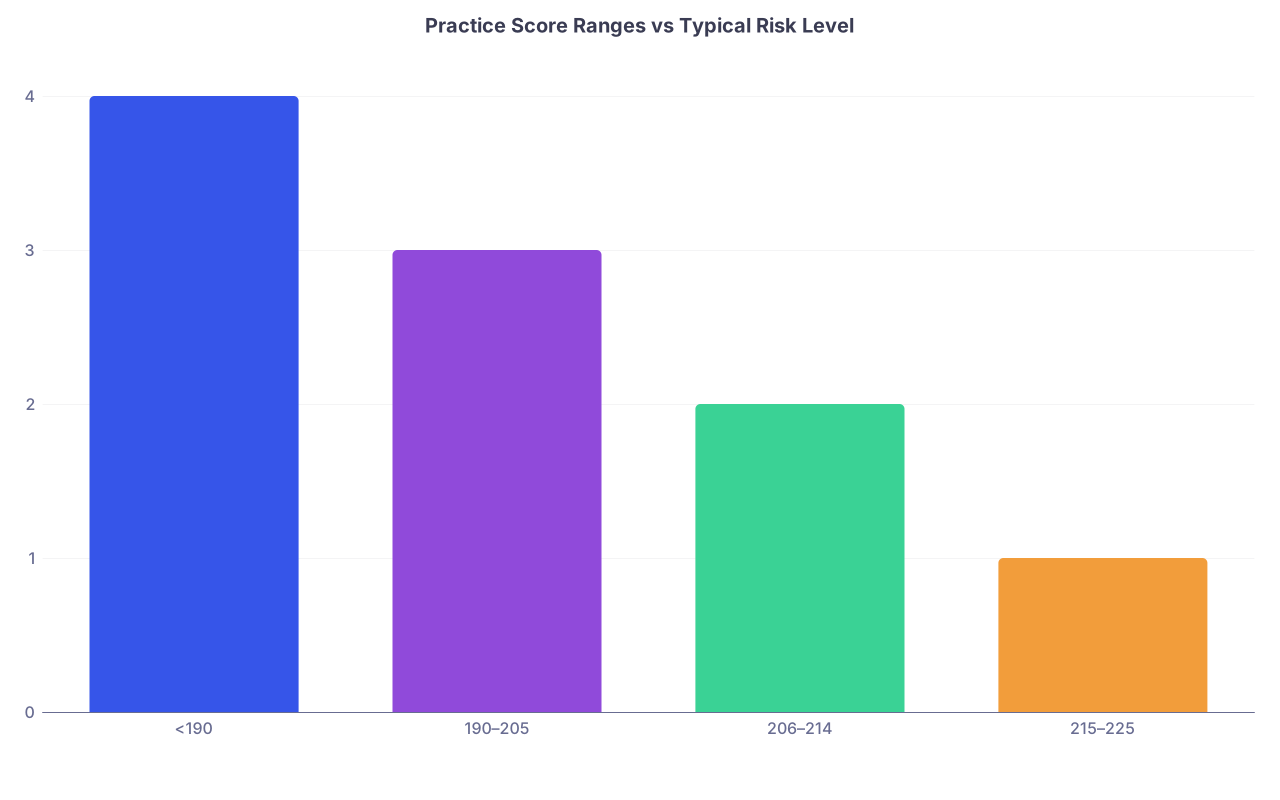
| Category | Value |
|---|---|
| <190 | 4 |
| 190–205 | 3 |
| 206–214 | 2 |
| 215–225 | 1 |
Here’s the hard truth breakdown:
- Consistently under 190: this is not a tweak situation. This is a structural “you’re missing major content and test-taking skills” situation.
- 190–205: there’s a real gap, but I’ve seen people jump 20–30 points from here with aggressive, targeted work in 4–8 weeks.
- 206–214: this is “so close it hurts” territory. You’re probably not doomed; you’re just scattered, inconsistent, or making the same dumb mistakes over and over.
- 215–225: not your scenario right now, but for context: this is usually fixable with refinement and more practice, not a complete overhaul.
What matters isn’t just the number; it’s the pattern. Are you:
- Flat for 3–4 practice tests in a row?
- Randomly jumping all over the place?
- Slowly trending up, but steeper than you’d like?
If you’ve taken one practice, scored below passing, and now you’re spiraling, that’s anxiety, not data. If you’ve taken three, spaced a week or more apart, did legit review after each, and you’re still stuck below passing? That’s a real signal. But still not a guarantee of failure.
Why You’re Stuck (It’s Usually Not Because You’re “Dumb”)
People love to say “just do more questions.” That advice is lazy.
When scores are stuck, it’s almost always one or more of these:
You’re doing questions, but not learning from them
You slam through UWorld, get 50–55% correct, feel terrible, then move on. No slow post-review, no pattern finding, no “why did I think this answer was right?” Just vibes and suffering. That doesn’t move scores.Your knowledge base is full of holes
If your internal medicine is shaky—heart failure management, chest pain, AKI, diabetes, pneumonia—you will bleed points constantly. You can’t “strategy” your way out of not knowing core management.You never trained for stamina and timing
Step 2 CK is long and draining. If you only ever do 10–20 questions at a time, of course your brain crashes on long NBMEs. That doesn’t mean you’re incapable; it means you’re unconditioned.You study like it’s Step 1 but P/F
Memorizing trivia. Obsessing over rare diseases. Neglecting the boring bread-and-butter: chest pain, altered mental status, OB triage decisions, peds vaccines, antibiotic choices. Step 2 punishes that.You’re so anxious you can’t think
When panic is high, reasoning shuts down. You start second-guessing everything. You change right answers to wrong ones. Not because you’re incapable, but because your brain is in “threat mode,” not “analyze mode.”
I’ve watched classmates who genuinely weren’t “top students” crawl from 188 → 216 → 228. And I’ve watched objectively smart people sit at 205 for a month because they refused to change how they studied.
You’re not doomed. But if you do what you’ve been doing, you will keep getting what you’ve been getting.
A Brutally Honest Fix-It Plan (If You’re Below Passing)
This isn’t magical. It’s just specific. And sometimes specific is what your brain needs when it’s spiraling.

| Step | Description |
|---|---|
| Step 1 | Below Passing Practice Scores |
| Step 2 | Consider Postponement |
| Step 3 | Intensive Rescue Plan |
| Step 4 | Rebuild From Foundation |
| Step 5 | Identify Weak Systems |
| Step 6 | Targeted Content + Daily Blocks |
| Step 7 | NBME Checkpoint |
| Step 8 | Refine and Maintain |
| Step 9 | Time to Exam |
Step 1: Get brutally clear on your weak areas
Not vibes. Data.
Take your recent NBME or UWSA report and actually list out your worst areas by category, not just “I suck at everything.”
Something like:
- Internal Med: weak in cardiology, nephrology, rheumatology
- OB/GYN: third-trimester complications, intrapartum management
- Peds: developmental milestones, vaccine schedules, febrile infant
- Psych: emergency presentations, medication choices
- Surgery: post-op complications, trauma
Now narrow it down again: pick the top 3 categories where you’re consistently bleeding points. Those are your priority zones.
Step 2: Shift from “volume of questions” to “depth of review”
This is where most people mess up.
You don’t need 120 questions a day. You need 40–80 questions that you wring out every drop of learning from.
A realistic daily structure (especially if you’re in the 190–210 range):
- 40 timed, random-tutor or random-timed questions (full block)
- 2–3 hours of slow review:
- For each wrong: Why did you pick what you did? What was your faulty assumption?
- For each right-but-guess: Treat it as wrong. Learn the concept.
- Write minimal notes only when it’s a recurring theme or high-yield concept.
If your review is taking 30 minutes and you’re blasting through, that’s not review. That’s skimming. Be honest with yourself.
Step 3: Fix your foundation in internal medicine first
If you’re below passing, 9 times out of 10 internal medicine is dragging your score down.
This is brutal but true: you cannot pass Step 2 CK while consistently bombing IM questions. It’s too much of the exam.
You need at least one solid, structured resource. Examples:
| Resource | Use Case |
|---|---|
| OnlineMedEd IM | Fast, structured review |
| Step-Up to Med | More detailed foundation |
| Boards & Beyond | Conceptual understanding |
| UWorld Explanations | Applied knowledge |
Pick one main thing. Don’t watch every video from every platform. That’s procrastination dressed up as productivity.
For your top 2–3 weakest IM systems, do this:
- Watch or read concise core review (e.g., heart failure, chest pain, AKI, COPD).
- Immediately follow with a targeted 10–20 question set on that topic.
- That same day, review those questions in depth.
You’re teaching your brain: “This is what this disease actually looks like in question form.”
What If I Don’t Have Enough Time Before My Test?
This is the most panic-inducing part. And yes, timing matters.
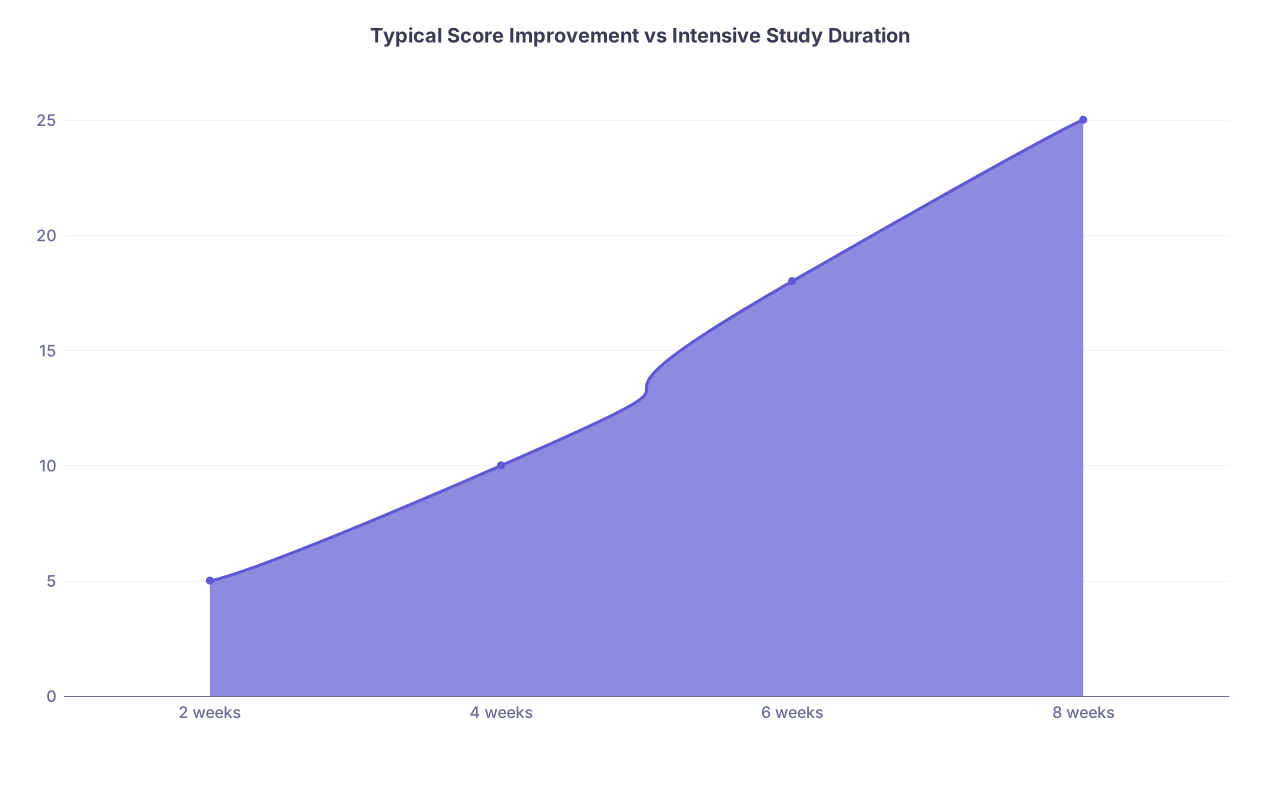
| Category | Value |
|---|---|
| 2 weeks | 5 |
| 4 weeks | 10 |
| 6 weeks | 18 |
| 8 weeks | 25 |
These are rough, but they track what I’ve seen over and over:
- 2 weeks of hard, high-quality work: maybe 5–8 point bump.
- 4 weeks: 8–15 points.
- 6–8 weeks: 15–25+ points if you’re actually focused and not just doom-scrolling Reddit between blocks.
So if you’re at 195 with 10 days left… is it possible to pass? Sometimes, yes. But you’re asking your brain for a miracle sprint. It’s risky.
If you’re 3–4 weeks out and sitting at 205–210, that’s different. That’s “intense push and high yield focus” territory, not hopeless.
If your school allows you to delay and you’re consistently below 200 within 2–3 weeks of your scheduled date, postponing is not “weak.” It’s sound risk management. Programs see fails. They do not see postponements.
I know the shame voice in your head says: “Everyone else is taking it on time. I’m behind. I’m dumb.” That voice is lying and also weirdly obsessed with other people’s timelines. Your job is to protect your long-term goals, not your ego for the next 3 weeks.
Panic Management: Because Your Brain Is Not a Robot
Here’s the part people pretend isn’t real: if your anxiety is at a 10/10 every time you open UWorld, your learning efficiency drops like a rock. You might be putting in 8 hours to get 3 hours’ worth of learning.
That doesn’t mean “just relax.” You’re not going to yoga your way to a 230. But you do need separation between:
- “I’m objectively underperforming right now”
vs. - “I’m catastrophizing 24/7 to the point I can’t think”
Very simple, not fluffy things that help:
- Timed breathing between blocks: 4-second inhale, 4-second hold, 6-second exhale. Do that for 1–2 minutes. It physically changes your arousal state.
- 10-minute walks after blocks, no phone. Let your brain defragment.
- Hard boundaries: e.g., no Step 2 talk after 10 pm. No looking up Reddit “I failed Step 2” threads at midnight. That stuff will destroy the little confidence you have left.
And if you’re at the point where you’re not sleeping, crying daily, or having panic attacks before every practice test, talk to someone. Your school counseling center, a trusted attending, literally anyone. Burnout + high stakes exam + total isolation is a nasty combination.
What If I Actually Fail the Real Exam?
Let’s go straight into the worst-case scenario your brain is replaying on a loop.
You sit for Step 2 CK. You walk out numb. Weeks later, score report drops: “Fail.”
Does it suck? Yes. Is it the end of everything? No. It’s a speed bump with sharp edges.
What usually happens:
- Your school may require a dedicated remediation period.
- You’ll likely have to delay your test date for the retake, and sometimes graduation.
- You’ll retake with a tighter, more supervised study plan.
Residency-wise: a fail on Step 2 is a red flag. That’s reality. Some PDs will filter you out. But plenty of programs care about the trend. If you go from fail → solid pass with improvement, they will at least look at the context.
You know what’s worse than failing once and remediating? Failing twice because you refused to face how unready you were the first time. That’s what haunts careers.
I’ve watched people fail Step 1 or Step 2 and still match into IM, psych, peds, FM. Their lives did not explode. Their path just got messier and more humbling than Instagram would like to admit.
You’re allowed to be terrified of failing. Just don’t let that fear lock you into repeating the same broken prep until you crash.
Last Thing: You’re Not a Score
You’ve probably tied your entire identity to whether you can break 214 or 230 or whatever number is stuck in your head. That’s how med school trains you to think—worth measured in three digits.
But here’s something I’ve seen again and again: the people who eventually become really good doctors are not always the ones who cruised through standardized tests. They’re often the ones who hit a wall, had to rebuild, and learned how to function while scared.
That might end up being you.
Years from now, you won’t remember the exact NBME that told you 202 and made you spiral. You’ll remember whether you faced that low score with avoidance and panic… or with an uncomfortable, disciplined plan to climb out of the hole.
You’re allowed to be scared. Just don’t stay stuck.
FAQ (Exactly 6 Questions)
1. My last three practice scores are 198, 201, and 203. Exam is in 3 weeks. Should I postpone?
If your trend is flat just below passing and you’ve been studying seriously, you’re in a high-risk zone. Could you scrape by? Maybe. But “maybe” is a rough bet with something this high-stakes. If your school allows postponement and you can get at least 3–4 more weeks of focused study, I’d seriously consider delaying. If you’re forced to keep the date, then for the next 3 weeks your entire life becomes: targeted weak area repair, daily full timed blocks, and at least one more NBME 7–10 days before test day to reassess.
2. Is it a bad sign if my UWorld % is around 50–55%?
Not automatically. Lots of people sit around 55–60% and still end up with passing or even decent scores, because UWorld is hard and cumulative. But if you’re below 55% and your NBMEs are under 210, that combination is concerning. The key isn’t the raw percentage; it’s whether your understanding during review is deep, whether earlier topics feel more solid over time, and whether newer blocks feel slightly easier. If you’re just randomly getting stuff right and wrong with no pattern, that’s a problem.
3. Which matters more for prediction: NBME or UWSA?
NBMEs generally track closer to the real deal, especially the newer ones. UWSAs can overestimate for some people, underestimate for others. If your NBMEs are below passing and your UWSA is magically higher, you don’t get to ignore the NBMEs. When in doubt, weight NBME more. Ideally, they converge within ~5–10 points. If they don’t, assume the lower number is closer to reality until proven otherwise.
4. How many NBMEs should I do if I’m below passing?
Enough to get real data, but not so many that you’re just bleeding morale. For someone struggling, usually 3–4 total over your prep is reasonable: one early to see baseline, one mid-course to check if your approach is working, and 1–2 close to the exam to make a go/no-go decision. But if you take two, review them deeply, change nothing about how you study, and then take two more… you’ve just paid money to confirm you’re still stuck.
5. I’m terrible at timing and can’t finish blocks. Will that sink me even if my knowledge improves?
If you regularly leave 5–10 questions blank per block, yes, timing will absolutely tank your score. You need to train timing like cardio. Do full 40-question timed blocks. Force yourself to make a choice and move on when stuck—no 5-minute deep dives on one question. Most people get faster as their pattern recognition improves and anxiety decreases. But if timing is still a wreck 1–2 weeks out, that’s a serious red flag, and you might need to delay and focus specifically on building stamina and pace.
6. What if I’ve “tried everything” and I’m still stuck?
You probably haven’t tried everything; you’ve tried everything you can think of alone. That’s different. At that point, you need outside eyes. A tutor, a faculty mentor, an upperclassman who scored well. Someone who can look at how you approach questions in real time and say, “Here’s where your reasoning is breaking.” Sometimes the fix isn’t more content; it’s that you misinterpret stems, get anchored on buzzwords, or panic and change answers. Those are hard to see in yourself. Getting help isn’t a sign you’re hopeless; it’s a sign you’re finally treating this like a solvable problem instead of a personal failing.