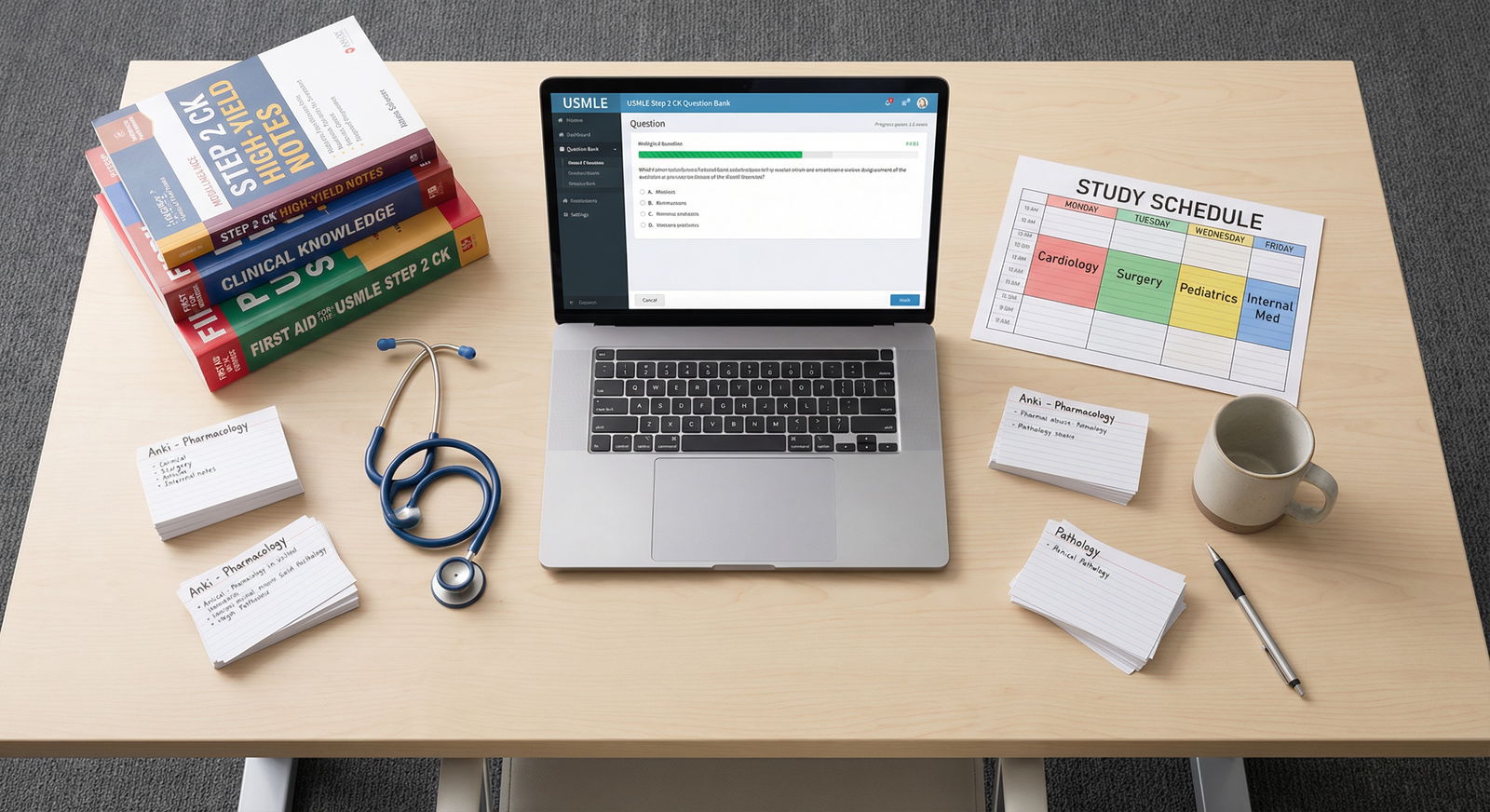
You’re asking the wrong question if you only ask, “Is 4, 6, or 8 weeks best for Step 2 CK?”
The real question is: “How long do I need based on where I’m starting and how I study?”
Let me cut through the noise.
The Real Answer: Most People Need 4–6 Weeks, Some Need 8, A Few Need 3
Here’s the blunt version:
- If you crushed your clerkships and did fine on Step 1: 4 weeks of true, full-time dedicated can be enough.
- If you’re average, a bit rusty, or didn’t love your shelf scores: 6 weeks is the safest default.
- If your shelves were weak, your baseline NBMEs are low, or you’re targeting a very competitive specialty from a weaker position: 8 weeks is reasonable—if you use it well.
The number of weeks only matters if three things are true:
- You’re actually studying most of the day (not half-dedicated, half-rotation).
- You have a clear plan for UWorld + NBMEs + review.
- You’re willing to adjust based on practice scores, not vibes.
Let’s break this down the way you actually need it: by profile, not by generic advice.
Step 2 Dedicated by Profile: Who Should Do 4, 6, or 8 Weeks?
Start here. This is the decision tree most students wish someone had given them.

| Step | Description |
|---|---|
| Step 1 | Start |
| Step 2 | 4-week dedicated |
| Step 3 | 6-week dedicated |
| Step 4 | 8-week dedicated |
| Step 5 | 6-week dedicated |
| Step 6 | Shelf scores mostly >= national mean? |
| Step 7 | Baseline NBME >= 230? |
| Step 8 | Shelf scores mostly <= 10th percentile? |
Who should do ~4 weeks?
You’re a 4-week candidate if most of this sounds like you:
- Shelf exams mostly at or above the national mean
- Step 1 pass wasn’t a squeaker; you were comfortably above the line
- You finished most of UWorld (or another Qbank) during rotations
- Your first dedicated practice test (NBME/Free 120) is ≥ 230
- You’re not trying to pull off a miracle jump from weak clinical knowledge to top-1% score
For you, 4 weeks is enough to:
- Finish remaining UWorld questions
- Review incorrects thoroughly
- Take 3–4 practice exams
- Do a focused pass on weak specialties (peds, OB, etc.)
Any more than that and you risk burnout and spinning your wheels.
Who should do ~6 weeks?
This is the most common and reasonable default.
You’re a 6-week candidate if:
- Shelf scores were mixed (some below, some at/above average)
- You didn’t fully crush all rotations, or you’re just not feeling sharp
- You’ve done some UWorld but not consistently across all clerkships
- Your baseline NBME is 215–235
- You want a solid, safe margin for a strong score, not just “pass and pray”
6 weeks gives you:
- Time to finish or nearly finish UWorld thoughtfully
- Space for 4–5 practice tests with real time to review them
- Enough time to circle back to weaker systems or rotations you hated/forgot
For the majority of students, 6 weeks is the sweet spot: long enough to improve, short enough to stay focused.
Who should do ~8 weeks?
Extended dedicated sounds nice until you hit Week 6 and feel like you’re melting. So you need a good reason for 8 weeks:
- Shelf exams repeatedly at the lower end (≤ 10th–15th percentile)
- You struggled with Step 1 or barely passed
- You feel your clinical foundation is shaky, especially on medicine and surgery
- Baseline NBME is below ~215
- You’re aiming to significantly outperform where you are now (e.g., from 200s to 230s+)
8 weeks isn’t “2 extra weeks to study a bit more.” It’s:
- 2–3 weeks of rebuilding core knowledge
- 4–5 weeks of aggressive Qbank + NBME work
- 1 week of focused consolidation and taper
If you’re not deliberate, 8 weeks can become 4 weeks of procrastination followed by 4 weeks of panic. Don’t do that.
What Actually Matters More Than 4 vs 6 vs 8
The number of weeks is a container. What you do inside that container is what determines your score.
1. Your baseline practice score
Before you pick a number of weeks, take one real practice exam under test-like conditions:
- NBME Comprehensive Clinical Science (CCSSA) or UWSA
- Full timed blocks, no pausing, no “I’ll finish this later”
Then:
- ≥ 240 baseline: You don’t need 8 weeks. 4–5 weeks usually enough.
- 225–239 baseline: 4–6 weeks depending on your goals (higher score → closer to 6).
- 210–224 baseline: 6–8 weeks smart.
- < 210 baseline: You want time. Plan 8 weeks if you can get them, with structured help if needed.
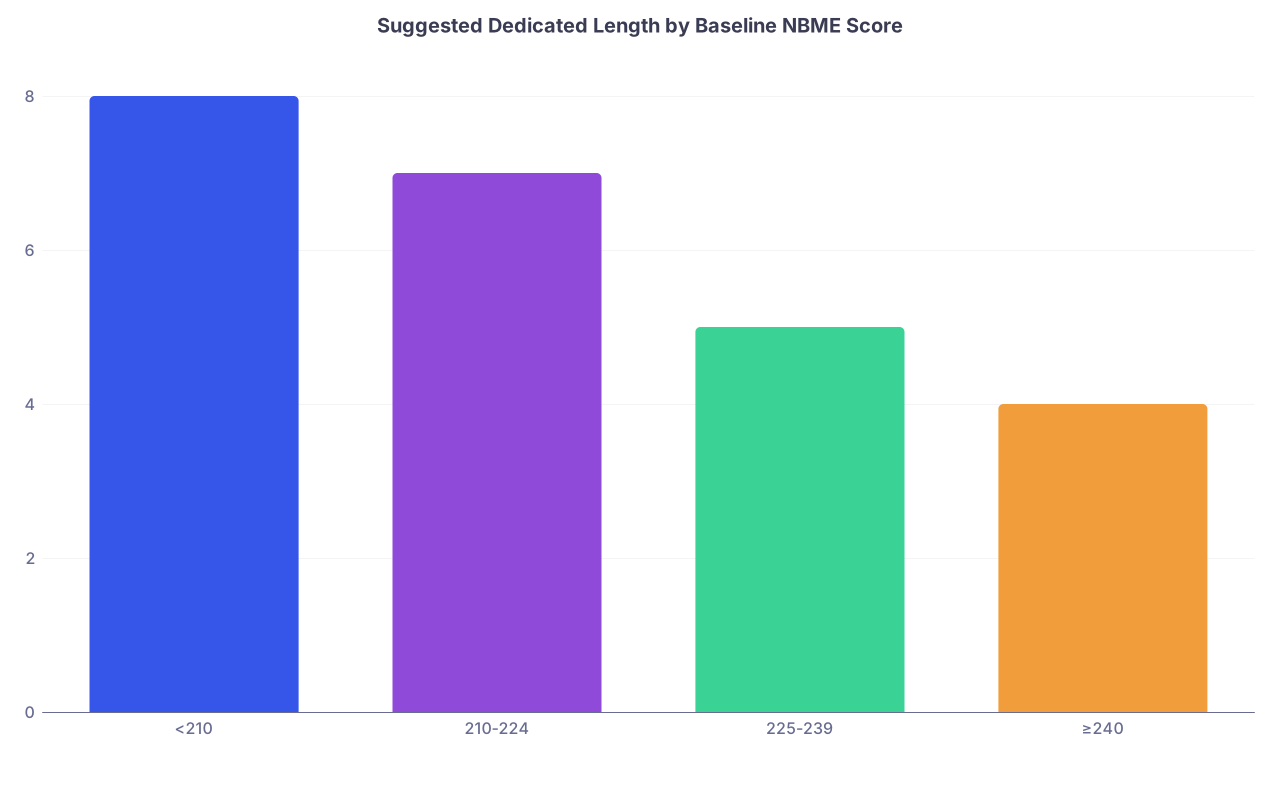
| Category | Value |
|---|---|
| <210 | 8 |
| 210-224 | 7 |
| 225-239 | 5 |
| ≥240 | 4 |
(Values are approximate suggested weeks.)
2. How many real questions you’ll get through
You don’t need 5 resources. You need one main Qbank done well.
Typical targets:
- UWorld Step 2 CK: ~3,800–4,000 questions
- Ideal: 1 full pass in dedicated (or by the end of dedicated if you started earlier)
- Strong students sometimes add Amboss for targeted weaknesses, but only after UWorld is mostly done
Your length of dedicated needs to match your question pace.
Rough rule of thumb:
- 4 weeks → average 80–120 questions/day (with review)
- 6 weeks → average 60–80 questions/day
- 8 weeks → average 50–70 questions/day, plus extra reading/remediation time
Be honest with yourself: If 40 good, fully reviewed questions already take you 5 hours, don’t pretend you’ll slam 120/day for a month.
3. Your fatigue and attention span
You’re not a robot. Nobody does 10 perfect hours of studying every day for 8 weeks straight.
I usually tell students to assume:
- 4-week dedicated → you can survive high-intensity daily effort
- 6-week dedicated → moderate intensity, sustainable
- 8-week dedicated → must be paced to avoid burning out before test day
If you’ve already been going hard on rotations + shelves, sometimes adding 2 “extra study weeks” at high intensity just makes you worse by test day.
What a Good 4-, 6-, and 8-Week Plan Actually Looks Like
Let’s talk structure. Here’s how a typical week count maps onto a realistic plan.
| Length | Main Focus | Practice Exams | UWorld Goal |
|---|---|---|---|
| 4 weeks | Qbank + rapid review | 3–4 tests | Finish / complete final 50–70% |
| 6 weeks | Qbank + spaced review | 4–5 tests | Full pass + targeted redo |
| 8 weeks | Rebuild + Qbank + consolidation | 5–6 tests | Full pass with more remediated review |
Sample 4-week structure (for stronger students)
- Weeks 1–3:
- 80–100 UWorld questions/day, timed, random
- Review all incorrects + marked questions
- 1 practice exam each week, review over 1–2 days
- Week 4:
- Finish remaining UWorld
- Final NBME/UWSA + Free 120
- Light review, high-yield topics, test strategy, sleep
Sample 6-week structure (standard plan)
- Weeks 1–2:
- 60–80 UWorld/day, mix of random + subject-based for weaknesses
- 1 practice exam end of Week 2
- Weeks 3–4:
- Continue UWorld
- 1 practice exam each week
- Start focused review (missed topics, low-shelf areas)
- Weeks 5–6:
- Clean up remaining Qbank
- Redo weak-system blocks or incorrects
- Final 1–2 practice exams
- Taper intensity last 3–4 days
Sample 8-week structure (for rebuilding)
- Weeks 1–2:
- 40–60 UWorld/day + structured content review
- Don’t rush. You’re rebuilding foundations here.
- Weeks 3–5:
- 60–80 UWorld/day
- Weekly practice exam + deep review
- Start pattern recognition for question style and timing
- Weeks 6–7:
- Second pass on weak topics or redo incorrects
- 1–2 more practice exams
- Week 8:
- Lighter volume
- Targeted brush-up (things you always forget)
- Final practice exam ~7–10 days before test, then taper
How to Use Practice Exams to Decide If Your Length Is Right
Your dedicated length isn’t fixed. It’s a hypothesis. Your practice scores tell you if it’s wrong.
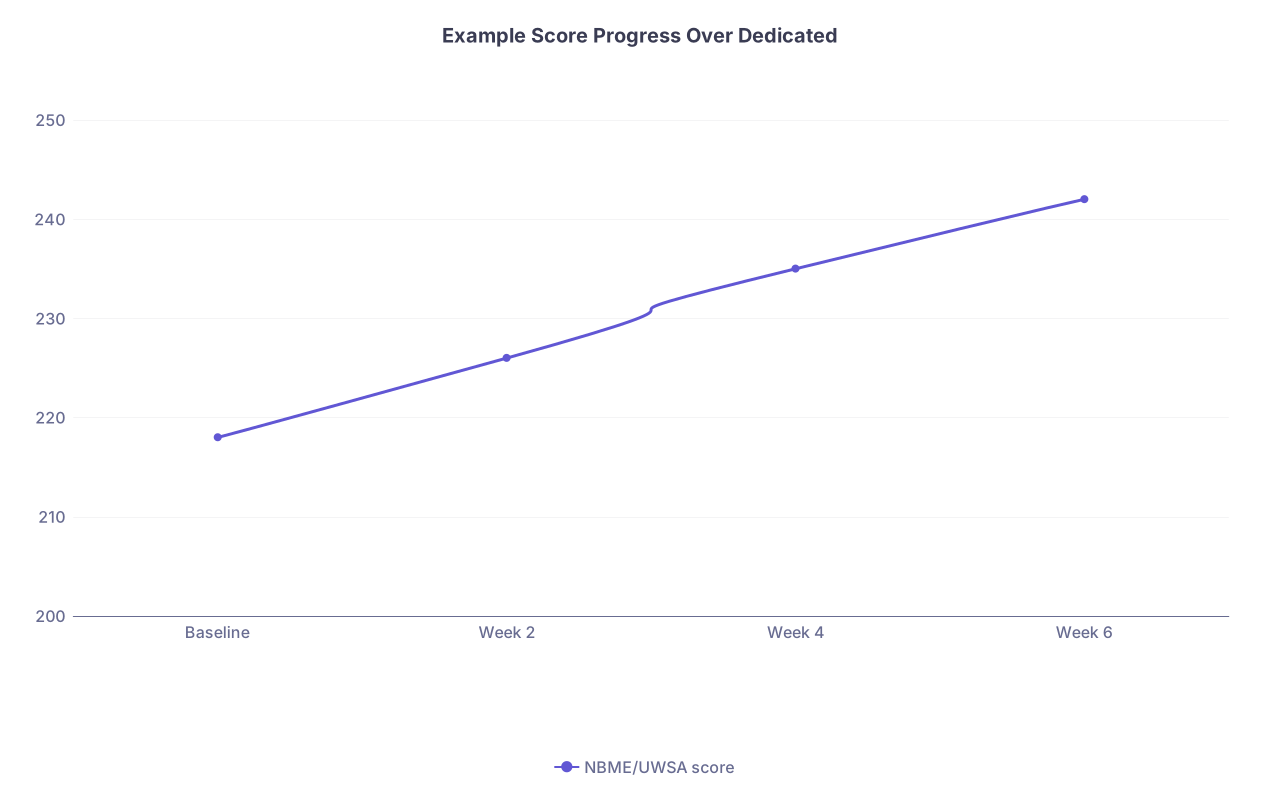
| Category | NBME/UWSA score |
|---|---|
| Baseline | 218 |
| Week 2 | 226 |
| Week 4 | 235 |
| Week 6 | 242 |
Quick rules:
- If your scores:
- Start ≥ 230 and are stable or rising, and you’re exhausted → you can move your test earlier if there’s availability.
- Start < 215 and aren’t budging after 3–4 weeks → you probably need more time and different strategy (not just “more weeks doing the same thing”).
- Don’t chase perfection. If you’re sitting at consistent 240s+, pushing the exam back two weeks for “maybe 5 more points” is usually a bad trade-off against burnout.
What People Get Wrong About Dedicated Length
A few myths I see over and over:
“Longer is always better.”
No. Longer just means more time to burn out or to study inefficiently. If you’re strong and need 4 weeks, taking 8 won’t double your score.“I’ll fix everything in dedicated.”
Step 2 CK is cumulative. If you checked out during rotations, 4 weeks isn’t magically going to replace 12 months of half-engagement.“I’ll decide the length as I go.”
That’s how you end up with 10 half-baked weeks where you never push hard because the finish line keeps moving. Pick a target date, then adjust with data.“I can do 120 questions/day for 8 weeks.”
You won’t. Not with full review. Be realistic.
How to Decide Today Between 4, 6, and 8 Weeks
If you want a simple, brutally direct framework:
- Take a real practice test this week.
- Look at:
- Baseline score
- Shelf history
- How much UWorld you’ve done
- Then use this:
- Choose 4 weeks if:
- Baseline ≥ 235–240
- Shelves mostly at/above average
- ≥ 50% of UWorld already done solidly
- Choose 6 weeks if:
- Baseline 215–235
- Shelves mixed
- UWorld < 50% done or poorly reviewed
- Choose 8 weeks if:
- Baseline < 215 or shelves consistently low
- Weak foundations, big gaps in core medicine/surgery
- You actually have 8 weeks without major clinical responsibilities
Then commit. Stop re-deciding your plan every three days based on anxiety.
FAQs: Step 2 CK Dedicated Length
1. Is 4 weeks enough to study for Step 2 CK?
Yes, for the right student. If you’ve stayed engaged during clerkships, did a good chunk of UWorld or another Qbank already, and your baseline practice exam is around 230+, 4 weeks of true, dedicated, full-time studying is typically enough. You’ll spend most of that time finishing UWorld, doing 3–4 practice tests, and tightening weak spots—not relearning medicine from scratch. If your baseline is under ~220, 4 weeks is usually too short unless your goal is just to pass.
2. Is 8 weeks of dedicated too long?
It can be. If you’re already at a solid baseline (≥ 225–230) and studying efficiently, 8 weeks often leads to burnout, plateauing, and overthinking. 8 weeks makes sense mainly for students starting with a low baseline, weak shelf history, or shaky fundamentals. Even then, you need to structure it so the first 2–3 weeks are rebuilding, not just dragging out what could have been done in 6 weeks. If you’re strong and just anxious, 8 weeks is usually not your friend.
3. How many practice exams should I take in each dedicated length?
Rough guide:
- 4 weeks: 3–4 exams (e.g., 2 NBMEs, 1 UWSA, plus Free 120)
- 6 weeks: 4–5 exams (spread about once per week)
- 8 weeks: 5–6 exams (about weekly, with one extra early to establish baseline)
What matters is not just the number, but that you fully review each one—go over every question, especially the ones you guessed right for the wrong reasons.
4. Can I do Step 2 CK dedicated while on an easy elective?
People do it. It’s not ideal, but if your school won’t give you a true break, you adapt. In that situation, your “6 weeks dedicated” might function more like “4 real weeks” if you’re losing time to the hospital. Be honest about how many actual study hours you get most days. If you’re consistently under 5–6 hours of focused work daily because of clinical duties, consider extending your timeline if you can.
5. When should I schedule my first practice test?
If you’re close to starting dedicated and haven’t done a recent standardized practice, do one baseline exam before or in your first week of dedicated. Don’t wait until Week 3. That baseline tells you whether your 4/6/8-week plan makes sense. Yes, it’s humbling. Do it anyway. It’s better to find out you’re at 210 now than two weeks before your real exam.
6. Should I push my exam back if my NBMEs are low?
Maybe—but not automatically. Look at the trend and the time:
- If you’re early in dedicated and still moving up, keep going.
- If you’re near your test date, your scores are stuck well below your target, and you have the option to delay, then pushing back 2–4 weeks with a specific revised plan can absolutely help.
- Don’t push back “just because I don’t feel ready” if your scores are actually in range. Go by numbers, not fear.
7. What’s one sign I picked the wrong dedicated length?
Big one: your daily plan is impossible to execute. If, by Day 3, you’re already skipping chunks of planned questions or reviews because your schedule is packed with fantasy productivity, your time frame and intensity don’t match. Either you shorten the resource list or extend the duration. The other sign? You’re not able to meaningfully review your UWorld and practice exams because you’re drowning in volume. If you’re only doing questions and never learning from them, you’ve got the balance wrong.
Open a spreadsheet or notes app right now and write three numbers: your latest practice score, your realistic daily question capacity, and your target test date. Use those to pick 4, 6, or 8 weeks—then lock it in and build a concrete, written plan for Week 1.