
You’re two weeks out from Step 2 CK. You’ve just finished an NBME and a UWorld Self-Assessment. One says 244. The other says 255. Your friend swears “NBMEs are always low” and some random Reddit post says “UWSA2 overpredicts by 10 points.”
You’re staring at the numbers thinking: “What’s real? Am I a 240? A 250? Or about to walk into a disaster?”
Let me give you the straight answer.
Short Answer: How Close Are Step 2 CK Self-Assessments Really?
Here’s the big picture:
Most modern Step 2 CK self-assessments (NBMEs and UWSAs) predict your real exam within about ±5–7 points if:
- You take them within 2–3 weeks of the real exam
- You’re actually trying (not half-distracted post-call)
- You’ve already done a serious chunk of content review and questions
Are they perfect? No. But they’re good enough that programs and advisors treat them as meaningful signals.
Let’s rank them by practical reliability for Step 2 CK, based on how they tend to correlate with real scores:
- UWSA 2 – usually the best predictor, slight overprediction for some
- NBME (newer forms like 10–12) – usually a bit conservative, but close
- UWSA 1 – useful, sometimes a bit optimistic
- Old NBMEs (if you’re still using outdated forms) – less aligned, less granular
If your self-assessments are clustered within a 5–8 point range in the last 2 weeks, assume your real Step 2 will land in that neighborhood.
What The Data and Real-World Experience Say
Let’s cut through the noise and look at practical patterns I’ve seen repeatedly.
General Score Accuracy Range
Across classes and advising conversations, most people will tell you something like this:
- UWSA 2: Often within ±5 points, sometimes spot-on
- UWSA 1: ±5–8 points, slightly optimistic for a subset
- New NBMEs (10–12): Often within ±5–7 points, sometimes a bit low
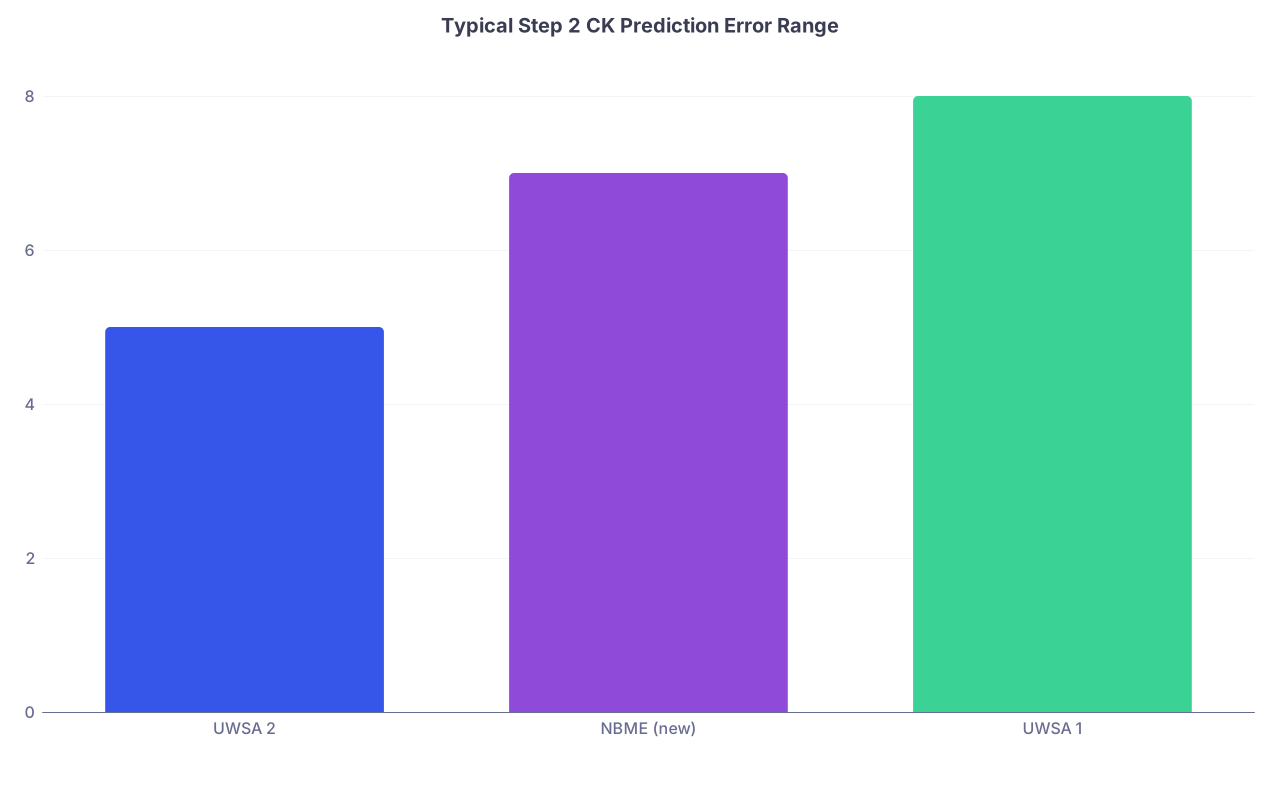
| Category | Value |
|---|---|
| UWSA 2 | 5 |
| NBME (new) | 7 |
| UWSA 1 | 8 |
Those numbers are not official NBME statements. They’re from what actually happens to real students comparing their practice tests to the final result.
Example scenarios I’ve seen repeatedly:
Student A:
- NBME 11 (10 days out): 243
- UWSA 2 (5 days out): 247
- Real Step 2 CK: 249
Student B:
- UWSA 1 (3 weeks out): 259
- NBME 10 (11 days out): 252
- UWSA 2 (4 days out): 255
- Real: 253
Student C:
- Doing okay but inconsistent:
- NBME 9: 226
- UWSA 1: 236
- UWSA 2: 238
- Real: 231
Do they always line up this nicely? No. But this is more typical than the horror stories.
Tool-by-Tool: How Each Self-Assessment Behaves
UWSA 2: The Workhorse Predictor
If I had to pick one snapshot to predict your score, it’s UWSA 2 within 7 days of the exam.
Why it’s good:
- Written by the same company as your main question bank
- Style and difficulty feel close to the real exam
- Provides a three-digit predictive score that’s often close
Common patterns:
- For many students: UWSA 2 ≈ Step 2 CK ± 5 points
- For high scorers (250+): I’ve seen it overshoot by ~5–10 points sometimes
- For borderline passes: it can be reasonably reassuring, but don’t relax if you’re near the edge
Bottom line: If your UWSA 2 is 5–7 points above your “goal floor,” you’re probably in a safe zone.
UWSA 1: Good, But Slightly Less Trustworthy
UWSA 1 still has value, especially as a mid-prep check, but it’s not the one I’d bet my rank list on.
Typical behavior:
- Often a touch optimistic compared to final
- Spread tends to be a bit wider (±5–8)
- Good for checking conceptual grasp and stamina early-ish
Use it to:
- Decide whether your plan is working
- Identify weak systems / question types
- See if you’re even in the right ballpark (e.g., 220 vs 250 trajectory)
Do not:
- Use UWSA 1 alone as your final green light
NBME Forms (Newer Ones): Closer to “Official” Feel
NBMEs are written by the same organization that writes Step 2 CK. So the logic is: closer style → closer prediction. Reality is mostly in line with that.
Newer forms (e.g., NBME 10–12):
- Tend to feel more “Step 2-ish” in style
- Usually slightly conservative or accurate, rarely wildly optimistic
- Good at exposing knowledge gaps and weird question styles you’ll see on test day
Typical pattern I see:
- Last NBME score is often within ~5–7 points of the real exam
- Many students score slightly higher on the real exam than their last NBME, especially if they keep working hard between the test and the exam date
If your last NBME is:
- ≥ 240 and consistent with other forms: you’re likely fine for most IM/primary care targets
- 220–230 and inconsistent / volatile: you need to plug holes fast
- < 215 near test day: you should at least consider whether to postpone, depending on your school’s policies and your timeline
How to Actually Use These Scores (Instead of Just Stressing About Them)
Staring at numbers is useless if you don’t change your behavior based on them. Here’s how to use them like an adult, not a Reddit thread.
1. Look at the Trend, Not a Single Snapshot
Single self-assessment = anxiety generator.
Multiple self-assessments over time = data.
If your last 3 are:
- 238 → 244 → 247
You’re trending upward. That’s what matters.
If they’re:
- 245 → 235 → 238
Your mean is probably around 238–240, and something (fatigue, schedule, content gaps) is messing with consistency.
Plot them. Be objective.
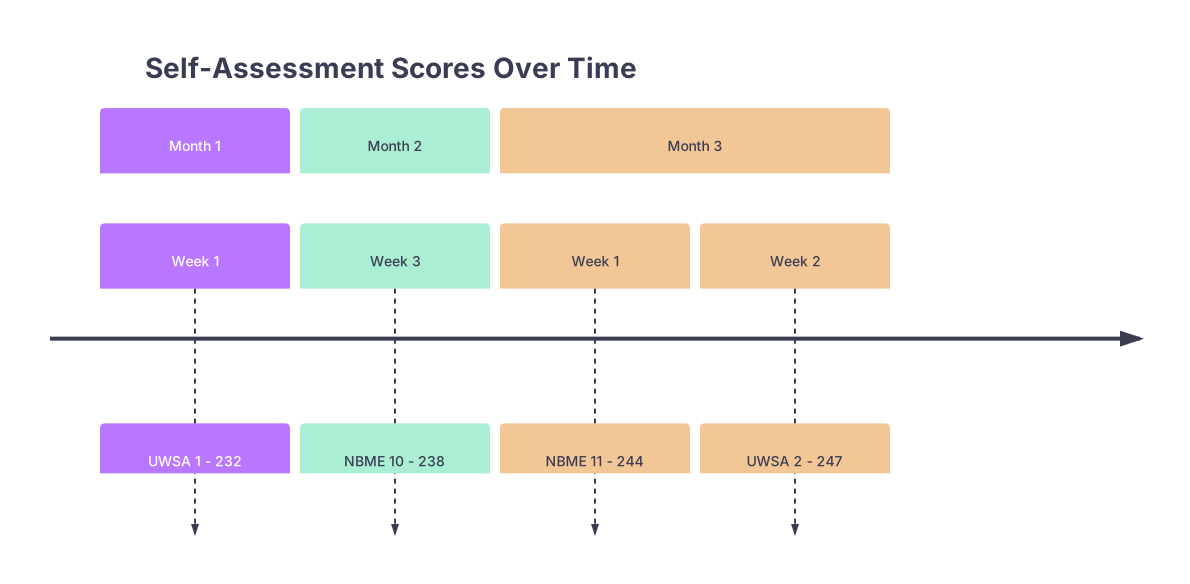
| Period | Event |
|---|---|
| Month 1 - Week 1 | UWSA 1 - 232 |
| Month 2 - Week 3 | NBME 10 - 238 |
| Month 3 - Week 1 | NBME 11 - 244 |
| Month 3 - Week 2 | UWSA 2 - 247 |
That’s a pattern you can work with.
2. Timing Matters More Than You Think
Same test. Different timing. Totally different predictive value.
- UWSA 2 taken 6 weeks out vs 4 days out is not the same beast
- NBMEs taken before you’ve done a serious chunk of UWorld are mostly “where you started,” not “where you’ll end”
Here’s a simple way to think about it:
| When You Take It | How Predictive It Is |
|---|---|
| > 6 weeks before exam | Low–Moderate |
| 3–6 weeks before exam | Moderate |
| 1–3 weeks before exam | High |
| < 5 days, with burnout | Distorted by fatigue |
If your final 2–3 self-assessments in the last 2 weeks are clustered tightly, that’s your best forecast.
3. Interpreting Over- vs Under-Prediction
You’ll hear stories like:
“UWSA 2 overpredicted me by 12 points.”
Or
“NBME 11 underpredicted by 15; I crushed the real thing.”
Both happen, but they’re the exception, not the rule.
General patterns:
Overprediction often comes from:
- Test-day fatigue, anxiety, poor sleep
- Guessing strategies failing under pressure
- Not having stamina for the final blocks
Underprediction often comes from:
- Testing while tired, post-call, or sick
- Not having fully reviewed content yet
- Making preventable careless errors you later fix
So when you see a weird outlier score, cross-check:
- Sleep that week
- Call schedule
- How rushed you felt
- Whether you reviewed mistakes and truly fixed them
Outlier ≠ destiny. But if 3 tests in a row tell the same story, believe them.
Practical Scenarios and What I’d Do
Let me be very concrete.
Scenario 1: Scores Are Clustered, Close to Your Goal
- NBME 10 (14 days out): 243
- NBME 11 (9 days out): 246
- UWSA 2 (5 days out): 248
Target: 245–250.
Interpretation: You’re there. The real exam is extremely likely to fall in the mid-240s to low-250s.
Plan:
- Stop chasing more full-lengths
- Fix weak subject areas from the last tests
- Protect sleep, nutrition, and basic sanity
Scenario 2: Wide Spread and Volatile Scores
- UWSA 1 (4 weeks out): 252
- NBME 9 (3 weeks out): 236
- NBME 10 (10 days out): 241
- UWSA 2 (4 days out): 243
Interpretation: Your true level is probably ~240. That 252 was likely an optimistic outlier.
Plan:
- Base your expectations on the cluster around 240–243
- Identify recurring weak areas from multiple forms (e.g. endocrine, ethics)
- Accept that you’re not magically a 255+ unless reality changes, not your feelings
Scenario 3: Borderline Passing / Low Scores
- NBME 9 (3 weeks out): 206
- UWSA 1 (2 weeks out): 212
- NBME 10 (9 days out): 214
- UWSA 2 (5 days out): 217
Interpretation: You’re probably around low 210s. That’s above the passing threshold historically, but not comfortably.
Plan:
- Talk to your dean / advisor about whether to proceed or postpone
- Don’t just keep taking tests; focus on targeted content remediation
- Fix absolute basics: patient safety, ethics, management algorithms
Here’s the reality: for a student in this zone, a 5–10 point swing on test day (either direction) is very possible. You need to tighten fundamentals.
What About Percent-Correct in Question Banks?
You’re going to ask this anyway, so let’s hit it.
UWorld % correct is a rough indicator, not a score converter.
Very general pattern (not gospel):
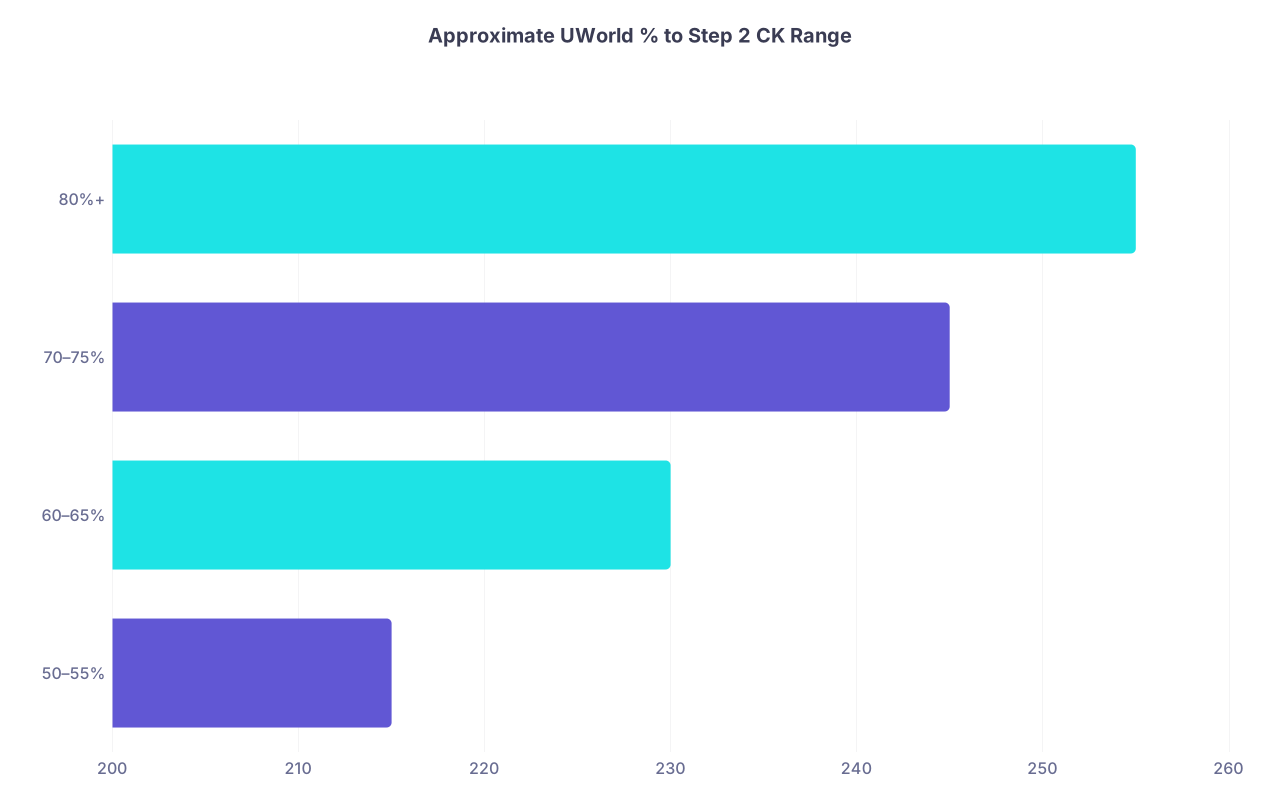
| Category | Value |
|---|---|
| 50–55% | 215 |
| 60–65% | 230 |
| 70–75% | 245 |
| 80%+ | 255 |
Those values are not “if you have 70% you will get 245.” They’re typical center-of-gravity ranges I’ve seen. There are plenty of 70% people who land 230, and plenty who hit 255. Test-taking skill and how you review matter a lot.
Self-assessments are more direct and more predictive than UWorld % alone. Use both, but trust the timed practice NBMEs/UWSAs more.
When to Stop Taking Self-Assessments
There is a point where more tests stop helping and only increase your anxiety.
Good stopping point:
- You have at least 2–3 recent self-assessments (within 2–3 weeks)
- Scores are within a ~5–8 point window
- Weak areas are identified and you’re actively fixing them
Past that, more tests mostly confirm what you already know.
If your last 2–3 scores are 245, 248, 246, you don’t need a 4th number that says 247 to be convinced you’re around 245–250.
FAQ: Step 2 CK Self-Assessments and Real Scores
1. Are Step 2 CK self-assessments accurate predictors of the real exam?
Yes, within limits. Modern NBME forms and UWSAs, especially UWSA 2, usually predict your actual Step 2 CK within about ±5–7 points if taken in the last 2–3 weeks, under real testing conditions, after a solid period of studying. Wild mismatches happen, but they’re not common.
2. Which is more accurate: NBME or UWorld Self-Assessments?
If I had to handicap it: UWSA 2 is often the single best predictor for many students, with newer NBME forms a close second and sometimes more conservative. UWSA 1 is useful but tends to be slightly more optimistic. Don’t rely on any single score in isolation; look at the cluster.
3. My UWSA 2 is 10 points above my last NBME. Which do I believe?
I’d split the difference and assume your real score is somewhere in the middle, especially if both were done reasonably close to the exam. Then ask: was one taken when you were exhausted? Was your content base significantly different? If you took NBME earlier and UWSA 2 later after more studying, the upward movement might be real.
4. How many self-assessments should I take for Step 2 CK?
For most students, 3–5 total is a solid range: one early/mid (UWSA 1 or NBME), one in the middle to recalibrate, and 1–2 in the final 2–3 weeks (usually a newer NBME plus UWSA 2). More than that, and you risk burning time and mental energy that could be better spent reviewing.
5. My self-assessments are all over the place. What does that mean?
It usually means one of three things: you’re inconsistent with sleep/fatigue, your foundation is shaky and you’re guessing a lot, or you’re taking some of these tests too early to be meaningful. Look at the last 2–3 done under decent conditions, not the earliest ones. Then work on stability: pacing, stamina, and review of mistakes.
6. Can I outperform my self-assessment scores on the real Step 2 CK?
Yes, and many people do by a few points—especially if their last exam was a bit early or taken when they were tired. Jumping 15–20 points above your most recent serious self-assessment is possible but not something to bank your plans on. Plan using your recent cluster of scores, then treat any upside on test day as a bonus, not a promise.
Key points to leave you with:
- Recent self-assessments (NBMEs + UWSA 2) usually predict your Step 2 CK within roughly ±5–7 points.
- Don’t obsess over a single score; the pattern across 2–4 recent exams is a much better truth.
- Use these scores to adjust your strategy, not just your anxiety level—fix the weaknesses they expose, then walk into test day knowing you’re playing in the score range you’ve actually earned.