
Most students are asking the wrong question about Step 2: it’s not “should I take a dedicated,” it’s “how much can I afford to step away from the wards without hurting everything else?”
Let me be blunt. Stopping rotations for a Step 2 dedicated block can be a great move, a neutral move, or a massive self-own depending on three things:
- Your Step 1 result
- Your target specialties/program competitiveness
- How you’ve been performing on shelf exams and practice tests so far
If you treat it like some magical tradition you “have to” follow, you’ll waste time and possibly hurt your application. If you treat it like a strategic lever—used in the right context—it can rescue an application or turn a decent profile into a strong one.
Let’s walk through when it is and is not worth pausing rotations, how long that pause should be, and what a dedicated Step 2 block should actually look like if you decide to do it.
The Core Question: Do You Need a Dedicated Block At All?
Here’s the answer many people do not want to hear:
If you’re consistently studying during rotations, scoring near or above your target on NBMEs/COMSAEs/CCSs, and your Step 1 is already strong for your specialty, you often do not need a long dedicated block. A short 1–2 week buffer is usually enough.
On the flip side, if any of the following are true, a dedicated block is very likely worth it:
- Step 1 is low or pass with clear concern for competitive programs (e.g., “pass” with barely passing performance, or a numerical score <230 if programs still see it via transcripts, or COMLEX barely passing).
- You’re aiming for competitive specialties (derm, plastics, ortho, neurosurgery, ENT, some academic IM) and want Step 2 to carry your application.
- Your shelf scores have been mediocre or inconsistent, and practice Step 2 exams are coming in below where you need them (e.g., <235–240 when you’re aiming for something that usually sees 250+).
If Step 2 is the exam that will “tell your story” because Step 1 no longer can, you treat it as a priority. That’s when pausing rotations makes sense.
How Long Should a Step 2 Dedicated Block Be?
You’re not studying for Step 1 from scratch. You’ve been living this material for a year.
Most students overestimate how long they need and underestimate how burnt out they’ll be if they drag it out.
Here’s a practical framework.
| Situation | Recommended Dedicated Length |
|---|---|
| Strong Step 1, strong shelves, strong practice tests | 0–1 week |
| Solid but not stellar across the board | 2 weeks |
| Weak Step 1 OR uneven shelves | 3–4 weeks |
| Multiple weak factors + true test anxiety or poor test history | 4–5 weeks (max) |
Past ~5 weeks, the marginal benefit drops for most people. You start rereading instead of learning, and your stamina drops. I’ve seen more students overcook Step 2 and plateau at 240–250 than “break through” just by brute-forcing 8 extra weeks.
So is it worth pausing rotations? If you need 2 or fewer weeks, you can often carve that out:
- Between clerkships
- Using vacation/reading time
- With a carefully planned schedule change through your dean’s office
If you’re talking 4+ weeks off? Then the downside risk becomes real, and you need to justify it with your numbers and goals.
The Tradeoffs: What You Gain vs What You Risk
Stopping rotations is not free. You’re trading clinical exposure, letters, networking, and continuity for study time.
What You Gain By Pausing Rotations
You gain:
- Protected, consistent study hours (8–10+ per day if you’re disciplined)
- Ability to stack full-length practice exams without post-call brain fog
- More recovery time (sleep, exercise, actual brain consolidation)
- Less cognitive switching between real patients and vignettes
The biggest win is cognitive bandwidth. You’re not trying to memorize micro minutiae after a 14-hour day on surgery when your brain feels like mashed potatoes.
What You Risk or Lose
You risk:
- Delaying required rotations → can compress 4th year and screw up audition/elective timing.
- Hurting relationships with attendings/teams if the schedule change is poorly communicated.
- Reducing time for away rotations or sub-Is in your chosen specialty.
- Appearing “academically fragile” if you request a huge pause without a clear reason or plan.
Residency programs care a lot about Step 2, but they also care whether you function as a solid team member on the wards. If your pause leads to awkward gaps, missing letters, or reduced clinical exposure in your chosen field, it can backfire.
Who Absolutely Benefits From a Dedicated Step 2 Block
Let me spell this out clearly. If you see yourself in these descriptions, a dedicated block is usually worth pausing rotations for.
Group 1: Step 1 “Rescue” Candidates
You:
- Had a low Step 1 (bare pass or below your specialty’s unofficial threshold)
- Already hear your dean or advisors saying: “You really need a strong Step 2”
- Are considering or already locked into a moderately/very competitive specialty
Here, Step 2 isn’t optional. It’s your redemption arc.
For you, a 3–4 week dedicated block can be the difference between:
- Story A: “They struggled initially but clearly mastered the clinical content later.”
- Story B: “They underperformed on both major board exams.”
If you’re in this group, pausing rotations is not “extra.” It’s strategic triage.
Group 2: Weak Shelf Performance, But Good Work Ethic
You:
- Do fine clinically but your shelf scores have been mid- or low-tier
- Struggle with timing, stamina, or question strategy
- Notice that knowledge is there in pieces, but test performance lags
Here, a dedicated block lets you:
- Do high-density question blocks back-to-back
- Tighten up weak systems (OB, peds, psych, etc.) in a structured way
- Calibrate with multiple practice NBMEs/COMSAEs and adjust quickly
You’re not “bad at medicine.” You just haven’t had sustained test-focused time. Dedicated is where you fix that.
Group 3: High-Aspiration, High-Variance Students
You:
- Have a decent Step 1 but not enough to carry a hyper-competitive specialty
- Have some shelves that were great and others that were suspiciously low
- Want to use Step 2 to show your best possible ceiling
For you, 2–3 weeks off is often enough. You don’t want to vanish from the wards for months, but you do want the space to push from “good enough” into the “this is clearly a strength” zone.
Who Usually Does Not Need to Pause Rotations
On the other side, here’s who I’d generally tell: do not blow up your schedule for a long dedicated.
- Step 1 strong, shelves strong, practice Step 2 already near target or better
- Applying to less competitive specialties where you’re already in a comfortable zone
- Have crucial sub-Is, away rotations, or letters that would be compromised by a big pause
In these cases, the best play is usually:
- Keep doing 20–40 mixed UWorld questions daily on rotations
- Use one lighter rotation or a short buffer for 7–10 days of higher-intensity review
- Schedule the exam strategically (e.g., right after IM, or after a lighter clerkship)
You don’t need to fix what isn’t broken.
A Realistic Dedicated Step 2 Study Plan (If You Pause Rotations)
If you decide pausing is worth it, the structure of your block will determine if it pays off.
Here’s a concrete 3–4 week skeleton that works for most people.
Baseline: Before You Start
- Take a practice exam (NBME or UWA) 3–5 days before starting full dedicated.
- Identify weakest areas (e.g., OB/GYN, psych, endocrine, heme/onc).
You’re not going in blind. You’re going in with a hit list.
Weekly Structure Overview
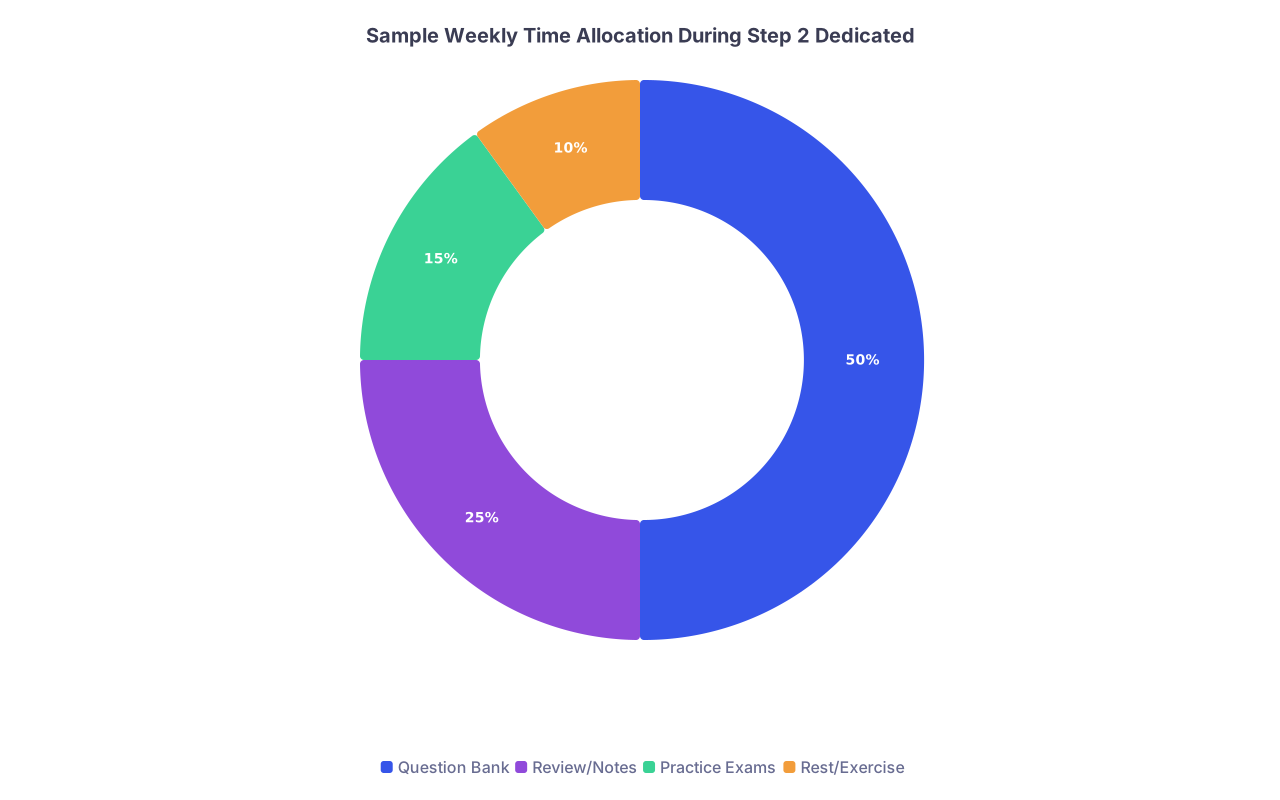
| Category | Value |
|---|---|
| Question Bank | 50 |
| Review/Notes | 25 |
| Practice Exams | 15 |
| Rest/Exercise | 10 |
Daily (6 days/week):
- 3–4 blocks of 40 questions (timed, random, mixed)
- Review every question thoroughly (right and wrong)
- 1–2 hours targeted content review (based on missed questions or weak systems)
Weekly anchors:
- Week 1: Heavy Qbank + fix obvious weak systems (e.g., OB, peds, psych).
- Week 2: Continue Qbank, add one full-length exam.
- Week 3: One or two more practice exams, taper content, focus on stamina.
- Week 4 (if you have it): Mostly exams and high-yield review, not learning brand new details.
Cramming 100% new content in week 4 is a waste. That’s when you should be fine-tuning test-taking and preserving your brain.
How to Decide: A Simple Decision Flow
You want a yes/no on “Should I pause rotations?”
Use this.

| Step | Description |
|---|---|
| Step 1 | Check Step 1 Result |
| Step 2 | Check Shelf + Practice Scores |
| Step 3 | You likely need 3-4 week dedicated |
| Step 4 | Short 0-1 week buffer, dont pause long |
| Step 5 | 2-3 week dedicated if schedule allows |
| Step 6 | Step 1 strong for your specialty? |
| Step 7 | NBMEs near target score? |
Translate that into real thresholds:
- “Strong Step 1” = At or above your specialty’s typical accepted range.
- “NBMEs near target” = Within ~5–10 points of what you’d be satisfied submitting to programs.
If you’re below both? That is when a serious dedicated block and pausing rotations is usually worth it.
How Programs Actually View a Dedicated Block
Residency programs don’t have a checkbox for “took dedicated time” vs “didn’t.” They see:
- Your Step 2 score
- The timing of your rotations
- The quality and timing of your letters
- Whether you graduated on time or with weird gaps
If pausing rotations:
- Doesn’t delay graduation
- Doesn’t destroy your ability to complete needed away rotations or sub-Is
- Leads to a clearly improved board exam profile
Then it’s a net positive or neutral.
Where it looks bad:
- You pause for a long time
- You still come out with a mediocre or low Step 2
- And you now have crunched or weak clinical experiences because of it
Pausing rotations is a bet. If you take the time but do not execute on it, you’ve doubled your losses: lost clinical time and a still-underwhelming score.
So if you do pause, you treat that study block like a job. Not optional. Not “study vibes.” Actual structured work.
FAQ: Pausing Rotations for Step 2
1. Will taking 4–6 weeks off for Step 2 hurt my residency application?
It can, but not automatically. It hurts you if it:
- Forces you to delay key sub-Is or away rotations
- Results in gaps or strange sequencing that scare programs (e.g., no IM rotation before applying to IM)
- Is paired with only a modest Step 2 score
If your school can rearrange things cleanly, you still graduate on time, and the break produces a much stronger Step 2 result, programs generally see that as a smart move, not a red flag.
2. Is a 1–2 week “micro-dedicated” even worth it?
Yes, for many students that’s the optimal move. A short, high-intensity window to:
- Take 1–2 practice exams
- Patch obvious gaps
- Ramp up Qbank volume without post-call fatigue
If you’re already close to your target on practice tests, 1–2 weeks is often enough and a lot safer than blowing up your schedule for a month.
3. If I did poorly on shelves, can I fix everything during dedicated?
You can improve a lot, but you won’t magically transform into a different person in 3 weeks. What you can do:
- Consolidate scattered knowledge
- Drill weak systems with focused practice
- Sharpen timing and stamina
But if you were barely studying all year and hoping dedicated will save you in one heroic sprint, that’s fantasy. You’ll improve, but not to an elite score band without real effort and discipline.
4. When’s the best time in the year to schedule a dedicated block?
Common high-yield windows:
- Right after finishing IM or a heavy medicine-adjacent block
- Between core rotations (if your school allows a flex month)
- During a lighter elective if you can downshift clinical effort temporarily
What you want to avoid is taking Step 2 very late (after ERAS submission) if Step 2 is supposed to rescue a weak Step 1. Programs can’t weigh a score that doesn’t exist yet.
5. Should I keep doing any clinical shifts during dedicated, or go 100% off?
If you truly want a dedicated block, minimize clinical work. A couple of short clinic sessions or call shifts is fine if required, but don’t pretend you’re “on dedicated” if you’re still working 50–60 hours/week. That’s just rotations plus guilt. Either commit to real protected time or don’t call it dedicated.
6. If my Step 1 was strong, can a mediocre Step 2 hurt me?
Yes, it can. Programs expect Step 2 to be roughly in line with or higher than Step 1. A noticeable drop raises questions about plateau, burnout, or inconsistent performance. In your situation, you might not need a long break, but you do need to respect Step 2 enough to avoid sleepwalking into it.
Bottom line:
- Pausing rotations for Step 2 is worth it when your Step 2 score will materially change how programs view your entire application—especially if Step 1 was weak or you’re shooting for competitive specialties.
- Most students do best with 2–4 weeks of true dedicated time; longer than 5 weeks is rarely necessary and often counterproductive.
- If you take the pause, treat it like a contract with yourself: structured days, aggressive practice, honest tracking—and then go back to the wards with a score that actually made the sacrifice worth it.