
It’s Sunday night. You’ve just finished another 40-question UWorld block and bombed more items than you want to admit. Your test date is on the calendar, you keep hearing people talk about “NBME 10, 11, 12, 13, UWSA1, UWSA2…” and you’re asking the only question that really matters:
“How many full-length practice exams do I actually need for Step 2 CK… and which ones?”
Let’s cut through the noise.
The Short Answer: A Clear Number
You’re not going to like this, but here’s the honest answer:
- Minimum that I’d call “safe but lean”:
3–4 serious practice exams - Ideal for most students aiming for a solid score (240–260 range):
5–6 total standardized practice exams - Upper limit where returns start to drop hard:
7–8 exams max, and only if you’re spacing them well and actually reviewing them
And no, doing 10–12 full-lengths won’t magically fix bad content knowledge or broken test-taking habits. At some point, you’re just doing 9-hour self-harm.
Here’s the breakdown of what that usually looks like in real life:
| Exam Type | Recommended Count |
|---|---|
| NBME Forms | 3–4 |
| UWSA (UWorld Self-Assessments) | 1–2 |
| Free 120 (official practice) | 1 |
| Other/random full-lengths | 0–1 (optional) |
If you want one sentence:
For most people, 4 NBME-style exams + 1–2 UWSAs + the Free 120 is a very reasonable target.
Now let’s talk about why and how to use them so you’re not just collecting score reports.
What Counts as a “Full-Length” for Step 2 CK?
You don’t need eight separate 9-hour marathons. You need standardized score-predictive assessments that mimic the real exam in style and difficulty.
The ones that actually matter:
NBME Step 2 CK Self-Assessments
- Most predictive
- Same question writers and style as the real exam
- Shorter than the real test but good enough for score prediction and readiness
UWorld Self-Assessments (UWSA1 and UWSA2)
- Very popular
- Slightly different feel than NBME, but still useful for practice and confidence
- Often used as “capstone” exams close to test day
USMLE Free 120 (official practice questions)
- Not a true “full-length,” but close enough that I count it
- Excellent for:
- Interface familiarity
- Style of question stems
- Final check on readiness
If you’re doing random qbank “self-assessments” or 8-block DIY tests using tutor blocks, those are fine for stamina practice, but they don’t replace NBME/UWSA/Free 120 for prediction.
How Many Exams Do You Need? Use This Framework
Don’t copy your roommate’s N=1 strategy. Use your baseline and goal to decide your number.
Step 1: Start With Your Baseline
Take an NBME or UWSA early. Not day one of dedicated, but 2–4 weeks before dedicated is reasonable.
Rough guideline based on that first score:
- Baseline ≥ 245
- Strong position
- You can usually get away with 3–4 total exams
- Baseline 230–244
- Very common zone
- Plan for 4–6 exams
- Baseline 220–229
- You have work to do, especially if you want 240+
- Aim for 5–6 exams, but focus heavily on learning from them, not just taking them
- Baseline < 220
- Danger zone if your test date is close
- You don’t need more tests; you need better studying
- 4–6 exams total can still make sense, but the gaps between them should be content-heavy, not test-heavy
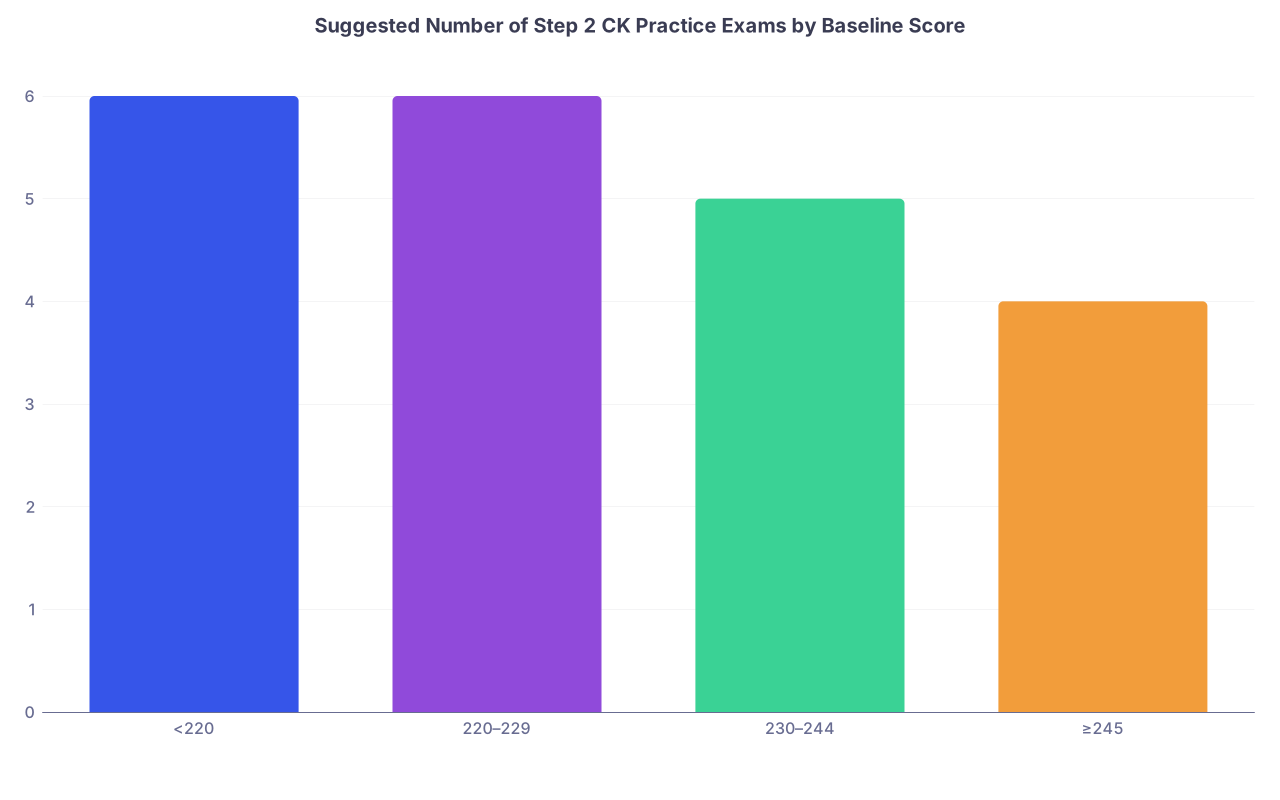
| Category | Value |
|---|---|
| <220 | 6 |
| 220–229 | 6 |
| 230–244 | 5 |
| ≥245 | 4 |
Step 2: Factor In Your Test Date
≤ 3 weeks until exam
You don’t have time for 6 full-lengths.
Reasonable: 2–3 standardized exams (e.g., 1–2 NBMEs + Free 120 or 1 UWSA)3–6 weeks until exam
This is the sweet spot for 4–5 exams spaced 5–7 days apart.> 6 weeks until exam
You can do 5–6 exams without burning out if you use them strategically.
Step 3: Adjust Based on Stamina and Anxiety
- If you fade hard after block 5?
You need at least a couple true long days to train stamina. - If your test anxiety spikes every time you see a score report?
Too many practice tests can backfire. Better to do fewer but higher-yield exams and spend real time on review.
A Concrete Example Schedule (5–6 Exam Plan)
Let’s say you have 5 weeks of dedicated. Here’s a very reasonable layout.
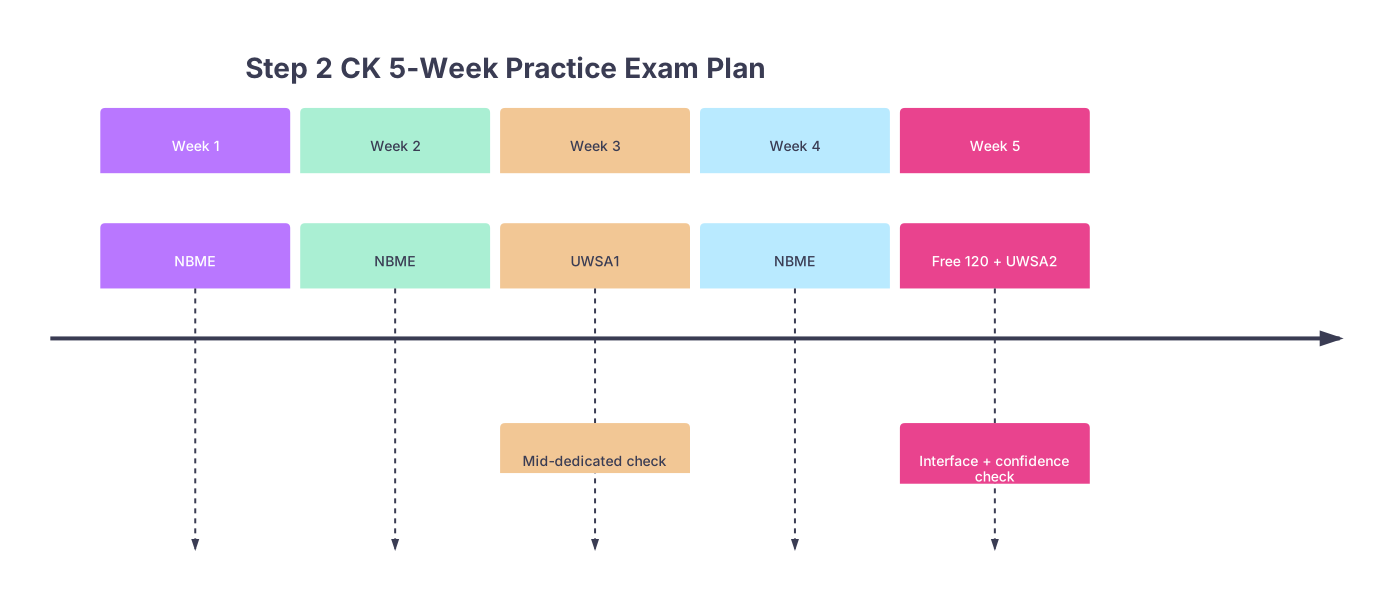
| Period | Event |
|---|---|
| Week 1 - NBME #1 | Baseline + curve check |
| Week 2 - NBME #2 | Gauge early progress |
| Week 3 - UWSA1 | Mid-dedicated check |
| Week 4 - NBME #3 | Near-final predictive |
| Week 5 - Free 120 + UWSA2 | Interface + confidence check |
How that plays out:
Week 1: NBME #1
Baseline. Painful but necessary. Sets the tone and reveals blind spots.Week 2: NBME #2
Check if your studying is working. Look for trend and pattern improvement, not just raw score.Week 3: UWSA1
Long-format practice and another data point. If you’re improving, good. If flat or lower, adjust hard.Week 4: NBME #3
Primary predictor. This is the one I care about most for “am I ready?”Week 5: Free 120 + UWSA2
- Free 120: Official questions, last interface check
- UWSA2: Confidence booster and final run-through, usually 5–7 days before test day (not the day before)
If you only have bandwidth for 4 exams, drop one of the mid-dedicated ones (e.g., skip UWSA1 or an extra NBME), but keep:
- At least 2 NBMEs
- UWSA2
- Free 120
The Big Mistakes With Practice Exams
Here’s where people blow it.
1. Treating Exams Like a Checklist, Not a Tool
If you take a full-length, glance at your 239, mutter “eh, fine,” and go back to grinding questions… you just threw away half the value.
You should be spending at least as much time reviewing the exam as you did taking it.
That means:
- Flagging missed questions by topic, not just by question ID
- Asking:
- Did I miss this because I didn’t know the content?
- Or because of poor test-taking (rushing, misreading, second-guessing)?
- Building a short, targeted list of 3–5 themes from each exam:
- “I keep missing pregnancy physiology”
- “I’m bad at management sequences (what’s next step)”
- “I bail out too early on long stems and miss key details”
If you’re not extracting patterns, you’re not learning from the exam.
2. Doing Exams Too Close Together
Two NBMEs 2 days apart? Useless. You haven’t given yourself time to improve anything.
You want at least:
- 4–7 days between big practice exams
- Those days should include:
- Focused review of the previous exam
- Targeted UWorld blocks on your weak areas
- Some mixed blocks to keep your global skills sharp
3. Ignoring Signs of Burnout
If every exam is dropping, your sleep is a disaster, and every NBME feels worse than the last, doing more tests doesn’t fix that.
At that point, I’d rather you:
- Take one exam,
- Spend 2–3 days seriously learning from it,
- Fix your schedule, sleep, and exercise,
- Then reassess.
More tests in burnout mode just generate more anxiety and less progress.
What If Your Practice Scores Are All Over the Place?
This happens a lot. NBME up, UWSA down, Free 120 up again. People freak out.
Here’s how to think about it:
- NBMEs tend to be the most predictive, especially the newer forms.
- Free 120 is usually a good sanity check, not a perfect predictor.
- UWSAs can be a little optimistic or pessimistic depending on the person.
Look at:
- Trend over 3+ exams, not any single test
- Your performance in:
- Internal medicine
- Peds
- OB/GYN
- Surgery
- Psych
If you’re consistently weak in one big section, that’s where score gain lives.
If 3–4 exams in a row show no improvement at all, that’s a strategy problem, not a “I need more practice tests” problem.
Stamina Practice vs Score Prediction
You don’t actually need six true 8-block days if your goal is just prediction. But you should do at least 1–2 full-length-style days to simulate the fatigue and pacing of the real exam.
Simple plan:
- Take an NBME or UWSA as usual (4 blocks)
- Add:
- 2–3 extra timed 40-question UWorld blocks before or after
- Treat it like test day:
- Wake up same time
- Same breakfast
- Same timing on breaks
One or two of these days is enough for most people to realize:
- “Wow, I crash in the afternoon”
- “I need a real lunch, not just coffee”
- “My pace slows down after block 5”
Better to learn that now than on game day.
Quick Reality Check: More Exams vs Better Studying
If you’re below where you want to be, doing more full-lengths is often the laziest-seeming, but actually worst, reflex.
Ask yourself:
- Am I re-reviewing UWorld questions I missed?
- Do I have notes or an error log that I actually look at?
- Am I doing mixed blocks or hiding in my favorite specialties?
- After each exam, do I walk away with 3 concrete adjustments?
If the answer is “no” to most of that, cap yourself at 5–6 exams and invest the time in actual learning.
FAQ: Step 2 CK Practice Exams
1. What’s the absolute minimum number of practice exams you’d recommend?
If you’re truly pressed for time, I wouldn’t go below:
- 2 NBME exams
- 1 UWSA (preferably UWSA2)
- Free 120
That gives you three predictive data points and one official-style check. Fewer than that and you’re going in half-blind.
2. When should I take my last full-length before Step 2 CK?
Ideal window: 5–7 days before your real exam. That’s usually UWSA2 or a later NBME. Don’t schedule a full-length the day before your test; do light review, skim notes, maybe a handful of questions, and protect your sleep.
3. My NBME scores are lower than my UWSA scores. Which do I believe?
Believe the NBMEs first. They’re closer in style and scaling to the real test. Use UWSA mainly for extra practice and confidence. If NBME and UWSA disagree wildly, assume your true score is closer to NBME until proven otherwise.
4. Do I need to sit for 8–9 hours straight every time I do a practice exam?
No. You only need 1–2 true “simulation days”. For the rest, doing the exam (4 blocks) in one sitting is enough. You can add 1–2 UWorld blocks before or after if you want extra stamina training, but you don’t need to mimic every single detail repeatedly.
5. Should I delay my test if my last practice exams are below my target?
Ask three questions:
- Are your last 2–3 exams trending up or flat/down?
- Are you within 5–10 points of a realistic target?
- Do you have actual time and plan to improve if you delay?
If your NBMEs are consistently well below passing or far from your goal and you can realistically buy more time, delaying is reasonable. But don’t delay just to take three more exams without changing how you study.
6. What’s the best next step if I’ve already done 4 exams and feel stuck?
Stop scheduling more tests for a moment. Take your last 2 practice exams, go through every single missed and guessed question, and write out a short list of:
- 5 content topics to shore up
- 3 recurring test-taking errors you’re making
Then build a 7-day mini-plan focused only on those. After that, take one more NBME or UWSA, see if there’s movement, and re-evaluate. More data without new behavior won’t help.
Today’s action item:
Open your calendar and count the weeks until your Step 2 CK date. Based on that number, sketch out exactly which 3–6 practice exams you’ll take and on which days. Put them in your schedule now, not “later.”