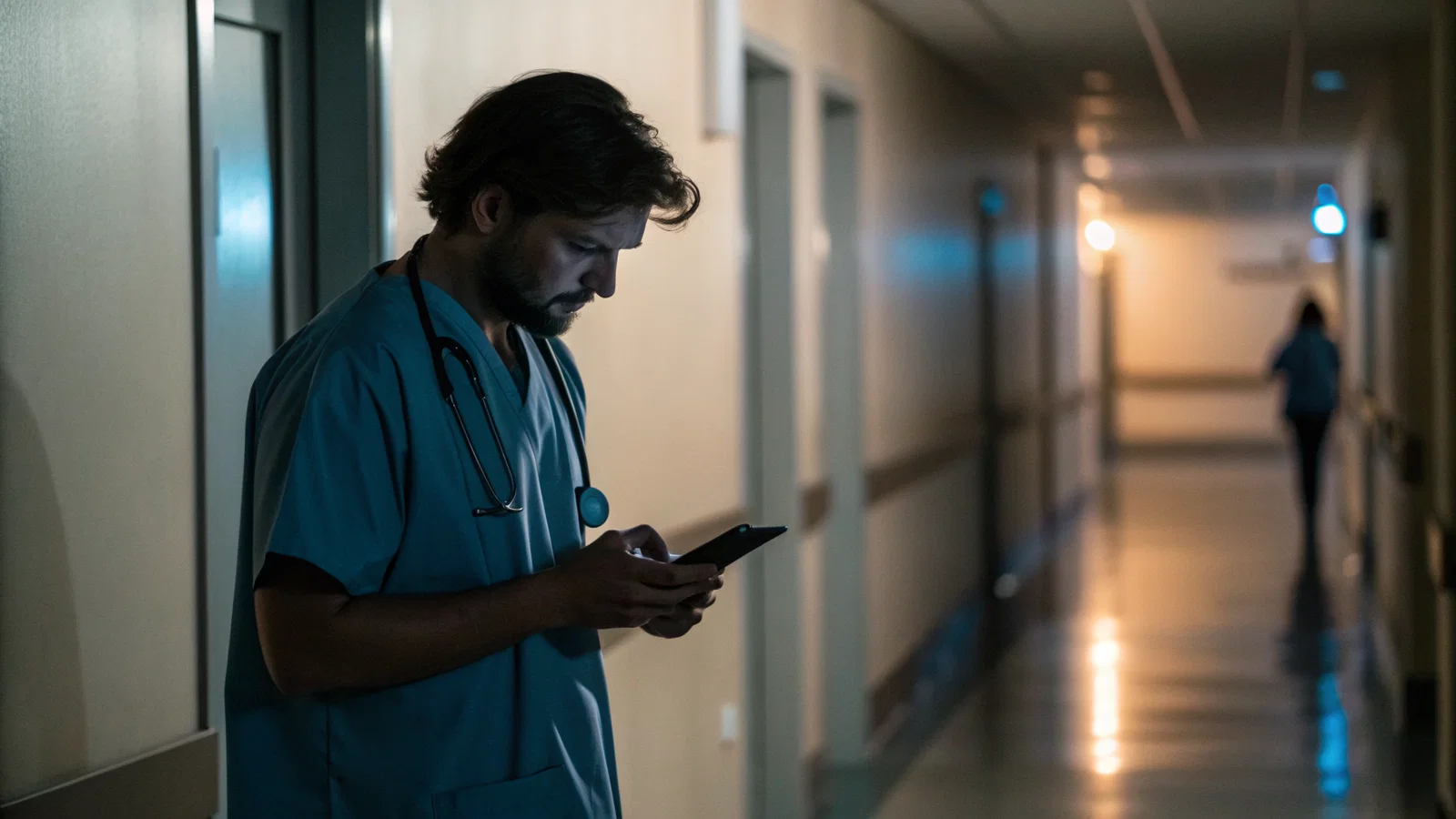
It's 2:14 AM. Your final evaluation for your sub-internship is due in 48 hours. ERAS submission is looming. And your preceptor, the attending who explicitly promised you a stellar evaluation and an Honors grade, has completely vanished into thin air.
You've checked your sent folder four times. Did you misspell their email? Did you sound too pushy in that follow-up note last week? What if they secretly hated your case presentations? What if they're going to give you a Pass out of pure spite, or worse, let your evaluation expire into a zero because they forgot you exist?
I've been in that exact spiral. Staring at an empty inbox, heart hammering against my ribs, convinced my entire residency application was crumbling because Dr. Smith hadn't clicked 'submit' on a portal link. Take a deep breath. Stop refreshing your email every thirty seconds. Let's walk through why this happens and how to fix it before your brain invents three more catastrophic scenarios.
The Silence That Screams: Why Ghosting Happens (And Why It's Probably Not About You)
That deafening silence after you click send on an evaluation request is a special kind of torture. You spent four weeks waking up at 4:30 AM, crushing your morning rounds, reading up on rare surgical techniques, and managing complex patients. You sacrificed sleep, sanity, and your social life for this rotation. And now? Nothing. Just an unread email sitting in a black hole.
Your brain immediately jumps to the worst possible outcome: They realized I'm an impostor. They saw me mess up that cranial nerve exam on Day 3. They're deliberately ignoring me because I don't deserve Honors.
Stop.
(For context on how these evaluations are viewed by programs, see also: How Program Directors Actually Read Your Clinical Evaluations (https://residencyadvisor.com/resources/med-school-life/how-program-directors-actually-read-your-clinical-evaluations).)
Here is the unvarnished reality of academic medicine: attendings are drowning. They aren't sitting at their desks cackling as they selectively ignore student emails to ruin careers. They are managing 28 inpatients, fighting prior authorizations with insurance companies, trying to finish 40 unsigned chart notes from Tuesday, and dealing with an inbox that receives 150 emails a day. On top of that, hospital IT systems routinely filter automatic survey links from MedHub or NewInnovations straight into spam folders.
(For more on how to fix your grade mid-rotation when things go sideways, see: What Clerkship Directors Won't Tell You: Fixing Honors Mid-Elective.)
When an attending ghosts you, it is almost never about your performance. It's about a chaotic, overworked healthcare system where administrative tasks like student evaluations sink to the absolute bottom of an attending's priority list. It isn't a silent judgment on your worth as a future physician. It's systemic operational noise.
(If you are worried about the broader implications of missing grades, read: What If I Don't Honor Any Clerkships? How Bad Is It Really?.)
Protocol for Panic: The Step-by-Step Outreach Strategy
When you're spiraling, taking blind action feels better than sitting on your hands. But panicking into their inbox with frantic, daily "Did you get my email???" messages will actually hurt your cause. You need a cold, calculated outreach protocol.
First, observe the 5-day rule. Send your initial request, then force yourself to step away from the inbox for five full business days. No weekend counting. If the silence continues after five days, send one carefully written follow-up email.
Do not guilt-trip them. Do not say, "As per my previous email which was ignored..." or "I really need this for my application." Frame it purely around logistical convenience.
Try something like this:
"Dear Dr. [Name], I know how incredibly busy the service has been this week! I'm just bumping this to the top of your inbox in case the automated evaluation portal link got lost in spam. I thoroughly enjoyed my time on the service and learning from you. Please let me know if you need me to re-send the evaluation link!"
If another five business days pass with zero response, it's time to escalate. This is where medical students freeze up. Won't contacting the course director make me look like a snitch? Will the attending get mad and tank my grade?
No. Course coordinators and rotation directors handle this exact scenario every single week. It's literally their job. Email the coordinator politely: "I wanted to check in regarding my grade submission for the elective. I sent a couple of follow-ups to Dr. X, but I know how busy the service is. Could you advise on how best to proceed?"
Crucial rule: Keep everything on email. Build a paper trail. If questions arise later about why your grade was delayed, having timestamped, professional follow-ups proves you did everything right on your end.
Damage Control: How to Salvage Your Honors Recommendation
What happens if your preceptor finally resurfaces three weeks late, apologizes profusely, and asks what you need?
Navigating this takes finesse. Don't act bitter or passive-aggressive. Express genuine gratitude immediately: "Thank you so much, Dr. X! I completely understand how demanding the service is."
However, if you need a letter of recommendation (LOR) and you're worried their unreliability means they'll miss the ERAS upload deadline, you need a backup plan. Fast.
Never put all your application eggs in an unreliable basket. If an attending takes three weeks to fill out a 5-question evaluation form, do not rely on them for a high-stakes residency letter of recommendation. Pivot immediately. Is there a senior fellow or a second attending on that same service who watched you work? Approach them instead. An enthusiastic, detailed letter from a junior attending or fellow beats a generic, late letter from a famous professor who can't remember your name.
What if this delay shows up as an incomplete on your transcript right as interview invitations go out? Own the narrative. Residency directors love candidates who handle ambiguity without crumbling. If asked about a delayed grade or evaluation hitch, frame it around resilience:
"Our service was handling unusually high clinical volume that month. I focused on maintaining high patient care standards and worked directly with our department coordinator to keep communications clear and professional."
To avoid this entire nightmare on future electives: make your performance undeniable on day one. Give clear daily presentations. Ask for mid-rotation feedback explicitly face-to-face. When an attending sees your face every day asking, "What is one thing I can improve tomorrow?", they are far less likely to forget you when the evaluation email hits their inbox.
Reality Check: Does One Ghosting Incident Tank Your Career?
Let's address the nuclear scenario keeping you awake at 3:00 AM: What if this ghosting results in a generic 'Pass' or missing evaluation, and my top residency program throws my application in the trash?
It won't. I promise you, it won't.
Admissions committees do not look at your application as a fragile card tower that collapses if one block wobbles. They look at trendlines. They evaluate the entire mosaic: your Step scores, core clerkship grades, research, leadership, personal statement, and the overwhelming consensus of your letters of recommendation.
One sluggish attending on a single elective cannot undo three years of hard work. If you have solid evaluations across your core rotations and strong letters from responsive faculty, a delayed or average elective grade is a minor blip that most program directors won't even glance twice at.
Look at how holistic residency selection really is. Program directors are human beings who went through the exact same chaotic training system. They know attendings ghost students. They've seen automated links die in spam folders. They know how messy clinic schedules get. What they actually care about is how you behave when things don't go according to plan. Did you stay calm? Did you follow protocol? Did you handle the situation with maturity and grace?
That resilience is what makes a great resident, not a flawless streak of instant email replies.
Key Takeaways
- It's workload, not your worth: Preceptor ghosting is almost always a result of overwhelming clinical and administrative duties, not a silent rejection of your clinical performance.
- Follow a systematic outreach timeline: Wait 5 business days before sending a polite, logistics-focused follow-up. Wait another 5 days before involving the course director.
- Build a professional paper trail: Always communicate via official email so you have time-stamped documentation of your efforts to resolve the issue.
- Pivot your LOR strategy early: If an attending proves unreliable at answering basic emails, secure a backup letter writer among other attendings or senior fellows.
- Keep the big picture in mind: Residency committees look at your entire application trajectory. One delayed or missing elective evaluation will not ruin your career.
You have survived anatomy lab, shelf exams, step prep, and endless hours on your feet in the OR. You are capable, competent, and vastly more resilient than your late-night anxiety wants you to believe. This ghosting attending is just one small bump on a very long road. Take a deep breath, close the email tab for the night, and trust the work you've put in. You've got this.