Some students do not “earn” honors. They are given honors—and once that label sticks, the system keeps handing it to them.
Let me tell you what really happens on clinical rotations, from the attending workroom conversations to the resident group chats to the grade meetings where your fate is decided in about three minutes.
A lot of what you’ve heard about “just work hard and be nice” is only half the story. Necessary, not sufficient. The students who walk out of third year with “Honors in everything” on their transcript are playing a much more specific game—often without realizing it.
I’m going to spell out that game for you.
The Ugly Truth: Evaluations Are Not Objective
Your rotation grade is not a pure reflection of your clinical performance. It is a social and cognitive mess filtered through tired residents, distracted attendings, and a grading system that pretends to be precise.
Here’s how it actually works behind the scenes.
On most rotations, at the end of the block, the system pings your residents and attendings: “Please evaluate Student X.” They click the link three days later on their phone between consults. They vaguely remember your face. They certainly do not remember the details of your SOAP notes from week 2.
So what do they grade?
They grade an impression.
I’ve sat in rooms where a chief resident literally said, “Wait, who was [student’s name]?” Someone answers, “Short hair, always asked to see more patients, did that nice presentation on pancreatitis.” The chief: “Oh yeah, that one was solid—probably Honors.”
That’s how thin the line is.
The students who get Honors across the board understand—consciously or not—that the game is about:
- Being memorable in the right way
- Reducing friction for the team
- Making it easy for evaluators to justify clicking “Outstanding”
Your job in third year is to manufacture a consistent, positive impression that survives the end-of-rotation amnesia.
The Core Pattern: What Honors Students Actually Do Differently
Let’s drop the fantasy that Honors students are simply “smarter” or “naturally gifted.” Some are. Many are not.
Here’s the real pattern I keep seeing.
1. They engineer predictability
Residents and attendings love the student they do not have to think about. The one who shows up, plugs in, and just quietly makes things smoother.
Honors students do small things with ruthless consistency:
- They’re early. Every day. Not once in a while. The intern knows that by 6:45, the list is printed, vitals are checked, new labs scanned, and the student has already flagged overnight events.
- Their pre-rounds are predictable. If you present, everyone in the room knows your structure by day 3. No erratic rambling, no reinventing the wheel each time.
- When asked to do something once, they do it that way every time, without having to be reminded.
Residents start saying in the workroom: “At least [your name] has that handled.” That’s the quiet sentence that translates to Honors later.
2. They understand what “helpful” really means
Most students think “helpful” means being eager and volunteering. Honors students understand that “helpful” means removing mental load from the team.
This is the difference:
Average student: “Let me know if there’s anything I can do to help.”
Honors student: “I already printed fresh lists, checked the 7 a.m. labs for our patients, and called the nurse on 621B about the electrolyte repletion.”
See the gap?
I’ve heard residents say: “I didn’t have to worry about discharge instructions; the student had the draft ready.” That is gold. Because when the resident fills out your evaluation, the vague feeling is: “The day was better with this student around.” That turns into “Outstanding” with zero hesitation.
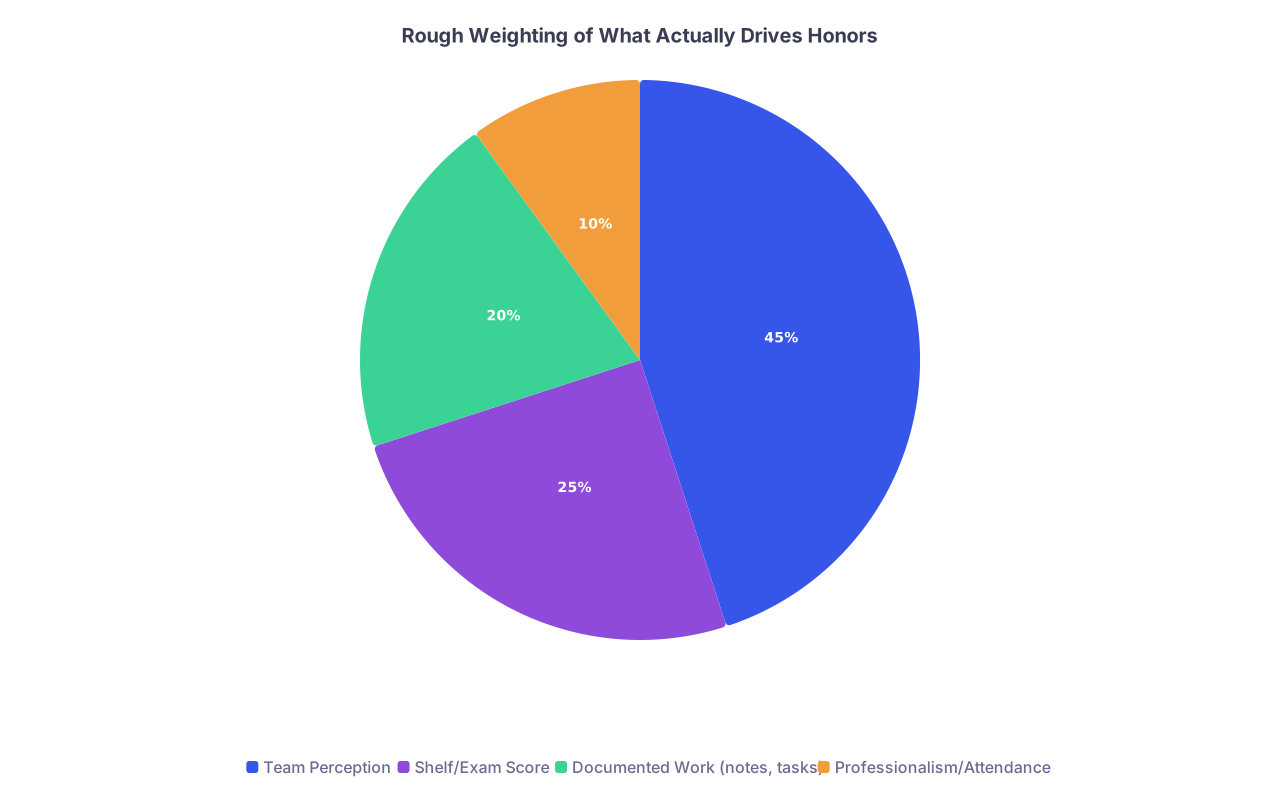
| Category | Value |
|---|---|
| Team Perception | 45 |
| Shelf/Exam Score | 25 |
| Documented Work (notes, tasks) | 20 |
| Professionalism/Attendance | 10 |
How Grades Are Really Decided: The Meeting You Never See
Let me walk you into a real grade meeting. I’ve sat through these.
There’s a spreadsheet. Columns: shelf score, numerical clinical score, comments, final grade.
A clerkship director scrolls. Faculty and chief resident throw in commentary. This process is disturbingly fast.
Here’s a realistic breakdown across many schools:
| Component | Rough Contribution to Final Grade |
|---|---|
| Clinical Evaluations | 50–60% |
| Shelf/Final Exam | 20–30% |
| Written Work/Assignments | 10–20% |
| Professionalism Flags | Can cap or sink grade |
What actually happens in that room?
- Student with 90th percentile shelf, but evals that say “quiet, reliable, solid” → often gets High Pass, not Honors.
- Student with 60–70th percentile shelf, but evals that say “top 5%,” “integral to team,” “worked at level of intern” → frequently gets Honors.
- If one attending writes “best student I’ve worked with in years” → everyone in that room relaxes and says, “Okay, Honors,” without overthinking.
I’ve literally heard: “Shelf is a little low, but look at these comments—Honors.”
So yes, numbers matter. But words matter more. Especially the adjectives and phrases that signal “top tier.”
The Hidden Signals Attendings Listen For (And Use Against You)
You think you’re being evaluated on knowledge alone. You’re not. You’re being read like a social and professional barometer.
Honors students reliably hit a couple of quiet signals.
1. They project “safe to supervise”
Attendings are always calculating risk. “If I let this student do more, how likely are they to miss something dangerous?”
Honors students:
- Admit what they don’t know before it becomes a problem.
- Volunteer plans, but phrase them in a way that invites correction: “For this patient with new A-fib, I was thinking we’d start with rate control—maybe metoprolol—then assess the need for anticoagulation based on CHA₂DS₂-VASc. Does that align with your approach?”
- Don’t BS. Faculty can smell fabricated answers from across the ward.
A student who says, “I’m not sure, but here’s how I’d think through it…” scores higher in my mind than the one who throws out a wrong confident answer then crumbles when pressed.
2. They’re coachable in real-time
Faculty and residents test you with “micro-corrections”:
- “Present focused, not exhaustive.”
- “Lead with the most important problem.”
- “Don’t read your note verbatim.”
Honors students don’t just nod. They change on the very next patient. People notice. I’ve heard attendings say, “I told her once on day 2 and she never did it again.” That one sentence? That’s an Honors-defining comment.
On the flip side, if you hear, “We talked about this,” during week 3, you’re already bleeding points.
The Social Game: What Honors Students Never Do
There are behaviors that quietly kill your grade, even if no one confronts you about them directly.
Honors students avoid these like the plague.
- They never make the team chase them. If the team is trying to figure out where you are, you’ve already lost ground. Honors students over-communicate: “I’m going to the cafeteria for 10 minutes—do you need anything while I’m down there?”
- They don’t display “clock-watcher energy.” The student who packs up their bag at 3:56 p.m., when everyone else is still drowning, gets mentally tagged as “minimum effort.” The student who says at 4:30, “Is there anything I can help with before I head out?” gets tagged as “team player.”
- They never embarrass the team in front of patients. Correcting a resident in front of a patient? Making jokes that land wrong? That stuff gets remembered, and not in the way you want.
- They don’t complain up. You can vent sideways with co-students at lunch. You do not vent to the attending about how “disorganized this rotation is.” That’s game over.
People tell me this is “political.” Fine. Call it what you want. It’s how humans in hierarchies actually behave.

| Step | Description |
|---|---|
| Step 1 | First 3 Days |
| Step 2 | Initial Impression: Organized, Engaged |
| Step 3 | Initial Impression: Disengaged, Quiet |
| Step 4 | Given More Responsibility |
| Step 5 | Given Minimal Tasks |
| Step 6 | More Opportunities to Shine |
| Step 7 | Harder to Stand Out |
| Step 8 | Strong Eval Comments |
| Step 9 | Generic Eval Comments |
| Step 10 | Honors-Level Grade |
| Step 11 | High Pass/Pass |
The First 3 Days: Where Honors Are Won or Lost
Most students coast at the beginning and “turn it on” later. Big mistake.
Residents and attendings form an initial mental category for you by day 2 or 3: high-functioning, average, or needs help. Once they’ve put you in a box, everything you do gets filtered through that.
Honors students treat the first 72 hours like an audition.
Here’s how that looks in real life:
- Day 1, they already know the common conditions on the service. On surgery, they’ve reviewed appendicitis, cholecystitis, SBO, post-op fever. On medicine, CHF, COPD, DKA, sepsis. Not at attending level—but their baseline is above “blank stare.”
- They ask one or two high-yield questions a day. Not a barrage. Not pimping the attending back. Just enough that people notice they’re thinking.
- They volunteer for something modest but concrete: “Would it be helpful if I started drafting discharge instructions?” or “Can I try writing the H&P on the new admit if you co-sign?”
By the end of day 3, the whisper in the workroom is: “This one’s actually good.” After that, they have to actively screw up to lose Honors.
Shelf Scores: How Much They Actually Matter
You want the blunt truth? Shelf/exam scores matter a lot only at the extremes.
If you have a 5th–10th percentile shelf: committees hesitate to give you Honors, even with good evals. They might do a “bump up” in one rotation, but not on every single one.
If you have a 90th+ percentile shelf: you get the benefit of the doubt on weaker narrative comments.
But between roughly 30th–80th percentile? The game is almost entirely dominated by clinical impressions and comments.
I’ve seen this exact case on internal medicine:
- Student A: 94th percentile shelf, comments: “Quiet, solid, did what was asked.” Final grade: High Pass.
- Student B: 63rd percentile shelf, comments: “Top 10% of students; took ownership; functioned at intern level.” Final grade: Honors.
No mystery there. Faculty care much more about whether they’d want you functioning as their intern than about a slightly higher percentile on an exam you took sleep-deprived after a call month.
What Honors Students Quietly Do Before and After Each Day
You want the boring, unsexy reality of what separates consistent Honors students? It’s not genius. It’s prep and closure.
Before the day:
- They glance at the EMR the night before. Not all patients. Just their own. Any new labs? New imaging? New consult notes? They walk in already oriented.
- They mentally rehearse presentations. Out loud. The clumsy, rambling version happens in their apartment, not on rounds in front of the attending.
- They look up 1–2 key questions from that day’s pathology. If they saw a new DKA patient, they read a quick UpToDate outline on management. Next morning, they casually show that their understanding deepened.
After the day:
- They write down feedback that stung a little. Then they fix it the very next day so the team sees the correction in real time.
- They review one patient they didn’t understand well. Not a two-hour rabbit hole. Just enough to convert “I was confused all day” into “I have a clue now.”
The cumulative effect of this 20–40 minutes of extra work daily is that by week 4, the resident feels like: “This student grew a lot and is operating at a high level.” That growth arc is one of the strongest arguments for Honors.
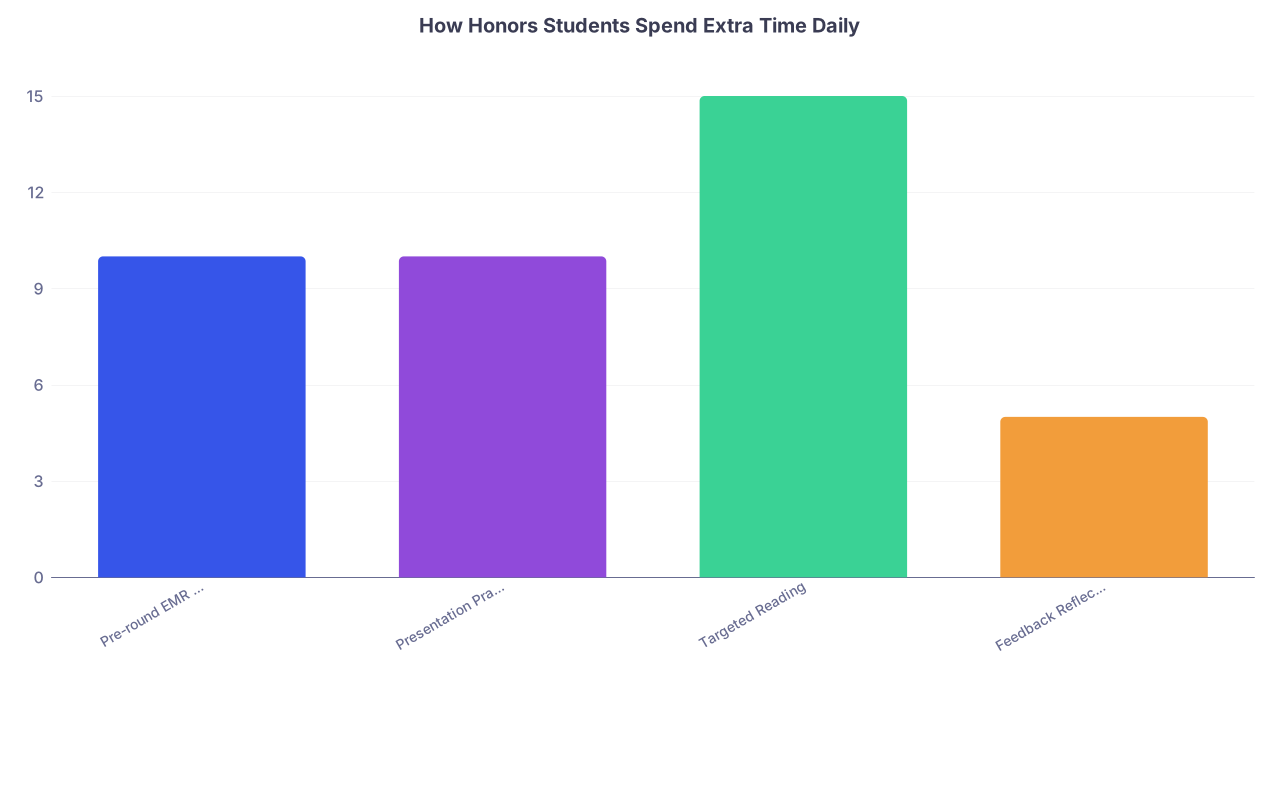
| Category | Value |
|---|---|
| Pre-round EMR Review | 10 |
| Presentation Practice | 10 |
| Targeted Reading | 15 |
| Feedback Reflection | 5 |
The “Favorites” Problem: Let’s Be Honest
Yes, there are favorites.
Sometimes a resident or attending just clicks with a student. Shared background, similar personality, same undergrad, same love for soccer—whatever. Does that bias evals? Of course it does.
You cannot control all of that. But you can shift the odds sharply in your favor by being the kind of student it is easy to like and respect:
- You show visible gratitude for teaching: “That explanation of AKI staging really helped—thanks for walking through it.”
- You don’t posture. Nobody likes the student whose main goal is to sound smart.
- You have enough of a personality that you’re not a ghost, but you’re not trying to become everyone’s best friend.
Remember: the person writing your evaluation is a human being, often exhausted, sometimes cynical, occasionally burned out. Honors students are the ones who make that person’s day 5–10% better, not worse.
That’s not sucking up. That’s being strategically human.
How to Recover If You Think You Blew It
You will have bad days. Maybe bad weeks. Honors students aren’t perfect; they just know how to manage damage.
If you think things are slipping, here’s the behind-the-scenes move most students are too scared to make:
Around week 2–3, pick one resident or attending and say, quietly and straightforwardly:
“I really want to improve and I value your perspective. Are there 1–2 concrete things I could be doing differently that would put me more in line with your strongest students?”
Not “How am I doing?” That invites vague reassurance.
A targeted question like that forces them to articulate actionable items. It also signals maturity. Then you implement those changes visibly. When eval time comes, that same person remembers: “They asked for feedback and actually improved.” That can pull you from High Pass territory back into the Honors discussion.
Do not wait until the last week. By then, everyone’s mind is already made up.
When You Should Not Chase Honors Everywhere
Here’s another truth nobody tells you: trying to gun for Honors on every rotation can burn you out and make you miserable. And ironically, that burned-out version of you performs worse.
I’ve seen students destroy their mental health trying to be “Honors in everything or I’ve failed.” Their energy tanks, their affect flattens, they start radiating stress. Teams sense it. Evaluations drop.
Strategically, you care most about:
- Core rotations that matter to your specialty of interest
- Rotations that feed into letters of recommendation
- Rotations that are major filters at some schools (often Medicine, Surgery, sometimes OB or Peds)
If you’re going into dermatology, yes, Medicine and Surgery Honors help. But Honors in Psych versus High Pass in Psych? That’s not making or breaking your career. Same for someone going into Psychiatry stressing over Honors in Surgery. There is a point of diminishing returns.
Long-term, programs care more about your trajectory, your letters, and whether your story makes sense than whether you missed Honors on Family Medicine because your attending never filled out the form properly.
FAQ (Exactly 3 Questions)
1. What if my resident clearly doesn’t like me—am I doomed for that rotation?
Not automatically, but you’re in trouble if they’re your only evaluator. Your job is to diversify. Ask to work more closely with another resident or attending when possible. Seek feedback early and implement it aggressively so at least the narrative becomes “rocky start, strong finish.” If you feel it’s truly personal or inappropriate, document specific incidents and talk discreetly to the clerkship director—not as a complaint, but as, “I’m worried this dynamic is affecting my learning and growth.” Sometimes they’ll quietly weight other evaluations more heavily.
2. How much should I “study” during a rotation if I’m also trying to be helpful on the wards?
The Honors students are not grinding for 4–5 hours every night. They’re doing 45–90 minutes of targeted reading and question practice that matches what they actually saw that day. On lighter days, they push shelf prep harder; on brutal call days, they survive and sleep. They don’t pretend they can do everything perfectly. They protect their energy enough to still show up as an engaged human the next morning.
3. Can an introverted or quiet student realistically get Honors everywhere, or is this rigged for extroverts?
Introverts get Honors all the time. Being loud is not the same as being engaged. You don’t need to be the social center of rounds. You do need to be visibly present, ask an occasional thoughtful question, communicate clearly with the team, and own your patients. Quiet, prepared, reliable, and curious beats loud and superficial in most attendings’ eyes. If you’re introverted, lean into structured contributions—strong presentations, well-prepared one-page teaching topics, meticulous follow-through. People remember and reward that.
Years from now, you’re not going to remember the exact percentile you got on your surgery shelf. You’ll remember the feeling of walking onto a team and realizing you knew how to function, how to contribute, and how to earn the trust of people who once terrified you. Honors on every rotation is not magic. It’s just learning that game sooner than everyone else—and choosing, deliberately, how far you actually want to play it.