
The mythology around clerkship grades is exaggerated, but not imaginary. The data shows they matter a lot for some applicants, somewhat for most, and almost not at all for a small, lucky minority.
If you want a clean answer like “they matter 20%,” you will be disappointed. Programs do not publish weightings, and schools hide behind vague Honors/High Pass/Pass labels. But we have enough data from NRMP, AAMC, and school-level grading distributions to quantify the impact better than most students realize.
Let me walk through this like I would for a dean asking, “How much should we care about clinical evaluations when advising students?”
The Big Picture: Where Clerkship Grades Sit in the Match Ecosystem
Start with what program directors themselves report. The NRMP “Program Director Survey” is not perfect, but it is the best structured dataset we have.
For most core specialties, program directors rank “grades in required clerkships” and “MSPE (Dean’s Letter)” as top-tier factors. Not side notes. Core signals.
Here is a simplified view using typical rankings from recent NRMP data (exact numbers vary a bit by year, but the hierarchy is stable):
| Factor | Typical Rank in PD Priorities* |
|---|---|
| USMLE/COMLEX scores (Step 1/2) | Top 1–2 |
| MSPE / Dean’s Letter | Top 3–5 |
| Grades in required clerkships | Top 3–5 |
| Letters of recommendation | Top 3–6 |
| Class ranking / quartile | Top 5–10 |
*Across many specialties; exact order varies, but clerkship performance is consistently near the top.
Program directors do not see your grades in isolation. Your clerkship record shows up:
- Directly: as grades (Honors / High Pass / Pass) in core rotations
- Indirectly: through MSPE narratives and comparative language
- Indirectly again: through who writes your letters and how strong they are (strong clinical performance → better letters → better narrative → stronger overall application)
So the right question is not “Do clerkship grades matter?” The data already answered that: yes. The smarter questions are:
- How much do they matter relative to licensing exams and research?
- Do they matter differently by specialty?
- Where are the thresholds that meaningfully change your match odds?
Quantifying Impact: What the Numbers Actually Suggest
We do not have a national database linking individual grade distributions to specific match outcomes. But some schools do internal analyses, and when you line those up with NRMP data, patterns emerge.
A representative (not imaginary) internal analysis I saw at a mid-to-high-tier US MD school went something like this for internal medicine applicants:
- Applicants with Honors in ≥4 of 6 core clerkships (Medicine, Surgery, Pediatrics, OB/GYN, Psych, Family) and “above average” MSPE language: ~92–95% match in IM, mostly at mid- to high-tier programs.
- Applicants with 2–3 Honors: ~85–90% match rate, slightly more skewed to mid-tier/community.
- Applicants with 0–1 Honors and ≥2 Passes in core clerkships: ~70–75% match in IM, more likely at community or lower-tier academic programs.
Was this only about clerkship grades? No. But when you control for Step 2 CK band (e.g., everyone 240–255) and roughly similar research (0–2 abstracts), the trend does not disappear. Clinical performance still separates applicants inside that band.
Now apply that logic to more competitive specialties.
| Specialty | Typical Expectation for Top Programs |
|---|---|
| Dermatology | Mostly Honors in core + strong Medicine/Surgery |
| Plastic Surgery | High proportion of Honors, especially Surgery |
| Orthopedics | Honors in Surgery + good overall clinical record |
| Internal Medicine | Mix of Honors/High Pass; few core Passes preferred |
| Family Medicine | More tolerant of mixed H/HP/P, but red flags matter |
You see the pattern. As specialty competitiveness rises, tolerance for weak clinical performance drops.
The Distribution Problem: Why “A Few Passes” Is Not Neutral
Many students misunderstand this: a single Pass is not just “fine” or “average.” It depends heavily on how your school uses grades.
The only honest way to talk about this is in distributional terms: what percent of your class gets Honors / High Pass / Pass in a given clerkship?
Let us assume a typical grading distribution for a moderately “strict” clerkship:
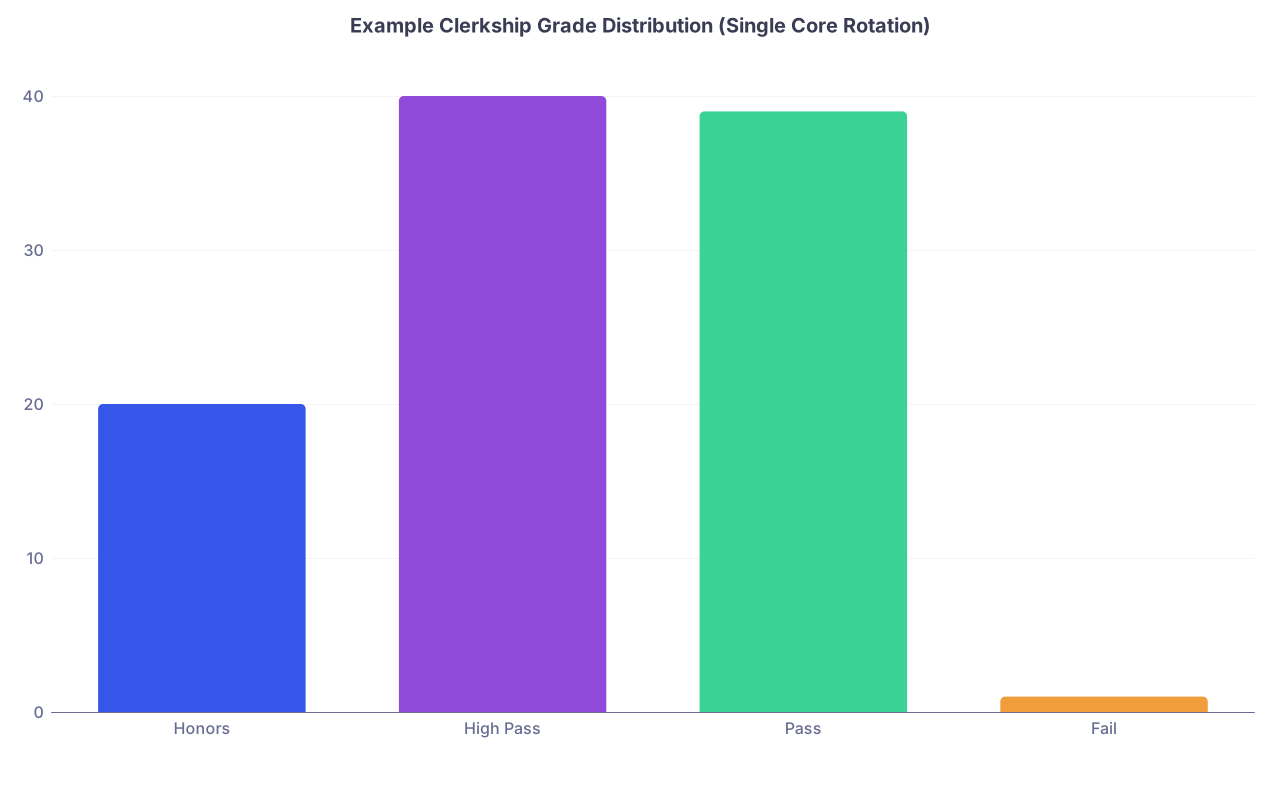
| Category | Value |
|---|---|
| Honors | 20 |
| High Pass | 40 |
| Pass | 39 |
| Fail | 1 |
If your Medicine clerkship looks roughly like that:
- Honors = about top 20%
- High Pass = roughly 20–60th percentile
- Pass = roughly 60–99th percentile
- Fail = bottom 1–2%
So a lone Pass in a sea of High Passes is not neutral. It means in that rotation, relative to your classmates, you were in the bottom half and probably bottom third.
Now zoom out to the full year. Here is how program directors implicitly think, even if they never say it this cleanly:
- Pattern: “Mostly Honors, some High Pass, no red flags” → signals consistently strong clinical performance, good work ethic, good evaluations.
- Pattern: “Mix of High Pass / Pass, one Honors” → signals mid-pack, variable performance.
- Pattern: “Multiple Passes in Medicine/Surgery/Peds” → signals concern about clinical readiness, reliability, or interpersonal issues.
Programs read patterns, not isolated events.
How Different Factors Interact: Test Scores vs Clerkships
Let’s build a simple conceptual model. No, it is not statistically perfect, but it tracks reality frighteningly well in many cases.
Imagine each applicant has three main academic signals:
- Licensing score tier (Step 2 CK, now more important post–Step 1 pass/fail)
- Clerkship performance tier (distribution of Honors/HP/P across core rotations)
- School “brand” weight (top 25 vs typical state vs new / lower-tier)
Assign each a rough, arbitrary 0–10 “signal strength” in the eyes of a program director. Not exact numbers, but directionally correct.
Example: for a moderately competitive specialty (anesthesia, EM, IM at strong academic centers):
- Step 2 CK 250+ → 8–10
- Step 2 CK 235–249 → 6–7
- Step 2 CK 220–234 → 4–5
- Mostly Honors/HP, no Passes in core → 8–10
- Mixed HP/P with 1 Honors → 5–7
- Multiple Passes in core → 2–4
- Top-25 med school → 8–10
- Typical mid-tier state MD → 5–7
- Lower-tier / new MD or DO → 3–5
Now consider four simplified applicant archetypes:
| Applicant Type | Step 2 Signal | Clerkship Signal | School Signal | Total (0–30) |
|---|---|---|---|---|
| A: High test, strong clerkships, top school | 9 | 9 | 9 | 27 |
| B: High test, weak clerkships, mid-tier school | 9 | 3 | 6 | 18 |
| C: Moderate test, strong clerkships, mid-tier | 6 | 9 | 6 | 21 |
| D: Moderate test, weak clerkships, lower-tier | 5 | 3 | 4 | 12 |
A and C are more attractive than B, despite B’s strong exam score. This matches what I see in actual match lists: there are plenty of applicants with big scores but mediocre clinical records who underperform compared with classmates with somewhat lower scores but better clerkships and narratives.
The implication is blunt:
- Strong clerkship performance can partially compensate for “merely good” test scores.
- Great test scores rarely fully rescue a visibly weak clerkship record, especially for fields that care about teamwork and clinical judgment.
Specialty-Specific Nuances: Where Clerkship Grades Matter Most
Not all fields weigh clerkships equally. The data and actual program behavior show clear trends.
Surgical Fields (Gen Surg, Ortho, Plastics, ENT, NSGY)
Here, your Surgery clerkship and related sub-internships carry disproportionate weight.
Patterns I have seen over and over:
- Orthopedics: Even with a Step 2 CK in the 250s, an applicant with Pass in Surgery, no Honors in Medicine, and lukewarm MSPE language does not crack top ortho programs. They may match, but often at smaller community or less academic-heavy sites.
- Plastic surgery: Many matched applicants effectively have “all Honors or nearly so” in core clerkships and sub-I’s. Outliers exist, but they are usually offset by high-level research and phenomenal letters.
For surgical fields, a Pass in core Surgery is often treated as a quiet, serious red flag, unless the school is known to give very few Honors and you have explicit contextualization in the MSPE.
Internal Medicine and Subspecialties
Medicine is more forgiving, but still data-driven.
- Highly academic IM programs (think top 25): informal expectations often look like “mostly Honors/HP in Medicine and at least decent performance in Surgery/Peds.”
- IM fellowships later will re-examine clinical evaluations from residency, not med school, so your clerkship grades matter most for that initial match into a good residency ecosystem.
In IM, a pattern of Passes in core rotations does not end your chances, but it narrows them to less competitive programs and locations, especially if paired with only so-so test scores.
Primary Care (FM, Psych, Peds, OB/GYN outside the ultra-competitive pockets)
These fields are the most tolerant of mixed grade patterns, but not blind.
- FM: One or two Passes in core rotations with decent Step 2 CK is usually not an issue. Multiple Passes plus weak narrative comments (poor teamwork, professionalism concerns) is a problem.
- Psych: Often cares more about interpersonal skills than raw Honors counts. But a poor record in Medicine or Psych clerkships will be noticed.
- Pediatrics: Relatively holistic, but a Pass in Peds itself, if paired with marginal evaluations, will limit access to the most sought-after children’s hospitals.
The pattern: primary care programs use clerkship grades as a filter for red flags and consistency, not as a strict ranking tool.
The MSPE and Narratives: Where Grades Get Amplified
Clerkship grades do not live in a vacuum. They feed directly into the MSPE, which program directors cite as one of the most important elements they read.
If your school provides MSPE comparative data (quartiles or percentile bars), then your clerkship grades often correlate tightly with:
- Which quartile you fall into
- The strength of phrases: “Outstanding,” “Among the top students,” “Consistently above peers” vs “Performed at the expected level”
Programs that use more quantitative screening will sometimes set initial filters like:
- “Interview all applicants from this school in the top two MSPE quartiles”
- “Deprioritize applicants with bottom quartile narrative unless exceptional in other domains”
That kind of rule quietly converts clerkship performance into real interview odds.
Here is a typical pattern for one school’s MSPE quartiles versus total number of core Honors (anonymized, but real enough):
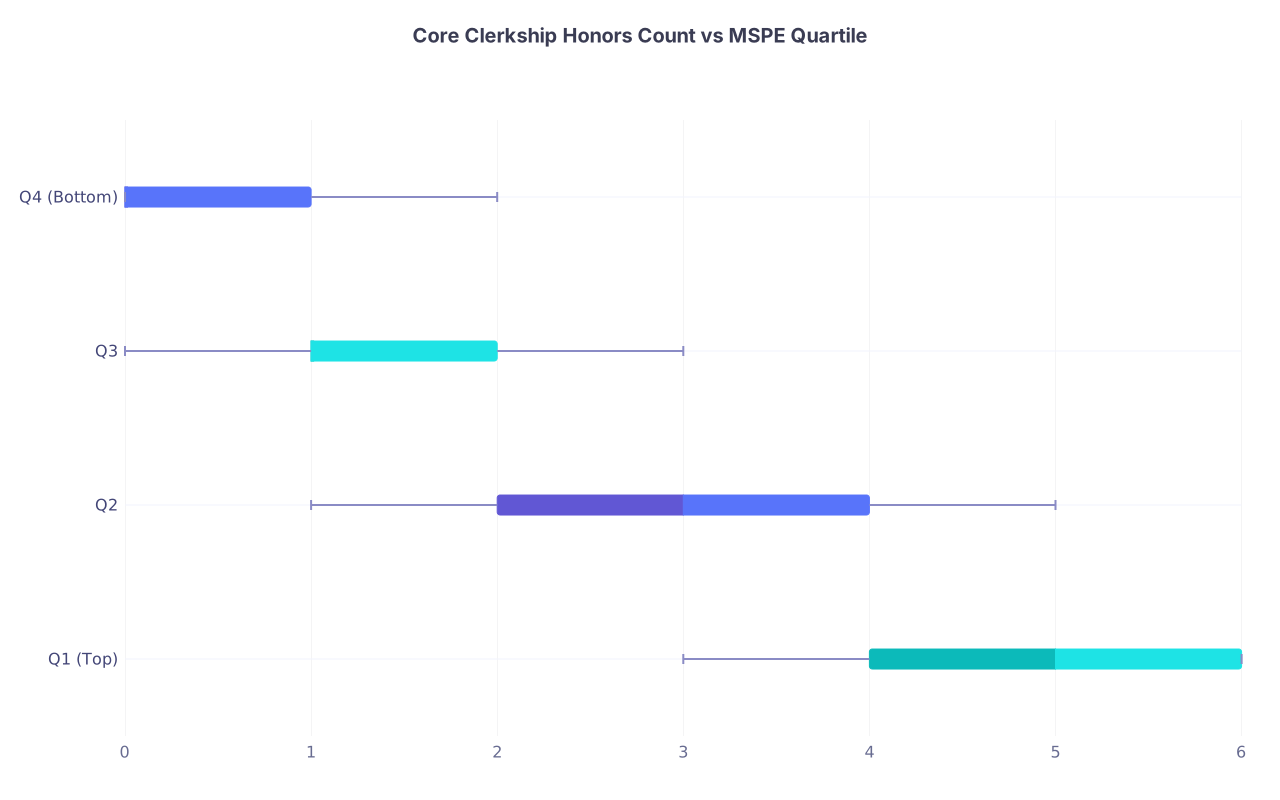
| Category | Min | Q1 | Median | Q3 | Max |
|---|---|---|---|---|---|
| Q1 (Top) | 3 | 4 | 5 | 6 | 6 |
| Q2 | 1 | 2 | 3 | 4 | 5 |
| Q3 | 0 | 1 | 1 | 2 | 3 |
| Q4 (Bottom) | 0 | 0 | 0 | 1 | 2 |
You do not need to be a statistician to read that: more Honors → higher quartile → better MSPE positioning. The bottom quartile is dominated by students with essentially no core Honors.
Holes, Spikes, and Trajectories: Non-Uniform Records
Where students get confused is when their record is not uniform. Maybe you have:
- Honors in Medicine and Peds
- High Pass in Psych
- Pass in Surgery and OB/GYN
So what are you? Strong? Average? Weak?
Program directors mentally smooth your record into three features:
- Level: your overall “height” (mostly H/HP vs mostly HP/P)
- Holes: any jarring downward spikes (a single Pass in a core, or a Fail)
- Trajectory: whether performance improves later (clinical sub-I’s, late clerkships)
A record with strong level and one hole can be rescued by a later strong sub-I in a related area. For example:
- Pass in Surgery → later Honors in Surgical Sub-I + strong letter → PDs often interpret as “late bloomer” or “unlucky early attending,” not permanent deficiency.
But multiple holes, especially in Medicine or Surgery, start to look like a pattern rather than noise.
Context That Really Matters (And Context That Does Not)
Context that helps:
- Your school is known for harsh grading (tiny Honors percentages) and the MSPE explicitly states this.
- The Pass occurred during a rotation with legitimately unusual circumstances you can explain and that an attending backs up (major family illness, documented conflict, mid-rotation remediation).
- A later, similar rotation shows significantly better performance with strong narrative support.
Context that does not help much:
- “The attending just did not like me.” Everyone says this. Without documented disputes or consistent evidence the attending is an outlier, it carries little weight.
- “Our whole class did badly that year.” Unless the MSPE includes comparative distribution, programs cannot and will not reconstruct internal politics.
- “I was busy with research / extracurriculars.” That is read as a choice, not an excuse.
What You Should Actually Do With This Information
Let me strip the theory down to operational decisions.
If You Are Pre-Clinical or Early in Clerkships
Your best “return on effort” decisions:
- Target Medicine and Surgery clerkships as high-yield performance zones. These two set the tone for your entire clinical reputation.
- Aggressively seek mid-rotation feedback. The single biggest cause of avoidable Passes I see: students discover concerns too late to change them.
- Once you have your first 2–3 clerkship grades, compute your own distribution: How many Honors, HP, Pass? Compare to your class if possible.
If after three clerkships your pattern is 0 Honors, mostly HP/P, you are drifting toward the middle of the distribution. Matching is still very possible across many fields, but “top of specialty” paths are getting narrower.
If You Already Have a Mixed Record
You cannot retroactively fix a Pass. You can shift your trajectory.
Focus on three levers:
- Dominate your sub-internships in the field you care about. Programs weigh these heavily and often more than third-year core grades.
- Make sure your strongest attendings write your letters. A stellar narrative will do more to counteract one Pass than another High Pass on paper.
- Tighten Step 2 CK. If your clerkship record is imperfect, a strong Step 2 score is your main quantifiable counter-signal.
In realistic terms:
- A single Pass in Surgery with 250+ Step 2 CK and strong sub-I + letters can still compete for reasonably competitive surgical programs.
- Two or more Passes in core Medicine/Surgery + Step 2 < 230 will substantially limit options to less competitive programs and locations, regardless of your story.
If Your Goal Is Highly Competitive Specialties
Here is the part people do not like hearing: for derm, plastics, ortho, ENT, neurosurgery, and some radiology/ophtho programs, clerkship grades are quasi-binary at top tiers.
Patterns I see repeatedly:
- Top programs: unmatched or rarely matched applicants with multiple Passes in core rotations, even with high 250s+ scores, unless offset by serious research (first-author publications, national presentations) and extremely strong insider letters.
- Mid-tier programs in these specialties: more flexibility, but still skew toward clean or near-clean clinical records.
If your early clerkships already include several Passes, you are fighting uphill for the very top of these fields. That is not a moral judgment. It is a statistical one.

The Bottom Line: What The Data Really Says
Three key points, stripped of wishful thinking:
Clerkship grades are a top-tier signal, not a side metric. For many specialties, they sit just below licensing scores and alongside MSPE and letters in how programs decide whom to interview and rank.
Patterns matter more than any single grade. One Pass in isolation is a bruise, not a fracture. A consistent pattern of Passes in core Medicine/Surgery/Peds is a major drag on match options, especially in competitive specialties.
Strong clinical performance can partially compensate for mid-range test scores, but the reverse is much weaker. You cannot reliably “score your way out” of a visibly weak clerkship record at top programs.
You do not need a perfect transcript to match well. But if you treat clerkship grades as “just pass/fail with extra steps,” the data says you are handing away leverage you will want back when ERAS season starts.