
The way attendings really rank students on clinical rotations has almost nothing to do with what your school tells you—and everything to do with how easy you are to trust at 6:30 a.m. when everyone’s tired and behind.
Let me walk you through what actually happens behind closed doors when your evaluation is written, your grade decided, and your “top-third / middle-third / bottom-third” label quietly stamped on your record.
How Your Grade Is Really Decided
Most students imagine some complex rubric, carefully and fairly applied.
What actually happens? A 5–15 minute conversation in a workroom or office near the end of the rotation, usually when everyone’s in a rush, with someone saying:
“Alright, let’s bang out the student evals before we forget.”
The structure varies by school and service, but the pattern is the same.
On a typical rotation, your grade is shaped by three layers:
- The attending’s global impression of you (this carries more weight than anyone admits).
- Resident input (especially the senior resident or chief).
- Whatever your school’s form forces them to click.
Here’s the uncomfortable truth: the online form and its 17 micro-competencies are mostly theater. The real decision—honors vs high pass vs pass—is usually made before the form is opened. The form is then back-filled to justify that gut-level call.
I’ve sat in those rooms and heard things like:
- “She’s solid. Not the strongest I’ve seen, but definitely top half. I’d give her honors.”
- “He knows the material but is kind of checked out. High pass.”
- “Nice kid. Just not ready to be left alone with anything. Pass.”
Notice what’s missing? No one is saying, “On behavioral anchor 3.4, I felt she met expectations.”
They argue in impressions, not checkboxes.
The Real Hierarchy: Who Actually Determines Your Grade
You think the attending is everything. They are not.
Here’s the actual hierarchy on most rotations:
| Role | Typical Influence Level |
|---|---|
| Attending | Very High |
| Senior Resident | High |
| Intern/Junior | Moderate |
| Fellow | Variable |
| Nurse/Staff | Informal but powerful |
Now, how it actually plays out:
On many inpatient services, the attending will say:
“What do the residents think?”
If the senior resident says, “She’s great. Very dependable. I’d give her honors,” you’re basically done. The attending may tweak wording, but they rarely fight the team’s consensus unless there’s something extreme.
Conversely, if the residents shrug and say, “He’s fine,” that’s a kiss of death for top marks. “Fine” = middle of the pack. “I don’t really remember them” = bottom third.
The fellow matters more on subspecialty services (GI, cards, heme/onc) where you work closely with them. I’ve seen attendings defer to fellows entirely: “What did you think? I’ll go with your assessment.”
And the nurses? They do not click anything in your evaluation form, but if an attending hears even one, “That student never helps,” or “She rolled her eyes when I asked her to grab vitals,” that sticks. I’ve watched an attending drop a student from honors to high pass based on a single nurse comment. They won’t say that to you, but it happens.
The Five Hidden Dimensions Attendings Actually Use
Forget the official categories for a minute. When attendings talk about students, their brains are sorting you into a few buckets.
I’ll give you the real ones.
1. Trustworthiness Under Time Pressure
This is number one. Above intelligence. Above “work ethic.”
Attendings are constantly asking themselves one question about you:
“Can I trust this person with part of my patient’s care without hand-holding?”
They watch things you barely notice:
- Do you say “I don’t know” when you don’t know, or do you fake it?
- If you say you’ll follow up on a lab, does it actually get done?
- When you’re asked to call a consult, do you clarify the question and document the conversation, or just say “Yeah, they’re following”?
The students who get top rankings are the ones the attending forgets is “just a student” and starts treating like a baby intern. That mental shift—“I can lean on this person”—is what pushes you into honors territory at most places.
One attending I know on medicine says openly:
“I don’t need brilliance. I need to know if at 3 p.m. I ask you to get a CT read and call me with the result, you won’t disappear into the ether.”
If you want a simple translation of this: no loose ends. Ever.
2. Cognitive Pace, Not Just Knowledge
Program directors love to talk about “knowledge base.” Attendings don’t actually care about raw trivia as much as your speed of understanding.
They’re watching:
- How fast you integrate new info on rounds: “Given the drop in hemoglobin, how does that change your plan?”
- How quickly you adjust when your story is wrong: “Oh, the CT doesn’t show appendicitis, it shows diverticulitis. Fix your differential.”
- Whether your presentations evolve day to day or stay frozen while the patient’s situation changes.
What hurts you is static thinking. You keep presenting the same five problems in the same order with the same plan even after the patient’s course changes.
The comment you never want an attending to write:
“Pleasant, but clinical reasoning is slow to develop.”
That’s code for: not ready for responsibility.
You do not have to be a genius. You do have to show that between week 1 and week 4, your thinking gets sharper and faster. Attendings notice trajectory more than baseline.
3. Initiative Without Needing a Parade
There’s a fine line between showing initiative and being annoying. Most students are so afraid of crossing it that they end up invisible.
The students who get top rankings:
- Volunteer for useful tasks without being asked: writing notes, calling family with the team, pre-rounding on extra patients when someone’s overloaded.
- Read about their patients and bring it back: “I looked up the latest guideline on HFpEF; it suggested…”
- Anticipate next steps: asking for old outside records, checking if someone needs a swallow eval before they aspirate their lunch.
The attendings don’t put this in glowing prose. They just say something like:
“Very proactive. Functioned at the level of an intern.”
That sentence alone can swing you into honors, even if you’re not the sharpest on pimp questions.
On the flip side, if you’re always “waiting to be told” what to do, you’re sunk. One rotation director I know has a simple mental rule:
“If I never once thought, ‘Oh wow, they’re on top of it,’ they’re not getting honors.”
4. Social Fit on the Team
No one likes to admit this, but your likeability matters.
And I don’t mean being funny or loud. I mean: do people groan or relax when you walk into the workroom?
Attendings watch micro-interactions:
- Do you sit down next to the intern who’s drowning and quietly say, “I can grab those discharge summaries for you”?
- Do you thank the nurses, RTs, phlebotomists, or do you act like they’re in your way?
- Do you read the attending’s tone? Some want typewritten, polished notes. Others don’t care. If you ignore their preferences, they notice.
What kills students more than anything is friction.
Examples I’ve seen torpedo evaluations:
- Constantly correcting people on tiny details in front of patients.
- Dominating presentations or trying to “flex” knowledge at the expense of others.
- Looking visibly bored or scrolling your phone during teaching.
Attendings rarely say “the student was unlikeable.” They say:
- “Occasionally disruptive to team dynamic.”
- “Struggled to integrate feedback.”
- “Professionalism concerns.”
All of those are code for: This person was hard to work with.
5. Responsiveness to Feedback
This is the secret category that saves mediocre students and sinks otherwise strong ones.
What attendings are really grading is not how “good” you are. It’s how changeable you are.
If in week 1 you’re told:
“Tighten your presentations; lead with the overnight events and assessment.”
And in week 2 you’re still giving the exact same long-winded, scattered presentation? That’s fatal.
Conversely, if your knowledge is average but every single piece of feedback shows up in your behavior the next day, attendings rave about you.
I’ve heard dozens of these comments:
- “She improved dramatically over the block.”
- “He took feedback exceptionally well and adjusted quickly.”
- “Showed real growth.”
Those phrases are what committee members love. It tells them you’ll thrive as a resident. They’d rather have a B+ student who improves fast than an A student who’s rigid and touchy.
How Grades Get Translated to “Top / Middle / Bottom Third”
Let me show you how the sausage gets made.
Most schools or clerkship directors batch students at the end of a block. They may have 30–60 students who rotated through medicine, surgery, etc. The committee then sorts you into relative groups.
Here’s how those internal discussions actually sound:
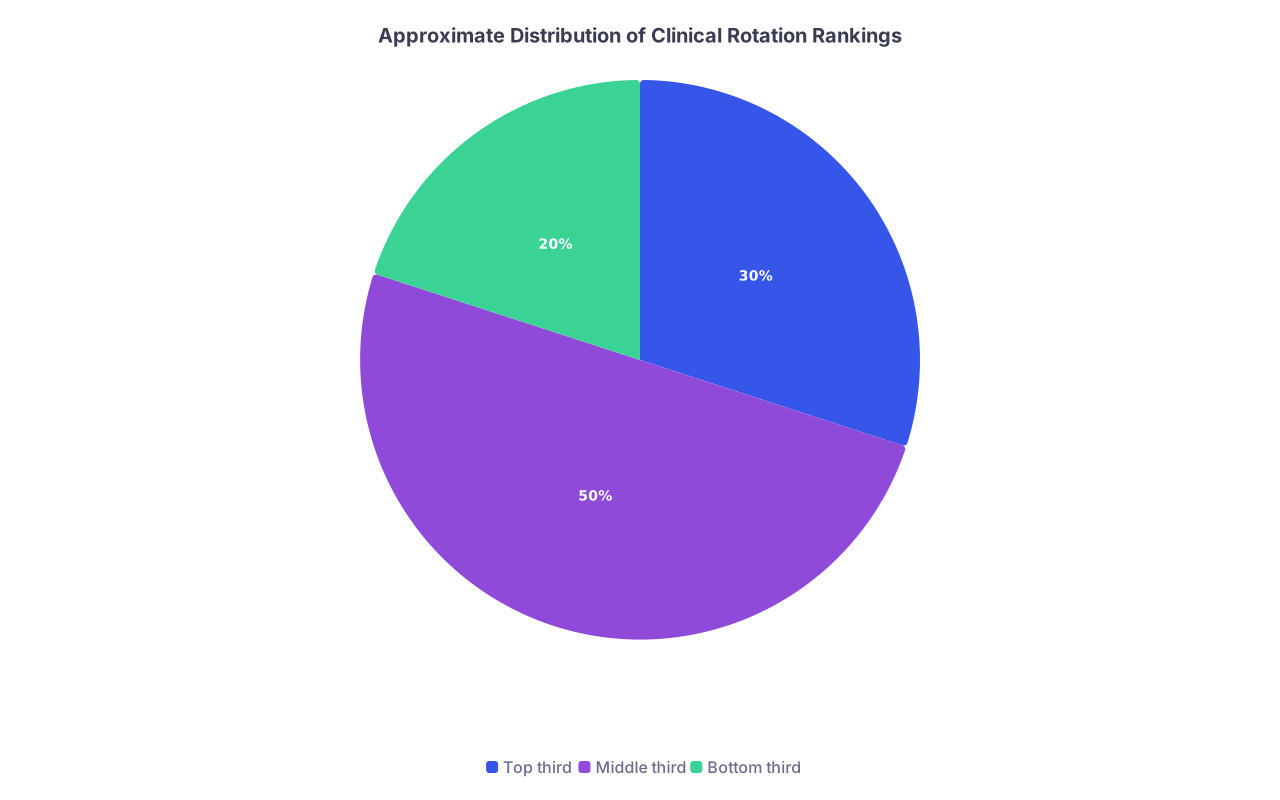
| Category | Value |
|---|---|
| Top third | 30 |
| Middle third | 50 |
| Bottom third | 20 |
The numbers vary, but the pattern doesn’t. They can’t give everyone honors. So:
- They pull the strongest narrative comments and evaluations.
- They look for consistent phrases: “top of class,” “functioned as an intern,” “would love to work with again.”
- They look for any hint of concern: “needs more confidence,” “quiet but engaged,” “occasionally disorganized.”
Then they rank. Informally at first.
A real exchange I heard in a medicine clerkship meeting:
- “Okay, of the 15 students this month, who are the clear top?”
- “Definitely Patel, Rodriguez, and Chang.”
- “Anyone borderline for that top tier?”
- “Maybe Lee, but her first attending was lukewarm, so I’d keep her in high pass.”
Notice something? They’re not obsessed with objectivity. They’re building a story of you from fragmented impressions.
Those “borderline” people live and die by one or two narrative comments. You want at least one attending who writes the kind of comment that tips the room in your favor when your file is read out loud.
Which leads to the key question: how do you push attendings to write those comments without begging?
How Students Accidentally Tank Their Rankings
Let me be blunt. Most students who end up in the bottom or low-middle group didn’t do something dramatic. They just had too many “minor” problems at once.
Common killers:
- Chronic lateness by 5–10 minutes. No one forgets.
- Never reading the chart before rounds; always confused about overnight events.
- Sloppy follow-through on tasks (“I think that got done”).
- Low energy or visible disinterest. You look like you’d rather be anywhere else.
- Being too quiet. Attendings forget your name. That’s deadly.
If an attending has to search their memory to remember you at all, you are not getting a strong evaluation. At best, you get “meets expectations.” Which is code for: middle-of-the-pack or lower once the distribution curve hits.
One more harsh truth: if you have a single rotation with documented professionalism issues, that note follows you far longer than you think. When programs read your MSPE (Dean’s letter), they’re hyper-attuned to any line like:
“Addressed concerns about timeliness / communication, with improvement over time.”
Residency PDs read that as: “This student triggered a red flag.” Attendings know this, so they don’t put it in lightly.
How to Nudge Attendings Toward a Strong Write-Up (Without Being Obvious)
You cannot control exactly what they write. But you can control what’s top of mind when they sit down to evaluate you.
The students who consistently do well are deliberate about this.
Three moves that work:
1. The Mid-Rotation Check-In That Actually Matters
Don’t do the generic “Any feedback for me?” as they’re running to a meeting. You’ll get “You’re doing fine.”
Instead, around the halfway mark, say:
“I want to make sure I’m developing the right way. Can you tell me one thing I should change this week to be more helpful to the team or clearer in my clinical reasoning?”
Then implement that change obviously and consistently.
What happens when they write your eval?
They remember:
“This is the student who actually fixed their issues. Impressive.”
2. Make Your Growth Visible
You can be working hard and still be invisible if the right people don’t see the change.
If you’re told to improve your assessment/plan, don’t just silently do it. The next day, you might say:
“I tried to incorporate your advice and lead with my assessment; let me know if this is closer to what you’re looking for.”
You’re not bragging. You’re connecting the dots in their brain: feedback → adjustment → growth. That’s exactly what attendings like to write.
3. Close the Loop at the End
On the last or second-to-last day, a simple, targeted close-out helps more than you think.
Something like:
“I’ve learned a lot this month working with you and the team. If you have any final feedback—especially on how I can be a stronger sub-I or intern—I’d really value it.”
Many attendings will give you a quick, candid summary. But more importantly, you’ve just triggered them to think intentionally about your strengths and trajectory right before they fill out the eval.
And yes, some will bump you up mentally from “good” to “very strong” after that interaction. I’ve watched it happen.
A Quick Visual of What Attendings Are Grading
Not what they say they’re grading. What they’re actually weighing when they click those boxes and type those comments:
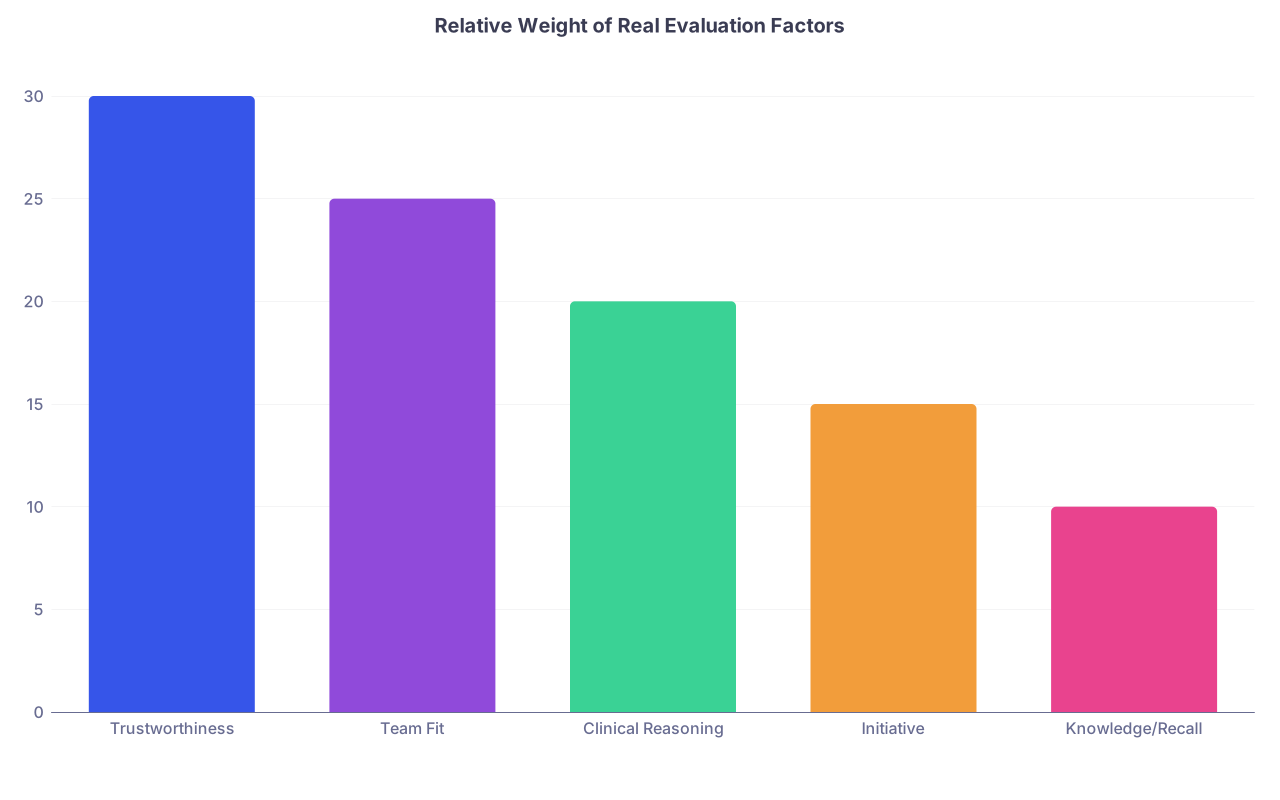
| Category | Value |
|---|---|
| Trustworthiness | 30 |
| Team Fit | 25 |
| Clinical Reasoning | 20 |
| Initiative | 15 |
| Knowledge/Recall | 10 |
Knowledge isn’t nothing. But if you’re banking on pimp question performance to carry you, you’re playing the wrong game.
FAQs
1. Do attendings really remember individual students when writing MSPE letters or residency letters?
Yes—if you made an impression. Strongly positive or strongly negative students are unforgettable. Those are the ones faculty mention by name years later: “I had a student on wards who basically ran the service like an intern” or “We had a student who disappeared whenever work showed up.”
Everyone else blends into “hard-working, pleasant, interested in learning.” That’s the kiss of death for standing out. Generic praise hurts more than mild but specific critique, because program directors discount boilerplate completely.
If you want a faculty member to remember you for a letter, you need a concrete story they can recall: a patient you took ownership of, a crisis you handled well, a moment of growth that impressed them. That’s what they write. Not “great fund of knowledge.”
2. How much do short interactions on consults or brief rotations actually matter?
More than you think, less than your core clerkships. On a one-week consult block, a single attending’s impression can still end up in your MSPE or in a specialty-specific letter.
But here’s the nuance: extremes shape your file. If you’re outstanding or a problem, that one-week slice will be mentioned. If you’re fine, it’ll fade. Still, bad behavior on a “minor” service spreads quickly. Attendings talk. Residents move between services and bring reputations with them.
In contrast, if you crush even a short consult month in the specialty you want, that attending’s “this student is in the top 5% I’ve worked with in the last five years” line will absolutely move the needle.
3. Is it better to be quiet and avoid mistakes, or more vocal and risk being wrong?
Quiet and “safe” is a trap. The students who get top rankings are not the ones who never say anything wrong; they’re the ones who think out loud, accept correction without defensiveness, and then adjust.
Attendings do not punish thoughtful wrong answers. They punish vagueness, passivity, and pretending to understand when you don’t. A student who says, “I think this is CHF exacerbation because of A, B, C, but I’m not sure how to interpret the BNP in this context” is far more impressive than one who just recites the lab values and has no opinion.
You are being evaluated as a developing clinician, not a court stenographer. Speak up.
4. How much does one bad rotation hurt my overall application?
One bad rotation with documented issues will sting, but it’s not fatal if everything else is strong. Committees and PDs look for patterns. If you have one outlier pass among many honors/high passes, they usually assume bad fit, bad luck, or a mismatch in expectations.
What kills you is a consistent narrative: multiple comments about professionalism, “needs to improve reliability,” “inconsistent follow-through,” or recurring low-middle rankings across services. That signals a real problem.
If you do have a bad block, your job is to overcorrect on the next one and, ideally, get an attending to explicitly state in your narrative: “I’m aware of prior concerns; on my service, the student was punctual, took ownership, and performed at the level of our top students.” That kind of comment reframes the story—and that’s what all of this comes down to in the end: the story your attendings tell about you when you’re not in the room.
Takeaway: Attendings are ranking you on trust, team fit, visible growth, and initiative far more than raw knowledge. Make their lives easier, own your patients, and respond to feedback aggressively, and your “rank” will quietly climb where it matters.