Your case presentations are probably not “bad.” They are just bloated, disorganized, and unfocused. That is fixable in three days. If you treat it like a skill, not a personality trait.
You are not “just bad at talking.” You are using a bad template, with zero feedback loop, while under-caffeinated and over-stressed. Let’s fix that.
This is a 3‑day, high‑yield repair plan for clinical case presentations for medical students on rotations. You will walk in on Day 4 and sound like a different person.
Step 0: Know Exactly What “Good” Sounds Like
Before you “work on presentations,” you need a target. Most students present the way they write H&Ps: as a data dump. That is why residents tune out after 20 seconds.
A strong oral case presentation is:
- Selective – only what changes management or refines the differential
- Structured – always in the same predictable order
- Purposeful – clearly connected to your assessment and plan
Here is the order attendings actually want, 90% of the time:
- One‑liner
- Focused HPI
- Focused, problem‑relevant PMH/meds/allergies/social/family
- Key exam findings
- Key diagnostics (labs/imaging/micro, only relevant ones)
- Assessment – problem list with reasoning
- Plan – by problem
That is it. Anything that does not sharpen the above is noise.
Day 1: Strip It Down and Rebuild the Skeleton
Your job on Day 1 is to stop free‑styling and lock in a rigid, repeatable structure.
1. Lock in the One‑Liner Template
Most students butcher the one‑liner. If you fix only this, your presentations improve overnight.
Use this formula:
Age + sex + key PMH + presenting problem + most relevant context
Examples:
- “Mr. Jones is a 67‑year‑old man with long‑standing hypertension and CAD presenting with 3 days of progressive shortness of breath and orthopnea.”
- “Ms. Smith is a 24‑year‑old woman with no significant past medical history presenting with acute right lower quadrant pain for 12 hours, concerning for appendicitis.”
Never start with “This is a very pleasant…” That is filler. Save that for notes if you must.
Exercise (30–45 minutes):
Write 10 one‑liners from old cases (from your notes, question banks, or memory). Then say them out loud.
Hard rule: 1–2 sentences, maximum 10 seconds.
If it takes you longer, you are including junk.
2. Memorize a 6‑Block Verbal Template
You will use this exact skeleton for almost every inpatient case. Make it automatic.
- Opening / One‑liner
- HPI
- Pertinent history (PMH, meds, allergies, social, family)
- Exam
- Data (labs, imaging, other tests)
- Assessment & Plan by problem
Keep the headings in your own brain, not spoken as “now moving to exam.” Just transition cleanly.
Here is a short version for a typical medicine admission:
- Opening: One‑liner
- HPI: Chronology + 3–4 key positives + 2–3 key negatives that refine the differential
- Pertinent history: Only what matters for this admission
- Exam: Abnormal first, then key negatives that matter
- Data: Only relevant labs and imaging; group and interpret
- Assessment / Plan: Top problems with your best guess and immediate management
Write this template out 5–10 times from memory. Then practice with one real case and time yourself.
Target length:
| Case Type | Ideal Time |
|---|---|
| New medicine admission | 4–6 minutes |
| New surgical admission | 3–5 minutes |
| ICU or complex case | 5–7 minutes |
| Overnight follow-up | 1–2 minutes |
If you regularly go beyond these times, you are including trivia.
3. Reformat One Real Case Using the Template
Pick a real patient you saw, or a UWorld case if you are desperate.
Do this on paper:
- Write the one‑liner.
- Bullet the HPI: 5–8 key points, all chronological.
- Bullet only pertinent PMH/meds/social items.
- Bullet exam: abnormal first, then must‑have negatives.
- Bullet key labs/imaging and write a one‑sentence interpretation.
- List 3–5 problems with a brief reasoning and plan for each.
Now present it out loud to a wall, a friend, or your phone. Record it.
You will hear:
- Rambling
- Repetition
- Apologies (“sorry this is long”)
- Filler words (“uh, like, kind of”)
Do not judge yourself. Just write down exactly what feels clumsy.
4. Build a Simple Feedback Loop
On Day 1, you also need a way to measure progress.
Make a quick checklist on an index card:
- One‑liner ≤ 10 seconds
- Clear structure (HPI → pertinent hx → exam → data → A/P)
- No reading from the chart
- HPI chronological, not organ system dump
- Exam: abnormal first
- Labs: grouped and interpreted
- A/P: problem‑based, not system dump
- Total time under target
Stick this in your white coat. You will use it on Days 2 and 3.
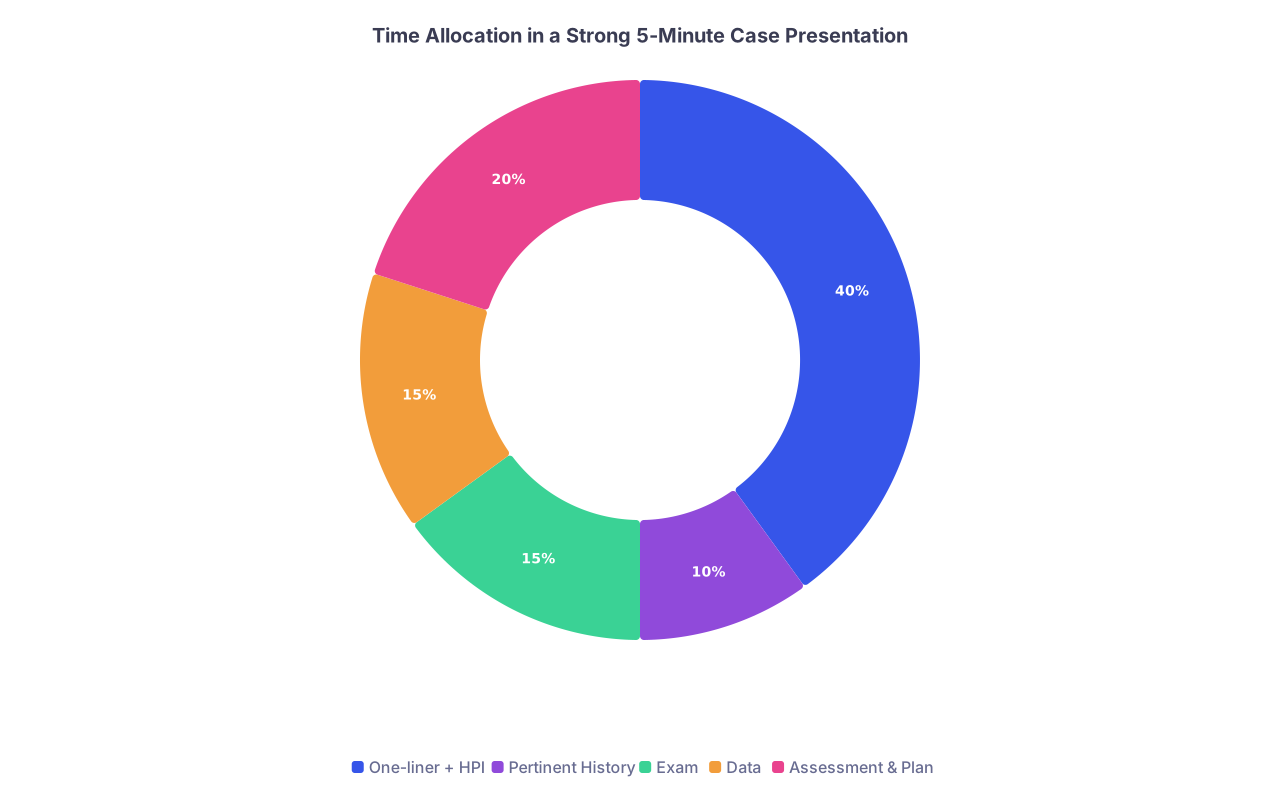
| Category | Value |
|---|---|
| One-liner + HPI | 120 |
| Pertinent History | 30 |
| Exam | 45 |
| Data | 45 |
| Assessment & Plan | 60 |
Day 2: Shorten, Sharpen, and Fix Your “Story Sense”
Day 2 is about two things:
- Shortening without losing clinical value
- Making the story actually make sense as a story
1. Practice the “Half‑Time Drill”
Take yesterday’s case. Time your full presentation. Say it is 6 minutes. Your new goal: present the same case in 3 minutes without omitting anything that truly changes management.
How:
- Kill adjectives that do not matter clinically.
- Replace lists with categories.
- Cut redundant negatives (“no fever, chills, night sweats, sick contacts, recent travel, animal exposures, weird hobbies…” – no.)
- Remove stable, irrelevant details (childhood tonsillectomy in a 70‑year‑old with CHF decompensation).
Example before (bloated HPI piece):
“His shortness of breath started kind of last week, maybe 5–6 days ago, not exactly sure, and it has progressively worsened. He now feels short of breath walking from his bedroom to the bathroom. He’s also had some mild chest tightness, no real pain, but a pressure, along with a bit of a cough, mostly dry, maybe some white sputum, hard to say.”
After (tight):
“He developed progressive dyspnea 5–6 days ago, now limited to 10–15 feet of exertion from baseline of 2 blocks. He reports mild non‑pleuritic chest tightness and a dry cough with occasional scant white sputum.”
Do 3 rounds of the Half‑Time Drill with the same case until you can hit 3 minutes cleanly.
2. Fix the HPI: Chronology, Not Checklist
Most weak presentations fall apart in the HPI. They sound like someone reading a ROS template.
You want a timeline:
- Start with “X days ago…” and move toward “today.”
- Group symptoms by when they happened, not by system.
- Tie in key risk factors and exposures at the moment they matter in the story.
Bad HPI snippet:
“He has a history of smoking, 30 pack‑years. He also has orthopnea, uses 3 pillows. He has some pedal edema. Two days ago he had chest pain…”
Better:
“Five days ago, he noticed increasing dyspnea on exertion. Over the next three days, he developed orthopnea, now using 3 pillows, and bilateral leg swelling to mid‑shin. Two days ago, he began having intermittent, non‑radiating chest pressure with exertion.”
Exercise (30–40 minutes):
- Grab 3 short UWorld or book cases.
- For each one, write a 4–5 sentence HPI that:
- Starts with “X time ago…”
- Uses 1–2 time anchors (“by yesterday,” “over the next two days”)
- Ends at “today in the ED/clinic”
Then speak them out loud. Listen for:
- ROS dump = wrong
- Random risk factor tossed in with no timing = weak story sense
3. Build a Problem‑Based Assessment and Plan
If your A/P is weak, your whole presentation feels weak, even if the HPI was solid.
Use a problem‑based template:
- List problem.
- Give your best diagnosis or differential in 1–2 sentences.
- Say what you are doing about it.
Example:
- “Problem 1: Acute decompensated heart failure, likely due to medication non‑adherence and uncontrolled hypertension. He has orthopnea, elevated JVP, bilateral edema, and a BNP of 1200 with pulmonary edema on CXR. We have started IV furosemide 40 mg BID, are monitoring daily weights and I/Os, and are optimizing his antihypertensives.”
Stop with “per primary team” nonsense. Say what you think should happen, even if you are guessing. Attendings care more about your reasoning than whether your plan matches theirs exactly.
Exercise (20–30 minutes):
- Take 3 real patients from your current service.
- For each, write a problem list of 3–5 items, and under each, write:
- 1 sentence for your impression
- 2–3 bullets for the plan
Then practice saying only the A/P out loud, as if you were giving an update.
4. Get One Piece of Real Feedback Today
Before you go home on Day 2, pick a resident who is not drowning and say:
“Can I present one patient to you in 3 minutes and get feedback only on structure and length? I am trying to tighten my presentations this week.”
Force them to be specific. Ask:
- “Was anything I said clearly unnecessary?”
- “Was there anything you wanted that I did not say?”
- “How was the length for this patient?”
Write their answers on your index card. Do not argue or defend yourself. Just absorb.

| Step | Description |
|---|---|
| Step 1 | Day 1: Structure |
| Step 2 | Day 2: Shorten & Sharpen |
| Step 3 | Day 3: Live Reps & Pressure Testing |
| Step 4 | One-liner practice |
| Step 5 | Template memorized |
| Step 6 | Half-Time drills |
| Step 7 | Problem-based A/P |
| Step 8 | Real-time practice on rounds |
| Step 9 | Debrief & refine |
Day 3: Pressure Test in Real Life and Polish
Day 3 is where you push this into real clinical settings. Not just talking into your phone.
1. Pre‑Round Micro‑Rehearsals
For every patient you will present:
Arrive 15–20 minutes early.
For each patient, take 3 minutes to:
- Jot the one‑liner.
- Bullet 3–5 HPI updates or overnight events.
- Bullet any new data worth saying.
- Update the problem list and plan.
Find a quiet hallway. Present each one to yourself out loud once. Full speed.
Sounds trivial. It is not. The difference between thinking “I kind of know this” and actually saying it out loud is massive.
If you stumble in the hallway, you would have crashed on rounds.
2. Use the 10‑Word Filter for What to Include
During Day 3, your brain will want to say everything. You need a filter. Use this question for each piece of data:
“Does this change my differential, my severity assessment, or my plan?”
If not, cut it. That is your 10‑word filter:
“Does this change differential, severity, or plan? If not, cut.”
Example:
- Past appendectomy in a 25‑year‑old with new‑onset psychosis? Irrelevant.
- Past IV drug use in a patient with fever and a murmur? Very relevant.
Discipline is the difference between student‑level and resident‑level presentations.
3. On Rounds: Own the Room for 60–90 Seconds at a Time
Here is the mental script for each case on Day 3:
- Step 1: Clear beginning.
- One‑liner, confident, no mumbling.
- Step 2: Short, story‑driven HPI/overnight events.
- 30–60 seconds max on follow‑ups.
- Step 3: Only key exam/data changes.
- Step 4: Problem‑based A/P, with your thinking exposed.
Example follow‑up presentation for a patient with pneumonia:
- “Mr. Johnson is a 54‑year‑old man with COPD admitted 2 days ago with community‑acquired pneumonia. Overnight he remained afebrile, his oxygen requirement decreased from 4L to 2L, and his productive cough is improving. On exam this morning, he has scattered crackles in the right lower lobe, but improved air entry overall. WBC has decreased from 15 to 11, and his creatinine is stable.
Assessment and plan:- CAP – clinically improving on ceftriaxone and azithromycin; we will continue day 3 of therapy, consider transition to oral antibiotics tomorrow if he remains stable, and encourage incentive spirometry.
- COPD – no evidence of acute exacerbation; continue home inhalers and monitor.
- Disposition – likely discharge in 1–2 days if oxygen requirement continues to decrease.”
That is under 90 seconds. Everyone stays awake.
4. Ask for One Focused Feedback Question After Rounds
Do not ask, “How are my presentations?” That gets you nonsense like, “You’re doing fine.”
Ask 1 specific question:
- “Was my level of detail appropriate today, or still too much?”
- “Did my problem list and plan make sense logically?”
- “Was my HPI too long, too short, or about right?”
Then shut up. Take notes. Pick one theme to work on for the next day.
5. End of Day 3: One Full Sim Case at “Attending Speed”
At night, do one final full practice with a fresh case. Use a complex UWorld stem or a patient from earlier in the week.
Your rules:
- Total time: 4–5 minutes. Set a timer.
- No notes in front of your face while speaking. Just your bullets.
- Follow the 6‑block skeleton exactly.
Afterwards, ask yourself bluntly:
- Did I ever feel lost about where I was in the structure?
- Did I say anything that obviously did not matter?
- Did my A/P sound like I understood the patient, or like I was reading from UpToDate?
If you have the energy, record and play it back once. You will hear exactly what still needs work.
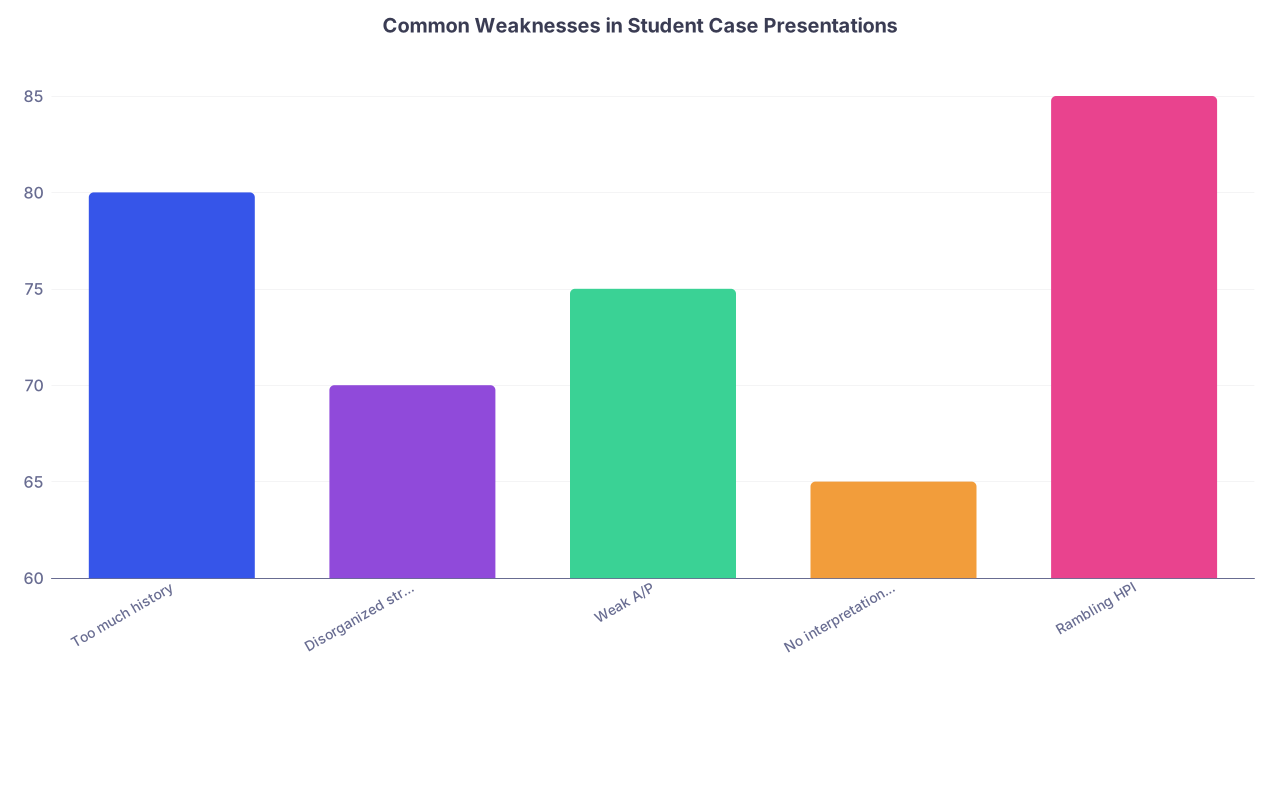
| Category | Value |
|---|---|
| Too much history | 80 |
| Disorganized structure | 70 |
| Weak A/P | 75 |
| No interpretation of labs | 65 |
| Rambling HPI | 85 |
Practical Tools You Can Use Tomorrow
You want concrete tools. Here they are.
1. Pocket “Presentation Script” (Edit This to Your Style)
Opening / HPI
- “X is a [age]-year‑old [sex] with [key PMH] presenting with [main problem] for [duration].
The issue began [timeframe] with [initial symptom]. Since then, [progression]. Currently, [status now]. Key associated symptoms include [3–4]. He denies [2–3 critical negatives].”
Pertinent history
- “Relevant history includes [only related PMH]. Medications include [only those that matter]. He [does/does not] use tobacco, alcohol, or drugs. Family history is notable for [… if relevant].”
Exam
- “On exam, he appears [general impression]. Vitals: [… only abnormalities or key normals]. Most notable findings are […]. No [key negative].”
Data
- “Key labs show [grouped abnormalities] with [1–2 key normals if they rule out something]. Imaging shows […]. These findings are consistent with […].”
Assessment and plan
- “Problem 1: […]. Most likely this represents […], given […]. We are [diagnostic steps] and [treatment].
Problem 2: […]. We will […].
For discharge planning, […].”
Use this as training wheels, then shorten and personalize.
2. Quick Specialty Adjustments
You do not present the same on psych as on surgery. Basic tweaks:
| Rotation | Emphasis |
|---|---|
| Internal Medicine | Full 6-block structure, reasoning-heavy A/P |
| Surgery | Short HPI, more exam + imaging, very concrete plan |
| Pediatrics | Add growth/development, vaccines, parental concerns |
| OB/GYN | Gestational age, gravid/para, pregnancy-specific risks |
| Psychiatry | HPI + mental status + safety, meds and adherence |
Do not overcomplicate this. Keep the same skeleton; just expand the parts that matter for that field.
3. Common Bad Habits You Should Kill Now
Recognize these? Stop them.
- Starting with vital signs instead of the problem.
- Reading every lab value, including normal sodiums.
- Giving the entire medication list when only 2 drugs matter.
- Ending with “and that is all” instead of a clear A/P.
- Saying “I do not know” without following with “but I thought about…”
Replace “I do not know” with:
- “I am not certain, but my thought process is […]. If I had to choose, I would […].”
Attendings respect thinking, not perfection.

What This Looks Like in Real Life After 3 Days
Let me spell out the difference you will feel.
Before:
- You dread being called on.
- You start talking and quickly realize you are lost in your own narrative.
- Halfway through the labs, the attending cuts you off.
- Feedback is “be more concise” with no explanation.
After 3 focused days:
- You know exactly how you will start every case.
- Your brain runs on rails: HPI → pertinent hx → exam → data → A/P.
- You self‑censor irrelevant details in real time.
- You finish in 3–5 minutes, and the room is still listening.
- Feedback starts shifting to clinical reasoning, not “organization.”
You do not need months to get there. You just need three days where you:
- Day 1: Build and memorize a rigid, simple structure.
- Day 2: Shorten and sharpen with deliberate drills and problem‑based A/P.
- Day 3: Pressure test in real rounds with pre‑round rehearsal and targeted feedback.
Do that, and your case presentations will stop being the weak link in your rotations.